7 Best GPUs for Machine Learning – AI & Deep Learning Compared
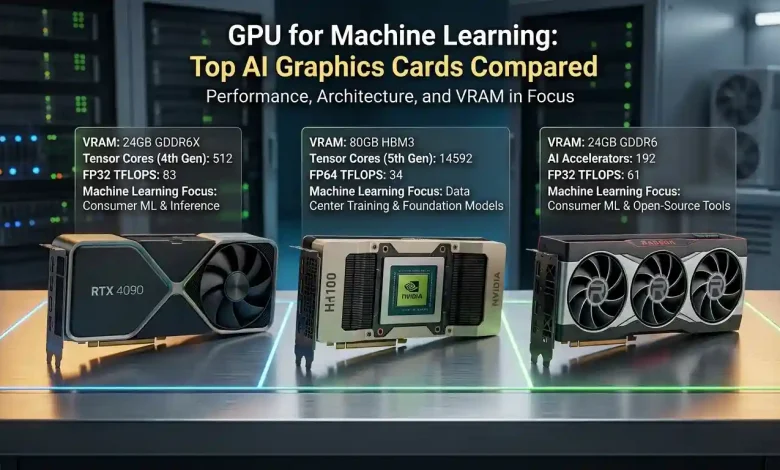
Table of Contents
GPU for Machine Learning has become an undeniable necessity in the modern era of artificial intelligence. As AI models grow in complexity and scale, the demand for powerful computational hardware escalates, pushing Graphics Processing Units (GPUs) to the forefront of AI development. In 2026, the global GPU market is experiencing unprecedented growth, with a significant portion driven by the increasing adoption of AI and deep learning applications across various industries. Businesses, researchers, and developers are actively seeking the most efficient and powerful GPUs to accelerate their machine learning workloads, making the choice of the right AI graphics card a pivotal decision.
Unpacking GPU Power: How Graphics Cards Accelerate AI
The rise of artificial intelligence, particularly deep learning, has fundamentally reshaped the landscape of computing. Unlike traditional CPUs, which are optimized for sequential processing, GPUs excel at parallel processing – executing many calculations simultaneously. This inherent capability makes them uniquely suited for the highly parallelizable computations required by neural networks, such as matrix multiplications and convolutions. As a result, GPUs can drastically reduce the training times for complex AI models, making groundbreaking research and rapid deployment possible.
The Architecture Behind AI Acceleration
Modern GPUs are engineering marvels, integrating specialized hardware units designed to bolster AI performance. At their core are thousands of smaller processing units, often referred to as CUDA Cores (in NVIDIA GPUs) or Stream Processors (in AMD GPUs). These general-purpose parallel processing units handle a wide array of computational tasks. However, the true game-changer for AI has been the introduction of specialized Tensor Cores by NVIDIA, and similar matrix acceleration capabilities in AMD’s architectures.
- CUDA Cores/Stream Processors: These are the generalists, handling standard floating-point operations, integer math, and general parallel computing. They are crucial for data preprocessing, activation functions, and other operations that do not fit the specialized design of Tensor Cores.
- Tensor Cores: Introduced by NVIDIA with its Volta architecture in 2017, Tensor Cores are specialized processing units designed to accelerate matrix multiplications and accumulations, which are at the heart of deep learning workloads. Instead of handling calculations sequentially, Tensor Cores perform large matrix operations in parallel, significantly increasing throughput. They are optimized for mixed-precision computing (e.g., FP16, BF16, INT8, FP8, FP4), which allows for faster performance without significantly compromising accuracy, making them essential for AI training and inference.
These architectural innovations enable GPUs to process the massive tensors (multi-dimensional arrays of numbers) that represent data in machine learning, from input data to model weights and activations, with unparalleled speed and efficiency.
Essential Criteria for Selecting an AI GPU
Choosing the optimal GPU for machine learning is a nuanced decision that hinges on several critical factors beyond just raw computational power. The right choice depends heavily on the specific nature of your AI workload, whether it involves large-scale training, fine-tuning, or real-time inference. Understanding these key considerations will empower you to make an informed investment that aligns with your specific AI training needs.
VRAM: The Cornerstone of Model Complexity
Video RAM (VRAM) is arguably the most critical specification when selecting a GPU for AI. It acts as the GPU’s “fast working memory,” where your AI model’s weights, activations (temporary math results), and batch data reside during computations. If your VRAM is insufficient, you risk encountering “CUDA out of memory” errors, being forced into smaller batch sizes, or experiencing significant slowdowns as the system offloads data to slower system RAM or SSDs.
- Model Size: Larger models, especially Large Language Models (LLMs) with billions of parameters, demand substantial VRAM. For instance, a 7B parameter model typically requires 16 GB of VRAM for FP16 training, while 13B models generally need 24 GB. For 70B parameter models, 80 GB of VRAM is often mandatory for FP16 training, pushing users towards enterprise-grade GPUs.
- Precision: Using lower precision formats like FP8 or 4-bit quantization can significantly reduce VRAM requirements, enabling larger models to fit into less memory, especially for inference workloads. However, training often benefits from higher precision.
- Batch Size and Context Length: For training, larger batch sizes improve throughput but consume more VRAM. For inference, especially with LLMs, the Key-Value (KV) cache, which stores conversation context, can quickly become a VRAM bottleneck as sequence lengths increase.
Most AI practitioners in 2026 find that 12GB-16GB VRAM is a comfortable baseline for local AI tasks, with 24GB being ideal for serious creative or prosumer work, and 48GB or more for revenue-critical team-based training or heavier fine-tuning tasks.
Processing Cores: CUDA, Tensor, and Stream Processors Explained
While VRAM determines what models can fit, the processing cores dictate how fast they run. NVIDIA’s ecosystem predominantly features CUDA Cores for general-purpose parallel computing and Tensor Cores for accelerated matrix operations critical to deep learning. AMD, on the other hand, utilizes Stream Processors for general compute and has introduced advanced matrix acceleration capabilities in its Instinct series to compete in the AI space.
- CUDA Cores (NVIDIA): These are the traditional parallel processing units that handle a broad range of computations. While not specialized for AI matrix math, they perform essential tasks in the overall machine learning pipeline.
- Tensor Cores (NVIDIA): These specialized units are the engines of AI acceleration. They are designed for high-throughput matrix multiply-accumulate (MMA) operations, common in neural networks. Different generations of Tensor Cores support various precisions (FP16, BF16, FP8, FP4), with newer generations offering significant performance boosts, especially for lower precision formats.
- Stream Processors (AMD): AMD’s equivalent to CUDA cores, these are general-purpose parallel processing units. AMD’s CDNA architecture in its Instinct GPUs integrates dedicated AI acceleration units that perform similar functions to NVIDIA’s Tensor Cores, optimized for FP16/BF16 workloads.
The balance between these core types, alongside their generation and optimization, significantly impacts a GPU’s AI performance. For many AI workloads, the efficiency of Tensor Cores or their AMD equivalents can be more indicative of performance than the sheer number of general-purpose cores.
Bandwidth, Bus, and Beyond: Understanding Data Flow
Memory bandwidth and the memory bus interface are crucial for how quickly data can move between the GPU’s VRAM and its processing cores. High-bandwidth memory (HBM) technologies, such as HBM2e and HBM3, found in enterprise-grade GPUs, deliver massive data throughput with lower latency and improved power efficiency, which is vital for feeding data fast enough to the cores.
- Memory Bandwidth: This metric directly affects how quickly data can be read from and written to VRAM. For data-intensive AI workloads, especially during training or when working with long context lengths in LLMs, higher bandwidth translates to faster training iterations and snappier inference. For example, the NVIDIA H100 offers significantly higher memory bandwidth than the A100, which is a primary driver of its inference speedup on memory-bound operations.
- Memory Bus Interface: A wider memory bus (e.g., 384-bit on an RTX 4090) allows for more data to be transferred simultaneously, contributing to higher overall memory bandwidth.
- Interconnect Technologies: For multi-GPU setups, technologies like NVIDIA’s NVLink and PCIe Gen 5 are vital. NVLink provides high-speed, low-latency communication between GPUs, enabling efficient scaling for distributed training of massive models. PCIe Gen 5 also offers increased bandwidth for communication between the GPU and the CPU/system memory.
Understanding these technical specifications is essential for matching the GPU’s capabilities to your workload’s demands, ensuring that data can flow efficiently to prevent bottlenecks.
Top AI Graphics Cards: A Detailed Comparison
The market for AI graphics cards in 2026 is dynamic, with NVIDIA maintaining a dominant position while AMD makes significant strides, and custom silicon from hyperscalers emerges as a growing force. The choice between consumer-grade and data center GPUs often comes down to budget, scale, and specific workload requirements. Here, we compare some of the leading GPUs shaping the AI landscape.
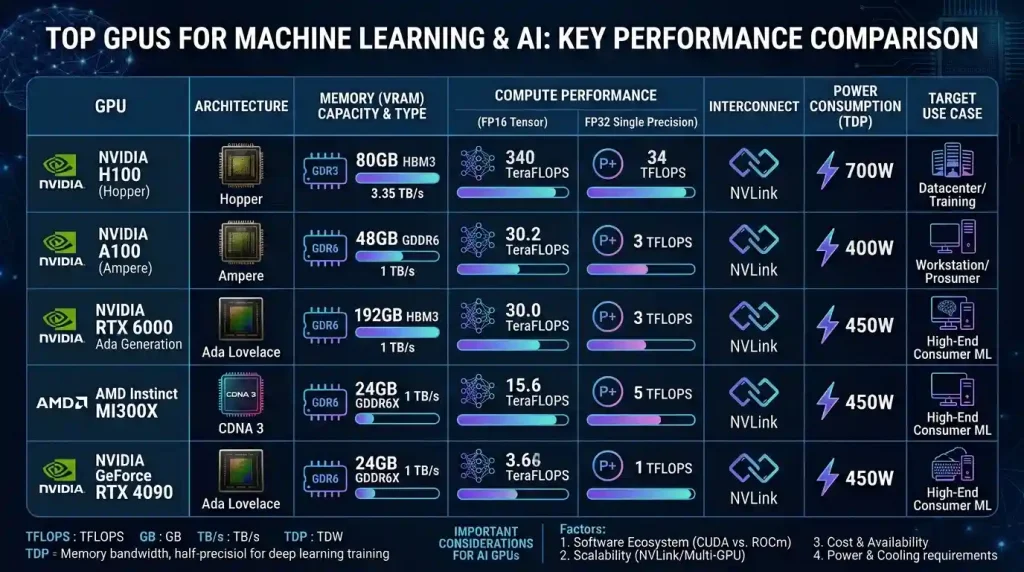
| GPU Model | Architecture | VRAM | Memory Type | Memory Bandwidth (TB/s) | FP16 Tensor TFLOPS (Est.) | FP8 Tensor TFLOPS (Est.) | Typical Use Case | Price Range (Est. USD) |
|---|---|---|---|---|---|---|---|---|
| NVIDIA RTX 4090 | Ada Lovelace | 24 GB | GDDR6X | 1.01 | ~330 | ~1320 | Local LLM inference (up to 13B), fine-tuning, image generation, entry-level training | $1,600 – $2,500 |
| NVIDIA RTX 5090 | Blackwell | 32 GB | GDDR7 | ~1.79 | ~1800 | ~3600 | Advanced consumer AI, faster fine-tuning & inference (7B-13B models), professional workstation AI | $2,000 – $2,500 |
| NVIDIA A100 (80GB) | Ampere | 80 GB | HBM2e | 2.04 | 624 | N/A | Cost-efficient enterprise training, inference for 70B models, cloud deployments, MIG partitioning | $9,500 – $15,000 |
| NVIDIA H100 (80GB SXM) | Hopper | 80 GB | HBM3 | 3.35 | 1,979 | 3,958 | Large-scale LLM training, high-speed inference for 70B+ models, advanced AI workloads | $22,000 – $40,000 |
| NVIDIA H200 | Hopper | 141 GB | HBM3e | 4.8 | ~2000+ | ~4000+ | Memory-intensive deep learning, very large model training (70B-175B), long context LLMs, reducing scaling complexity | $35,000+ |
| AMD Instinct MI300X | CDNA 3 | 192 GB | HBM3 | 5.2 | ~2600 | ~5200 | Massive memory-bound AI workloads, large-scale LLM training, high-performance computing, open ROCm ecosystem | $15,000 – $20,000 |
NVIDIA’s Reign: From Consumer RTX to Data Center Powerhouses
NVIDIA has historically dominated the AI hardware market, a position it continues to hold firmly in 2026, commanding approximately 80% of the AI accelerator market by revenue. This dominance stems from a combination of cutting-edge hardware innovation and a mature, widely adopted software ecosystem.
Consumer-Grade Powerhouses: RTX Series for Enthusiasts and Researchers
While primarily designed for gaming, NVIDIA’s consumer-grade RTX series GPUs have proven to be incredibly capable for AI tasks, especially for individual researchers, startups, and those working on small to medium-scale projects. Their appeal lies in their exceptional value proposition, offering AI performance that can rival data center cards at a fraction of the cost.
- NVIDIA RTX 4090: The RTX 4090, built on the Ada Lovelace architecture, remains a benchmark for high-performance consumer AI hardware. With 24 GB of GDDR6X memory and 4th-generation Tensor Cores, it handles LLM inference for 13B parameter models at interactive speeds, generates high-resolution images rapidly, and supports fine-tuning for models up to 20B parameters using techniques like LoRA/QLoRA. It’s often chosen for local development and experimentation due to its balance of compute, memory, and availability.
- NVIDIA RTX 5090: Expected to be a top-tier consumer option in 2026, the RTX 5090, based on the Blackwell architecture, significantly builds upon the 4090. It is anticipated to feature 32 GB of GDDR7 memory and 5th-generation Tensor Cores with native FP8 and FP4 support. This translates to substantial performance gains, making it the strongest consumer option for advanced fine-tuning and inference for 7B to 13B models, though larger models might still require quantization. The RTX 5090 offers a notable performance-per-watt improvement over its predecessors.
Data Center Dynamos: NVIDIA’s A-series and H-series
For large-scale AI training, complex distributed workloads, and enterprise applications, NVIDIA’s data center GPUs are the undisputed champions. These cards prioritize raw performance, massive memory capacity, and robust interconnectivity.
- NVIDIA A100: Despite newer generations, the A100, based on the Ampere architecture, remains a widely deployed and well-supported GPU for enterprise AI and cloud-based machine learning. Available in 40GB and 80GB configurations, it introduced powerful Tensor Cores and Multi-Instance GPU (MIG) support, allowing it to be partitioned into smaller, independent GPU instances. It offers a proven, cost-efficient solution for training and inference, especially for tasks that don’t demand the absolute cutting edge.
- NVIDIA H100: The H100, featuring the Hopper architecture, is a proven workhorse for large-scale training of LLMs and cutting-edge AI workloads. It offers 80 GB of HBM3 memory, significantly higher memory bandwidth, and the Transformer Engine, which optimizes performance for transformer-based models by adjusting precision. The H100 delivers substantial throughput improvements over the A100, making it more efficient for demanding training tasks and often resulting in lower cost per unit of work despite a higher hourly rental cost. Its NVLink 4.0 also enhances multi-GPU scaling.
- NVIDIA H200: Building on the Hopper architecture, the H200 sets a new standard for memory-intensive AI training. Its key differentiator is its massive 141 GB of HBM3e memory and 4.8 TB/s memory bandwidth, designed to support very large models (e.g., 70B to 175B parameters) and extremely long context lengths more efficiently. The H200 reduces the complexity of scaling and excels in scenarios where memory capacity is the primary limiting factor.
- NVIDIA B200 (Blackwell): The B200 represents NVIDIA’s latest Blackwell architecture, offering an exceptional leap in AI performance. With up to 192 GB of HBM3e memory and 8 TB/s bandwidth, it is designed for maximum throughput in demanding enterprise workloads. It features 5th-generation Tensor Cores with native FP8 and FP4 precision support, delivering a substantial performance increase for both training and inference over previous generations.
AMD’s Ascent: A Contender in the AI Arena
While NVIDIA holds the lion’s share, AMD is increasingly asserting its presence in the AI hardware market. With strategic investments in its Instinct line of GPUs and the ROCm software ecosystem, AMD is positioning itself as a viable alternative, particularly for organizations seeking cost-effective solutions and open-source flexibility.
Challenging the Status Quo: AMD’s Radeon Pro and Instinct Accelerators
AMD’s offerings are becoming more competitive, especially in memory-intensive and open-source friendly environments.
- AMD Instinct MI300X: The MI300X is a formidable accelerator, featuring an industry-leading 192 GB of HBM3 memory and 5.2 TB/s of bandwidth, built on the CDNA 3 architecture. This massive memory capacity and bandwidth make it highly suitable for large-scale, memory-bound AI workloads, including the training of massive LLMs. It is optimized for FP16/BF16 workloads and is a strong contender for high-performance computing (HPC) and deep learning deployments, especially within the growing ROCm ecosystem.
- AMD Instinct MI350X: The MI350X builds on the MI300X, reportedly matching NVIDIA’s B200 on FP8 compute and exceeding it on memory with 288GB HBM3E. This demonstrates AMD’s aggressive push to compete at the very top tier of AI accelerators.
AMD’s strategy often involves offering competitive hardware at potentially lower costs, making its GPUs attractive for those willing to invest in its evolving software stack.
The Crucial Role of Software Ecosystems: CUDA vs. ROCm
The performance of a GPU for machine learning is not solely about raw hardware specifications; the accompanying software ecosystem plays an equally, if not more, critical role. The two dominant platforms are NVIDIA’s CUDA and AMD’s ROCm.
- NVIDIA CUDA: CUDA has been NVIDIA’s proprietary parallel computing platform and API since 2007, giving it a nearly two-decade head start in development and optimization. This long history has led to a mature, battle-tested ecosystem with extensive library coverage (e.g., cuDNN for deep learning operations, cuBLAS for matrix math), compilers, and tools. Major AI frameworks like PyTorch and TensorFlow were built around or heavily optimized for CUDA, making it the de facto standard for AI development. While ROCm has narrowed the gap, CUDA typically still outperforms ROCm by 10-30% in most machine learning tasks and offers broader framework compatibility and a more stable, user-friendly experience, especially for production environments and large-scale training.
- AMD ROCm: ROCm (Radeon Open Compute) is AMD’s open-source GPU computing platform, designed as a direct competitor and alternative to CUDA. Its key advantages lie in its open-source nature, offering transparency and community-driven development, along with the potential for cost-competitive hardware solutions. ROCm has matured significantly, with PyTorch now officially supporting it, and performance improving, particularly on memory-bound and open-source workloads, especially with AMD’s latest MI300X GPUs. However, ROCm installations can still be more complex and sensitive to system changes, and its library coverage, while expanding, often lags behind CUDA’s highly optimized and comprehensive suite. For cost-conscious builders or those prioritizing open-source principles, ROCm is a compelling option, but it often requires more technical expertise.
The choice between CUDA and ROCm often comes down to balancing performance, ecosystem maturity, ease of use, and cost. For critical production workloads, CUDA remains the safer and less risky option. For experimentation, learning, or specific local inference tasks where cost and memory constraints are paramount, ROCm and AMD hardware are increasingly viable. For a deeper dive into these platforms, exploring resources like this comparison of ROCm vs. CUDA can provide further insights.
Future Outlook: Innovations and Emerging Trends
The AI hardware landscape is evolving at an unprecedented pace, driven by relentless demand for more computational power and efficiency. In 2026, several key trends are shaping the future of GPUs for machine learning.
- Specialized AI Accelerators and Custom Silicon: Beyond traditional GPUs, there’s a growing trend towards highly specialized AI accelerators, including custom Application-Specific Integrated Circuits (ASICs) developed by hyperscalers like Google (TPU), Amazon (Trainium), and Microsoft (Maia). These custom chips are designed for specific AI workloads and promise greater efficiency and performance for their respective ecosystems. The market share of custom ASICs is projected to grow significantly, posing a challenge to merchant GPU providers.
- Chiplet Architectures and Advanced Packaging: Manufacturers are increasingly adopting chiplet-based GPU architectures and advanced packaging techniques (like 2.5D/3D stacking) to enhance scalability, performance, and memory integration. These innovations allow for greater flexibility in design and improved data flow.
- Energy Efficiency and Sustainability: With AI workloads consuming enormous power, efficiency is a growing concern. Future GPUs will focus on delivering higher performance per watt, driven by advancements in process nodes and power management ICs. Lower power consumption not only reduces operating costs but also addresses environmental impact.
- Increased On-Device and Edge AI: The shift towards running sophisticated AI models directly on devices (smartphones, IoT devices, autonomous vehicles) and at the “edge” of networks is accelerating. This requires energy-efficient, smaller GPU designs and Neural Processing Units (NPUs) capable of real-time inference, reducing reliance on remote data centers for basic intelligence.
- Cloud GPU Offerings and Accessibility: The GPU rental market continues to expand, making high-performance computing more accessible to smaller teams and startups. Cloud providers are offering increasingly diverse GPU options, flexible pricing models, and enhanced service quality, allowing organizations to scale resources as needed without significant upfront hardware investments.
These trends indicate a future where AI hardware is even more diverse, specialized, and integrated, driving innovation across various sectors.
Conclusion: Choosing Your AI Accelerator
Choosing the best GPU for machine learning in 2026 is a decision that demands careful consideration of your specific use case, budget, and desired scale. There is no single “best” GPU; rather, the optimal choice is one that aligns perfectly with your workload requirements. For individual researchers and smaller teams, NVIDIA’s RTX 4090 and the upcoming RTX 5090 offer exceptional value and performance for fine-tuning, experimentation, and local inference of models up to 13B parameters. They strike an impressive balance between compute power, VRAM, and affordability.
For large-scale training, enterprise applications, and working with very large language models (70B parameters and above), NVIDIA’s data center GPUs like the H100, H200, and the new B200 (Blackwell) remain the industry standard. These accelerators offer immense VRAM, superior memory bandwidth, and robust interconnectivity essential for distributed training and memory-intensive tasks. AMD’s Instinct MI300X and MI350X are emerging as strong challengers, particularly for memory-bound workloads and for those who value an open-source ecosystem.
Ultimately, a successful GPU strategy involves understanding that VRAM capacity is often the primary bottleneck, and the software ecosystem (CUDA vs. ROCm) significantly impacts usability and performance. By carefully evaluating your model size, precision requirements, training versus inference needs, and considering the long-term implications of hardware and software compatibility, you can select the AI graphics card that will truly accelerate your machine learning journey.