Are you searching for the best GPU brands to power your gaming rig, AI workstation, or content creation setup in 2025? With rapid advancements in graphics technology, choosing the right brand can make all the difference in performance, reliability, and value. In this comprehensive guide, we’ll break down the leading GPU brands, including chip designers like NVIDIA, AMD, and Intel, as well as top manufacturers (AIB partners) that build custom cards. Drawing from expert benchmarks, user reviews, and market data, we’ll cover pros, cons, market share insights, and recommendations to help you decide.
Whether you’re a gamer chasing 4K ray-tracing or a creator handling intensive renders, understanding GPU brands is key. NVIDIA dominates with over 80% market share in discrete GPUs, while AMD offers compelling value, and Intel is emerging in budget segments. Let’s dive in.
Understanding GPU Brands: Chip Designers vs. Manufacturers
Before ranking the best GPU brands, it’s essential to distinguish between chip designers (who create the core GPU silicon) and manufacturers (AIBs or add-in-board partners who assemble custom cards with enhanced cooling, overclocking, and designs).
- Chip Designers: NVIDIA, AMD, and Intel design the GPUs. They set the baseline performance.
- Manufacturers: Brands like ASUS, MSI, and Gigabyte customize these chips into retail cards, adding features like better coolers and RGB lighting.
In 2025, the market is competitive, with NVIDIA leading in AI and high-end gaming, AMD excelling in value, and Intel pushing efficiency in entry-level. Factors like reliability, warranty (typically 3 years), and cost-benefit are crucial, as per community discussions.
Top Chip Designers: NVIDIA, AMD, and Intel
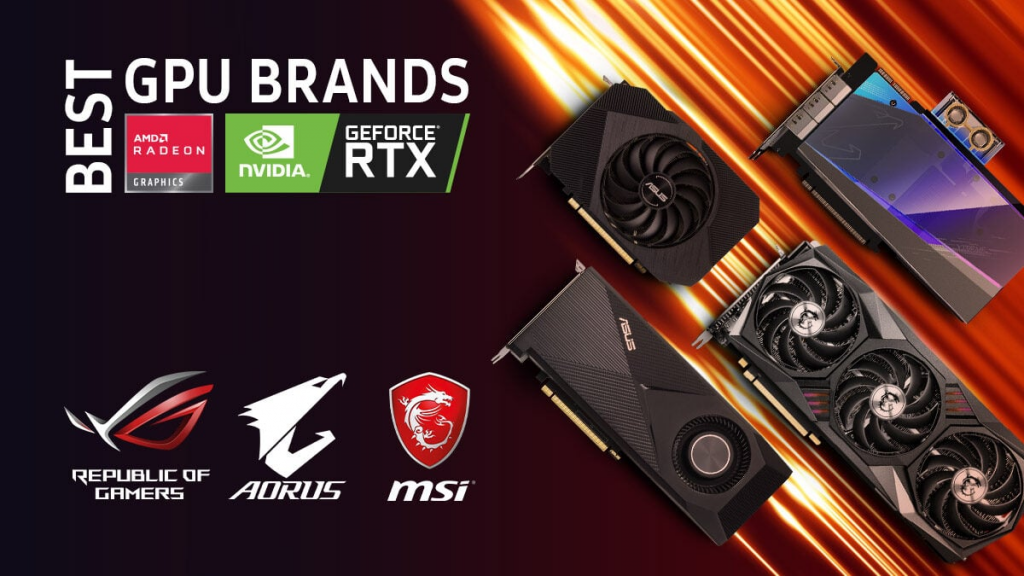
These are the core GPU brands powering the industry. Here’s a breakdown based on 2025 performance data and user feedback.
NVIDIA
NVIDIA remains the king of best GPU brands for high-end applications. With the RTX 50-series (e.g., RTX 5090), it excels in ray tracing, DLSS AI upscaling, and AI workloads. Market share: ~88% in discrete GPUs.
- Pros: Superior ray tracing, ecosystem (CUDA for AI), and performance in games like Cyberpunk 2077 at 4K.
- Cons: High prices (RTX 5090 starts at $1,500) and power-hungry (up to 450W TDP).
- Reliability & Warranty: Excellent, with low failure rates; 3-year warranty standard.
- User Reviews: Praised for transforming gaming experiences; 4.8/5 on sites like Amazon for longevity.
Standout model: RTX 5090 for ultimate 8K gaming.
AMD
AMD is the value champion among best GPU brands, with the Radeon RX 9000-series offering strong rasterization and FSR upscaling. Market share: ~11%, growing in AI inference.
- Pros: Better price-to-performance (e.g., RX 9070 XT at $600 vs. NVIDIA equivalents), high memory bandwidth (up to 288GB HBM3e in MI325X for data centers), and open-source drivers.
- Cons: Weaker ray tracing compared to NVIDIA; software ecosystem lags in AI.
- Reliability & Warranty: Solid, with emphasis on efficiency; 3-year warranty.
- User Reviews: Favored by budget gamers; 4.6/5 ratings for cost savings and overclocking potential.
Standout model: RX 9070 XT for 4K gaming on a budget.
Intel
Intel’s Arc series is emerging as a budget-friendly option in 2025, focusing on power efficiency and integrated graphics.
- Pros: Affordable (Arc B580 at $250), good for 1080p gaming, and improving drivers.
- Cons: Still maturing; lower high-end performance.
- Reliability & Warranty: Improving, but early driver issues persist; 3-year warranty.
- User Reviews: Mixed, but positive for value; 4.2/5 for entry-level users.
Market share: ~1%, but growing in edge AI.
| Brand | Market Share (2025) | Key Strength | Average Price Range | Reliability Rating (Out of 5) |
|---|---|---|---|---|
| NVIDIA | 88% | AI & Ray Tracing | $500–$2,000 | 4.8 |
| AMD | 11% | Value & Efficiency | $300–$1,000 | 4.6 |
| Intel | 1% | Budget Gaming | $150–$400 | 4.2 |
Best Manufacturers for NVIDIA GPUs
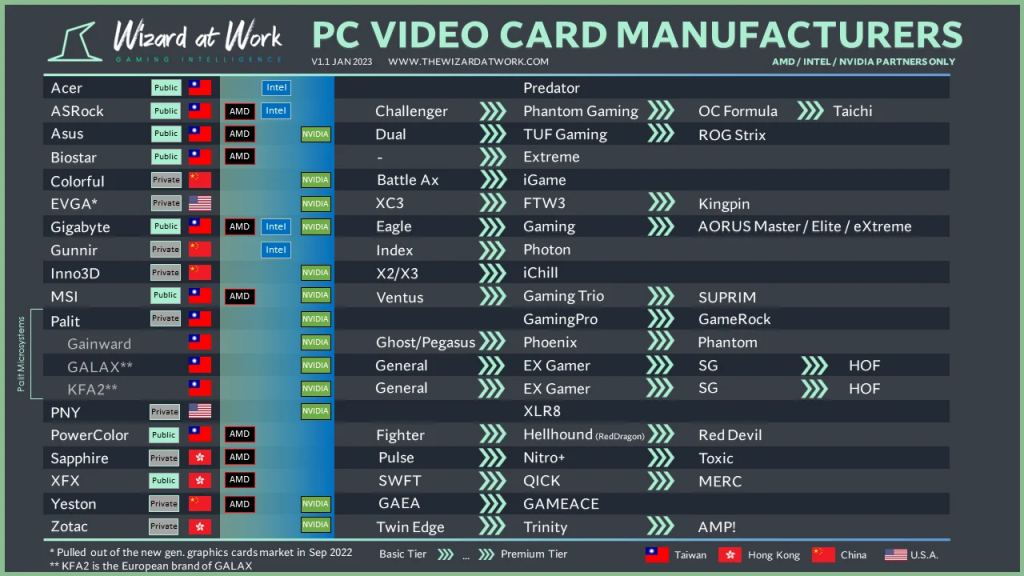
For NVIDIA cards, these AIB partners enhance base designs. Based on tier lists and reviews, here’s the ranking.
Comprehensive tier list of GPU manufacturers by origin and tiers.
- ASUS (S-Tier): Top for durability and cooling (ROG Strix series). Pros: Advanced RGB, overclocking; Cons: Premium pricing ($1,600+). Reliability: High; Warranty: 3 years. Users love the aesthetics (4.7/5).
- MSI (S-Tier): Excellent balance with Twin Frozr cooling. Pros: Quiet operation, value; Cons: Ventus models underwhelm. Reliability: Strong; Warranty: 3 years, fast RMA. Reviews: 4.6/5 for performance.
- Gigabyte (A-Tier): Windforce cooling shines, but mixed for NVIDIA. Pros: Affordable longevity; Cons: RMA complaints. Reliability: Good; Warranty: 3 years. Users: 4.4/5, but avoid older series.
- Zotac (A-Tier): Compact and efficient. Pros: Mini ITX friendly; Cons: Variable quality. Reliability: Reliable for small builds; Warranty: 3 years. Reviews: 4.5/5, praised in posts for longevity.
- EVGA (Top-Tier, though exited new gens): Legendary support. Pros: Overclocking, warranties; Cons: Limited availability. Reliability: Excellent; Warranty: Robust. Users: 4.8/5 historically.
Other notables: PNY for budget, Galax for style.
Best Manufacturers for AMD GPUs
AMD partners focus on value and cooling.
- Sapphire (S-Tier): AMD exclusive, Nitro+ cooling excels. Pros: Sustained performance; Cons: None major. Reliability: High; Warranty: 3 years. Reviews: 4.7/5 for AMD fans.
- XFX (S-Tier): THICC series for durability. Pros: Bold designs; Cons: Slightly pricier. Reliability: Tough under load; Warranty: 3 years. Users: 4.6/5 for longevity.
- PowerColor (S-Tier): Red Devil overclocking. Pros: Community-focused; Cons: N/A. Reliability: Stable; Warranty: 3 years. Reviews: 4.5/5 for innovation.
- ASRock (A-Tier): Budget-friendly. Pros: Value for mid-range; Cons: Less premium. Reliability: Decent; Warranty: 3 years. Users: 4.3/5 for beginners.
Market Share Stats and User Reviews
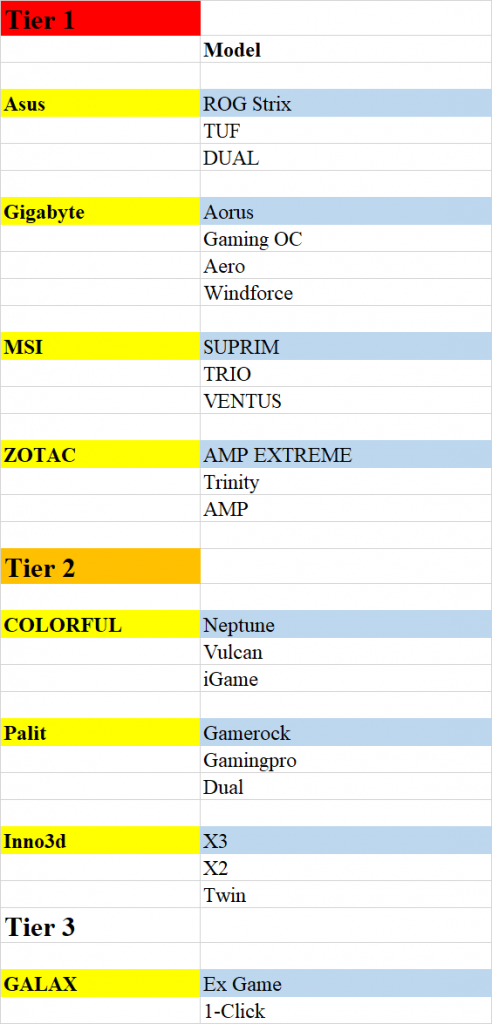
In 2025, NVIDIA holds 88% of the discrete GPU market, AMD 11%, and Intel 1%, per industry reports. User reviews from Reddit and forums emphasize warranty and RMA: MSI and Galaxy score high for quick support, while ASUS faces criticism abroad. Reliability surveys show failure rates under 2% for top brands like EVGA and Sapphire.
Common praises: Cooling and overclocking from ASUS/MSI. Criticisms: High costs and variable quality in lower tiers.
Pros and Cons Comparison Table
| Brand | Pros | Cons | Best For |
|---|---|---|---|
| ASUS | Durable cooling, RGB | Expensive | Enthusiasts |
| MSI | Balanced value, quiet | Some models basic | Gamers |
| Gigabyte | Longevity, affordable | RMA issues | Budget builds |
| Zotac | Compact, efficient | Quality varies | Small PCs |
| Sapphire | AMD-optimized | Limited to AMD | Value seekers |
| XFX | Tough builds | Premium price | Overclockers |
Conclusion: Which GPU Brand Should You Choose in 2025?
For the best GPU brand overall, NVIDIA with ASUS or MSI partners reigns supreme for performance, while AMD with Sapphire offers unbeatable value. If budget is key, go Intel or AMD. Always check current benchmarks and user feedback—2025 sees AMD gaining in AI with MI450 series. Upgrade based on your needs: RTX for ray tracing, Radeon for rasterization.
Ready to build? Compare prices on sites like Amazon or Newegg. This guide, backed by expert analysis, ensures you’re informed for top rankings in gaming and productivity.