Discrete GPU Explained: Benefits Over Integrated Graphics 1
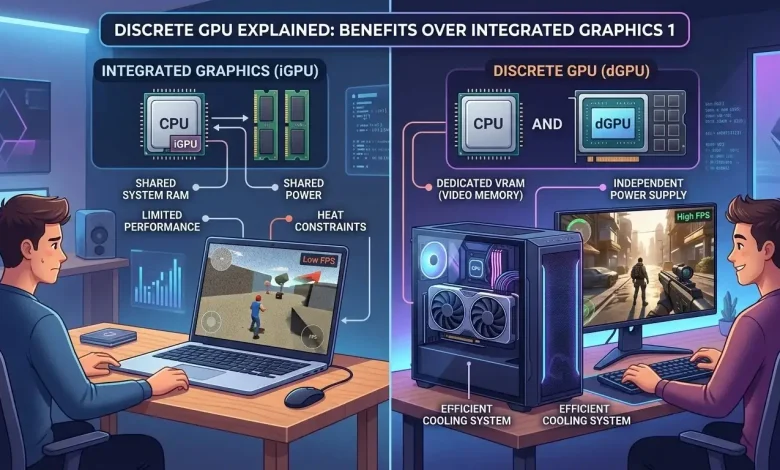
Table of Contents
Discrete GPU technology represents a cornerstone of modern computing, particularly for tasks that demand significant graphical horsepower. From immersive gaming experiences to professional content creation and complex scientific simulations, a discrete Graphics Processing Unit (GPU) offers a substantial leap in performance compared to its integrated counterparts. This comprehensive article delves into what a discrete GPU is, how it differs fundamentally from integrated graphics, and the numerous benefits it brings to various computing scenarios, helping you understand why it often stands as a critical component in high-performance systems.
What is a Discrete GPU?
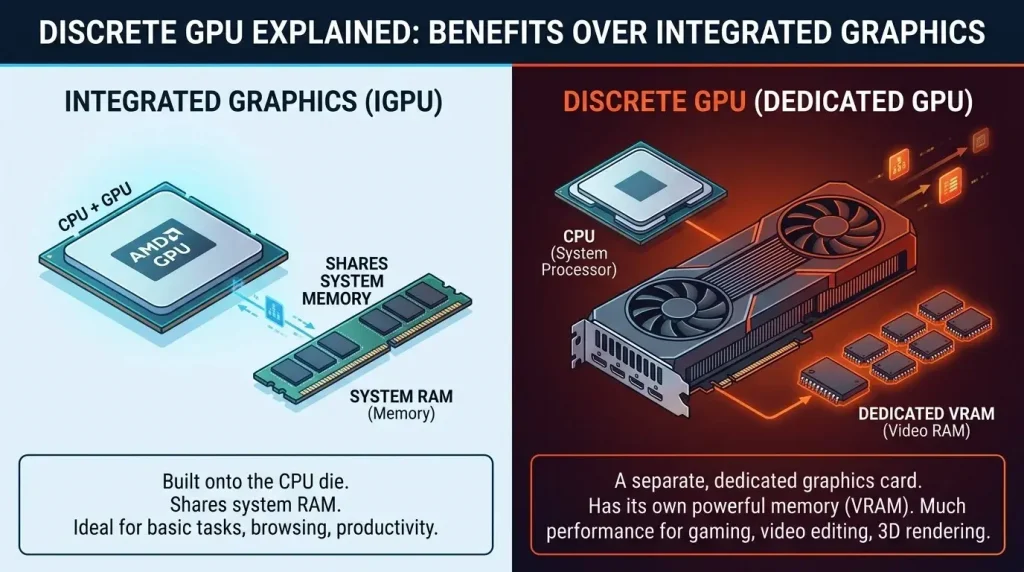
A discrete GPU, often referred to as a dedicated graphics card, is a standalone graphics processing unit that operates independently from the computer’s Central Processing Unit (CPU). It is a separate hardware component, typically installed in a PCIe (Peripheral Component Interconnect Express) slot on the motherboard in desktop computers. In laptops, discrete GPUs are usually soldered directly onto the mainboard but still function as separate entities from the CPU. This independence allows it to dedicate all its resources solely to graphics processing, without drawing power or memory from the CPU.
The core function of a GPU is to rapidly render images, videos, and animations for display on a monitor. While CPUs excel at sequential processing, GPUs are designed for parallel processing, handling thousands of calculations simultaneously. This architecture makes them exceptionally efficient at the repetitive, intensive calculations required for graphics rendering. Modern discrete GPUs are not just about displaying visuals; they are powerful parallel processors used in diverse fields such as artificial intelligence (AI) training, machine learning, scientific research, and cryptocurrency mining, thanks to their ability to accelerate complex computational tasks.
Understanding Integrated Graphics
In contrast to discrete GPUs, integrated graphics (iGPUs) are graphics processing units built directly into the computer’s CPU or motherboard. This design means that the iGPU shares system resources, including memory and processing power, with the CPU. Integrated graphics have been a staple in computing for decades, particularly in laptops and entry-level desktop PCs, where space, cost, and power efficiency are primary concerns.
Historically, integrated graphics were significantly less powerful than discrete solutions, capable of handling only basic display tasks, web browsing, word processing, and light multimedia consumption. While modern iGPUs, such as Intel’s Iris Xe or AMD’s Radeon Graphics within their APUs (Accelerated Processing Units), have made considerable advancements, they still operate under the fundamental limitation of sharing resources with the CPU. This shared architecture inherently limits their performance potential when faced with graphically demanding applications.
Key Architectural Differences
The distinction between discrete and integrated graphics goes beyond mere placement; it lies in their fundamental architectural design, which dictates their capabilities and limitations.
- Processing Cores: Discrete GPUs typically feature a significantly higher number of processing cores compared to integrated graphics. These cores are specialized for graphical computations, allowing discrete GPUs to handle complex rendering tasks more efficiently.
- Dedicated Memory (VRAM): One of the most critical differences is the presence of dedicated Video Random Access Memory (VRAM) in discrete GPUs. This high-speed memory is exclusively used by the GPU, ensuring fast access to graphical data without competing with the CPU for system RAM. Integrated graphics, on the other hand, borrow a portion of the system’s main RAM, which is generally slower and creates a bottleneck when large amounts of graphical data need to be processed.
- Power and Cooling Systems: Discrete GPUs are designed with their own power delivery and cooling systems. This allows them to draw more power and dissipate the resulting heat effectively, enabling higher clock speeds and sustained performance under heavy loads. Integrated graphics, being part of the CPU, must operate within the CPU’s thermal design power (TDP) and cooling solutions, limiting their power draw and heat generation.
- Bandwidth: The connection between a discrete GPU and the CPU (via PCIe) offers significantly higher bandwidth than the internal bus used by integrated graphics. This high-bandwidth connection is crucial for transferring large textures and complex graphical instructions quickly, minimizing latency.
Performance Benefits: Gaming and Professional Workloads
The most apparent advantages of a discrete GPU manifest in its superior performance across a wide range of applications, especially those that are graphically intensive.
Gaming
For gamers, a discrete GPU is indispensable. It delivers higher frame rates, allowing for smoother and more responsive gameplay, especially in modern AAA titles at higher resolutions and graphics settings. Advanced features like real-time ray tracing and AI-enhanced graphics technologies (such as NVIDIA’s DLSS or AMD’s FSR) are exclusive to discrete GPUs, providing more realistic lighting, reflections, and overall visual fidelity. Integrated graphics simply cannot keep up with these demands, often struggling to run even less demanding games at acceptable frame rates or resolutions.
Professional Workloads
Beyond gaming, discrete GPUs are critical tools for professionals in various fields:
- Video Editing and Content Creation: Tasks like 4K video editing, 3D rendering, animation, and graphic design rely heavily on GPU acceleration. Discrete GPUs drastically reduce rendering times, enable real-time previews, and handle complex effects with greater efficiency.
- 3D Modeling and CAD: Architects, engineers, and product designers using CAD (Computer-Aided Design) and 3D modeling software benefit from the dedicated processing power of discrete GPUs. They allow for smoother manipulation of complex models, faster rendering of detailed designs, and more accurate simulations.
- Artificial Intelligence and Machine Learning: The parallel processing architecture of GPUs makes them ideal for accelerating AI and machine learning workloads, including training large language models and computer vision systems. Data scientists and AI researchers frequently utilize high-end discrete GPUs for their computational needs.
- Scientific Simulations: Researchers in fields like physics, chemistry, and meteorology use discrete GPUs to run complex simulations and process vast datasets, significantly speeding up their computational research.
Memory: Dedicated VRAM vs. Shared System RAM
The approach to memory management is a pivotal differentiator between discrete and integrated graphics.
Dedicated VRAM: Discrete GPUs come equipped with their own dedicated Video Random Access Memory (VRAM). This specialized, high-speed memory is physically located on the graphics card itself, providing the GPU with exclusive and rapid access to graphical data. VRAM is optimized for the unique demands of graphics processing, such as storing textures, frame buffers, and complex shaders. The amount of VRAM (ranging from 2GB to 48GB or more in high-end cards) directly impacts a GPU’s ability to handle high-resolution textures and large datasets. For instance, dedicated VRAM on modern data center GPUs can deliver memory bandwidths of 2,000–4,800 GB/s.
Shared System RAM: Integrated graphics, by contrast, do not have their own dedicated memory. Instead, they reserve and utilize a portion of the computer’s main system RAM (Random Access Memory). This shared approach means the CPU and iGPU are contending for the same memory resources, which can lead to performance bottlenecks. The system RAM, designed for general-purpose computing, is also significantly slower than VRAM for graphics-intensive tasks, typically offering bandwidths of 50–100 GB/s. When the iGPU requires more memory, it can further strain system resources, impacting overall system performance. This shared memory limitation is a primary reason why integrated graphics struggle with demanding graphical workloads.
| Feature | Discrete GPU | Integrated Graphics (iGPU) |
|---|---|---|
| Location | Separate card (PCIe slot) or soldered on mainboard | Built into CPU or motherboard |
| Memory | Dedicated VRAM (Video RAM) | Shares system RAM |
| Performance | Superior, high frame rates, advanced features (ray tracing) | Basic visuals, suitable for everyday tasks, limited for demanding apps |
| Power Consumption | Higher, requires more robust power supply | Lower, more energy-efficient |
| Heat Generation | Generates more heat, requires dedicated cooling | Generates less heat, utilizes CPU cooling |
| Cost | Higher initial cost | Lower initial cost, often included with CPU |
| Upgradeability | Upgradeable in many desktop systems | Generally not upgradeable |
| Use Cases | High-end gaming, video editing, 3D rendering, AI/ML, CAD | Web browsing, office work, video playback, light gaming |
Power Consumption, Heat, and Cooling
The superior performance of discrete GPUs comes with increased power demands and a corresponding rise in heat generation, necessitating robust cooling solutions.
Power Consumption: Discrete GPUs are power-hungry components, drawing significantly more wattage than integrated graphics. A high-end discrete GPU can have a Thermal Design Power (TDP) ranging from 350W to 600W or even higher for specialized data center GPUs. This higher power draw requires a more capable power supply unit (PSU) in desktop systems. In laptops, this translates to reduced battery life when the discrete GPU is active.
Heat Generation: The considerable power consumed by discrete GPUs is converted into heat. This high power density, concentrated in compute clusters and memory controllers, makes thermal management a critical engineering challenge. If this heat is not effectively dissipated, it can lead to thermal throttling, where the GPU automatically reduces its clock speeds to prevent damage, thus hindering performance.
Cooling Solutions: To combat the heat, discrete GPUs employ dedicated and often elaborate cooling systems. These typically include large heatsinks, multiple fans, and sometimes advanced cooling technologies like vapor chambers or liquid cooling. Desktops with discrete GPUs require adequate case airflow, while gaming or workstation laptops feature thicker chassis and more sophisticated internal cooling mechanisms to manage the heat generated by the dGPU. Integrated graphics, by operating within the CPU’s thermal envelope, generate much less heat and rely on the CPU’s cooling solution, contributing to thinner, lighter, and more energy-efficient designs, particularly in laptops.
Upgradeability and Longevity
The long-term value and flexibility of a computer system are significantly influenced by its graphics solution.
Upgradeability: In most desktop PCs, discrete GPUs are user-upgradeable. This means that as new, more powerful graphics cards become available, users can replace their existing discrete GPU to enhance performance without needing to buy an entirely new system. This modularity extends the lifespan of a desktop computer for demanding applications. For laptops, however, discrete GPUs are typically soldered to the motherboard, making them generally non-upgradeable.
Longevity and Driver Support: Discrete GPUs often receive frequent and highly optimized driver updates from manufacturers like NVIDIA and AMD. These updates can significantly improve performance, fix bugs, and add support for new gaming titles and software features, even for slightly older cards. This continuous software support contributes to the longevity of a discrete GPU, allowing it to efficiently run newer applications and games for a longer period. While integrated graphics also receive driver updates, they are often less frequent and less focused on raw performance improvements for demanding workloads.
Cost Considerations
The financial aspect is a significant factor in deciding between discrete and integrated graphics.
Higher Initial Cost: Discrete GPUs represent an additional and often substantial cost to a computer system. The price can vary widely, from a few hundred dollars for entry-level models to over a thousand dollars for high-end gaming or professional cards. This added expense contributes significantly to the overall price of a gaming PC or a workstation.
Integrated Graphics Savings: Systems relying solely on integrated graphics are generally more affordable, as they eliminate the cost of a separate GPU, its dedicated VRAM, and the more robust power and cooling solutions it requires. This makes integrated graphics a budget-friendly choice for users with less demanding graphical needs. While the upfront cost of discrete GPUs is higher, the performance benefits and potential for extending a system’s useful life through upgrades can be a worthwhile investment for specific users. However, recent trends show that even modestly priced discrete GPUs can offer significant performance gains, making them more accessible than in the past.
When to Choose a Discrete GPU
The decision between a discrete GPU and integrated graphics ultimately hinges on your specific computing needs and budget. A discrete GPU is undeniably the superior choice if you:
- Engage in High-End Gaming: For playing modern games at high resolutions, settings, and frame rates, especially with advanced features like ray tracing, a discrete GPU is essential.
- Perform Video Editing, 3D Rendering, or Content Creation: Professionals working with demanding applications for video production, animation, graphic design, and 3D modeling will experience significant acceleration and efficiency gains with a discrete GPU.
- Work with AI/Machine Learning or Data Science: The parallel processing power of discrete GPUs is crucial for training AI models, running simulations, and handling large datasets in scientific computing.
- Require Multiple High-Resolution Displays: Discrete GPUs typically offer more display outputs and the power to drive multiple high-resolution monitors without performance degradation.
- Value Upgradeability: For desktop users who want the flexibility to upgrade their graphics performance in the future, a discrete GPU is the only viable option.
Conversely, if your primary uses include web browsing, email, word processing, streaming videos, and very light casual gaming, integrated graphics will likely suffice and offer advantages in terms of cost, power efficiency, and system portability. However, even for seemingly simple tasks, a discrete GPU can offload work from the CPU, potentially improving overall system responsiveness. For more detailed information on GPU technology, consider visiting Wikipedia’s article on Graphics Processing Units.
Conclusion
In the ever-evolving landscape of computing, the discrete GPU stands out as a powerful and specialized component, offering unparalleled graphical performance and computational acceleration over integrated graphics. While integrated solutions have improved significantly for everyday tasks, the dedicated processing power, proprietary VRAM, and robust cooling of a discrete GPU make it indispensable for demanding applications such as high-fidelity gaming, professional content creation, and advanced AI workloads. Understanding these fundamental differences is key to making an informed decision when building or purchasing a computer, ensuring your system is equipped to handle your specific needs with optimal efficiency and performance.