RTX 4080 GPU Review: Superb Performance for Gaming and Professional Creators
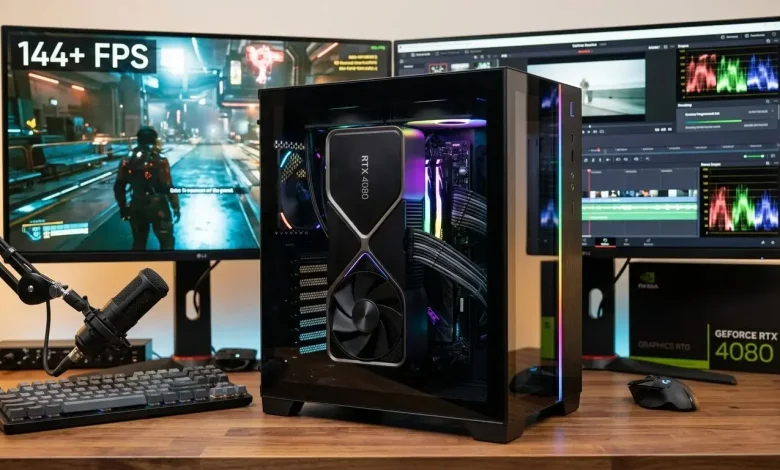
Table of Contents
The 4080 GPU, specifically the NVIDIA GeForce RTX 4080, stands as a formidable contender in the high-end graphics card market, offering a compelling blend of gaming prowess and robust creator performance. Launched on September 20th, 2022, this GPU, built on the Ada Lovelace architecture, aimed to bridge the gap between enthusiast-grade performance and a slightly more accessible price point compared to its flagship sibling, the RTX 4090. Despite the subsequent introduction of the RTX 4080 Super, the original RTX 4080 continues to deliver exceptional experiences for both avid gamers and professional content creators, making it a relevant option in today’s landscape.
Introduction: The Powerhouse Unveiled 4080 GPU
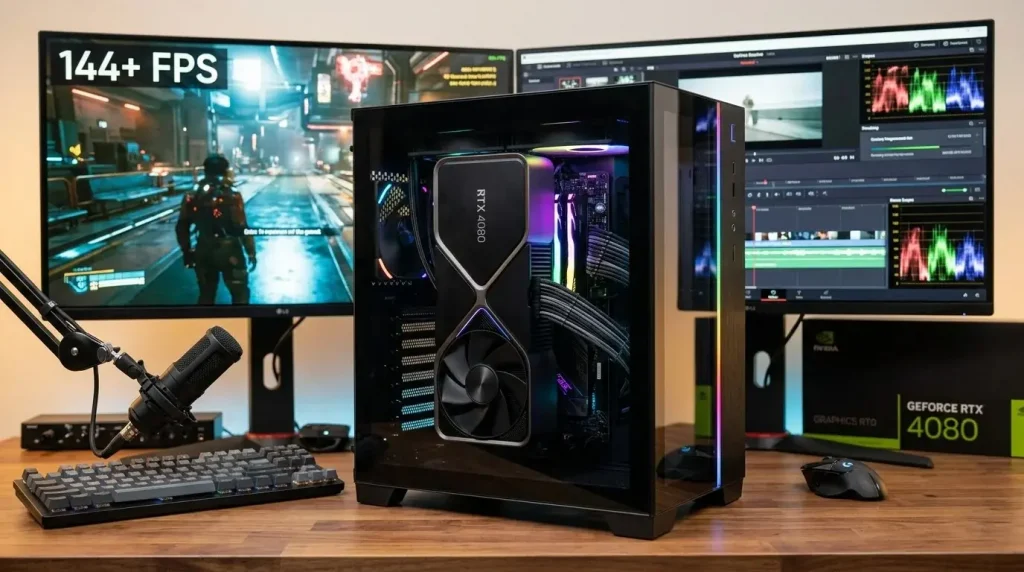
When NVIDIA introduced the GeForce RTX 4080, it immediately positioned itself as a premium graphics solution designed to tackle the most demanding tasks. At its core lies the AD103 graphics processor, fabricated using a 5 nm process (NVIDIA’s custom TSMC 4N process), featuring 9,728 CUDA cores, 304 Tensor Cores, and 76 Ray Tracing (RT) Cores. This hardware configuration is complemented by 16 GB of GDDR6X memory, operating on a 256-bit interface with a memory bandwidth of 716.8 GB/s. These specifications underscore its capability to handle complex calculations, render intricate scenes, and process large datasets with impressive efficiency. The RTX 4080 supports DirectX 12 Ultimate, ensuring compatibility with the latest gaming technologies, including hardware-accelerated ray tracing and variable-rate shading.
Unmatched Gaming Dominance Across Resolutions
For gamers, the RTX 4080 promises a truly immersive and high-fidelity experience, particularly at 1440p and 4K resolutions. Its raw rasterization performance is exceptionally strong, often surpassing previous-generation flagships like the RTX 3090 Ti. In a suite of 13 games tested at 4K, the RTX 4080 averaged 111 FPS, demonstrating a 20-30% improvement over prior-generation cards. At 1440p, the card maintains an average of around 189 FPS, making it an excellent choice for high-refresh-rate monitors.
4K Gaming Performance
The RTX 4080 truly shines in 4K gaming, delivering smooth framerates in graphically intensive titles. Games like Cyberpunk 2077, even with ray tracing enabled and DLSS 3, can easily reach 100+ FPS at 4K. In titles such as Red Dead Redemption 2 and Borderlands 3, the card can achieve 70-120 FPS in high settings. While the RTX 4090 undeniably offers higher raw performance, the RTX 4080 often comes within 25% of its performance, especially with DLSS 3 enabled, making the gaming experience often indistinguishable at 1440p.
Ray Tracing and DLSS 3 Capabilities
One of the RTX 4080’s most significant advantages is its exceptional ray tracing performance, bolstered by 3rd-generation RT Cores. It provides very good ray tracing capabilities, allowing for realistic lighting, reflections, and shadows in supported games. When paired with NVIDIA’s Deep Learning Super Sampling (DLSS) 3, which includes Frame Generation, the performance uplift is even more dramatic. DLSS 3 can boost frame rates significantly, sometimes by up to 2.7x, by generating entirely new frames using AI. This technology is particularly beneficial in CPU-limited scenarios, such as Microsoft Flight Simulator, and allows for much smoother gameplay even with demanding ray tracing settings. While DLSS 3 introduces a minor increase in latency, the overall improvement in fluidity and visual quality is substantial, and with NVIDIA Reflex, latency can be significantly mitigated.
Choosing the right GPU involves understanding these technical advancements and how they translate into real-world gaming scenarios. For instance, understanding the magic of DLSS 3 can help gamers optimize their settings for the best possible experience, balancing visual fidelity with performance.
Accelerating Creative Workflows with the RTX 4080
Beyond gaming, the RTX 4080 is a powerful tool for content creators, offering substantial performance gains in various professional applications. Its Ada Lovelace architecture, with its enhanced Tensor Cores and dual NVIDIA Encoders (NVENC), provides significant acceleration for tasks like video editing, 3D rendering, and graphic design.
Video Editing and Streaming
For video editors, the RTX 4080 delivers excellent performance in applications like DaVinci Resolve Studio. It can be about 10% faster than the RTX 3080 Ti in overall scores and on par with the RTX 3090 Ti. The dual NVENC encoders are particularly beneficial for streamers and video editors, allowing for higher quality and more efficient video encoding, supporting formats like AV1. This means faster export times and smoother live streaming experiences without significant performance compromises. NVIDIA Broadcast app, another feature leveraging AI, further enhances voice and video quality for content creators.
3D Rendering and Design
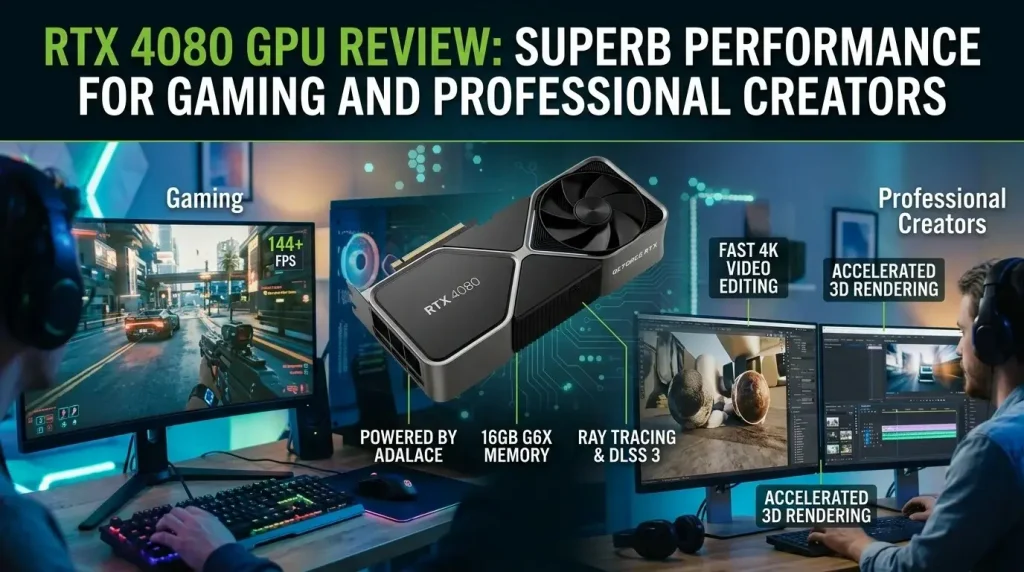
In 3D rendering applications such as Blender and V-Ray, the RTX 4080 demonstrates remarkable speed. It can be nearly 70% faster than the RTX 3080 and more than 30% faster than the best 30-series video cards for GPU rendering. In V-Ray, it is approximately 75% faster than the RTX 3080 and 40% faster than the RTX 3090 Ti, albeit trailing the RTX 4090 by about 30%. This makes it an ideal choice for professionals working with complex 3D models, animations, and simulations, significantly reducing render times and improving overall productivity. The 16GB of GDDR6X memory provides ample bandwidth for large 3D environments and high-resolution textures.
Here’s a comparison of key specifications for the RTX 4080:
| Feature | NVIDIA GeForce RTX 4080 |
|---|---|
| Architecture | Ada Lovelace (AD103) |
| Manufacturing Process | 5 nm (TSMC 4N) |
| CUDA Cores | 9,728 |
| RT Cores | 76 (3rd Gen) |
| Tensor Cores | 304 (4th Gen) |
| Memory | 16 GB GDDR6X |
| Memory Interface | 256-bit |
| Memory Bandwidth | 716.8 GB/s |
| Boost Clock | Up to 2.51 GHz |
| TDP | 320 W |
| Recommended PSU | 750 W |
| Launch Price (MSRP) | $1199 USD |
Diving Deeper: Ada Lovelace Architecture and Key Technologies
The NVIDIA Ada Lovelace architecture is the backbone of the RTX 4080’s impressive performance. This architecture introduces several innovations that contribute to its efficiency and capabilities. Key advancements include improved streaming multiprocessors for up to 2x performance and power efficiency, fourth-gen Tensor Cores for up to 4x performance with DLSS 3, and third-gen RT Cores for up to 2x ray tracing performance. A crucial new feature is Shader Execution Reordering (SER), which optimizes ray tracing workloads by dynamically reorganizing them for better GPU utilization, leading to significant performance boosts in ray-traced games. Displaced Micro-Meshes and Opacity Micro-Masks further enhance the detail and complexity of ray-traced scenes. For more detailed information on the Ada Lovelace architecture and its groundbreaking features, you can refer to the Wikipedia page on Ada Lovelace architecture.
Power, Thermals, and System Requirements
The RTX 4080 has a Total Graphics Power (TGP) of 320 W. While this is a significant power draw, reviews indicate that in many gaming workloads, the card’s average power consumption often stays below its rated TGP, sometimes around 251W for average gaming, especially at lower resolutions or when CPU-bottlenecked. This efficiency is a testament to the Ada Lovelace architecture. NVIDIA recommends a 750-watt power supply unit (PSU) for systems equipped with an RTX 4080, although higher wattage might be advisable depending on the other components, particularly a high-end CPU.
In terms of thermals, the RTX 4080 Founders Edition and custom AIB models generally feature robust cooling solutions, often triple-slot and triple-fan designs. These coolers are highly effective at keeping temperatures in check, even under heavy load, often staying in the low 60°C range. The efficiency of the cooling systems also contributes to quiet operation, with fans often remaining idle at low temperatures.
Value Proposition and Market Positioning
Upon its launch, the RTX 4080 had an MSRP of $1199. However, street prices for various custom models could range higher, with some reaching up to $1549. The introduction of the RTX 4080 SUPER later aimed to offer improved performance at a lower starting price of $999, which significantly altered the market landscape for the original RTX 4080. As of June 2026, the price of the original RTX 4080 can still be found at varying rates, with some online retailers listing it around $1779, while used prices are considerably lower, around $795.
When comparing the RTX 4080 to its successor, the RTX 4080 SUPER, the latter generally offers a slight performance edge (around 1.7% in 3DMark benchmark) at a lower launch price. Against the RTX 4070 Ti SUPER, the RTX 4080 typically shows a 12-14.5% performance lead in average framerates, especially in demanding titles and with ray tracing enabled. However, the RTX 4070 Ti SUPER often presents a better “cost per frame” value, making the choice dependent on budget and specific performance needs.
The RTX 4080 is an undeniable upgrade over previous-generation cards like the RTX 3080 Ti, offering a 20-40%+ performance increase in many scenarios, particularly with ray tracing. However, its initial pricing made it a controversial product for some, as the performance gap to the RTX 4090 was larger than the price gap suggested, leading to questions about its value proposition at launch. Despite this, for users seeking top-tier 4K gaming and professional content creation capabilities without reaching the RTX 4090’s premium, the RTX 4080 remains a powerful and efficient GPU. For further insights on selecting components, consider a comprehensive graphics card buying guide.
Conclusion: Is the RTX 4080 the Right Choice for You?
The NVIDIA GeForce RTX 4080, even with newer “SUPER” variants in the market, continues to be an exceptionally capable graphics card for those who prioritize high-performance gaming at 1440p and 4K, alongside demanding content creation tasks. Its Ada Lovelace architecture delivers impressive rasterization and ray tracing capabilities, significantly enhanced by DLSS 3 with Frame Generation. The card’s efficiency and robust cooling solutions ensure stable and relatively quiet operation.
While its initial price point drew criticism, and the RTX 4080 SUPER offers a compelling alternative with improved value, the original RTX 4080 remains a potent choice. For gamers aiming for 4K 60+ FPS in most titles with ray tracing, and creators needing acceleration in rendering, video editing, and 3D design, the RTX 4080 provides a top-tier experience. Its long-term viability is further bolstered by NVIDIA’s continuous driver support and ecosystem features like NVIDIA Studio and Broadcast. Ultimately, if the performance aligns with your budget and requirements, the RTX 4080 stands as a testament to high-end GPU engineering.