GPU Stock: A Comprehensive Analysis of Market Dynamics and Future Trends
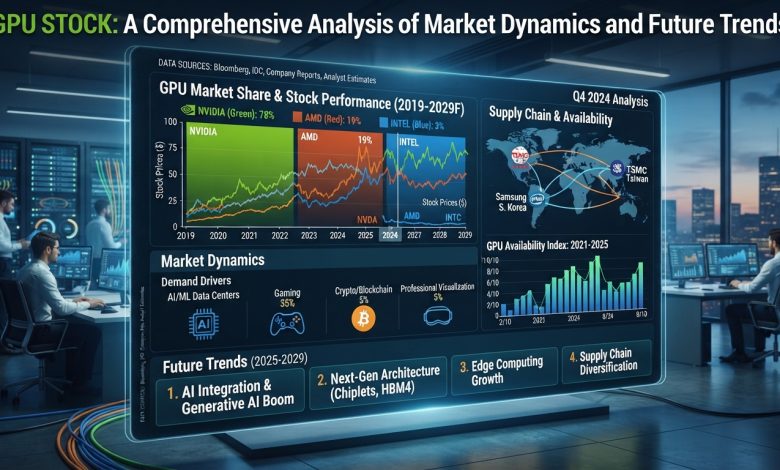
Table of Contents
GPU stock, encompassing Graphics Processing Units for both consumer and enterprise markets, is currently navigating a complex landscape shaped by unprecedented demand, evolving technological applications, and persistent global supply chain challenges. Once primarily associated with high-end gaming and rendering graphics, GPUs have become the indispensable backbone of modern artificial intelligence (AI) infrastructure, high-performance computing (HPC), and data analytics. This fundamental shift has led to a market where demand consistently outpaces even record-breaking hardware production, resulting in higher prices and limited availability for various segments.
Introduction to GPU Stock Dynamics
The dynamics of GPU stock have undergone a dramatic transformation in recent years. Historically, GPU availability and pricing largely followed predictable consumer demand cycles, often tied to new gaming releases and hardware upgrade cycles. However, the last few years have introduced a “perfect storm” of factors that have fundamentally altered this equilibrium. The market has transitioned from temporary volatility to a state of structural cost inflation, with a new, higher baseline for GPU pricing. This is not merely a transient shortage; it’s a reflection of deeper structural changes in the global technology landscape.
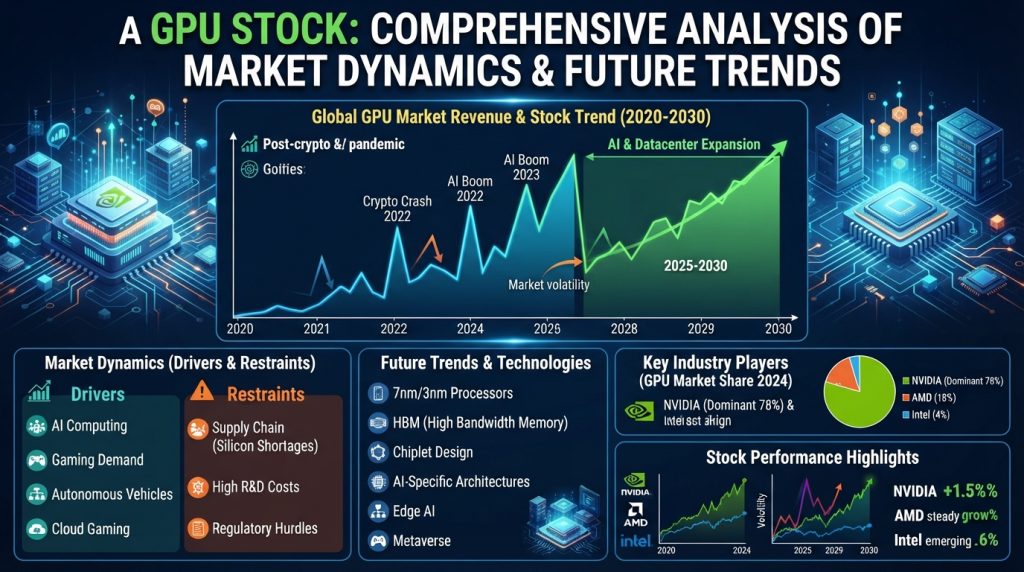
The global Graphics Processing Unit market, valued at approximately $43.6 billion in 2025, is projected to reach an estimated $112.9 billion by 2032, expanding at a Compound Annual Growth Rate (CAGR) of 14.5% during 2026-2032. Other reports indicate a projection from $62.4 billion in 2024 to an impressive $821.3 billion by 2034, with a robust CAGR of 29.40% from 2025 to 2034. For gaming alone, the GPU market size is expected to increase from USD 38.72 billion in 2026 to USD 66.24 billion by 2031, growing at a CAGR of 11.34% over 2026-2031. These projections underscore the immense and sustained growth expected across all GPU segments.
The AI-Driven Surge in GPU Demand
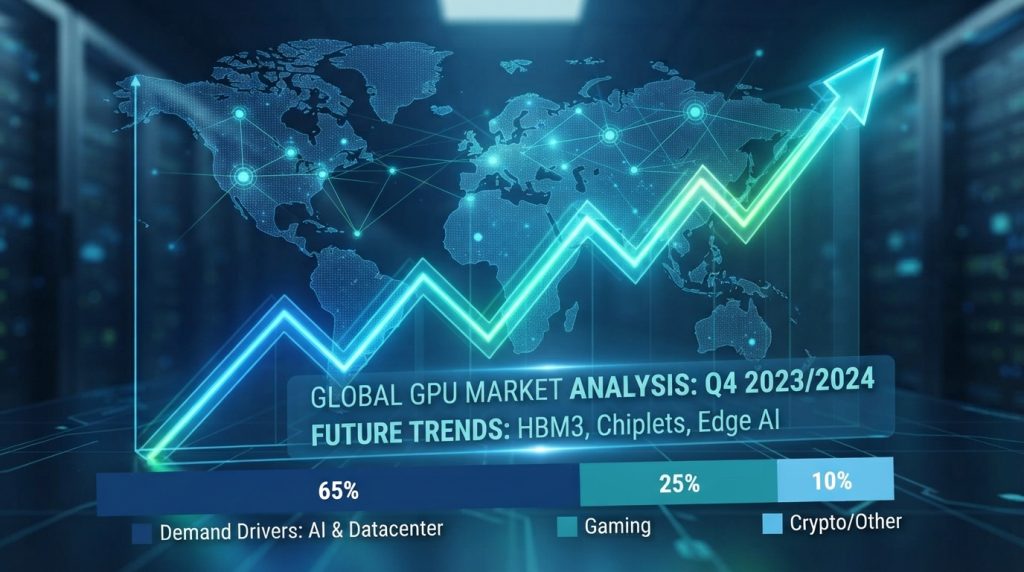
The most significant driver of the current GPU market dynamics is the exponential growth in artificial intelligence and machine learning. Training sophisticated AI models, especially large language models (LLMs) and generative AI, demands immense computational power that GPUs are uniquely equipped to provide due to their parallel processing capabilities. This has led to a surge in demand from enterprise AI clients, cloud computing platforms, and data centers.
Large AI companies and tech giants are purchasing GPUs in massive volumes, often tens of thousands of units at once, and some are even reserving future production months or years in advance. This bulk acquisition creates significant pressure on the available supply, leaving fewer GPUs for smaller businesses, startups, and individual developers. The demand for AI compute continues to outpace supply, leading to broad price increases across both older and newer Nvidia GPUs used for AI training and inference.
The impact of AI demand on GPU pricing is not merely a technical issue but a strategic factor influencing product development, scalability, and long-term competitiveness for businesses. Companies are investing billions of dollars annually into AI infrastructure, with a large portion of this spending directed towards purchasing new GPUs. The integration of GPUs in AI development has not only enhanced the efficiency and speed of computations but has also paved the way for innovations previously considered unattainable.
Supply Chain Bottlenecks and Manufacturing Disruptions
Despite record hardware production, GPU shortages persist due to a confluence of factors, including infrastructure bottlenecks, supply chain limitations, and geopolitical tensions. Manufacturing delays, such as those caused by a 6.4 magnitude earthquake in January 2025 that disrupted TSMC’s production and damaged over 30,000 high-end wafers, have significantly impacted GPU availability.
Key components like VRAM chips and advanced packaging capacity, such as TSMC’s CoWoS packaging (essential for stacking HBM alongside AI processors), have become critical bottlenecks. The demand for such integration techniques has exploded, creating secondary choke points that add months to delivery timelines. Global logistics delays and shortages of other components further exacerbate these issues.
Geopolitical tensions, including tariffs and trade policies, particularly those impacting Chinese imports, have also increased costs and reduced supply. The U.S.–China trade war, for example, escalated in early 2025 with significant tariffs imposed by both countries, directly affecting the GPU market which relies heavily on both Chinese materials and U.S. chip design. These restrictions have created unpredictable procurement challenges for global enterprises, with some companies facing sudden access limitations or discovering their global deployment plans are no longer guaranteed by geopolitics.
Furthermore, a deeper supply crisis has emerged concerning memory chips, which have become a binding constraint on AI infrastructure globally. Samsung, for instance, reportedly lifted prices for server memory chips by 30% to 60%, with forecasts of continued price increases into early 2026 as demand outpaces capacity expansion. Lead times for data center GPUs currently range from 36 to 52 weeks, and shortages are expected to persist through at least 2026, as new fabrication plants won’t come online until 2025–2027.
| Factor | Impact on GPU Stock/Pricing | Current Status (2026) |
|---|---|---|
| AI Demand | Massive, sustained increase in demand, driving up prices and leading to enterprise bulk purchases. | Primary driver of current shortages and high prices; continues to outpace supply. |
| Manufacturing Delays | Disruptions (e.g., earthquakes, component shortages) affecting production of wafers and other critical parts. | Ongoing; advanced packaging capacity (e.g., CoWoS) remains a significant bottleneck. |
| Supply Chain Issues | Global logistics delays, shortages of VRAM chips, and other components. | Persistent, contributing to extended lead times and higher costs. |
| Geopolitical Tensions | Tariffs, trade policies, and export controls increasing costs and limiting market access. | Continues to create unpredictable procurement challenges and market instability. |
| Cryptocurrency Mining | Historically created demand spikes and price inflation for consumer GPUs. | Waning influence compared to AI demand; some pressure has shifted. |
Cryptocurrency and Its Waning Influence on GPU Stock
In the past, cryptocurrency mining was a significant factor in driving up GPU demand and prices, leading to periods where popular graphics cards were either out of stock or sold at inflated rates, sometimes doubling or tripling their MSRP. Miners would frequently buy entire stocks of new GPUs as soon as they became available, especially for cryptocurrencies like Ethereum which relied on proof-of-work models. The impact of cryptocurrency mining was particularly acute in 2017 and 2021, creating a severe shortage and price spikes.
However, the landscape of digital currencies has evolved. While cryptocurrency mining previously contributed significantly to demand, the evolving nature of digital currencies has shifted some of that pressure. Specifically, the transition of Ethereum to a proof-of-stake model has reduced the incentive for GPU-based mining for that particular cryptocurrency, which was a major driver of GPU demand from the crypto sector. While a fundamental imbalance between supply and demand for high-end GPUs still persists, the “transient, speculative demand” from crypto mining has largely been replaced by the “massive, persistent enterprise capital demand” from AI data centers. This indicates that while crypto’s impact isn’t entirely gone, its role in the current GPU market crunch is far less dominant than that of AI.
Market Share and Competitive Landscape
The GPU market is dominated by a few key players, primarily NVIDIA and AMD, with Intel making recent inroads into the discrete GPU segment. NVIDIA has solidified its position as the market leader, particularly in the discrete GPU sector. According to Q4 2025 data, NVIDIA’s market share of total graphics card shipments reached a new high of 94%, an increase of 10 percentage points from Q4 2024. In contrast, AMD’s GPU shipment market share dropped to 5% from 7% in the previous quarter and 15% in the same period a year prior. Intel’s market share for discrete Arc GPUs remained flat at 1% in Q4 2025.
NVIDIA’s dominance is especially pronounced in desktop graphics cards and its AI-oriented GPU lines, driven by strong demand for its computing performance across industries from gaming to data centers. The company’s advanced processors are in high demand and incredibly expensive, fueling significant sales growth and margins. NVIDIA’s market capitalization has soared, reflecting its strong position in tapping into the demand for AI chips.
However, competition continues to drive innovation. Emerging players like Qualcomm and Samsung are disrupting the market with their offerings, adding diversity and fueling competition, particularly in mobile devices. Intel is also investing significantly in its foundry business to manufacture advanced chips, potentially becoming a manufacturing partner for NVIDIA and AMD in the future. Despite AMD clawing back some market share in late 2024, NVIDIA remains utterly dominant in gaming graphics market share. The future of the consumer GPU industry remains uncertain, with both NVIDIA and AMD reportedly planning for challenging times ahead, indicating a potential shift away from prioritizing gamers.
GPU Pricing Trends and Consumer Impact
The pricing of GPUs has been highly volatile and has settled into a new, structurally higher baseline. This shift is largely attributed to the replacement of transient speculative demand (like crypto mining) with massive, persistent enterprise capital demand from AI data centers. GPU prices have jumped significantly this year, with data showing broad increases across older and newer Nvidia GPUs. For example, the Neo Cloud H100 index rose 20% over three months, and the Neo Cloud B200 index climbed 22%.
For consumers, this translates to longer waits, higher prices, and increased competition for what used to be mainstream hardware. The historical trend of devices becoming exponentially more powerful while becoming more affordable (often referred to as Moore’s Law) has reached an economic inflection point, as manufacturing advanced silicon is now far more complex and capital-intensive.
The price increases are not just for the GPUs themselves but extend to related components. High-bandwidth memory (HBM) prices, for instance, have increased by 20-30% year-over-year, and GPU cloud costs have risen by 40-300% depending on the region. Memory, once predictable and inexpensive, has become a major contributor to volatility in system pricing. These higher costs are almost always passed on to end consumers, making GPUs not just scarce but more expensive when they are available.
Future Outlook and Emerging Trends
The future of the GPU market is poised for continued expansion, driven predominantly by advancements in AI and high-performance computing. The global graphics cards (GPU) market is projected to grow at a CAGR of approximately 9.5% from 2026 to 2035, supported by sustained investment in AI infrastructure, expanding cloud gaming platforms, and increasing GPU adoption in industrial automation and autonomous systems. The data center segment is expected to be the fastest-growing vertical, projected to account for over 30% of total market revenue by 2030, with a CAGR of 14-16%.
Technological innovation will continue to shape the market. Future GPUs are expected to deliver even higher computational power, with advancements in architecture and processing capabilities. Enhanced ray tracing technology will evolve to offer more realistic lighting and reflections, while better AI integration will play a pivotal role in future GPU designs. The market is moving away from raw raster performance towards AI-based rendering, frame generation, and ray tracing features that directly influence buying decisions.
The rise of cloud gaming services is also a significant trend, requiring robust graphic processing capabilities to deliver high-quality gaming experiences. The gaming laptop segment is projected to expand significantly, as newer mobile GPU designs narrow the performance gap with desktops while improving battery life and portability.
However, challenges remain. Supply constraints are expected to stay elevated through 2026, as demand for AI infrastructure continues to outpace manufacturing expansion. Geopolitical trade restrictions and input cost volatility for components like substrates and power components also present ongoing hurdles. Despite these challenges, the GPU market is central to the global tech race, serving as the infrastructure layer of the AI economy and the engine of immersive digital experiences. The benefits and risks of investing in GPU stocks are substantial, with companies like NVIDIA, AMD, Intel, Arm Holdings, and Qualcomm being key players in this dynamic industry.
Conclusion
The GPU market is in a state of profound transformation, fundamentally reshaped by the insatiable demand for artificial intelligence and machine learning. While historical factors like cryptocurrency mining once drove significant fluctuations, the current landscape is dominated by the strategic imperative of AI, leading to persistent high demand and elevated pricing. Supply chain complexities, manufacturing delays, and geopolitical tensions continue to create bottlenecks, ensuring that GPU stock remains a critical and often scarce commodity.
NVIDIA maintains a commanding lead in market share, particularly in the discrete GPU and AI accelerator segments, with AMD and Intel striving for innovation and market penetration. The future points towards continued growth, with an emphasis on enhanced computational power, advanced AI integration, and the expansion of cloud gaming and data center infrastructure. For consumers and businesses alike, navigating the GPU market requires a keen understanding of these intricate dynamics, as access to these powerful processors is no longer a mere convenience but a strategic asset in an increasingly AI-driven world. The long-term outlook suggests a sustained boom, driven by technological advancements and the ever-expanding applications of AI, making the GPU market a focal point of global technological and economic development. Further information on the history and evolution of GPUs can be found on Wikipedia.