GPU 2060 Review: Is RTX 2060 Still Good in 2026?
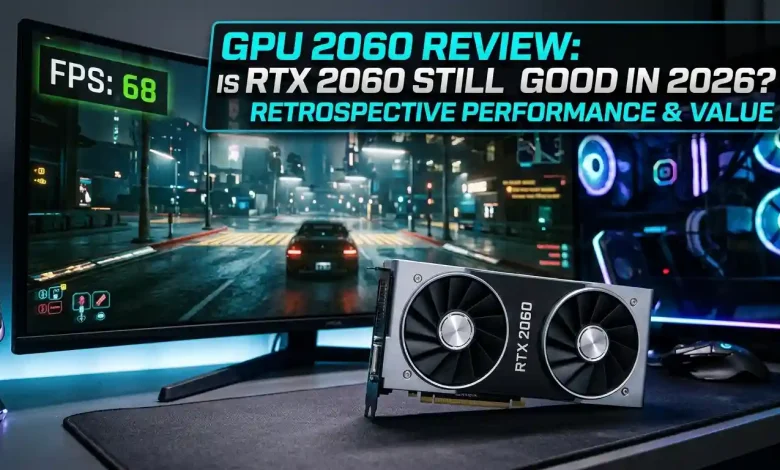
Table of Contents
GPU 2060, specifically the NVIDIA GeForce RTX 2060, was released on January 7, 2019, marking a significant moment in graphics card history by bringing real-time ray tracing and DLSS (Deep Learning Super Sampling) to a more accessible price point. Nearly seven years later, as we navigate mid-2026, the question of its relevance and capability looms large for budget-conscious gamers and those holding onto their trusty Turing-era hardware. The graphics card market has evolved dramatically, with new architectures, improved performance, and advanced features becoming standard. This comprehensive review aims to assess whether the RTX 2060 can still deliver a satisfactory gaming experience in 2026, considering the demands of modern titles, the competitive landscape, and the ever-present factors of price and value.
Introduction: The Enduring Legacy of the RTX 2060
When the NVIDIA GeForce RTX 2060 debuted, it quickly became a popular choice for 1080p gaming, offering a compelling blend of performance, innovative features like ray tracing and DLSS, and a relatively affordable price tag of $349. It was lauded for providing solid frame rates in AAA titles of its era and enabling a glimpse into the future of graphics with its dedicated RT and Tensor Cores. The card, built on the 12nm Turing architecture with 1920 CUDA cores and 6GB of GDDR6 VRAM, positioned itself as the entry point to NVIDIA’s new RTX ecosystem. Fast forward to 2026, and the technological landscape has advanced considerably. GPUs from NVIDIA’s 30-series, 40-series, and even the recently launched 50-series, alongside strong competition from AMD’s Radeon and Intel’s Arc lines, have reshaped performance expectations and feature sets. This article delves into how the RTX 2060 stands up against these modern advancements, scrutinizing its gaming prowess, feature viability, and overall value in the current hardware climate.
A Look Back: The RTX 2060’s Initial Impact
The RTX 2060 was a trailblazer, introducing hardware-accelerated ray tracing and AI-powered DLSS to the mainstream. These technologies, once exclusive to higher-end RTX 20-series cards, allowed for more realistic lighting, reflections, and shadows, along with performance boosts through intelligent upscaling. At its launch, the 6GB of GDDR6 memory was generally sufficient for 1080p gaming, and its raw rasterization performance rivaled or surpassed previous generation cards like the GTX 1070 Ti in many scenarios. The card’s 160W TDP was reasonable, and it quickly found its way into countless gaming PCs, becoming a benchmark for capable 1080p performance. It offered a significant upgrade path for those coming from older GTX 900 or 1000 series GPUs, solidifying its place as a strong contender in the mid-range market of its time. Its long-term popularity is evident, with the RTX 2060 still being one of the most prevalent GPUs on the Steam Hardware & Software Survey in late 2025.
Gaming Performance in 2026: A 1080p Mainstay with Caveats
The crucial question for any older GPU is its ability to run modern games. In 2026, the RTX 2060 still demonstrates solid performance for 1080p gaming, particularly in esports titles and slightly older AAA games. Many benchmarks from early and mid-2026 indicate that the RTX 2060 can achieve smooth gameplay at high settings in popular titles at 1080p resolution. For instance, competitive games like CS2, Valorant, and Dota 2 run flawlessly, often hitting well over 100 FPS. Even some newer AAA games can be played at 60 FPS or above at 1080p with a mix of medium to high settings, especially when leveraging DLSS. Games like Black Myth: Wukong and Spider-Man 2 can achieve around 60 FPS at 1080p with medium settings and DLSS quality mode.
However, the 6GB VRAM of the RTX 2060 is increasingly becoming a bottleneck in more demanding modern AAA titles. Games are now often recommending 8GB, 10GB, or even 12GB of VRAM for optimal performance at higher settings. When the 2060 runs out of VRAM, players can experience stutters, texture loading issues, and overall instability. For example, in titles like Star Wars Jedi Survivor, a 6GB card struggles at 1440p, leading to “mushy” textures. While 1080p remains its sweet spot, even there, some very graphically intensive games might require significant compromises in settings or rely heavily on DLSS to maintain playable frame rates. Moving to 1440p or 4K is generally not recommended for modern AAA gaming, as the card simply lacks the horsepower and VRAM for a consistently smooth experience at these resolutions.
RTX 2060 vs. The Modern Mid-Range Competition
In 2026, the GPU market offers numerous alternatives that often outperform the RTX 2060, especially when considering new prices. The competitive landscape includes cards like the AMD Radeon RX 6600, NVIDIA’s own RTX 3050, and newer budget-friendly offerings like the RTX 5050 and Intel Arc series.
| GPU Model | Approx. New Price (2026) | Approx. Used Price (2026) | Key Advantages over RTX 2060 | Key Disadvantages vs RTX 2060 |
|---|---|---|---|---|
| NVIDIA RTX 2060 (6GB) | $386 | $115 – $126 | Good 1080p performance with DLSS, lower power consumption. | Limited 6GB VRAM, older RT cores, weaker rasterization vs. newer rivals. |
| NVIDIA RTX 3050 (8GB) | $249 | N/A (often similar to new price) | Newer architecture, 8GB VRAM, better RT performance than 2060, better NVENC. | Generally similar or slightly lower raw gaming performance than RX 6600. |
| AMD Radeon RX 6600 (8GB) | $329 | N/A (often similar to new price) | Significantly better rasterization performance than RTX 2060 and RTX 3050, 8GB VRAM. | Weaker ray tracing, FSR not as mature as DLSS (though improving). |
| NVIDIA RTX 5050 (6GB/8GB) | $290 | N/A (too new for stable used market) | Latest architecture, improved RT and DLSS, potentially more power efficient. | 6GB VRAM may still be a limitation in some models. |
The RTX 2060’s performance falls behind newer budget options like the RX 6600 in raw rasterization, with the RX 6600 being approximately 31.5% faster in synthetic benchmarks. Even the RTX 3050, while often slightly behind the RX 6600 in pure FPS, offers 8GB of VRAM and newer architecture benefits, making it a more future-proof option than the 2060, particularly for applications that benefit from NVIDIA’s ecosystem. The new RTX 5050 (when available) presents a compelling budget option with updated architecture and features.
On the new market, the RTX 2060 is considered a poor value. For a similar price as a new RTX 2060 ($386), you can find cards like the Radeon RX 7700 XT which offers significantly better 3DMark scores. Even when looking at budget options under $300, cards like the Intel Arc B580 and Radeon RX 9060 XT 8GB are recommended over older generations.
Ray Tracing and DLSS in 2026: A Double-Edged Sword
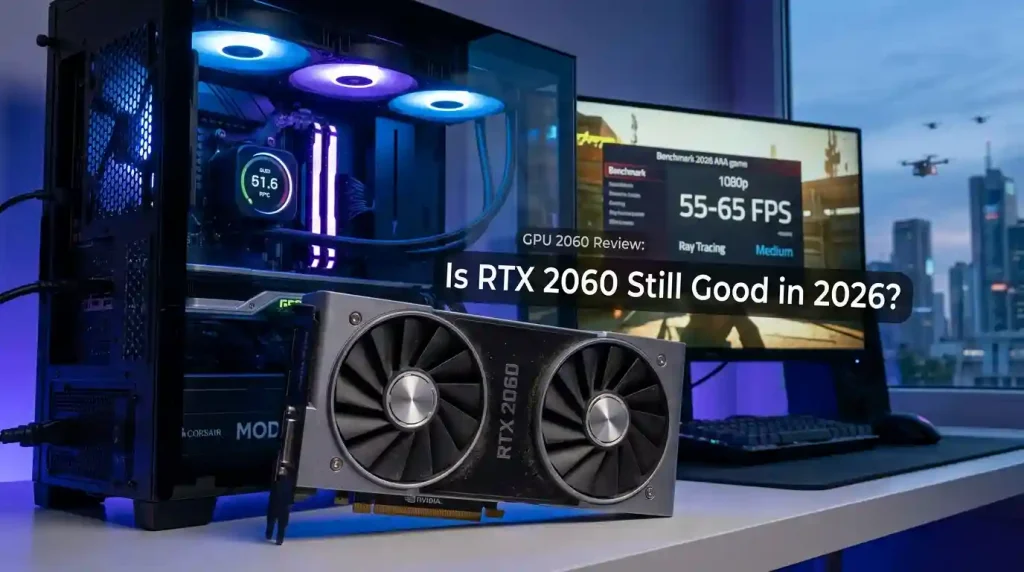
The RTX 2060 was one of the first cards to support ray tracing, but its first-generation RT cores and limited 6GB VRAM mean that ray tracing performance in 2026 is generally quite poor. While technically capable, enabling ray tracing in modern, demanding titles often results in significant performance hits, dropping frame rates to unplayable levels even at 1080p. Games that heavily utilize ray tracing effects, such as Cyberpunk 2077 or Dying Light 2 with high RT settings, will struggle immensely on the RTX 2060. It often requires extreme compromises in other graphical settings to make ray tracing even “technically usable” at around 40-50 FPS in some titles, which many users would find unsatisfactory.
However, DLSS remains a significant saving grace for the RTX 2060. NVIDIA “accidentally futureproofed” the card by introducing DLSS before games truly needed it, and in 2026, DLSS can significantly boost performance and improve the gaming experience, especially in demanding titles. With DLSS, many games that would otherwise struggle can become playable at 1080p with decent frame rates. Some sources even mention DLSS 4 upscaling being tested on the RTX 2060, providing a much smoother and more enjoyable gaming experience. This AI-driven upscaling technology allows the GPU to render at a lower resolution and then intelligently upscale the image, making titles more playable without sacrificing too much visual quality. It is, arguably, the primary reason the RTX 2060 remains viable for some modern gaming, mitigating its VRAM limitations to a degree, though it cannot fully compensate for the architectural advancements of newer generations. To understand more about the progression of graphics technology, one might refer to detailed historical overviews on Wikipedia’s History of Nvidia GPUs.
Power Consumption, Thermals, and Longevity
The RTX 2060 has a Thermal Design Power (TDP) of 160W, which is relatively low compared to many modern high-performance GPUs. This means it typically draws less power and, consequently, generates less heat. At its launch, the power consumption was noted to be higher than its Pascal predecessor, the GTX 1060, but still well within reasonable limits, peaking around 166W during gaming. In 2026, this lower power draw is a definite advantage, as it translates to cooler operation and less strain on power supply units, making it suitable for budget systems or those with less robust power infrastructure.
From a thermal perspective, most RTX 2060 cards, including both Founder’s Edition and aftermarket models, typically run at acceptable temperatures under load, often in the low 70s Celsius, with some aftermarket coolers offering even better performance. Fan noise can vary by model, but many are designed to be relatively quiet, especially at idle.
Regarding longevity, the RTX 2060 is a testament to NVIDIA’s engineering, still functioning well after over seven years. However, while the physical hardware remains robust, the limiting factor for its longevity in a gaming context is increasingly its 6GB of VRAM and first-gen RT cores. While it might continue to run for years, its ability to handle new, graphically intensive games will diminish further without significant compromises.
The Second-Hand Market: Value Proposition
For many users in 2026, the primary appeal of an RTX 2060 will be its price on the used market. A new RTX 2060 is a poor investment, with an average new price of $386 in June 2026, significantly underperforming newer cards at similar price points. However, in the used market, prices are considerably lower, ranging from approximately $115 to $126. Some users on Reddit reported seeing prices in the $80-$100 range for a used RTX 2060 in September 2025.
This low price point can make it an attractive option for extreme budget builds or for upgrading very old systems. For around $120, a used RTX 2060 offers 1080p gaming capabilities that are far superior to integrated graphics or older entry-level discrete GPUs. However, even in the used market, some newer budget-tier cards like the RTX 3050 and RX 6600 (often found used for slightly more) can offer better overall performance and more VRAM. The used GPU market for budget cards, including the RTX 3060 and RTX 3080, saw prices rising by 10-12% in early 2026, indicating sustained demand for affordable options. This suggests that while the RTX 2060 is cheap, better value might be found by extending the budget slightly for a newer generation used card, such as an RTX 3060 (12GB) or even an RTX 2060 SUPER, which can be found for around $160 used.
Conclusion: Is the RTX 2060 Still Good?
In conclusion, the NVIDIA GeForce RTX 2060 remains a surprisingly capable GPU in 2026, but with significant caveats. For 1080p gaming, especially in esports titles and many older or well-optimized AAA games, it still provides a smooth and enjoyable experience, largely thanks to the enduring power of DLSS. Its low power consumption and robust build quality contribute to its longevity.
However, the card’s age is increasingly showing. The 6GB of VRAM is a substantial limitation for modern AAA titles, leading to performance issues and texture problems at higher settings or resolutions. Its first-generation RT cores struggle to deliver a satisfying ray tracing experience, often requiring too many compromises to be truly viable. In the new GPU market, the RTX 2060 is no longer a good value, as newer cards like the RX 6600, RTX 3050, or even the latest RTX 5050 offer superior performance and features for a similar or often better price.
For those who already own an RTX 2060, it can continue to serve as a decent 1080p gaming solution, especially if paired with a good CPU and if you’re willing to tweak settings and heavily utilize DLSS. An upgrade isn’t strictly necessary if you’re satisfied with its performance in the games you play. However, if you are looking to buy a GPU in 2026, the RTX 2060 only makes sense as a very cheap second-hand purchase (ideally under $120) for a strict budget build, where its raw processing power for the price still offers some value. For any new purchase, or if your budget allows for slightly more, newer generation alternatives provide a significantly better gaming experience, more VRAM, and a greater degree of future-proofing. The RTX 2060 is not unusable in 2026, but it is certainly no longer a recommended buy for the average consumer seeking modern gaming performance without compromise.