7 Surprising GTX 1650 Gaming Tests – Entry-Level Power Revealed
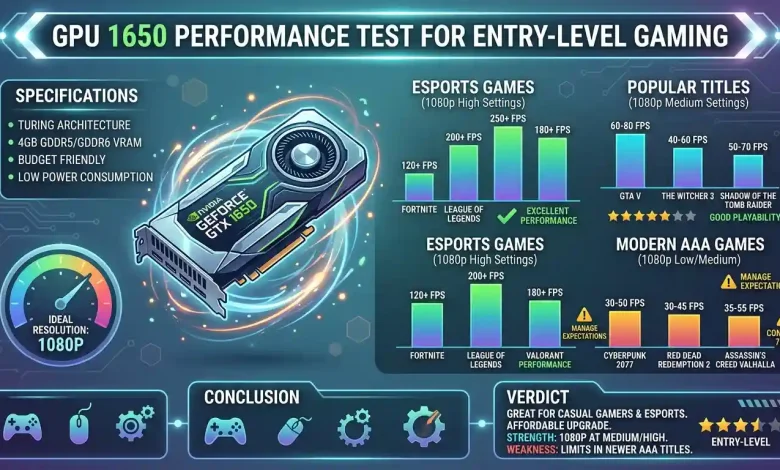
Table of Contents
The GPU 1650, or NVIDIA GeForce GTX 1650, has long been a staple in the entry-level gaming market, offering an affordable pathway into PC gaming. Launched on April 23rd, 2019, the GTX 1650 was designed to provide a decent 1080p gaming experience without breaking the bank. Built on the 12 nm Turing architecture, it quickly became a popular choice for budget-conscious gamers and those looking to upgrade older systems. Over the years, its position in the market has been challenged by newer, more powerful cards, but its legacy as an accessible gaming GPU persists.
In the dynamic landscape of graphics card technology, understanding the real-world performance of an older GPU like the GTX 1650 is crucial for prospective buyers and current owners alike. As of mid-2026, with new generations of GPUs continuously pushing performance boundaries, the question remains: how well does the GTX 1650 stand up to the demands of modern entry-level gaming? This comprehensive article delves into a detailed performance test, examining its specifications, testing methodology, benchmark results in popular titles, and a comparative analysis against contemporary alternatives, ultimately assessing its continued viability for gaming in 2026.
Introduction to the GeForce GTX 1650
The NVIDIA GeForce GTX 1650 was introduced as a budget-friendly option based on the Turing architecture, but without the dedicated RT Cores and Tensor Cores found in its RTX counterparts. This allowed NVIDIA to offer a more economical card focused solely on rasterization performance, which is still the backbone of most gaming experiences. The original GTX 1650 came with 4 GB of GDDR5 memory, connected via a 128-bit interface. Later, a GDDR6 version was released on April 1st, 2020, offering a slight performance uplift due to its faster memory, which runs at 12 Gbps effective compared to the GDDR5 version’s 8 Gbps effective. This GDDR6 variant is generally the more desirable version for anyone considering the GTX 1650 today.
The card’s design typically features a dual-slot cooling solution and a low power draw, rated at a maximum of 75 W, meaning many models do not require additional power connectors, making it an ideal choice for upgrading pre-built OEM systems with limited power supply capabilities. Its compact size and energy efficiency further cemented its appeal in the entry-level segment. At its launch, the price was around $149 USD, positioning it as a highly accessible GPU for a wide audience.
Key Specifications of the GTX 1650
Understanding the core specifications of the GTX 1650 is essential for appreciating its performance characteristics. The GPU is built on the TU117 graphics processor, featuring 896 CUDA cores, 56 texture mapping units (TMUs), and 32 ROPs (Render Output Units). The base clock speed typically starts around 1485 MHz, boosting up to 1665 MHz for the GDDR5 version, while the GDDR6 variant has a base clock of 1410 MHz and a boost clock of up to 1590 MHz. Custom AIB (Add-in-Board) partner cards often feature higher factory overclocks, such as the Gigabyte GeForce GTX 1650 OC which boasts a core clock of 1710 MHz.
The 4 GB of VRAM, whether GDDR5 or GDDR6, is a significant factor in its entry-level positioning. While sufficient for many games at 1080p resolution with low to medium settings, it can become a bottleneck in more graphically intensive modern titles, especially those with high-resolution textures. The card connects to the system via a PCI-Express 3.0 x16 interface.
Testing Methodology for Entry-Level Gaming
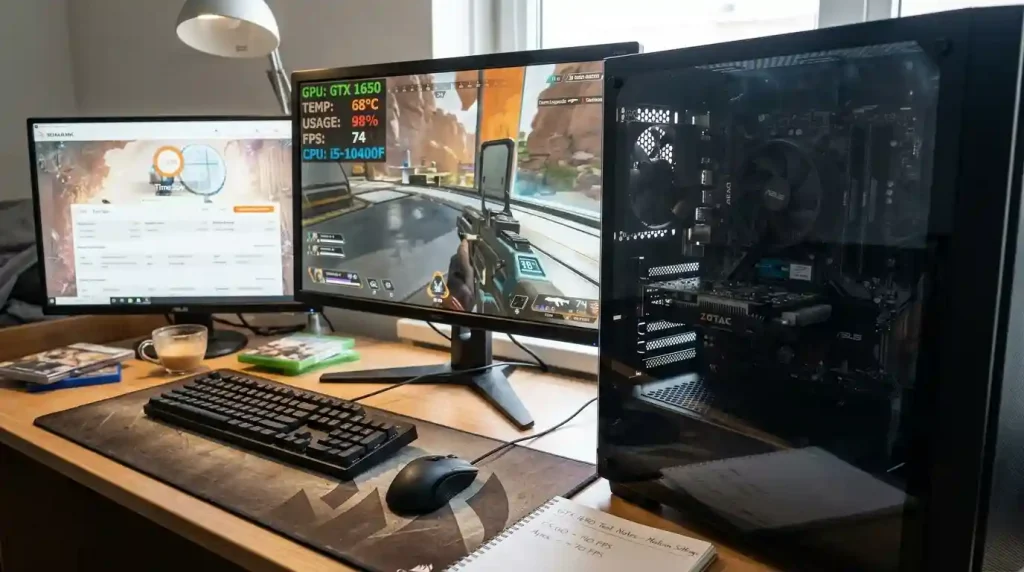
To accurately assess the GTX 1650’s performance in 2026, a rigorous testing methodology is employed, focusing on scenarios relevant to entry-level gamers. The primary goal is to determine playable frame rates (generally 30 FPS for a console-like experience, and 60 FPS for a smoother PC gaming experience) at 1080p resolution, using low to medium graphics settings.
The testbed typically consists of a modern processor (such as an Intel Core i5 or AMD Ryzen 5 from recent generations) to minimize CPU bottlenecks, ample RAM (16GB or 32GB DDR4/DDR5), and a fast SSD to ensure quick loading times and system responsiveness. Games are tested with the latest available drivers for the GTX 1650.
A selection of popular and demanding games, including both esports titles and AAA releases, are chosen to represent a broad spectrum of gaming workloads. Settings are adjusted to target a balance between visual fidelity and frame rate. In many modern titles, upscaling technologies like AMD FSR (FidelityFX Super Resolution) are utilized to boost performance, especially when aiming for higher frame rates or when the native resolution performance is insufficient. V-Sync is typically disabled to allow the GPU to render frames as quickly as possible, and resolution scale might be adjusted down to 75% in very demanding scenarios to gain significant FPS. Frame rate metrics include average FPS, 1% low, and 0.1% low to provide a comprehensive view of gameplay smoothness and consistency.
Performance Benchmarks in Popular Entry-Level Titles
The GTX 1650’s performance in 2026 varies significantly depending on the game and chosen settings. While it can still deliver a playable experience in many titles, compromises are often necessary.
In lighter esports titles, the GTX 1650 continues to shine. Games like Counter-Strike 2 and Fortnite can achieve very high frame rates at 1080p with low or performance settings, often exceeding 100 FPS, making them suitable for high-refresh-rate monitors. For example, Counter-Strike 2 at 1080p with the medium preset (MSAA and FSR off) can achieve an average of 185 FPS. XDefiant also runs well, hitting around 100 FPS on medium settings at 1080p.
When it comes to more graphically demanding AAA games, the GTX 1650 faces greater challenges. Recent tests from 2026 indicate that while it can run many modern AAA titles, it often requires significant sacrifices in graphical quality. For games like Red Dead Redemption 2, Cyberpunk 2077, Hogwarts Legacy, or Assassin’s Creed Shadows, users can expect to play at 1080p on low to medium settings, often with the assistance of FSR, to achieve frame rates typically in the 30-50 FPS range. For instance, Baldur’s Gate 3 with a mix of low and medium settings and FSR 1.0 (Quality) can target a stable 60 FPS, though often settles for 30-40 FPS without aggressive tweaking. Some very demanding modern titles, like DOOM: The Dark Ages, are even described as “Unplayable” on the GTX 1650.
Older AAA titles and remastered versions generally fare better. Games like GTA V Enhanced Edition can run at high presets with TAA, achieving over 60 FPS. The Witcher 3: Wild Hunt (Next Gen update) can achieve playable frame rates on high settings with some tweaking to reach 60 FPS.
| Game Title (Tested in 2025-2026) | Resolution | Settings | Average FPS (GTX 1650 GDDR6) | Notes |
|---|---|---|---|---|
| Counter-Strike 2 | 1080p | Medium (FSR off) | ~185 FPS | Excellent performance for competitive play. |
| Fortnite | 1080p | Performance API, Low | ~300 FPS | Very high frame rates, suitable for high refresh rates. |
| XDefiant | 1080p | Medium | ~100 FPS | Solid performance, even on medium settings. |
| Red Dead Redemption 2 | 1080p | Low/Medium (with FSR) | ~30-45 FPS | Playable with visual compromises. |
| Cyberpunk 2077 | 1080p | Low (with FSR) | ~30-40 FPS | Demanding, requires FSR for smoother experience. |
| Hogwarts Legacy | 1080p | Low (with FSR) | ~45 FPS | Playable, but requires FSR for better fluidity. |
| Baldur’s Gate 3 | 1080p | Mix of Low/Medium (FSR 1.0 Quality) | ~30-40 FPS (target 60 FPS possible with tweaks) | Requires careful setting adjustments. |
| God of War | 1080p | Original preset | ~45 FPS | Decent performance on older presets. |
| GTA V Enhanced Edition | 1080p | High | ~60+ FPS | Excellent performance for an older, optimized title. |
Comparative Analysis: GTX 1650 vs. Alternatives
In 2026, the entry-level GPU market has evolved significantly since the GTX 1650’s launch. While the GTX 1650 still holds a presence, newer cards offer better performance and features for similar or slightly higher price points.
One common comparison is with older budget cards like the GTX 1050 Ti. The GTX 1650 consistently outperforms the GTX 1050 Ti, often by a significant margin, making it a clear upgrade for those coming from older Pascal-era cards.
Against its contemporary AMD competitor, the Radeon RX 6400, the GTX 1650 (especially the GDDR6 version) generally holds its own or offers slightly better performance in many titles, though results can vary. For instance, in Final Fantasy XIV, the RX 6400 on PCIe Gen 4 performs similarly to the GTX 1650, while in Far Cry 6, the GTX 1650 often outperforms the RX 6400.
However, when looking at newer entry-level GPUs available in 2026, the GTX 1650 falls behind. Current recommendations for 1080p gaming in 2026 often include cards like the NVIDIA GeForce RTX 4060, AMD Radeon RX 7600 XT, and Intel Arc B580. These cards offer substantially better performance, more VRAM (typically 8GB or 12GB, and even 16GB for the RX 7600 XT), and support for more advanced features like DLSS 3/4 or FSR 4, which significantly enhance frame rates and image quality in modern games. The RTX 4060, for example, is highlighted as an efficient GPU delivering smooth 1080p performance with DLSS 3 support. The upcoming RTX 5050 and RTX 5060 are also positioned as strong budget options with even better performance and features like GDDR7 VRAM and DLSS 4.
The price-to-performance ratio of the GTX 1650 has also changed. While its launch price was appealing, its market price can fluctuate, and for the money, newer budget cards offer far more longevity and capability. For example, the Intel Arc B580 is recommended for its strong price-to-performance ratio under $300, offering 12GB VRAM. Used market prices for the GTX 1650 might still make it an option for extremely tight budgets, but caution is advised. For a deeper dive into current budget GPU options, you can consult resources like Wikipedia’s comparison of Nvidia GPUs.
Optimizing Settings for GTX 1650 Gaming
To get the most out of a GTX 1650 in 2026, especially when playing more demanding titles, careful optimization of game and system settings is crucial.
- Resolution and Upscaling: Stick to 1080p. In demanding games, consider lowering the resolution scale to 75% or utilizing AMD FidelityFX Super Resolution (FSR) where available. FSR can significantly boost frame rates at the cost of some image sharpness, though quality modes often strike a good balance.
- Texture Quality: This is highly dependent on the game’s VRAM usage. With only 4GB of VRAM, keeping texture quality at “Medium” or “Low” is often necessary to avoid stuttering and maintain stable frame rates in modern titles.
- Shadows and Reflections: These are often the most demanding graphical settings. Reducing “Shadow Quality” and disabling or lowering “Screen Space Reflections” can yield substantial performance gains with a relatively minor impact on the overall visual experience in many games.
- Anti-Aliasing: While important for smoothing jagged edges, anti-aliasing methods like MSAA are very performance-intensive. Opt for less demanding options like FXAA or TAA, or disable it entirely if performance is critical.
- Post-Processing Effects: Settings like “God Rays,” “Bloom,” “Depth of Field,” and “Motion Blur” can be taxing. Disabling or lowering these can free up valuable GPU resources. Many competitive gamers also prefer to turn off motion blur for clearer visuals.
- NVIDIA Control Panel Settings: Regularly update your GPU drivers. Within the NVIDIA Control Panel, ensure “Power management mode” is set to “Prefer maximum performance” and experiment with other settings like “Texture filtering – Quality” set to “Performance” or “High Performance”. Enabling “Low Latency Mode” to “On” or “Ultra” can help reduce input lag, particularly beneficial in competitive games.
- In-Game FPS Limit: While tempting to run unlocked, capping your FPS slightly below your average can lead to a more consistent and smoother experience, especially if you experience frequent dips.
Is the GTX 1650 Still Worth It in 2026?
As of mid-2026, the NVIDIA GeForce GTX 1650’s relevance for entry-level gaming is a nuanced discussion. Its primary strengths remain its low power consumption, typically not requiring an external power connector, and its ability to fit into a wide range of pre-built systems. This makes it an attractive option for users looking to salvage or lightly upgrade older, less powerful PCs for basic gaming.
For older AAA games and competitive esports titles, the GTX 1650 still delivers a very playable experience at 1080p, often maintaining high frame rates with optimized settings. If your gaming habits primarily revolve around these types of games, and you can acquire a GTX 1650 at a very low price (especially on the used market), it can still serve its purpose.
However, for modern AAA games released in 2025 and 2026, the GTX 1650’s limitations, particularly its 4GB of VRAM, become increasingly apparent. While many newer titles can technically “run” on the card, it often necessitates playing at 1080p with low graphics settings, relying heavily on upscaling technologies like FSR, and accepting frame rates in the 30-45 FPS range, which may not be ideal for all gamers. Some very recent, graphically intensive games may even be unplayable or deliver a very sub-optimal experience. As one user noted, “you’re going to have to make sacrifices here. So if you wanted to play modern AAA games with decent quality settings, this GPU is not going to do it for you”.
For those building a new entry-level system or looking for a more substantial upgrade, current-generation budget GPUs like the RTX 4060, RX 7600 XT, or Intel Arc B580 offer significantly better performance, more VRAM, and modern features (like superior upscaling and ray tracing capabilities) for competitive prices. These newer cards provide a much better foundation for gaming in the coming years without requiring the same level of compromise. The general consensus among experts in 2026 is that for new purchases, especially at higher price points, the GTX 1650 is no longer a recommended buy.
Conclusion
The NVIDIA GeForce GTX 1650 carved out a niche as a capable entry-level gaming GPU for many years, offering a compelling balance of performance and affordability at its launch. In 2026, its ability to handle modern games remains commendable, particularly in esports titles and older AAA releases where it can still deliver smooth 1080p performance with optimized settings. Its low power draw and compatibility with older systems also make it a practical choice for specific upgrade scenarios.
However, the evolving demands of modern AAA gaming, coupled with the emergence of more powerful and feature-rich budget GPUs from NVIDIA, AMD, and Intel, have shifted the landscape. The GTX 1650’s 4GB of VRAM and its reliance on aggressive settings compromises or upscaling to achieve playable frame rates in the newest titles highlight its age. While it can still provide an enjoyable gaming experience for the casual or budget-conscious gamer sticking to less demanding games or the used market, it is no longer the go-to recommendation for a new entry-level PC build in 2026. Prospective buyers are encouraged to consider newer alternatives for better long-term value, performance, and access to contemporary gaming features.