GPU Definition: Understanding the Powerhouse of Modern Computing
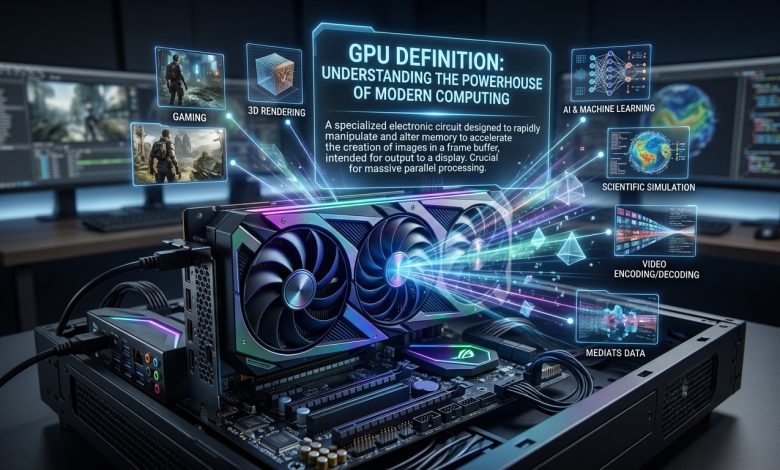
Table of Contents
GPU definition refers to a Graphics Processing Unit, an electronic circuit specifically engineered to accelerate the creation and rendering of digital images and computer graphics. Originally designed to handle the computationally intensive demands of 3D graphics in gaming, the GPU has evolved into a versatile processor capable of performing a wide array of mathematical calculations at high speeds, extending its utility far beyond its initial purpose. Modern GPUs are crucial components in various devices, including video cards, system boards, mobile phones, and personal computers. Their unique design allows them to process many pieces of data simultaneously, making them exceptionally efficient for tasks that involve applying similar mathematical operations to large datasets.
What Exactly is a GPU?
At its core, a Graphics Processing Unit (GPU) is a specialized electronic circuit adept at rapid mathematical calculations, particularly those relevant to graphics rendering, machine learning (ML), and video editing. Unlike a Central Processing Unit (CPU), which is designed for general-purpose tasks and sequential processing, a GPU is built for parallel processing, meaning it can perform multiple operations concurrently. This fundamental architectural difference allows GPUs to break down complex problems into thousands or even millions of smaller, independent tasks and process them all at once, leading to significant increases in processing efficiency for many compute-intensive workloads.
The GPU is often the main component found on graphics cards, which also include other elements such as video RAM (VRAM) for memory, various ports (like HDMI or DisplayPort), and cooling mechanisms. While GPUs are best known for their role in enhancing gaming experiences, their parallel processing capabilities have made them indispensable in creative production, artificial intelligence (AI), scientific simulations, and even cryptocurrency mining.
A Brief History and Evolution of GPUs
The concept of a graphics accelerator began to take shape in the 1980s, but the modern GPU, as we understand it today, truly emerged in the 1990s. Early graphics controllers, known as video display controllers or blitters, had limited internal calculation capabilities, primarily handling basic memory movement operations. The introduction of programmable graphics processors in the late 1990s marked a significant turning point. These early GPUs started to offload specific graphics tasks from the CPU, such as drawing lines and text, and later integrated 3D functionality.
NVIDIA’s GeForce 256, released in 1999, is widely credited with coining the term “GPU” and was marketed as the world’s first GPU. It integrated transformation, clipping, and lighting (T&L) engines, which were previously CPU-intensive tasks, onto the graphics chip. This integration significantly boosted real-time 3D rendering capabilities. Over the subsequent decades, GPUs continued to evolve rapidly, with increasing numbers of processing units and advancements in programmable shader technology. This evolution enabled increasingly realistic graphics and laid the groundwork for the GPU’s expansion into non-graphical applications.
GPU Architecture: The Engine of Parallelism
Understanding GPU architecture is key to grasping its exceptional processing power. Unlike the CPU, which typically features a few powerful, general-purpose cores optimized for sequential, decision-heavy work, a GPU comprises hundreds or even thousands of simpler, specialized cores designed for massively parallel computations. This design allows GPUs to execute thousands of threads simultaneously.
The architecture of a modern GPU can be broadly understood in layers, with the hardware layer forming the foundation. This layer consists of the physical components, including:
- CUDA Cores / Stream Processors: These are the fundamental parallel processing units within NVIDIA (CUDA Cores) and AMD (Stream Processors) GPUs. They execute thousands of threads concurrently, accelerating tasks ranging from AI inference to complex graphics rendering. For instance, NVIDIA’s CUDA cores are small parallel processors that enable the GPU to break down large workloads into thousands of smaller operations and process them simultaneously, which is ideal for tasks that can be split into many similar operations.
- Tensor Cores: Introduced by NVIDIA, Tensor Cores are specialized hardware units designed to accelerate matrix operations, which are central to deep learning workloads. They perform high-throughput tensor computations, such as matrix multiplication and accumulation, at speeds traditional GPU cores cannot match, often using lower-precision formats for efficiency while maintaining accuracy through mixed-precision computing.
- RT Cores: These are dedicated hardware units, particularly in NVIDIA RTX GPUs, that accelerate ray tracing calculations. Ray tracing is a rendering technique that simulates realistic lighting, reflections, and shadows by tracing the path of light rays in a scene, and RT Cores significantly speed up this computationally intensive process.
- Video RAM (VRAM): VRAM serves as the high-speed memory buffer for GPUs, storing textures, datasets, and computational instructions that the GPU can access quickly. The amount and speed of VRAM significantly impact a GPU’s performance, especially when handling complex scenes or large datasets.
- Cache Hierarchy: Similar to CPUs, GPUs employ a cache hierarchy (L1, L2, and shared memory) to optimize data retrieval speeds and minimize latency.
- Memory Bus and Bandwidth: These factors determine the speed and volume of data transfer between the GPU and its VRAM, directly influencing overall performance.
The combination of these components, particularly the sheer number of specialized cores, enables GPUs to handle data-intensive and computationally demanding tasks with remarkable efficiency.
How GPUs Work: Mastering Parallel Processing
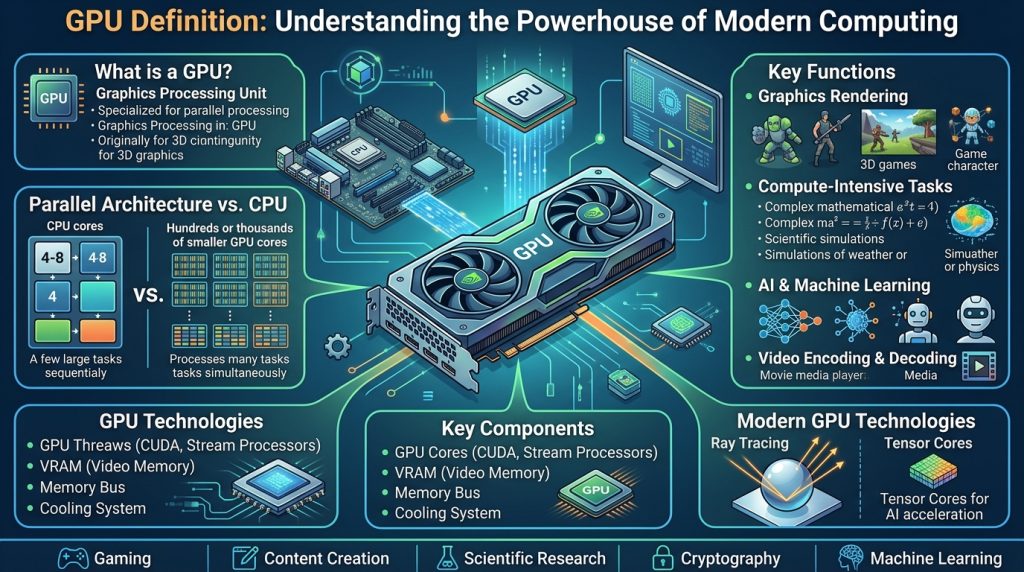
The operational prowess of a GPU lies in its ability to perform parallel processing, a method where many calculations or processes are carried out simultaneously. Unlike a CPU, which processes tasks sequentially, one after another, a GPU divides a large computational problem into thousands or even millions of smaller, independent tasks that can be executed concurrently. This is often referred to as Single Instruction, Multiple Data (SIMD) processing, where the same operation is applied to multiple data points simultaneously.
This parallel architecture makes GPUs incredibly effective for workloads that involve repetitive operations on large datasets. For example, in graphics rendering, each pixel on a screen can be processed independently, allowing numerous GPU cores to render pixels simultaneously, greatly reducing rendering time and enabling smoother, more realistic visuals.
To manage this massive concurrency, modern GPUs organize their cores and threads into hierarchical structures. NVIDIA GPUs, for instance, group CUDA cores into Streaming Multiprocessors (SMs). Each SM contains its own schedulers, caches, and special-function units, and manages groups of threads called “warps”. A warp typically consists of 32 threads that execute the same instruction on different data simultaneously, making it an efficient unit of parallel execution. This hierarchical organization allows the GPU to efficiently schedule and execute a vast number of tasks, keeping its thousands of cores continuously busy.
The interaction between the CPU and GPU is also critical. While the GPU excels at parallel mathematical computations, the CPU handles orchestration, operating system tasks, sequential logic, and data loading. In most production AI systems, both CPU and GPU work in tandem, with the CPU offloading compute-intensive, parallelizable portions of an application to the GPU, leading to significantly faster application performance from the user’s perspective. This synergistic approach ensures that each processor handles the tasks it is best suited for, maximizing overall system efficiency.
Types of GPUs: Integrated, Dedicated, and Hybrid
GPUs come in different forms, each with distinct characteristics and applications:
Wikipedia provides further technical details on GPU types and their historical context.
Integrated GPUs (iGPUs)
Integrated GPUs are built directly into the computer’s CPU or motherboard. They share the system’s main memory (RAM) with the CPU, which makes them a more cost-effective and energy-efficient solution. Integrated GPUs are typically used for lighter graphics tasks, such as web browsing, video playback, and casual gaming. While they offer sufficient performance for everyday computing, their shared memory and limited processing power make them less suitable for graphically demanding applications, such as high-end gaming or professional content creation. Most PCs today, particularly laptops and budget-friendly desktops, feature integrated processors with a combined CPU and GPU.
Dedicated (Discrete) GPUs (dGPUs)
Dedicated GPUs are separate hardware components that come on their own expansion cards, typically referred to as graphics cards or video cards. These GPUs have their own dedicated high-speed video memory (VRAM), which provides faster data access and does not contend with the CPU for system RAM. Dedicated GPUs are significantly more powerful than integrated GPUs, featuring a larger number of processing cores and higher clock speeds. They are designed for heavy graphics tasks, including high-resolution gaming, professional video editing, 3D rendering, and complex scientific simulations. The presence of a discrete GPU allows for superior performance and visual fidelity in applications that demand extensive graphical processing power.
Hybrid GPU Setups
Some systems, particularly laptops, employ a hybrid GPU setup that combines both an integrated GPU and a dedicated GPU. In such configurations, the integrated GPU handles less demanding graphical tasks to conserve power and extend battery life. When more graphical power is needed, such as when launching a game or a demanding professional application, the system automatically switches to the more powerful dedicated GPU. This dynamic switching allows for an optimal balance between performance and power efficiency. This approach provides the flexibility of a dedicated GPU for intensive workloads while retaining the energy efficiency of an integrated GPU for lighter use.
Key Components of a Modern GPU
Beyond the core processing units like CUDA Cores and Tensor Cores, a GPU is a complex piece of hardware composed of several critical components that work in concert to deliver its performance:
| Component | Description | Primary Function |
|---|---|---|
| Graphics Processing Unit (GPU) Die | The central silicon chip containing all the processing cores (CUDA, Tensor, RT) and logic circuits. | Performs all graphical and general-purpose computations. |
| Video Memory (VRAM) | High-speed memory (e.g., GDDR6, HBM2/3) dedicated to the GPU. | Stores textures, frame buffers, and other data for quick access by the GPU. |
| Memory Controller | Manages data flow between the GPU die and VRAM. | Ensures efficient and high-bandwidth data transfer to and from VRAM. |
| Memory Bus | The data pathway connecting the GPU to its VRAM. | Determines the amount of data that can be transferred per clock cycle, impacting bandwidth. |
| Power Delivery System (VRM) | Voltage Regulator Module, responsible for providing stable and consistent power to the GPU. | Ensures the GPU receives the necessary power at the correct voltage, crucial for stability and overclocking. |
| Cooling Solution | Heat sinks, fans, and sometimes liquid cooling systems. | Dissipates the significant heat generated by the GPU during operation to prevent overheating and maintain performance. |
| PCIe Interface | PCI Express slot connector. | The physical interface through which the graphics card connects to the motherboard, enabling communication with the CPU and other system components. |
| Display Outputs | Ports like HDMI, DisplayPort, DVI, or USB-C. | Connects the graphics card to monitors or other display devices. |
| Video BIOS (VBIOS) | Firmware containing instructions for the GPU. | Initializes the graphics card and provides basic operational settings. |
These components are carefully engineered and integrated to work together, maximizing the GPU’s computational throughput and ensuring efficient operation under demanding workloads. Advancements in semiconductor manufacturing have enabled GPUs to pack more transistors and processing units while simultaneously optimizing power consumption, leading to more powerful and energy-efficient designs.
Applications Beyond Graphics: The Rise of GPGPU
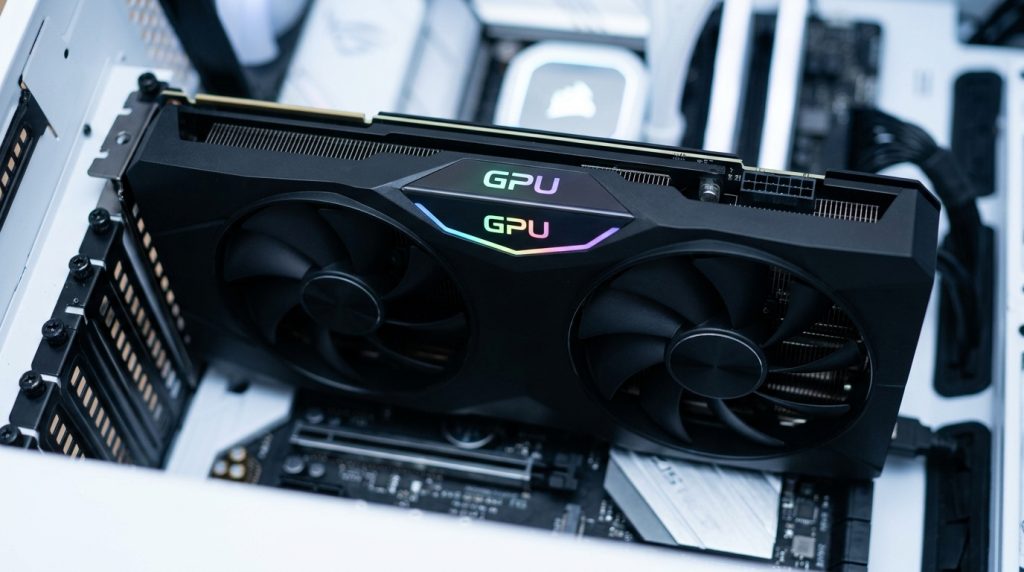
While GPUs were initially developed to accelerate graphics rendering, their highly parallel architecture proved to be exceptionally well-suited for a broader range of computational problems. This realization led to the emergence of General-Purpose computing on Graphics Processing Units, or GPGPU, a cutting-edge technology that leverages GPUs for tasks traditionally handled by the Central Processing Unit (CPU).
The benefits of GPGPU technology are vast, primarily stemming from its enhanced computational speed and efficiency for parallel tasks. By offloading compute-intensive portions of an application to the GPU, while the remainder of the code still runs on the CPU, applications can run significantly faster. This capability has transformed numerous fields:
- Machine Learning and Artificial Intelligence: GPUs are the workhorses of modern AI, essential for training neural networks and performing machine learning inferences. Their ability to process massive datasets and perform complex matrix multiplications in parallel makes them ideal for tasks like image recognition, natural language processing, and autonomous driving. Specialized cores like NVIDIA’s Tensor Cores are specifically designed to accelerate these AI workloads.
- Scientific Simulations: From molecular dynamics and climate modeling to astrophysics and fluid dynamics, GPUs accelerate complex scientific simulations that require vast numbers of calculations. This allows researchers to model intricate systems with greater speed and accuracy.
- Data Analytics: GPGPUs play a vital role in processing large datasets for real-time analytics, risk analysis, and algorithmic trading in finance. Their parallel processing capabilities enable quicker insights into market trends and financial risks.
- Video Processing and Content Creation: Beyond gaming graphics, GPUs are pivotal in advanced video editing, 3D rendering, and virtual reality (VR) applications, providing real-time processing capabilities for content creators. This includes tasks like rendering, encoding, and special effects.
- Cryptocurrency Mining: GPUs were initially favored for cryptocurrency mining due to their efficiency in solving the complex cryptographic puzzles that underpin blockchain transactions.
- Medical Imaging and Diagnostics: In the medical field, GPGPUs significantly accelerate the processing of medical images such as MRI and CT scans, enabling faster and more accurate diagnostics.
The paradigm shift towards GPGPU has made GPUs not just graphics accelerators but central processing hubs for a wide range of computationally demanding applications, often achieving speedups of several orders of magnitude compared to optimized multi-core CPU implementations.
The Future of GPU Technology
The trajectory of GPU technology points towards continuous innovation, driven by the escalating demands of AI, high-performance computing, and increasingly immersive digital experiences. Several key trends are expected to shape the next generation of GPUs:
- Increased Computational Power and Efficiency: Future GPUs are anticipated to deliver even higher performance, pushing the boundaries of computational capabilities through advancements in architecture and processing power. There will be a continued focus on optimizing power consumption, leading to more energy-efficient GPUs that offer better performance per watt, which is crucial for reducing the carbon footprint of AI and high-performance computing.
- Enhanced AI Integration and Specialization: As AI models become more complex and pervasive, future GPUs will feature greater integration of AI-specific hardware. This includes more powerful Tensor Cores and dedicated inference accelerators, optimized for lightning-fast machine learning computations. We may see GPUs designed specifically for AI-centric tasks, potentially evolving into central processing hubs for AI systems.
- Advancements in Ray Tracing: Ray tracing technology, which simulates realistic lighting, reflections, and shadows, will continue to evolve. Future GPUs are expected to offer enhanced ray tracing capabilities, enabling hyper-realistic graphics in gaming, cinema, and especially in virtual reality (VR) and augmented reality (AR) applications. These advancements will redefine user experiences by integrating real-time ray tracing with other immersive technologies.
- Heterogeneous Architectures and Edge Computing: The shift towards heterogeneous computing models, where CPUs and GPUs work even more seamlessly together, is expected to accelerate. Future GPUs may feature more processing cores on a single chip, allowing for more efficient task allocation. Furthermore, GPUs will play a key role in the rise of edge AI, enabling real-time AI inference closer to where data is generated, in devices ranging from smartphones to smart appliances.
- Integration with Emerging Technologies: GPUs are also expected to integrate with other burgeoning technologies. Their parallel processing capabilities make them fundamental to blockchain technology, and future GPUs could be optimized for faster transaction verifications and enhanced security protocols at reduced energy costs. While still nascent, the potential for GPU integration with quantum computing could unlock entirely new paradigms of computational power.
The continuous innovation in GPUs is set to transform not only computing but also various aspects of daily life and global infrastructure. They will remain central to accelerating model training, enhancing real-time inference, and driving technological innovation across diverse industries.
Conclusion
The Graphics Processing Unit (GPU) has evolved from a specialized component for rendering computer graphics into a versatile and indispensable powerhouse of modern computing. Its unique parallel processing architecture, characterized by thousands of specialized cores, enables it to tackle computationally intensive tasks far more efficiently than traditional CPUs. From revolutionizing gaming visuals with technologies like ray tracing to fueling the rapid advancements in artificial intelligence, scientific research, and data analytics through GPGPU, the GPU’s impact is profound and ever-expanding. As technology continues to push the boundaries of computational demand, the ongoing innovation in GPU architecture, efficiency, and specialized functionalities promises to unlock even more groundbreaking applications, cementing its role as a critical driver of future technological progress.