V100 GPU Benchmarks: Powerful AI Training and HPC Workloads Performance Analysis
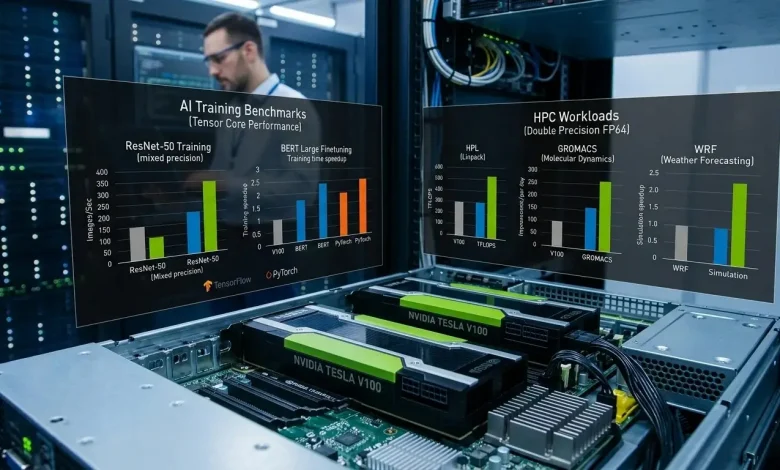
Table of Contents
V100 GPU benchmarks for AI training and HPC workloads have long served as a critical barometer for performance in high-demand computational environments. Introduced by NVIDIA in 2017, the Tesla V100, based on the Volta architecture, marked a significant leap forward in GPU technology, especially with the introduction of Tensor Cores. These specialized processing units were designed to accelerate mixed-precision matrix arithmetic, which is fundamental to deep learning and certain scientific computing tasks. The V100 quickly became a cornerstone in data centers, research institutions, and cloud platforms, powering some of the most complex AI models and scientific simulations globally. Its robust performance characteristics established a new standard, making it an indispensable tool for researchers and developers pushing the boundaries of artificial intelligence and high-performance computing.
Introduction to the NVIDIA V100 GPU
The NVIDIA V100 GPU, part of the Tesla family, emerged as a game-changer in the landscape of accelerated computing upon its release. Built on the 12nm FinFET manufacturing process, it packed an unprecedented number of transistors, delivering immense raw computational power. Its design was meticulously crafted to address the escalating demands of deep learning frameworks and complex scientific simulations, offering a blend of high memory bandwidth, substantial processing cores, and innovative architectural features. The V100’s impact was immediate, providing capabilities that were previously unattainable for many organizations, thus accelerating discovery and innovation across various fields. It effectively democratized access to extreme computational power, moving advanced AI and HPC from niche academic pursuits to mainstream industrial applications.
The Revolutionary Volta Architecture and V100’s Key Features
At the heart of the V100’s prowess lies the NVIDIA Volta architecture. This architecture represented a monumental shift, primarily due to the integration of Tensor Cores. These new processing units were specifically engineered to perform mixed-precision calculations, which are highly efficient for deep learning. Each Tensor Core can perform 64 FMA (Fused Multiply-Add) operations per clock for FP16 inputs and FP32 outputs, significantly boosting throughput for matrix operations crucial to neural network training. Beyond Tensor Cores, the V100 featured a substantial number of traditional CUDA Cores—5,120 FP32 CUDA Cores and 2,560 FP64 CUDA Cores—enabling strong performance across a wide array of general-purpose GPU computing tasks. The GPU also boasted up to 32GB of HBM2 memory, providing 900 GB/s of memory bandwidth, which is essential for data-intensive applications. Furthermore, the introduction of NVIDIA NVLink technology dramatically increased the GPU-to-GPU communication bandwidth, allowing for scalable multi-GPU configurations that could act as a single, powerful computing unit, overcoming traditional PCIe bottlenecks. This comprehensive suite of features ensured the V100 could tackle the most demanding AI and HPC workloads with unparalleled efficiency and speed.
V100 for AI Training: Deep Learning Performance V100 GPU Benchmarks
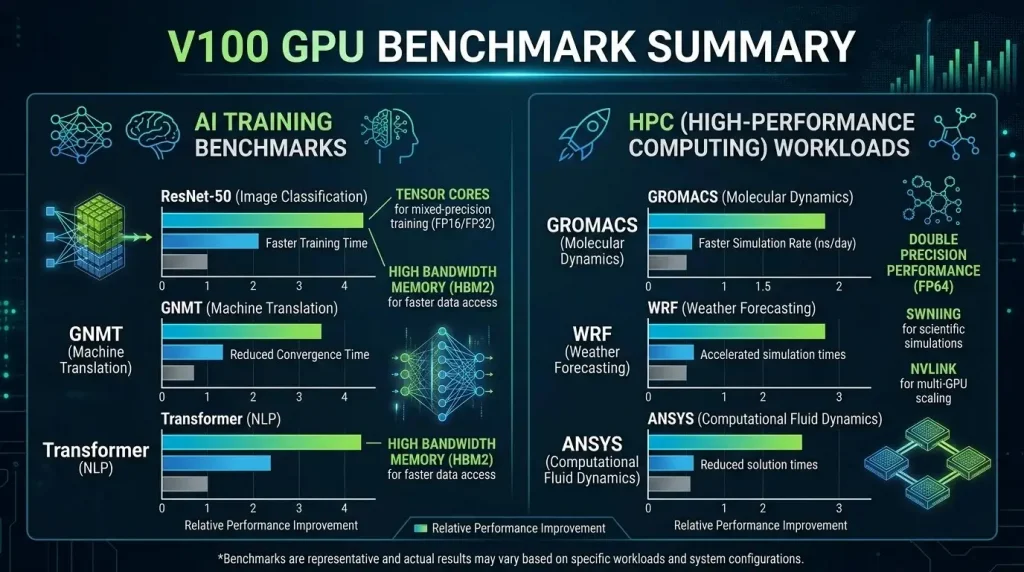
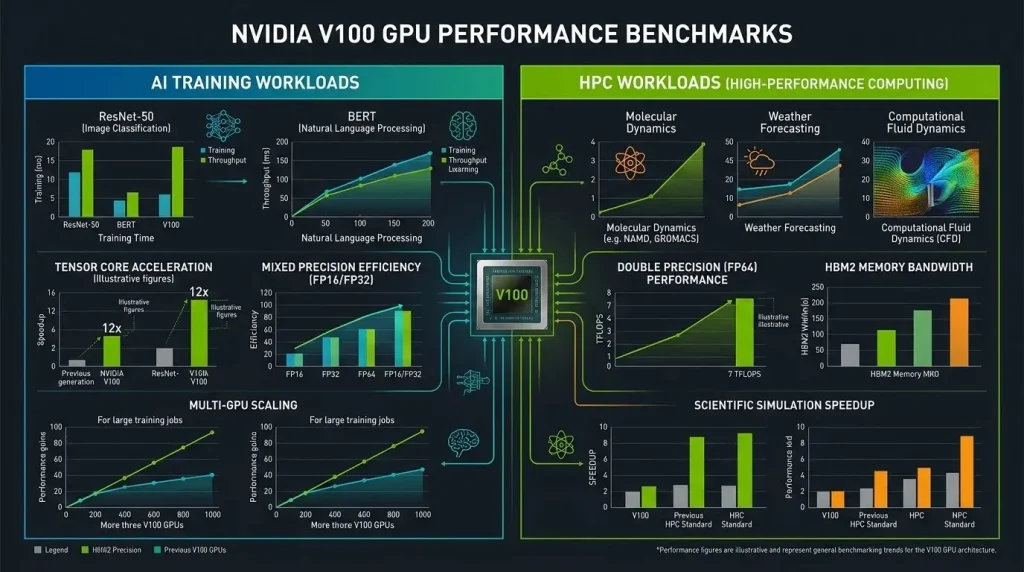
For AI training, particularly in deep learning, the V100’s performance benchmarks showcased its exceptional capabilities. The Tensor Cores proved instrumental in accelerating model training times for various neural network architectures, including Convolutional Neural Networks (CNNs), Recurrent Neural Networks (RNNs), and Transformers. Benchmarks often compared the V100 against previous generation GPUs, such as the Pascal-based P100, demonstrating speedups of 5x to 15x or even more in specific deep learning tasks. For instance, training complex image classification models like ResNet-50 or object detection models like Mask R-CNN saw substantial reductions in training time. The V100’s ability to utilize mixed-precision training (FP16 for computations, FP32 for accumulation and weights) was a critical factor in these gains, as it allowed for faster computations with minimal loss in model accuracy. Frameworks like TensorFlow, PyTorch, and MXNet quickly optimized their operations to leverage Tensor Cores, solidifying the V100’s position as the go-to accelerator for AI research and development. In language models, where large matrix multiplications are ubiquitous, the V100 provided a significant boost, enabling the training of larger and more complex models in reasonable timeframes, thus driving advancements in natural language processing.
V100 for HPC Workloads: Scientific Computing and Simulation Insights
Beyond AI, the V100 also delivered impressive performance for High-Performance Computing (HPC) workloads. Its extensive FP64 (double-precision floating-point) capabilities, with 2,560 FP64 CUDA Cores, made it highly suitable for scientific simulations that require high precision, such as molecular dynamics, weather forecasting, seismic imaging, and quantum chemistry. Benchmarks across these domains consistently showed significant speedups compared to CPU-only systems or even older GPU generations. For example, in molecular dynamics simulations using software like AMBER or NAMD, the V100 could process millions of atoms with unprecedented speed, drastically reducing the time required for complex simulations. Similarly, in fields like computational fluid dynamics (CFD) or finite element analysis (FEA), the V100’s parallel processing power and high memory bandwidth allowed for the handling of larger datasets and more intricate models, yielding faster convergence and more detailed results. The NVLink interconnect also played a crucial role in scaling HPC applications across multiple GPUs, allowing researchers to tackle problems of immense scale by pooling computational resources effectively. The V100’s balanced architecture, combining high FP32 and FP64 throughput with ample memory and fast interconnects, made it a versatile powerhouse for a broad spectrum of scientific and engineering challenges.
| Feature | NVIDIA Tesla V100 | NVIDIA A100 (for context) |
|---|---|---|
| Architecture | Volta | Ampere |
| Process Technology | 12 nm | 7 nm |
| Transistors | 21.1 Billion | 54.2 Billion |
| CUDA Cores | 5,120 (FP32) / 2,560 (FP64) | 6,912 (FP32) / 3,456 (FP64) |
| Tensor Cores | 640 | 432 (3rd Gen) |
| FP32 Performance | 15.7 TFLOPS | 19.5 TFLOPS |
| FP64 Performance | 7.8 TFLOPS | 9.7 TFLOPS |
| Tensor Performance (FP16) | 125 TFLOPS | 312 TFLOPS (with TF32) / 624 TFLOPS (FP16) |
| Memory | 16GB or 32GB HBM2 | 40GB or 80GB HBM2e |
| Memory Bandwidth | 900 GB/s | 1.5 TB/s or 2 TB/s |
| NVLink Bandwidth | 300 GB/s | 600 GB/s |
Comparative Analysis: V100 Against Contemporary and Successor GPUs
While the V100 was revolutionary in its time, the rapid pace of GPU innovation means it has been succeeded by newer architectures, most notably NVIDIA’s Ampere (A100) and Hopper (H100) GPUs. A comparative analysis highlights the V100’s enduring value while also showcasing the advancements made. Against its contemporaries from AMD or Intel during its prime, the V100 generally held a significant lead, particularly in AI workloads, largely due to its dedicated Tensor Cores. When compared to its successor, the A100, the improvements are stark. The A100, introduced in 2020, delivered up to 20x higher performance for certain AI workloads and up to 2.5x higher performance for HPC workloads compared to the V100. This was achieved through a combination of increased CUDA and Tensor Cores, a more advanced 7nm manufacturing process, larger and faster HBM2e memory, and an even more powerful third-generation NVLink interconnect. The A100 also introduced new Tensor Float 32 (TF32) precision, offering FP32 range with FP16 performance for AI, further differentiating it. However, the V100 remains a highly capable and cost-effective solution for many applications, particularly those that do not require the absolute bleeding edge of performance or that are limited by budget considerations. Its robust software ecosystem and proven track record ensure its continued relevance in many data centers. For a broader understanding of NVIDIA’s GPU advancements, one can refer to the Wikipedia page on NVIDIA Graphics Processing Units.
Optimizing V100 Performance for Peak Efficiency
Achieving peak performance with the V100 GPU requires careful optimization at several levels, from software configuration to code development practices. One of the most significant optimization strategies for AI training involves leveraging mixed-precision computing. By training neural networks using FP16 data types for activations and weights, while maintaining FP32 for certain critical operations like weight accumulation, developers can significantly accelerate training without sacrificing accuracy. NVIDIA’s Automatic Mixed Precision (AMP) feature in deep learning frameworks automates this process, making it easier for practitioners to harness Tensor Core power. For HPC applications, optimizing CUDA kernels is paramount. This involves carefully managing memory access patterns to maximize memory bandwidth utilization, minimizing data transfers between host and device, and ensuring proper thread block and grid configurations to fully utilize the GPU’s streaming multiprocessors (SMs). Using libraries like cuBLAS, cuFFT, and cuDNN, which are highly optimized for NVIDIA GPUs, can provide substantial performance gains. Furthermore, in multi-GPU setups, optimizing communication using NVLink for direct peer-to-peer transfers reduces latency and increases throughput, which is crucial for distributed training and large-scale simulations. Profiling tools such as NVIDIA Nsight Systems and Nsight Compute are indispensable for identifying performance bottlenecks and guiding optimization efforts. Regular updates to CUDA Toolkit and GPU drivers also ensure access to the latest optimizations and bug fixes, further enhancing performance and stability.
The Enduring Legacy and Future Relevance of the V100
The NVIDIA V100 GPU has left an indelible mark on the fields of AI and HPC, establishing itself as a foundational technology that propelled numerous breakthroughs. Its introduction of Tensor Cores fundamentally changed how deep learning models are trained, making complex architectures feasible and accelerating the pace of AI research. For HPC, it provided a versatile and powerful platform that enabled scientists and engineers to tackle grand challenges with unprecedented computational speed. While newer generations like Ampere and Hopper have surpassed the V100 in raw performance, the V100’s legacy endures. Many data centers and cloud providers continue to operate V100 instances, offering a robust and cost-effective solution for a wide range of AI and HPC tasks. It remains a workhorse for many academic institutions and smaller enterprises, providing ample power for significant research and development efforts. Its widespread adoption also built a strong software ecosystem, with extensive documentation, community support, and optimized libraries, which continues to benefit users of all NVIDIA GPUs. The V100’s contribution to democratizing access to high-performance computing and accelerating the AI revolution is undeniable, solidifying its place as a landmark product in the history of GPU technology.
Conclusion
The NVIDIA V100 GPU set a benchmark for accelerated computing, fundamentally transforming capabilities in AI training and HPC workloads. Its innovative Volta architecture, characterized by the groundbreaking introduction of Tensor Cores, delivered unparalleled performance gains for deep learning, while its robust FP64 capabilities and high memory bandwidth made it indispensable for scientific simulations. Although newer generations like the A100 and H100 have since pushed the boundaries of computational power, the V100’s impact remains profound. It continues to be a highly capable and widely used accelerator, providing a powerful platform for numerous applications across diverse sectors. Its legacy is not just in its raw performance figures, but in how it catalyzed an era of rapid advancements in artificial intelligence and high-performance computing, making once-unimaginable computational feats a reality. The V100 stands as a testament to engineering innovation, having laid crucial groundwork for the accelerated computing landscape we see today and for future developments yet to come.