GPU 3060 Gaming Benchmarks and Performance Review: 10 Real Insights for Smooth Gameplay

Table of Contents
GPU 3060 The GPU 3060, a prominent mid-range graphics card from NVIDIA’s Ampere generation, continues to be a highly relevant option for gamers in 2026, even several years after its initial launch in January 2021. Originally positioned as a strong contender for 1080p gaming and a capable performer at 1440p, its enduring popularity is evident from its status as the most widely used graphics card on the Steam platform. This comprehensive review delves into the gaming benchmarks and performance of the RTX 3060, examining its capabilities in modern titles, its architectural strengths, and its current standing in a rapidly evolving market. With NVIDIA reportedly bringing back the RTX 3060 12GB to address supply issues and a renewed focus on its value, understanding its performance nuances is more important than ever.
Introduction to the GPU 3060
The NVIDIA GeForce RTX 3060 entered the market as part of the highly anticipated Ampere lineup, succeeding the Turing architecture found in the RTX 20 series. Built on Samsung’s 8nm process, the RTX 3060 utilizes the GA106 GPU, offering a significant increase in transistor count and CUDA cores compared to its predecessors. It was designed to bring the benefits of NVIDIA’s second-generation RT Cores and third-generation Tensor Cores to a more accessible price point, democratizing features like real-time ray tracing and DLSS (Deep Learning Super Sampling) for a broader audience. This card quickly established itself as a go-to choice for gamers seeking a balance of performance and affordability, particularly for those targeting smooth gameplay at 1080p resolution. Its generous 12GB of GDDR6 VRAM, connected via a 192-bit memory interface, was a notable feature at launch, providing ample headroom for texture-heavy modern games, even surpassing the VRAM capacity of some higher-tier cards from its own generation at the time.
Key Specifications and Architecture
The NVIDIA RTX 3060 is powered by the GA106 graphics processor, featuring 3,584 CUDA cores, 112 Tensor Cores, and 28 RT Cores. This configuration allows the card to deliver a theoretical FP32 performance of 12.74 TFLOPS. The Ampere architecture itself introduced several groundbreaking innovations, including enhanced RT Cores that allow for concurrent ray tracing, shading, and compute operations, and improved Tensor Cores with support for new precisions like Tensor Float 32 (TF32). These architectural improvements are crucial for the RTX 3060’s ability to handle complex graphical workloads, especially those involving ray tracing and AI-driven upscaling technologies like DLSS. The 12GB of GDDR6 memory, operating on a 192-bit bus at 15 Gbps effective speed, provides a memory bandwidth of 360 GB/s. This substantial VRAM capacity, while somewhat unusual for a card in its performance tier, has proven beneficial as game asset sizes continue to grow, offering a degree of future-proofing that some contemporary cards with less memory might lack. The card’s boost clock typically reaches 1777 MHz, though real-world clocks often run higher under optimal conditions.
Gaming Performance at 1080p
For 1080p gaming, the RTX 3060 continues to deliver a highly satisfying experience in 2026, often achieving smooth frame rates at high to ultra settings in many modern titles. Many benchmarks from late 2024 and early 2026 indicate that the RTX 3060 can still push well over 60 FPS in popular games. For instance, in “Marvel’s Spider-Man Miles Morales,” the RTX 3060 at 1080p with very high settings can achieve an average of 85 FPS, with 1% lows at 61 FPS. Similarly, in “Uncharted: The Lost Legacy” and “Horizon Zero Dawn” at ultra quality presets and 1080p, the card delivers around 85 FPS and 81 FPS respectively. Even in more demanding titles like “Cyberpunk 2077,” the RTX 3060 can achieve playable frame rates, especially when DLSS is enabled. Without DLSS, some newer, poorly optimized games, particularly those built on Unreal Engine 5, might struggle to maintain a consistent 60+ FPS at ultra settings, often requiring a drop to medium settings to ensure smoother gameplay. However, with DLSS enabled, the card can frequently push frame rates into the 70-90+ FPS range even in these demanding scenarios, highlighting the importance of NVIDIA’s upscaling technology for extending the card’s lifespan in 1080p gaming. Esports titles like “Counter-Strike 2” and “Valorant” run exceptionally well, with the RTX 3060 easily providing high refresh rate experiences, often exceeding 100 FPS.
Gaming Performance at 1440p
While the RTX 3060 shines at 1080p, its performance at 1440p (2560×1440) is more of a mixed bag, yet still generally capable for many titles, especially with the assistance of DLSS. For less demanding games or those with good optimization, the RTX 3060 can provide a solid 1440p experience at high settings. However, in graphically intensive AAA games at 1440p with ultra settings, users might need to temper expectations or rely heavily on DLSS to maintain desirable frame rates. For example, in titles like “Watch Dogs Legion” at 1440p, native resolution only yields around 62 FPS, but enabling DLSS Quality can boost this to 81 FPS. Without DLSS, ray tracing at 1440p can significantly reduce frame rates, sometimes making games unplayable, dropping well below 40 FPS in demanding scenarios. This underscores the RTX 3060’s positioning as a card that can do 1440p, but often requires compromise on settings or leveraging NVIDIA’s smart upscaling. Compared to its predecessor, the RTX 2060 Super, the RTX 3060 shows a more significant performance uplift at 1440p, sometimes being 17% faster. Against AMD’s RX 6600 XT, the RTX 3060 can sometimes slightly outperform it at 1440p, especially in NVIDIA-favored or sponsored titles. However, in some DirectX 12 and Vulkan API games, the RX 6600 XT can be faster at 1440p for general gaming.
Comparative Gaming Benchmarks (Average FPS at 1080p / High Settings)
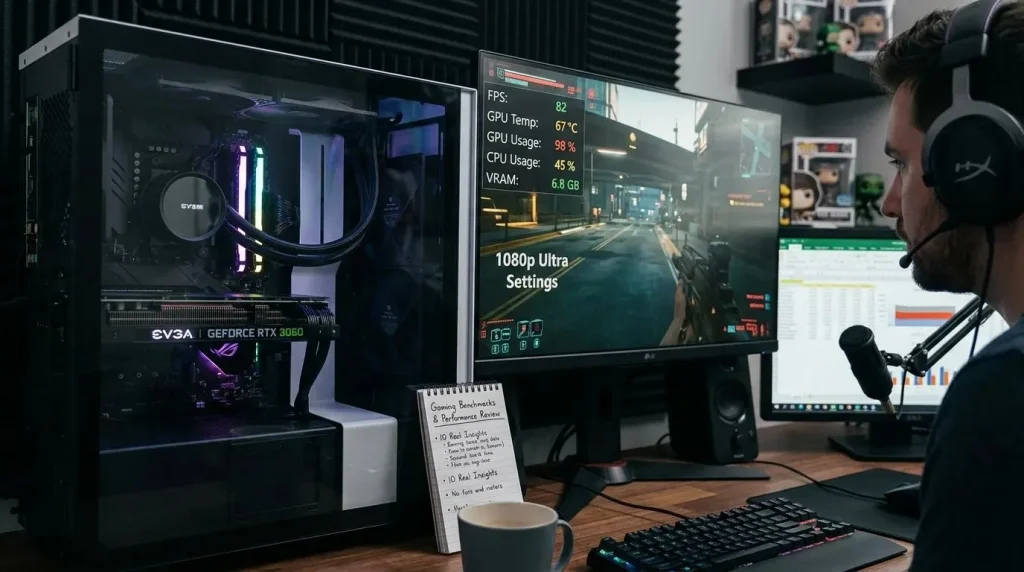
To provide a clearer picture of the RTX 3060’s standing, let’s examine its performance against some key competitors and its immediate predecessor in a selection of popular titles. These figures represent average frame rates and can vary based on specific game settings, CPU, and system configuration.
| Game Title | RTX 3060 (12GB) | RTX 2060 Super (8GB) | RX 6600 XT (8GB) |
|---|---|---|---|
| Cyberpunk 2077 | 41 FPS | 36 FPS | ~35-40 FPS (without RT) |
| Red Dead Redemption 2 | 63 FPS | 57 FPS | ~60-65 FPS |
| Days Gone | 86 FPS | 76 FPS | N/A |
| Marvel’s Spider-Man Remastered | 99 FPS | ~87 FPS (estimate based on 2060 Super performance) | N/A |
| Horizon Zero Dawn | 81 FPS | N/A | N/A |
| Warzone | 190 FPS | N/A | N/A |
| Apex Legends | 190 FPS | N/A | ~130 FPS |
| Hogwarts Legacy | 70 FPS (1080p, Ultra) | N/A | N/A |
Ray Tracing and DLSS Capabilities
One of the RTX 3060’s defining features is its support for real-time ray tracing and DLSS, thanks to its second-generation RT Cores and third-generation Tensor Cores. While the RTX 3060 is capable of ray tracing, it often requires the assistance of DLSS to achieve playable frame rates, especially at higher resolutions or with demanding ray tracing effects enabled. In ray-tracing heavy titles like “Control” at 1440p with all RT features enabled, the RTX 3060 might only manage around 29 FPS natively. However, activating DLSS can significantly boost these numbers, bringing the experience closer to 60 FPS. The RTX 3060 generally outperforms the RTX 2060 in ray tracing workloads, sometimes by up to 26% more efficiently, due to the architectural improvements in Ampere’s RT Cores. Compared to AMD’s RX 6000 series, which was their first attempt at ray tracing, the RTX 3060 typically offers superior ray tracing performance, with AMD cards often lagging due to their first-generation RT technology. The continuous evolution of DLSS, with versions like DLSS 4 and even DLSS 4.5, further enhances the RTX 3060’s longevity, providing better image quality and performance balance, particularly in newer, more demanding titles. DLSS 4.5, for instance, offers noticeably better image quality but might come with a slight performance hit compared to DLSS 4, making DLSS 4 a preferred choice for mid-range GPUs seeking a balance.
Power Consumption and Thermals
The NVIDIA GeForce RTX 3060 has a Total Graphics Power (TGP) of 170W, making it one of the more power-efficient cards in its performance class, especially within the Ampere family. This relatively low power draw means it typically requires a single 8-pin power connector, and a good quality 550W-650W power supply unit (PSU) is generally recommended for a full system build, allowing for sufficient headroom and mitigating issues from transient power spikes. In terms of thermals, the RTX 3060 generally operates at reasonable temperatures. In tests, the GPU core temperature can hover around 64-65°C under load, such as during a “Metro Exodus” benchmark. Custom AIB (Add-in Board) models with larger heatsinks and multiple fans often provide excellent cooling performance, keeping noise levels in check. However, smaller or more compact RTX 3060 variants might run with higher fan speeds, resulting in more noticeable noise, particularly when overclocked. The moderate power requirements also contribute to its suitability for a wider range of PC cases, including smaller form factor builds.
Value Proposition and Market Standing
The RTX 3060’s value proposition in 2026 is complex but generally positive, especially for budget-conscious gamers targeting 1080p and capable 1440p gaming. Despite being a few years old, its 12GB of VRAM and support for DLSS and ray tracing keep it competitive. Its original MSRP was $329, though market prices have fluctuated significantly. As of June 2026, NVIDIA has reportedly begun re-introducing the RTX 3060 12GB to the market at around $350, recognizing its continued demand and a desire to fill gaps in supply. This move highlights its enduring popularity, cemented by its status as the most used GPU in the Steam survey. When considering alternatives, newer cards like the RTX 4060 exist, but the RTX 3060’s 12GB VRAM can be a significant marketing and practical advantage over the 8GB of the RTX 4060, particularly as games become more VRAM intensive. Compared to AMD’s offerings like the RX 6600 XT, the RTX 3060 offers a strong alternative, often with superior ray tracing and DLSS capabilities, though the RX 6600 XT might have an edge in raw rasterization in some titles. Ultimately, for gamers looking for a solid 1080p experience and the ability to dabble in 1440p and ray tracing with DLSS, the RTX 3060 remains a compelling choice, offering a strong price-to-performance ratio, especially if found at a reasonable price point. Its longevity is further extended by continuous driver updates and the evolution of DLSS technology. For those interested in a deeper dive into the technical evolution of GPU architectures and their impact on performance, Wikipedia’s article on the Ampere microarchitecture provides a comprehensive overview of the underlying technology that powers the RTX 3060.
Conclusion
The NVIDIA GeForce RTX 3060, even in 2026, continues to stand as a formidable mid-range graphics card, offering a compelling blend of performance, features, and value for mainstream gamers. Its robust Ampere architecture, coupled with 12GB of GDDR6 VRAM, ensures excellent performance at 1080p in virtually all modern titles, often allowing for high to ultra settings. While 1440p gaming with the RTX 3060 may necessitate some graphical compromises or a reliance on DLSS, the card is still capable of delivering enjoyable experiences. Its support for NVIDIA’s ray tracing and DLSS technologies remains a significant advantage, effectively extending its lifespan in a market increasingly focused on advanced visual fidelity. With NVIDIA’s decision to re-introduce the 12GB variant, the RTX 3060’s presence in the market is reinforced, offering a proven solution for gamers seeking a reliable and feature-rich GPU without breaking the bank. For those prioritizing a smooth 1080p gaming experience, with ample VRAM for future titles and access to advanced upscaling, the RTX 3060 remains a highly recommended option.