10 Best GPU for Deep Learning: Top Cards for AI Training Models
Table of Contents
GPU for Deep Learning has become the cornerstone of advancing artificial intelligence, driving innovation across various sectors from natural language processing to computer vision and scientific research. In 2026, as AI models grow exponentially in size and complexity, the demand for powerful and efficient Graphics Processing Units (GPUs) for training these intricate models has never been higher. Selecting the right GPU is a pivotal decision for researchers, startups, and enterprises, directly impacting the speed, accuracy, and scalability of AI training outcomes. Modern GPUs are engineered with specialized architectures, high-bandwidth memory, and advanced processing units designed to handle the massive parallel processing and high data throughput required by today’s state-of-the-art AI workloads.
Why GPUs are Essential for Deep Learning
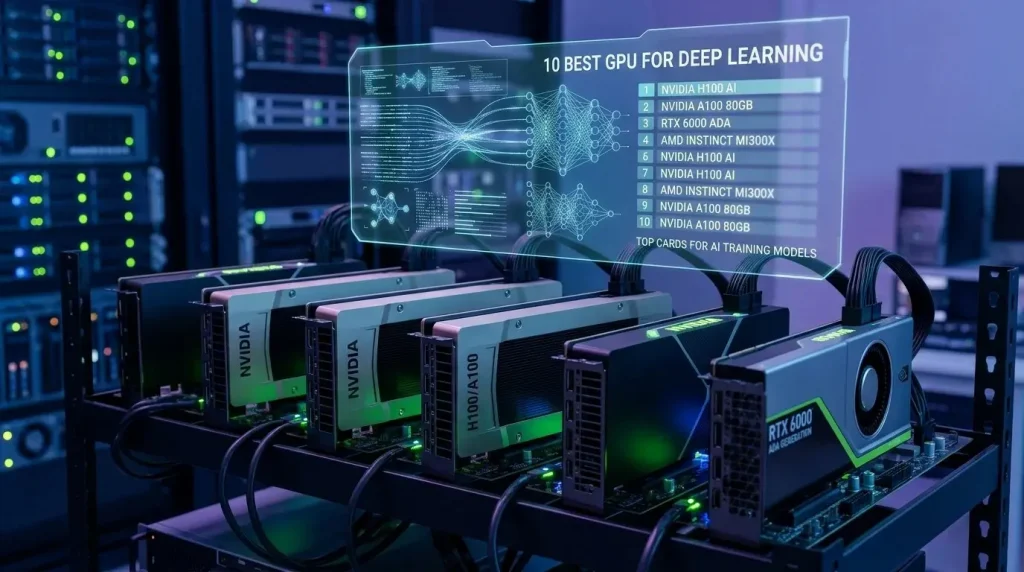
The unparalleled computational demands of deep learning algorithms necessitate hardware capable of performing billions of calculations per second efficiently. Traditional Central Processing Units (CPUs), while versatile, are designed for sequential processing and struggle with the highly parallel nature of neural network computations. This is where GPUs excel. GPUs possess thousands of smaller, specialized cores that can execute numerous calculations simultaneously, a paradigm known as parallel processing. This architecture is perfectly suited for matrix multiplication and convolution operations, which are the fundamental building blocks of neural networks.
The scale of AI models in 2026 has grown exponentially, with billion-parameter language models and multi-modal architectures now commonplace. These advancements push the limits of hardware, requiring a GPU for AI training that can handle massive parallel processing and high data throughput. Modern GPUs offer specialized tensor cores, high-bandwidth memory, and support for advanced floating-point operations. According to AI model complexity and GPU demands statistics 2026, state-of-the-art GPUs can reduce training times by up to 60% compared to previous generations, enabling faster breakthroughs in model accuracy and speed.
Key GPU Specifications for AI Training
When evaluating GPUs for deep learning, several key specifications dictate their suitability and performance for AI training tasks. Understanding these metrics is crucial for making an informed decision.
CUDA Cores and Stream Processors
For NVIDIA GPUs, CUDA Cores are fundamental. These are the parallel processing units that perform the general-purpose computations required by deep learning algorithms. The more CUDA Cores a GPU has, the more parallel tasks it can execute simultaneously, leading to faster training times. While NVIDIA’s CUDA architecture dominates the deep learning landscape, AMD GPUs utilize “Stream Processors” that serve a similar function, though their architecture and ecosystem (ROCm) differ. The sheer number of these processing units is a primary indicator of raw computational power for deep learning.
VRAM (Video Random Access Memory)
VRAM is arguably the most critical specification for deep learning. It refers to the dedicated memory on the GPU, used to store model weights, gradients, optimizer states, activations, and the KV cache during training and inference. As AI models become larger, their memory footprint grows significantly. Running out of VRAM can lead to “Out of Memory” (OOM) errors, forcing models to offload data to slower system RAM or failing the training process altogether. For instance, a 7B parameter model in FP16 precision requires approximately 14GB just for its weights, but the total VRAM needed for training can easily exceed 80GB, depending on the configuration and optimizer used.
The KV cache, in particular, can be a significant VRAM consumer, scaling linearly with both context length and batch size. For a Llama 3.1 70B model with a 128K context, the KV cache alone can consume around 40 GB, meaning multiple concurrent requests can quickly exhaust even high-capacity GPUs.
Memory Bandwidth
Memory bandwidth measures how quickly the GPU can access its VRAM. High-bandwidth memory (HBM, HBM2e, HBM3) is crucial for deep learning workloads because large datasets and complex models constantly transfer data between the processing units and memory. A higher memory bandwidth reduces bottlenecks, ensuring that the GPU’s processing cores are fed data efficiently, thus improving overall training speed. GPUs like the NVIDIA H100 with HBM3 memory push bandwidth to 3.35 TB/s, significantly improving performance for memory-bound tasks.
Tensor Cores
NVIDIA’s Tensor Cores are specialized processing units designed to accelerate matrix operations, particularly those used in AI and deep learning. Introduced with the Volta architecture (Tesla V100 GPU) in 2017, they have since evolved through Turing, Ampere, and Hopper architectures. Tensor Cores are optimized for mixed-precision computations, allowing them to perform calculations using lower precision formats (like FP16, BF16, or FP8) for matrix multiplications while maintaining higher precision for accumulation, leading to significant speedups without sacrificing model accuracy. This makes them particularly effective for training large language models (LLMs) and transformer-based architectures.
Top NVIDIA GPU for Deep Learning
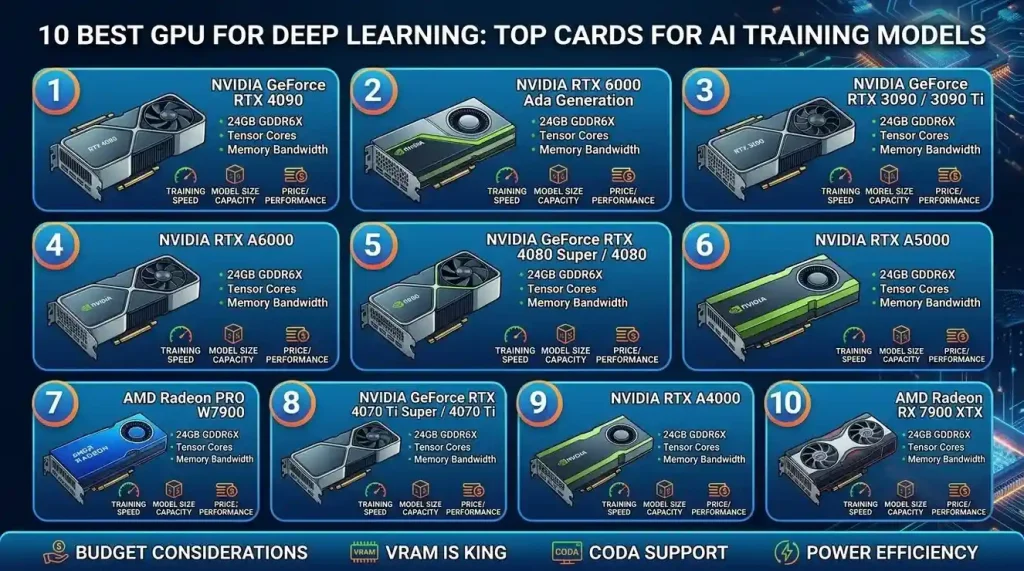
NVIDIA continues to lead the market for deep learning GPUs, offering a range of cards tailored for different budgets and scales of operation.
NVIDIA Enterprise-Grade GPUs: H100, H200, and B200
For large-scale, professional AI training, NVIDIA’s data center GPUs remain the gold standard. The NVIDIA H100 Tensor Core GPU, built on the Hopper architecture, defines the performance baseline for production AI in 2026. It features fourth-generation Tensor Cores and a Transformer Engine with FP8 precision, offering up to 4x faster training for GPT-3 (175B) models compared to its predecessor, the A100. With up to 80GB of HBM3 memory and 3.35 TB/s bandwidth, it excels in training large transformers, running production LLM inference, and scaling across multiple GPUs with NVLink.
The NVIDIA H200 Tensor Core GPU, an advancement on the Hopper architecture, sets a new standard for AI training with up to 141GB HBM3e memory and up to 4.8TB/s bandwidth, delivering exceptional 32-bit floating-point performance. It’s particularly strong for large models and long contexts, especially when more VRAM than the H100 is needed without moving to the even higher-end B200.
The latest iteration, the NVIDIA B200 Tensor Core GPU (Blackwell architecture), represents a significant leap forward, offering 3x the training performance and 15x the inference performance of previous-generation systems. With up to 192GB HBM3e memory and 8 TB/s bandwidth, the B200 is the “go big” option for maximum throughput headroom in demanding training jobs. Availability for the B200 remains tight globally through mid-2026 due to high demand.
NVIDIA Consumer-Grade GPUs: RTX 4090 and RTX 5090
For individual researchers, small teams, and prosumers, NVIDIA’s high-end consumer GPUs offer remarkable performance at a more accessible price point.
| GPU Model | Architecture | VRAM | Memory Type | Memory Bandwidth | Tensor Performance (FP8) | Typical Use Case |
|---|---|---|---|---|---|---|
| NVIDIA H200 | Hopper | 141GB | HBM3e | 4.8 TB/s | ~1979 TFLOPS (with sparsity) | Large-scale LLM training, HPC, enterprises needing high memory |
| NVIDIA B200 | Blackwell | 192GB | HBM3e | 8 TB/s | Much higher than H200 (next-gen) | Maximum throughput for very large training jobs |
| NVIDIA A100 | Ampere | 80GB | HBM2e | 1.5 TB/s – 2.0 TB/s | ~624 TFLOPS (with sparsity) | Previous gen enterprise workhorse, still cost-efficient |
| NVIDIA RTX 5090 | Ada Lovelace-Next | 32GB | GDDR7 | ~1.5 TB/s (est.) | Advanced (5th Gen Tensor Cores) | High-end consumer AI, 7B/13B FP16, 34B QLoRA, image generation |
| NVIDIA RTX 4090 | Ada Lovelace | 24GB | GDDR6X | 1.01 TB/s | 1,320 TFLOPS | Cost-effective local development, fine-tuning, image generation |
| AMD Instinct MI300X | CDNA 3 | 192GB | HBM3 | 5.3 TB/s | 2614.9 TFLOPS (FP16/BF16 with sparsity) | Massive AI models, high-memory tasks, reducing multi-GPU overhead, ROCm ecosystem |
| NVIDIA L40S | Ada Lovelace | 48GB | GDDR6 | 864 GB/s | 1458 TFLOPS (FP8) | Mid-scale fine-tuning, larger inference workloads, good VRAM/cost |
The NVIDIA RTX 4090 remains a highly popular choice for deep learning, offering an excellent balance of memory, compute, and availability. With 24GB of GDDR6X memory and 1.01 TB/s bandwidth, it comfortably supports training models up to 13B parameters and fine-tuning models up to 20B parameters using LoRA/QLoRA. It delivers 1,320 TFLOPS of FP8 tensor compute, making it well-suited for fine-tuning and smaller-scale inference workloads. It’s often lauded for its impressive cost-per-TOPS ratio compared to data center cards.
Looking ahead, the NVIDIA RTX 5090 (based on the Ada Lovelace-Next architecture), expected around $2,000–$2,500, brings 32GB of GDDR7 memory and advanced Tensor Cores. It is projected to be the best consumer GPU for AI in 2026, capable of running 7B models at full FP16, QLoRA fine-tuning for 13B and 34B models, and advanced Stable Diffusion workflows. Its Blackwell architecture’s 5th generation Tensor Cores will deliver FP8 and FP4 inference acceleration where supported.
AMD’s Growing Presence in AI: Instinct MI300X
While NVIDIA has historically dominated the AI hardware market, AMD is making significant strides, particularly with its Instinct line of accelerators. The AMD Instinct MI300X, based on the CDNA 3 architecture, is a formidable competitor. It boasts up to 192GB of HBM3 memory and 5.3 TB/s bandwidth, making it ideal for massive AI models and high-memory tasks where VRAM capacity is paramount. Its larger memory pool allows it to train very large AI models without splitting them across multiple GPUs, reducing data movement overhead. Major cloud providers like Microsoft Azure and tech giants like Meta have begun integrating the MI300X into their AI infrastructure, signaling its growing adoption.
The MI300X offers leadership efficiency and performance, with AI-specific functions including new data-type support, and enhanced computational throughput. While NVIDIA’s CUDA ecosystem is more mature, AMD’s ROCm software stack provides an open alternative for developers comfortable with its environment.
Cloud-Based GPU Solutions for AI Training
For many individuals and organizations, investing in on-premise high-end GPUs can be prohibitively expensive. Cloud-based GPU providers offer a flexible and scalable alternative, allowing users to rent GPU resources on an hourly or on-demand basis. This model is particularly beneficial for fluctuating workloads or for experimenting with different GPU configurations without a large upfront investment. Leading providers in 2026 include:
- NVIDIA DGX Cloud: Offers access to NVIDIA’s most powerful enterprise GPUs, including H100 and B200, with integrated software stacks and support.
- AWS (Amazon Web Services): Through services like SageMaker and EC2 instances, AWS provides a wide range of NVIDIA GPUs (including A100 and H100) and its custom-built AWS Trainium2, which offers up to twice the performance of previous models for AI training.
- Google Cloud Platform (GCP): Offers both NVIDIA GPUs (up to H100) and its custom Tensor Processing Units (TPUs), specifically optimized for TensorFlow workloads. Google Cloud TPU v5p, for instance, offers immense scalability with 8,192 cores per pod and 2.4 PFLOPS per pod.
- CoreWeave: Specializes in GPU-accelerated cloud infrastructure, offering a wide range of NVIDIA GPUs with Kubernetes-based orchestration for seamless scaling, focusing on large-scale AI training and inference.
- Lambda Labs: Known for providing on-demand access to NVIDIA A100 and H100 GPUs, focusing on streamlined workflows and competitive pricing for AI developers and researchers.
- RunPod, JarvisLabs, Vast.ai: These platforms offer competitive pricing and flexible serverless GPU options, often favored by solo developers and small teams for research and experimentation due to their cost-efficiency and ease of use.
The choice of cloud provider often depends on the specific workload, budget, and integration requirements. For large-scale training, reserved clusters from providers like Lambda or the hyperscalers (AWS, GCP, Azure) are preferred for guaranteed capacity and sustained throughput.
Building Your Deep Learning Workstation
For those opting for local deep learning, building a dedicated workstation offers direct control and can be cost-effective for consistent, non-bursty workloads. Key components beyond the GPU include:
- CPU: While the GPU does the heavy lifting for training, a capable multi-core CPU (e.g., Intel Core i7/i9 or AMD Ryzen 7/9) is still important for data preprocessing, model loading, and managing the overall system.
- RAM: Sufficient system RAM (64GB to 128GB or more) is crucial, especially for larger datasets that might not entirely fit into GPU VRAM or for managing multiple processes.
- Storage: Fast NVMe SSDs are essential for quick loading of datasets and models, significantly reducing I/O bottlenecks. Multiple large SSDs might be necessary for extensive datasets.
- Power Supply (PSU): High-end GPUs consume significant power, so a robust PSU with ample wattage (e.g., 1000W-1600W for single or multi-GPU setups) is mandatory.
- Cooling: Powerful GPUs generate substantial heat. Effective cooling solutions, whether air or liquid, are critical to prevent thermal throttling and ensure stable performance during long training runs.
For local LLM inference in 2026, a minimum of 8GB VRAM (e.g., NVIDIA RTX 3060) is needed for 7B models, 24GB VRAM for 13B models, and 48GB+ for 70B models. The NVIDIA RTX 4090 with 24GB VRAM is a strong single-GPU option for models that fit within its memory.
Future Trends in AI Hardware
The AI hardware landscape is evolving rapidly, driven by the increasing demands of complex models and the need for greater energy efficiency and scalability. Several trends are shaping the future:
- Diversification of Architectures: Beyond traditional GPUs, specialized AI accelerators like Intel Gaudi 3, AWS Trainium2, and Google TPUs are becoming more prominent, each optimized for specific AI workloads and frameworks.
- Neuromorphic Computing: These chips aim to mimic the structure and function of the human brain, offering ultra-low power consumption and event-driven processing, which could be transformative for edge AI and real-time pattern recognition.
- Photonic Computing: Utilizing light instead of electricity for calculations, photonic chips promise massive parallelism, extreme energy efficiency, and high-bandwidth communication, potentially leading to AI accelerators orders of magnitude faster and more efficient.
- Custom Silicon and Chiplet Designs: Companies are increasingly designing custom AI chips tailored to their specific applications, and chiplet-based designs (like AMD’s CDNA 3 architecture) offer better scalability and power efficiency by integrating various specialized components.
- Energy Efficiency and Sustainability: With AI’s growing carbon footprint, hardware designs are prioritizing lower power consumption to address environmental concerns and operational costs.
- Hybrid Quantum-Classical Systems: While full quantum computers are a longer-term goal, hybrid systems that combine quantum capabilities for optimization and exploration with classical AI hardware are on the horizon.
These innovations highlight a shift towards more specialized and energy-efficient hardware solutions, moving beyond simply adding brute compute power. As emphasized by experts, the future of AI will be “soldered in circuits, tuned in optics and tested in physical space,” signifying the critical role of hardware in driving the next wave of AI breakthroughs. Forbes
Conclusion
The landscape of GPUs for deep learning is dynamic and rapidly advancing in 2026, driven by the insatiable demand for more powerful and efficient AI training models. NVIDIA continues its dominance with enterprise powerhouses like the H100, H200, and the groundbreaking B200, offering unparalleled performance for large-scale deployments. For individuals and smaller organizations, the RTX 4090 and the upcoming RTX 5090 provide exceptional value and capability for local development and fine-tuning. AMD’s Instinct MI300X is a strong contender, particularly for memory-intensive workloads, challenging NVIDIA’s long-held market leadership. Furthermore, cloud-based GPU solutions offer flexible access to these high-performance resources, democratizing AI development. As AI continues its rapid evolution, the synergistic development of hardware and software will remain critical, with future innovations promising even more specialized, energy-efficient, and brain-inspired computing architectures to power the next generation of artificial intelligence. Choosing the best GPU ultimately comes down to a careful evaluation of workload requirements, budget, and the desired scale of operation.