7 Reasons RTX 3050 Is a Solid Budget Choice for 1080p Gaming
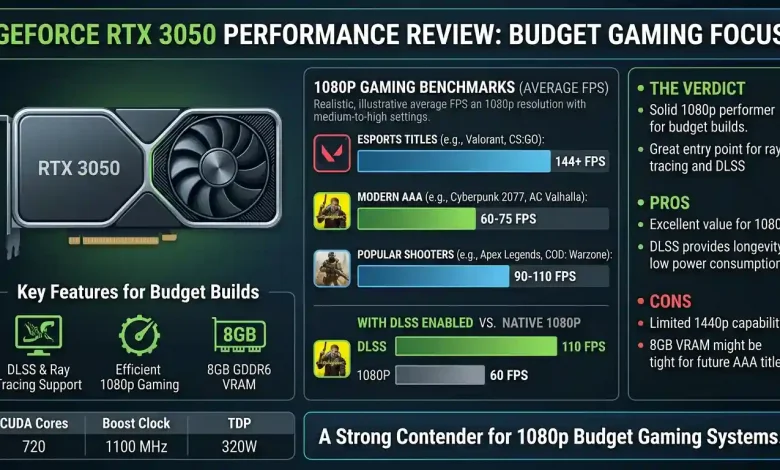
Table of Contents
The NVIDIA GeForce RTX 3050 has carved out a significant niche in the budget gaming PC market since its initial launch in January 2022. Positioned as an entry-level graphics card within NVIDIA’s Ampere architecture, it aims to deliver modern gaming experiences, including ray tracing and DLSS, to a wider audience without breaking the bank. This comprehensive review will delve into the RTX 3050’s performance, specifications, and overall value proposition for gamers building or upgrading a budget-friendly system in 2026. With the GPU market constantly evolving, understanding where the RTX 3050 stands today is crucial for making an informed purchasing decision.
Introduction: The Budget Gaming Contender
The NVIDIA GeForce RTX 3050 was introduced with the promise of bringing NVIDIA’s coveted RTX features, such as real-time ray tracing and DLSS (Deep Learning Super Sampling), to the mainstream budget segment. At its launch price of $249 for the 8GB variant, it aimed to replace older cards like the GTX 1650 and GTX 1660 Super, offering a generational leap in technology and performance for 1080p gaming. Over time, a 6GB variant was also released in early 2024, further diversifying its appeal with an even lower price point of $179 at launch and reduced power requirements. This review focuses on assessing both variants’ suitability for budget gaming PCs in the current landscape of 2026, considering performance, efficiency, and market value.
NVIDIA GeForce RTX 3050: Key Specifications
The NVIDIA GeForce RTX 3050 comes in two main desktop variants: the original 8GB model and the later 6GB model. Both are built on the 8 nm process and utilize the Ampere architecture, supporting DirectX 12 Ultimate.
- RTX 3050 8GB: This version is based on the GA106 graphics processor and features 2560 CUDA cores, 80 Tensor Cores, and 20 Ray Tracing Cores. It comes with 8 GB of GDDR6 memory on a 128-bit memory interface, delivering a memory bandwidth of 224 GB/s. The boost clock typically reaches 1777 MHz. Its Thermal Design Power (TDP) is rated at 130 W, requiring an 8-pin power connector.
- RTX 3050 6GB: Launched in early 2024, this variant uses a GA107 graphics processor, featuring 2304 CUDA cores, 72 Tensor Cores, and 18 Ray Tracing Cores. It has 6 GB of GDDR6 memory on a narrower 96-bit memory interface, resulting in 168 GB/s memory bandwidth. The boost clock is slightly lower, around 1470 MHz. A key advantage of the 6GB model is its lower power consumption, rated at just 70 W, meaning it typically does not require any additional power connectors beyond the PCIe slot. This makes it an ideal drop-in upgrade for older or pre-built systems with limited power supply options.
Both versions offer display outputs including HDMI 2.1 and DisplayPort 1.4a, and connect via a PCI-Express 4.0 x8 interface. These specifications are crucial to understanding their performance capabilities and suitability for various budget gaming scenarios.
1080p Gaming Performance: Hitting the Sweet Spot
The NVIDIA RTX 3050, particularly the 8GB variant, was designed with 1080p gaming in mind, aiming for 60 frames per second (FPS) with high to very high settings in many modern titles. Benchmarks from its launch and recent tests show that it generally achieves this goal in less demanding games and with some adjustments in more graphically intensive ones.
- Mainstream Titles: In popular competitive and lightweight games like Valorant, CS2, Fortnite, and Overwatch 2, the RTX 3050 (both 6GB and 8GB) can easily deliver high frame rates, often exceeding 100 FPS, making it suitable for high-refresh-rate 1080p monitors.
- AAA Games: For more demanding AAA titles such as Cyberpunk 2077, God of War, Assassin’s Creed Valhalla, and Shadow of the Tomb Raider, the 8GB RTX 3050 can typically achieve playable frame rates (around 60 FPS) at 1080p with medium to high settings. However, in some of the most graphically intensive games, users may need to lower settings to maintain a consistent 60 FPS or rely on DLSS. The 6GB variant, while still capable at 1080p, may require more compromises in settings for demanding titles due to its reduced CUDA cores and memory bandwidth.
- 1440p Gaming: While primarily a 1080p card, the RTX 3050 can handle some lighter games or older titles at 1440p with reduced settings, especially with DLSS enabled. For instance, in games like Hitman 3, it can even manage over 60 FPS at 1440p with medium settings. However, for demanding games, 1440p is generally not recommended for a smooth experience without significant visual compromises.
Overall, the 8GB RTX 3050 offers a solid 1080p gaming experience, often surpassing the performance of the older GTX 1660 Super by a small margin (around 5-10%). The 6GB version provides a more budget-conscious option for solid 1080p performance, particularly in less intensive games.
Ray Tracing and DLSS: Modern Features on a Budget
One of the RTX 3050’s standout features is its support for hardware-accelerated ray tracing and NVIDIA’s Deep Learning Super Sampling (DLSS) technology. These features distinguish it from previous-generation GTX cards and AMD’s entry-level competitors that might struggle with ray tracing.
- Ray Tracing Performance: The RTX 3050 includes dedicated RT cores, enabling it to handle ray tracing effects. However, its ray tracing performance is considered entry-level. In demanding titles with ray tracing enabled, like Cyberpunk 2077, Control, or Metro Exodus, the 3050 often struggles to maintain playable frame rates at native 1080p without DLSS, frequently dropping into the 30-40 FPS range or lower. For a smoother experience with ray tracing, DLSS becomes “pretty much essential.”
- DLSS Impact: This is where the RTX 3050 truly shines in implementing modern features. DLSS leverages AI Tensor Cores to upscale lower-resolution images to higher resolutions, significantly boosting frame rates with minimal perceived loss in visual quality. With DLSS enabled in “Quality” mode, the RTX 3050 can see substantial performance gains, often making ray-traced games playable at 1080p. For example, in Cyberpunk 2077, DLSS can improve performance by an incredible 48% at 1080p. In Metro Exodus, DLSS can boost frame rates from the low 40s to around 58 FPS at 1440p. This technology is a game-changer for budget GPUs, allowing users to experience cutting-edge graphics that would otherwise be unplayable.
For gamers interested in experiencing ray tracing on a budget, the RTX 3050, especially when paired with DLSS, offers a viable pathway, setting it apart from cards that lack similar upscaling technologies.
Power Consumption and Thermals: Efficiency for Budget Builds
Power efficiency and thermal performance are critical considerations for budget gaming PCs, where power supply limitations and case airflow might be constrained. The RTX 3050 generally excels in this regard, especially its 6GB variant.
- Power Consumption: The 8GB RTX 3050 has a Total Graphics Power (TGP) of 130 W and typically requires one 8-pin PCIe power connector. In real-world gaming, its power draw usually hovers between 115W and 125W, making it a relatively efficient card. NVIDIA recommends a minimum 550W PSU for systems running the 8GB RTX 3050. The 6GB RTX 3050 is significantly more power-efficient, rated at just 70 W TGP. This variant typically draws all its power directly from the PCIe slot, eliminating the need for supplementary power connectors. This low power draw makes the 6GB model an excellent choice for compact or older OEM systems with smaller power supplies (e.g., 300W-350W).
- Thermals and Acoustics: Many RTX 3050 custom models feature dual-fan cooling solutions that effectively manage temperatures and keep noise levels low. Reviews often highlight the card’s ability to run cool and quiet, even under load. The lower power consumption of the 6GB variant further contributes to its quiet operation and reduced thermal output, making it suitable for small form factor (SFF) builds and HTPCs.
The RTX 3050’s efficiency, particularly the 6GB model, makes it a highly appealing option for budget builds where system power and cooling might be limiting factors, offering modern performance without demanding a robust power infrastructure.
Comparison with Alternatives and Value Proposition
In the budget GPU segment, the RTX 3050 faces competition from both older NVIDIA cards and AMD’s offerings. Understanding its comparative performance and current market pricing is key to evaluating its value.
| GPU Model | VRAM (GB) | Memory Bus (bit) | CUDA Cores (NVIDIA) / Stream Processors (AMD) | Typical 1080p Gaming Performance (Relative) | Key Features | Typical Power (W) | Current Market Price (Approx. USD, New) |
|---|---|---|---|---|---|---|---|
| NVIDIA RTX 3050 (8GB) | 8 GDDR6 | 128 | 2560 | Good (100%) | Ray Tracing, DLSS, NVIDIA Reflex | 130 | $230 – $250 |
| NVIDIA RTX 3050 (6GB) | 6 GDDR6 | 96 | 2304 | Mid-Good (85-90% of 8GB) | Ray Tracing, DLSS, No external power needed | 70 | $170 – $220 |
| AMD Radeon RX 6600 | 8 GDDR6 | 128 | 1792 (Stream Processors) | Better (110-125% of 8GB RTX 3050) | Ray Tracing, FSR, Smart Access Memory | 132 | $200 – $250 (Often found cheaper than 3050 for better performance) |
| NVIDIA GTX 1660 Super | 6 GDDR6 | 192 | 1408 | Slightly Lower (90-95% of 8GB RTX 3050) | None (No RT/DLSS) | 125 | ~ $150-200 (Used market primarily) |
As shown in the table and supported by various benchmarks, the AMD Radeon RX 6600 generally offers superior raw rasterization performance compared to the RTX 3050, often providing a 10-25% FPS uplift in games. The RX 6600 can frequently be found at a similar or even lower price point than the 8GB RTX 3050, making it a strong contender for pure gaming performance without DLSS. However, the RTX 3050’s key advantage lies in its support for DLSS and better ray tracing performance when DLSS is enabled. If a gamer prioritizes these modern features, the RTX 3050 offers a compelling package.
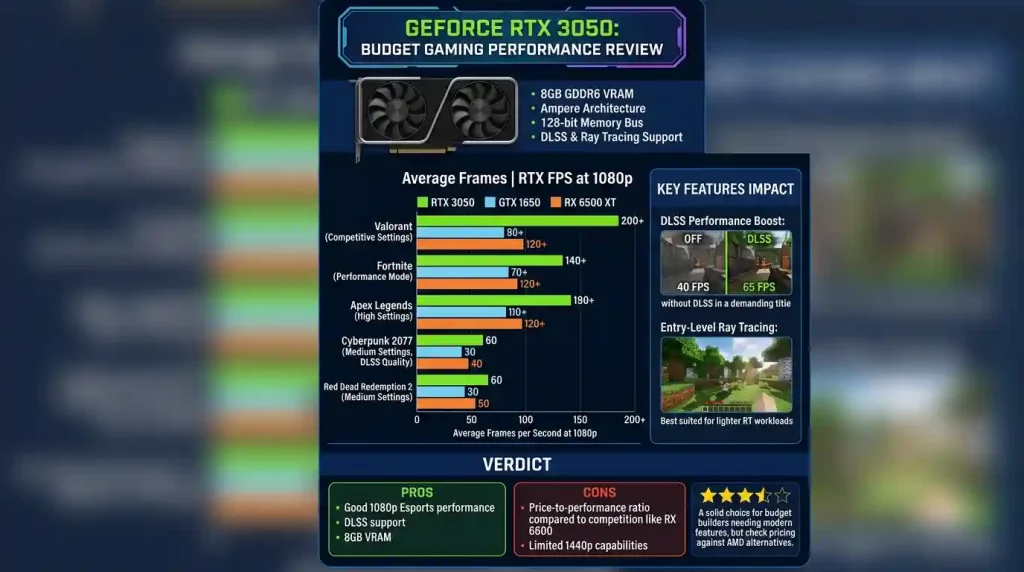
The older GTX 1660 Super, while still a capable 1080p card, lacks ray tracing and DLSS. It performs slightly below the 8GB RTX 3050 but can sometimes be found cheaper, especially in the used market.
The 6GB RTX 3050, with its sub-$200 price point and no external power requirement, has emerged as a leader in the ultra-budget segment for new GPUs. Its ability to operate solely on PCIe slot power makes it an “honest” entry point for users looking for an easy upgrade in older systems, despite a slight reduction in performance compared to the 8GB model.
In conclusion, the RTX 3050 (8GB) offers a balanced package of decent 1080p performance with modern features like DLSS and ray tracing. The RTX 3050 (6GB) excels in value and compatibility for extremely budget-constrained or power-limited builds. The choice largely depends on whether a buyer prioritizes raw performance (RX 6600) or NVIDIA’s feature set (RTX 3050), and the specific budget available. For further information on the broader GPU market, resources like Wikipedia’s comparison of NVIDIA GPUs can offer valuable context.
Who is the RTX 3050 For?
The NVIDIA GeForce RTX 3050 targets a specific demographic within the PC gaming community. It is primarily designed for:
- Budget-Conscious 1080p Gamers: Gamers who primarily play at 1080p resolution and are looking for a card that can handle most modern titles at playable frame rates (e.g., 60 FPS) with medium to high settings, especially when leveraging DLSS.
- Upgrades from Older GPUs: Users upgrading from integrated graphics or much older cards like the GTX 1050, GTX 1650, or similar, seeking a significant performance boost and access to current-generation features.
- Entry-Level Ray Tracing Enthusiasts: Those who want to experiment with ray tracing without investing in a high-end GPU, understanding that DLSS will often be necessary to achieve smooth frame rates.
- System Builders with Power Constraints (6GB model): The 6GB variant is particularly attractive for pre-built office PCs or compact systems that have limited power supply wattage and may not have additional PCIe power connectors. Its ultra-low 70W power draw makes it a versatile drop-in upgrade.
- Light Content Creation: While not a powerhouse for intensive tasks, the RTX 3050 can handle light content creation tasks, such as photo editing and casual video editing, making it a versatile option for users with mixed needs.
It’s important to set realistic expectations; the RTX 3050 is not intended for high-refresh-rate 1440p gaming or uncompromised 4K experiences, nor is it a top-tier ray tracing card without DLSS. Its strength lies in its ability to offer a balanced and modern 1080p gaming experience at an accessible price point, particularly with the aid of NVIDIA’s smart technologies.
Conclusion: A Balanced Choice for Entry-Level Gamers
The NVIDIA GeForce RTX 3050, in both its 8GB and 6GB iterations, remains a relevant graphics card for budget gaming PCs in 2026. It successfully delivers on its promise of providing a solid 1080p gaming experience with access to modern features like ray tracing and, critically, DLSS. The 8GB model offers better overall performance for its class, while the 6GB variant stands out for its exceptional power efficiency and compatibility with virtually any desktop system due to its minimal power requirements.
While direct competitors like AMD’s RX 6600 may offer superior raw rasterization performance at a similar price, the RTX 3050 distinguishes itself with its robust feature set, particularly DLSS, which significantly enhances playability in demanding titles and with ray tracing enabled. For gamers looking to upgrade from older, non-RTX cards or integrated graphics, the RTX 3050 represents a worthwhile investment, providing a tangible leap in visual fidelity and frame rates.
Ultimately, the choice of a budget GPU involves balancing performance, features, and cost. The RTX 3050, especially when found at a competitive price, offers a compelling and balanced proposition for entry-level gamers who want to experience the latest gaming technologies without a premium price tag. Its ability to run cool, quiet, and efficiently, particularly the 6GB model, further solidifies its position as a practical and sensible choice for a wide range of budget-constrained builds.