6 Reasons GTX 1660 Is Still a Great Budget GPU for 1080p Gaming
Table of Contents
The GPU 1660 series, comprising the GTX 1660, GTX 1660 Super, and GTX 1660 Ti, has long held a significant position in the budget and mid-range gaming PC market. Launched by NVIDIA between February and October 2019, these graphics cards, based on the Turing architecture, were designed to offer solid 1080p gaming performance without the premium cost associated with dedicated RT (Ray Tracing) and Tensor (AI) cores found in the RTX series. Even in mid-2026, many enthusiasts and budget-conscious builders continue to consider the 1660 series for its reliability and respectable performance. This comprehensive review delves into the capabilities of the GTX 1660 lineup, examining its relevance in today’s hardware landscape, its performance across various applications, and its overall value for money in the context of budget PC builds.
Introduction: The Enduring Appeal of the GTX 1660 Series
The NVIDIA GeForce GTX 1660 series emerged at a crucial time, bridging the gap between older Pascal-based cards and the new, more expensive RTX series. While the RTX cards introduced groundbreaking ray tracing and AI-driven DLSS technologies, the GTX 16-series focused on delivering optimized traditional rasterization performance at a more accessible price point. This strategy proved highly successful, making the 1660 cards extremely popular among gamers looking for excellent 1080p experiences without breaking the bank. Fast forward to 2026, and these cards, particularly the GTX 1660 Super and Ti variants, can often be found on the used market at attractive prices, prompting a re-evaluation of their viability for modern budget builds. Their appeal lies in their proven track record, efficiency, and consistent ability to handle a wide range of games at acceptable frame rates, even as newer, more powerful (and costly) GPUs enter the market.
A Look Back: The Evolution of the GTX 1660 Family
The GTX 1660 series consists of three primary models, each offering incremental improvements over its predecessor:
- NVIDIA GeForce GTX 1660: The original, launched in March 2019, featured 1408 CUDA cores and 6GB of GDDR5 memory. It was a direct successor to the GTX 1060, offering better performance and efficiency thanks to the new Turing architecture.
- NVIDIA GeForce GTX 1660 Ti: Released earlier in February 2019, this was initially the top-tier of the 16-series. It boasted 1536 CUDA cores and faster 6GB GDDR6 memory, providing a noticeable performance uplift over the base 1660. The 1660 Ti operates at a base clock of 1500 MHz and can boost up to 1770 MHz.
- NVIDIA GeForce GTX 1660 Super: Launched in October 2019, the 1660 Super was a strategic release by NVIDIA. While it maintained the same 1408 CUDA cores as the original GTX 1660, it received a significant upgrade to 6GB of much faster GDDR6 memory (14 Gbps effective), matching the memory speed of the 1660 Ti and surpassing its memory bandwidth (336 GB/s vs 288 GB/s for the Ti). This memory upgrade allowed the 1660 Super to deliver performance very close to that of the more expensive 1660 Ti, often making it the sweet spot in terms of price-to-performance. The 1660 Super operates at a base clock of 1530 MHz, boosting to 1785 MHz.
All three cards are built on the 12nm TU116 graphics processor, a variant of the Turing architecture that foregoes the dedicated RT and Tensor cores of the RTX line, streamlining the silicon for traditional rasterization. This focus on core performance, combined with NVIDIA’s efficient Turing architecture, laid the groundwork for their lasting relevance.
Performance Metrics: Gaming and Beyond
Gaming Performance at 1080p
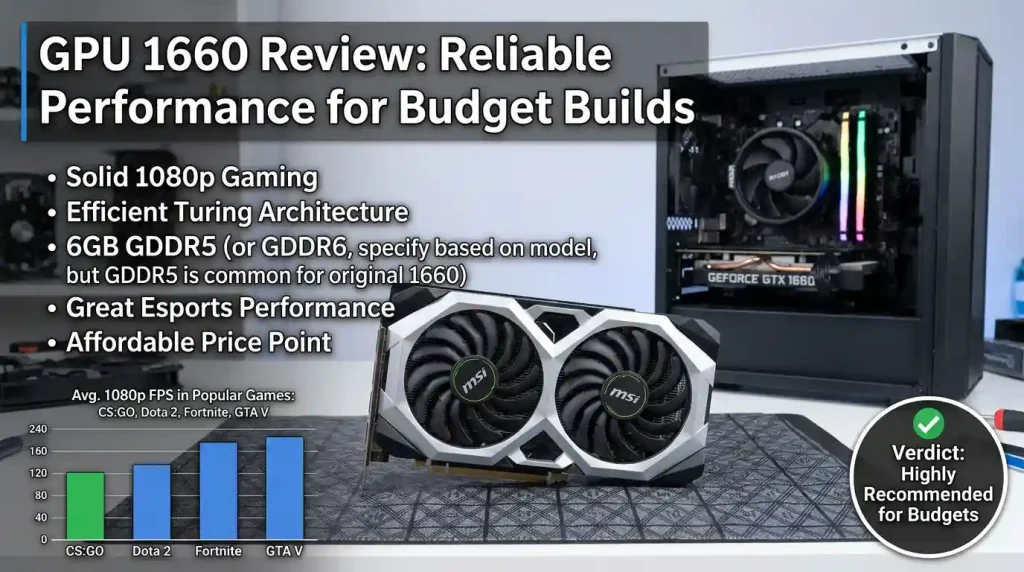
For gamers targeting 1080p resolution, the GTX 1660 Super and 1660 Ti remain surprisingly capable even in mid-2026. While they may not be able to max out every brand-new AAA title at 60 FPS, they offer a very respectable gaming experience with some settings adjustments. Benchmarks from late 2023 and early 2024 indicate that the GTX 1660 Super can still achieve playable frame rates in many modern AAA games at 1080p with medium to high settings. For example, in titles like Cyberpunk 2077, it can achieve above 60 FPS on medium settings with high textures. Similarly, in games like Red Dead Redemption 2, it can hit around 55 FPS on a middle-balanced preset, which is still considered very playable. Esports titles like Counter-Strike 2, Apex Legends, and Fortnite run exceptionally well, often exceeding 100 FPS on competitive settings, making them excellent choices for competitive gamers.
The 6GB of GDDR6 VRAM, while becoming a bottleneck in some of the most VRAM-intensive modern games at ultra settings, is generally sufficient for 1080p gaming if users are willing to tweak a few settings. Reducing texture quality slightly can often resolve VRAM limitations without a significant impact on visual fidelity, maintaining smooth gameplay. The 1660 Ti, being marginally faster than the 1660 Super, offers a slight edge, often delivering an average of ~86 FPS at 1080p with high/ultra settings (varying by title), making it an excellent card for both competitive and AAA gaming with tuned settings. Even the base GTX 1660 can still run most games, though it may require lowering settings more aggressively.
Productivity and Content Creation
Beyond gaming, the GTX 1660 series offers decent performance for light to moderate productivity and content creation tasks. The Turing architecture includes an improved NVENC encoder, which is beneficial for streamers, allowing them to encode high-quality 1080p60 streams while gaming with minimal performance impact. For video editing, photo editing, and other GPU-accelerated applications, the 6GB of GDDR6 memory and the CUDA core count provide a solid foundation for tasks that can leverage GPU acceleration. While not on par with higher-end RTX cards or professional workstation GPUs, the 1660 series can certainly handle common creative workloads for hobbyists and entry-level professionals.
Key Features and Specifications
The NVIDIA GTX 1660 series is built upon the Turing architecture, which brought several advancements to mainstream GPUs. Although it lacks the dedicated RT Cores for real-time ray tracing and Tensor Cores for AI (like DLSS) found in the RTX series, it benefits from other Turing innovations.
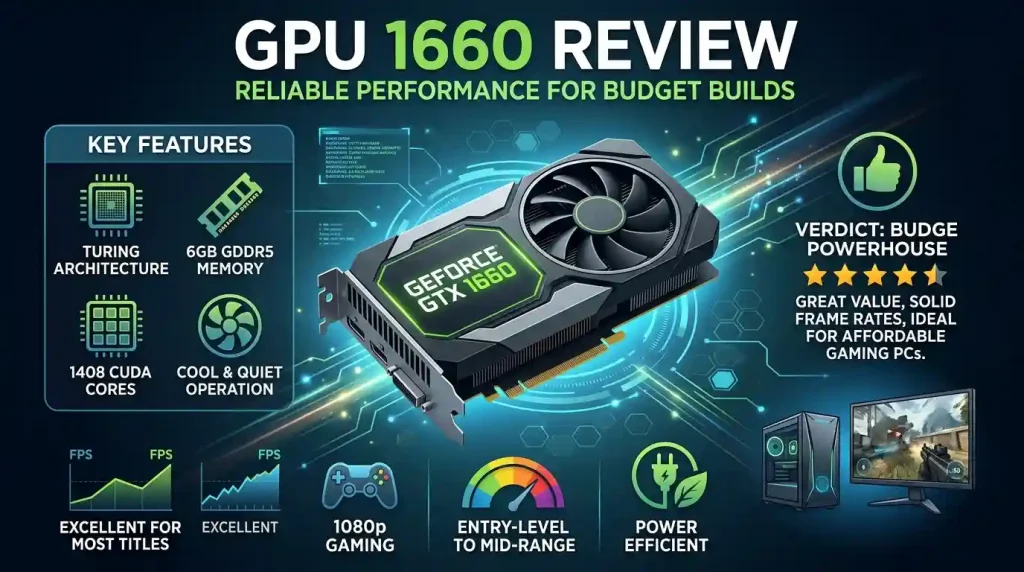
- Turing Shader Architecture: Improved shader execution efficiency, leading to better performance per CUDA core compared to the previous Pascal generation. It also introduced new advanced shading technologies like Variable Rate Shading, Mesh Shading, and Texture-Space Shading, which improve performance and image quality.
- GDDR6 Memory: Both the 1660 Super and 1660 Ti utilize fast GDDR6 memory, offering significantly higher bandwidth than the GDDR5 used in the original 1660 and older cards like the GTX 1060.
- NVENC Encoder: An enhanced hardware video encoder that provides excellent quality for streaming and video recording with minimal performance overhead, a major advantage for content creators.
- Power Efficiency: The 12nm fabrication process and architectural optimizations result in impressive power efficiency. The TDP (Thermal Design Power) for all cards in the 1660 series is around 120-125W, typically requiring a single 8-pin power connector and a recommended PSU of 450W. This makes them suitable for a wide range of budget power supplies.
- PCIe 3.0 Interface: Connects to the system via a PCI-Express 3.0 x16 interface.
Here’s a comparison table of the key specifications for the three GTX 1660 variants:
| Feature | GTX 1660 | GTX 1660 Super | GTX 1660 Ti |
|---|---|---|---|
| Launch Date | March 14, 2019 | October 29, 2019 | February 22, 2019 |
| GPU Architecture | Turing (TU116) | Turing (TU116) | Turing (TU116) |
| CUDA Cores | 1408 | 1408 | 1536 |
| Base Clock | 1530 MHz | 1530 MHz | 1500 MHz |
| Boost Clock | 1785 MHz | 1785 MHz | 1770 MHz |
| Memory Size | 6GB GDDR5 | 6GB GDDR6 | 6GB GDDR6 |
| Memory Interface | 192-bit | 192-bit | 192-bit |
| Memory Speed (Effective) | 8 Gbps | 14 Gbps | 12 Gbps |
| Memory Bandwidth | 192 GB/s | 336 GB/s | 288 GB/s |
| TDP | 120 W | 125 W | 120 W |
| Launch Price (MSRP) | $219 | $229 | $279 |
The Competition: Where the 1660 Stands in 2026
In 2026, the competitive landscape for budget GPUs has evolved significantly. New cards from NVIDIA, AMD, and Intel have entered the market, often offering features like hardware-accelerated ray tracing and more VRAM. The primary competition for the GTX 1660 series on the new market includes cards like the Intel Arc B570/B580, AMD Radeon RX 6600, and NVIDIA’s own RTX 3050 6GB or 8GB models.
- AMD Radeon RX 6600: Often considered one of the best budget GPUs, the RX 6600 (non-XT) offers competitive performance against the 1660 Super, frequently outperforming it and providing 8GB of VRAM, which offers better future-proofing.
- NVIDIA GeForce RTX 3050 (6GB/8GB): The RTX 3050 8GB generally offers a slight performance edge over the GTX 1660 Super in traditional rasterization and critically includes RT Cores and Tensor Cores for ray tracing and DLSS, respectively. However, the 6GB variant of the RTX 3050, launched with a lower TDP of 70W and often without an external power connector, is consistently outperformed by the GTX 1660 Super in gaming, despite being a newer generation card. The 1660 Super also often boasts a better cost per frame than the RTX 3050 8GB.
- Intel Arc Series (e.g., B570, B580): Intel’s recent entries like the Arc B570 are positioned as strong contenders in the sub-$200 market, offering good value and performance for their price.
Despite newer alternatives, the GTX 1660 Super and Ti remain relevant, particularly in the used market, where they can be found at significantly reduced prices. Their continued appeal stems from their robust rasterization performance and relatively low power consumption, making them excellent choices for those upgrading older systems or building on a very tight budget.
For a more in-depth understanding of GPU architectures and their impact on performance, Wikipedia’s article on the Turing microarchitecture provides valuable technical details.
Value Proposition: Is it Still Worth Buying in 2026?
The question of whether a GTX 1660 series card is worth buying in 2026 largely depends on its price, the intended use case, and whether one is buying new or used.
- New Market: On the new market, the GTX 1660 series is largely superseded by more modern budget GPUs from AMD and Intel, which offer better performance per dollar and often include features like more VRAM or hardware-accelerated ray tracing/DLSS. Therefore, buying a new GTX 1660 card at its original MSRP in 2026 is generally not recommended.
- Used Market: This is where the 1660 series truly shines in 2026. If found at a significantly reduced price, particularly the GTX 1660 Super or Ti, it can offer exceptional value for 1080p gaming. Many online sources and community discussions indicate that the 1660 Super is a decent 1080p card when found at attractive prices on the used market. It’s considered one of the better used-market buys for budget 1080p gaming if the price is right. For casual gamers who primarily want to play and enjoy games without necessarily hitting 60+ FPS on ultra settings, the 1660 Super is often “enough”.
The main limitation remains the 6GB of VRAM. While sufficient for many games at 1080p with tuned settings, it can become a bottleneck in the most demanding, texture-heavy AAA titles released in 2024-2026. However, for esports, older AAA titles, or newer games with adjusted settings, the 1660 Super/Ti continues to deliver reliable performance. If you already own a 1660 Super, it’s advised to keep using it until you encounter performance problems that leave you wanting more.
Building a Budget PC Around the GTX 1660
For those considering a budget PC build centered around a used GTX 1660 Super or Ti, here are some recommendations:
- Processor: Pair it with a modern mid-range CPU like an Intel Core i3 (12th gen or newer) or an AMD Ryzen 5 (5000 series or newer). Even an older Ryzen 5 3600 or an Intel Core i5-9400F would be a good match, minimizing CPU bottlenecks while keeping costs down.
- RAM: 16GB of DDR4 RAM (3200MHz preferred) is highly recommended for a smooth gaming and multitasking experience.
- Storage: An SSD (NVMe preferred, but SATA is fine) for the operating system and frequently played games will significantly improve load times and overall system responsiveness.
- Power Supply: A reliable 450W to 550W power supply will be more than adequate for a system featuring a GTX 1660 series card, given its low power consumption.
- Monitor: A 1080p monitor, ideally with a refresh rate of 75Hz or 144Hz, will allow you to fully appreciate the frame rates the 1660 series can deliver, especially in esports titles.
This type of build offers a cost-effective entry into PC gaming, capable of running a vast library of games at enjoyable frame rates without a substantial investment. The 1660 series’ lower power draw also means less heat and quieter operation compared to some more power-hungry alternatives, which is an added bonus for budget-conscious builders.
Conclusion: A Legacy of Value
The NVIDIA GeForce GTX 1660 series, particularly the Super and Ti variants, has carved out a lasting legacy as reliable performers for budget-conscious PC builders. While launched several years ago, these cards, built on the efficient Turing architecture, continue to deliver commendable 1080p gaming performance in 2026. They are especially attractive on the used market, where their reduced prices make them excellent value propositions for those seeking solid rasterization performance without the need for cutting-edge features like hardware-accelerated ray tracing or the higher price tag of newer GPUs.
For competitive gamers, casual players, and those looking to build an affordable system capable of handling a wide array of titles at 1080p, a GTX 1660 Super or Ti remains a viable and smart choice. While newer cards offer more VRAM and advanced features, the 1660 series proves that reliable performance, efficiency, and a good price can ensure a GPU’s relevance for many years after its initial launch. It stands as a testament to NVIDIA’s ability to deliver products that cater to diverse segments of the market, proving that you don’t always need the latest and greatest to enjoy a fulfilling gaming experience.