GPU PS5 Comparison: Console Graphics vs PC Gaming GPUs
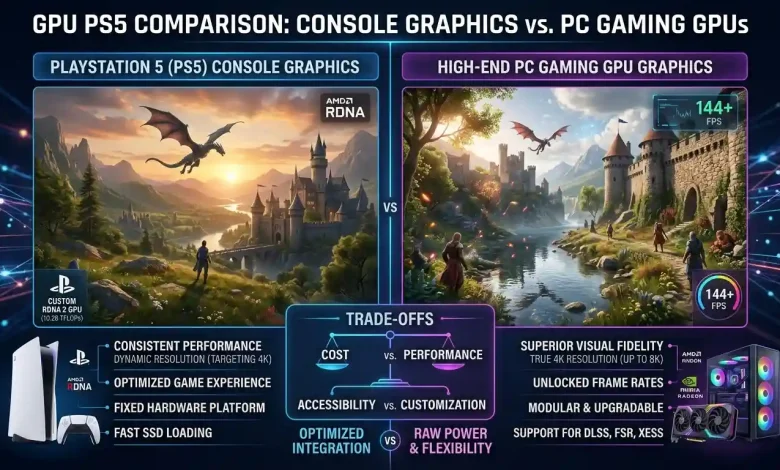
Table of Contents
GPU PS5 Comparison: Console Graphics vs PC Gaming GPUs delves into one of the most debated topics in the gaming world: which platform truly offers the superior graphical experience. With the PlayStation 5 (PS5) having firmly established itself as a leading console, its custom AMD RDNA 2 GPU frequently draws comparisons with the ever-evolving landscape of discrete PC gaming graphics cards. This article aims to provide a comprehensive analysis, dissecting the architectural nuances, performance metrics, and unique advantages each platform presents, helping gamers understand where their priorities might best align.
Understanding the PS5’s Integrated GPU Architecture
The PlayStation 5 is powered by a custom AMD GPU, codenamed “Oberon” (or “Oberon Plus” for the updated model), which is based on the RDNA 2 architecture. This integrated solution is a significant leap from previous console generations, offering substantial graphical horsepower in a streamlined package. Specifically, the PS5’s GPU features 36 compute units (CUs) clocked at a variable frequency, peaking at 2.23 GHz, delivering a theoretical peak performance of 10.28 teraFLOPS (TFLOPs). This TFLOPs figure, while a common measure of GPU power, doesn’t tell the whole story, as console performance is heavily influenced by deep hardware-software optimization.
One of the key aspects of the PS5’s design is its System-on-a-Chip (SoC) integration, where the CPU and GPU are part of a single, highly optimized unit. This allows for extremely efficient data transfer and reduced latency, factors that often contribute to a smoother and more consistent gaming experience despite raw TFLOPs comparisons. The GPU also shares a unified 16GB GDDR6 memory system with the CPU, operating on a 256-bit bus with a bandwidth of 448 GB/s. This unified memory architecture further enhances efficiency by allowing both the CPU and GPU quick access to a large pool of high-speed memory.
The PS5’s GPU also boasts hardware-accelerated real-time ray tracing, a cutting-edge rendering technique that simulates light interaction for more realistic visuals. This feature, once exclusive to high-end PC GPUs, is now a standard offering in the current console generation, albeit with varying levels of implementation and performance impact. The console’s fixed hardware configuration allows developers to target specific performance profiles with greater precision, optimizing games to run effectively at resolutions like 4K and frame rates up to 120Hz.
The Power of Discrete PC Gaming GPUs
In contrast to the PS5’s integrated solution, PC gaming relies on discrete graphics processing units. A discrete GPU is a standalone component with its own dedicated memory (VRAM), power management, and cooling system, separate from the CPU. This independence allows discrete GPUs to pack more cores, higher clock speeds, and specialized architectures designed solely for graphical rendering and parallel processing.
The PC market offers a vast array of GPUs from manufacturers like Nvidia (GeForce series) and AMD (Radeon series), ranging from entry-level cards to enthusiast-grade powerhouses. These cards feature their own dedicated VRAM, typically ranging from 8GB to 24GB or more, which prevents the GPU from having to share system memory with the CPU, thus freeing up resources and boosting overall efficiency. Modern high-end PC GPUs, such as Nvidia’s RTX 40 series (e.g., RTX 4080 SUPER, RTX 4090) and AMD’s RX 7000/9000 series (e.g., RX 7900 XTX, RX 9070 XT), significantly outperform the PS5’s GPU in raw computational power. For instance, an Nvidia RTX 4080 SUPER can be up to three times more powerful than the PS5 in like-for-like scenarios.
The primary advantage of discrete PC GPUs lies in their raw horsepower and the flexibility they offer. Gamers can choose a GPU that perfectly matches their performance needs and budget, with the option to upgrade components independently as new technologies emerge or demands increase. This modularity ensures a longer upgrade path and access to the latest graphical innovations.
Key Performance Metrics and Benchmarks
Comparing console and PC GPU performance directly can be complex due to platform-specific optimizations and architectural differences. While TFLOPs provide a theoretical measure of floating-point operations, real-world gaming performance is influenced by factors such as memory bandwidth, driver efficiency, and game engine optimization.
The PS5’s GPU, with its 10.28 TFLOPs, is often compared to PC GPUs like the AMD Radeon RX 6700 (non-XT variant), the Nvidia GeForce RTX 2070 Super, or the RTX 3060 Ti in terms of raw rasterization performance. However, these comparisons are approximate, as the PS5’s highly optimized ecosystem allows it to extract more consistent performance than a similarly specced PC GPU might achieve. For example, the AMD Radeon RX 6700 is considered the most similar GPU to the PS5’s Oberon GPU across the board. Some sources also suggest the RTX 3070 or RX 6700 XT as comparable in performance.
In practice, the PS5 targets 4K resolution at 30-60 frames per second (FPS) for many demanding titles, often utilizing dynamic resolution scaling to maintain performance. While it can achieve 120 FPS in less graphically intensive games or at lower resolutions, maintaining high frame rates at native 4K with advanced graphical settings is challenging for the console.
PC GPUs, especially mid-to-high-end models, can significantly surpass the PS5’s performance. For instance, an RTX 4070 SUPER or AMD RX 7900 XTX can deliver frame rates 2.8 to 3.2 times faster than the PS5 in demanding titles like Cyberpunk 2077 or Alan Wake 2, even without relying on upscaling technologies. High-end cards like the Nvidia RTX 5090 offer unparalleled performance, running games like Cyberpunk 2077 at 4K with ray tracing at a smooth 59fps, a 37% increase over the previous generation’s RTX 4090.
| Feature/Component | PlayStation 5 GPU | Mid-Range PC Gaming GPU (e.g., RTX 4070/RX 7700 XT) | High-End PC Gaming GPU (e.g., RTX 4090/RX 7900 XTX) |
|---|---|---|---|
| Architecture | Custom AMD RDNA 2 | Nvidia Ada Lovelace / AMD RDNA 3/4 | Nvidia Ada Lovelace / AMD RDNA 3/4 |
| TFLOPS (Theoretical Peak) | ~10.28 TFLOPs (FP32) | ~29-49 TFLOPs (e.g., RTX 4070: ~29 TFLOPs, RX 7700 XT: ~35 TFLOPs) | ~82 TFLOPs (RTX 4090) to ~100+ TFLOPs (RTX 5090) |
| Memory (VRAM) | 16 GB GDDR6 (shared with CPU) | 8GB – 16GB GDDR6/GDDR7 (dedicated) | 16GB – 24GB+ GDDR6X/GDDR7 (dedicated) |
| Memory Bandwidth | 448 GB/s | ~500-600 GB/s (e.g., RTX 4070: ~504 GB/s, RX 7700 XT: ~432 GB/s) | ~1008 GB/s (RTX 4090) to ~1344 GB/s (RTX 5090) |
| Ray Tracing Support | Hardware-accelerated | Dedicated RT Cores (Nvidia) / Ray Accelerators (AMD) | Dedicated RT Cores (Nvidia) / Ray Accelerators (AMD), often more advanced generations |
| Upscaling Technologies | Proprietary (PSSR on PS5 Pro) | Nvidia DLSS, AMD FSR, Intel XeSS | Nvidia DLSS, AMD FSR, Intel XeSS, often latest generations with Frame Generation |
| Cost (GPU only/Console) | $499 (Console Launch Price) | $400-$700 (Current Gen Mid-Range GPU) | $1000-$2000+ (Current Gen High-End GPU) |
Ray Tracing and Next-Gen Features: PS5 vs. PC
Ray tracing, a technology that accurately simulates the path of light, has become a hallmark of next-generation graphics. The PS5 supports hardware-accelerated ray tracing, enabling more realistic lighting, reflections, and shadows in supported games. However, enabling ray tracing on the PS5 often leads to a “serious frame rate drop,” making it more suitable for single-player experiences rather than competitive online games. The PS5 Pro, for example, is said to offer 2x to 4x faster ray tracing than the standard PS5, incorporating some RDNA 3 features.
PC gaming GPUs, particularly Nvidia’s RTX series and AMD’s Radeon RX series, have been at the forefront of ray tracing development. Nvidia’s dedicated RT Cores and AMD’s Ray Accelerators are specifically designed to handle the intensive calculations required for ray tracing, often allowing for higher fidelity and better performance compared to consoles. High-end PC GPUs can run ray tracing at significantly higher settings and resolutions, often combined with AI-powered upscaling technologies like Nvidia’s Deep Learning Super Sampling (DLSS) or AMD’s FidelityFX Super Resolution (FSR) to mitigate performance impact. These technologies dynamically render games at a lower resolution and then upscale them to a higher resolution using AI, effectively boosting frame rates with minimal perceived loss in image quality.
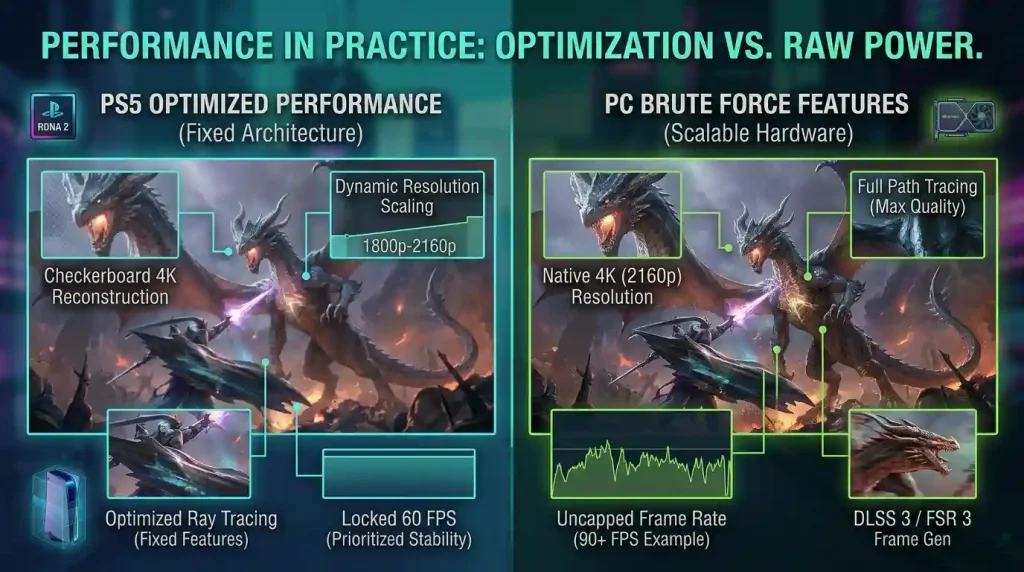
The PS5 Pro is also incorporating a custom machine learning solution for AI upscaling, akin to DLSS, which can enhance resolution and performance. This signifies a convergence in approaches to leveraging AI for graphical enhancements across platforms. While consoles offer a standardized ray tracing experience, high-end PCs provide the flexibility to push ray tracing to its limits, offering a truly immersive visual feast for those with the appropriate hardware.
Cost-Effectiveness and Upgradeability
The initial upfront cost is a major differentiator between console and PC gaming. The PS5 launched at $499, offering a complete gaming system ready to play out of the box. Building a comparable gaming PC, however, can often cost significantly more. While a PC offering performance similar to the PS5 might cost around $770 today (excluding peripherals and software), a high-end gaming PC can easily run into thousands of dollars. For example, an entry-level RTX 5060 GPU alone costs around $350-$380.
However, the cost-effectiveness equation shifts when considering the long-term. Consoles offer a plug-and-play experience but are largely locked into their initial hardware for the duration of their generation. Upgradability is limited mainly to storage expansion. When a new console generation arrives, gamers typically need to purchase an entirely new system to keep up with the latest advancements.
PC gaming, on the other hand, boasts unparalleled upgradeability. Users can replace individual components like the GPU, CPU, RAM, or storage as needed, extending the lifespan of their system and allowing for incremental performance improvements. While individual upgrades can be costly, this modularity can potentially lead to better long-term value, as users don’t have to buy a whole new system every few years. Additionally, PC game prices can often be lower than console games, especially with frequent sales on digital storefronts, and online multiplayer often doesn’t require a paid subscription, which can contribute to overall savings over time. Some analyses suggest that over a 10-year period, the total cost of ownership for a PC might even out or be slightly higher than a console, depending heavily on upgrade frequency and game purchasing habits.
The Future of Gaming Graphics: Convergence or Divergence?
The evolution of GPU technology points towards both convergence and divergence between console and PC gaming. Console hardware, like the PS5’s RDNA 2-based GPU, increasingly incorporates features once exclusive to high-end PCs, such as ray tracing and AI-driven upscaling. This trend suggests that future console generations will continue to narrow the gap in core graphical features. The PS5 Pro, with its hybrid RDNA architecture incorporating elements from RDNA 2 and RDNA 3, and a custom ML solution, exemplifies this drive towards advanced graphical capabilities within a console framework.
However, a fundamental divergence remains in the philosophical approach to gaming hardware. Consoles prioritize a standardized, optimized, and relatively affordable experience, where developers can fine-tune games for a single hardware target. This ensures consistency and accessibility for a broad audience. PCs, conversely, offer an open, customizable, and scalable platform that caters to enthusiasts seeking the absolute bleeding edge of graphics, performance, and versatility.
The continuous innovation in discrete PC GPUs, with each new generation pushing boundaries in raw power, VRAM capacity, and advanced rendering techniques (like path tracing), will likely ensure that high-end PCs retain their position as the ultimate graphical powerhouse. Features like Nvidia’s DLSS 4 with Multi Frame Generation and AMD’s FSR 4 continue to evolve, offering significant performance boosts that often outpace what consoles can achieve with their fixed hardware. While consoles will continue to provide excellent value and a seamless gaming experience, the PC platform will remain the arena for uncompromising visual fidelity and groundbreaking graphical innovation.
Conclusion
In the ongoing GPU PS5 comparison, it’s clear that both console graphics and PC gaming GPUs offer compelling experiences, each with distinct strengths. The PlayStation 5 provides an incredibly optimized and coherent gaming platform, delivering stunning visuals and next-generation features like ray tracing at a highly competitive price point. Its integrated AMD RDNA 2 GPU, coupled with a unified memory system, ensures a consistent and high-quality gaming experience without the complexities of PC hardware configuration.
On the other hand, PC gaming GPUs, with their discrete architecture and vast performance tiers, represent the pinnacle of graphical power and flexibility. High-end PC GPUs routinely outperform the PS5’s capabilities, offering superior resolutions, higher frame rates, more advanced ray tracing, and greater customization options. The ability to upgrade individual components also provides a long-term pathway for performance enhancement, albeit with a higher initial investment.
Ultimately, the choice between the PS5 and a gaming PC hinges on individual priorities. For gamers seeking a streamlined, plug-and-play experience with excellent graphics and value, the PS5 is an outstanding choice. For enthusiasts who demand the absolute best in visual fidelity, uncompromising performance, and the freedom to customize and upgrade their hardware, a gaming PC with a powerful discrete GPU remains the undisputed champion. As technology continues to advance, the symbiotic relationship between console and PC innovations will likely continue to drive the entire gaming industry forward, benefiting players on both platforms. For more information on graphics processing units, you can refer to Wikipedia’s detailed explanation of GPUs.