GPU RTX 3060 Review: Amazing Performance for Gaming, Editing & Streaming
Table of Contents
The GPU RTX 3060, launched on February 25, 2021, arrived as a highly anticipated graphics card from NVIDIA, aiming to deliver strong performance in the mainstream segment. Positioned as an upgrade for gamers still using older GTX-class GPUs, particularly the popular GTX 1060, it promised significant advancements in both rasterization and ray tracing capabilities. This comprehensive review delves into its suitability for gaming, editing, and streaming in today’s demanding digital landscape, considering its core specifications, real-world performance, and overall value.
Introduction to the NVIDIA GPU RTX 3060
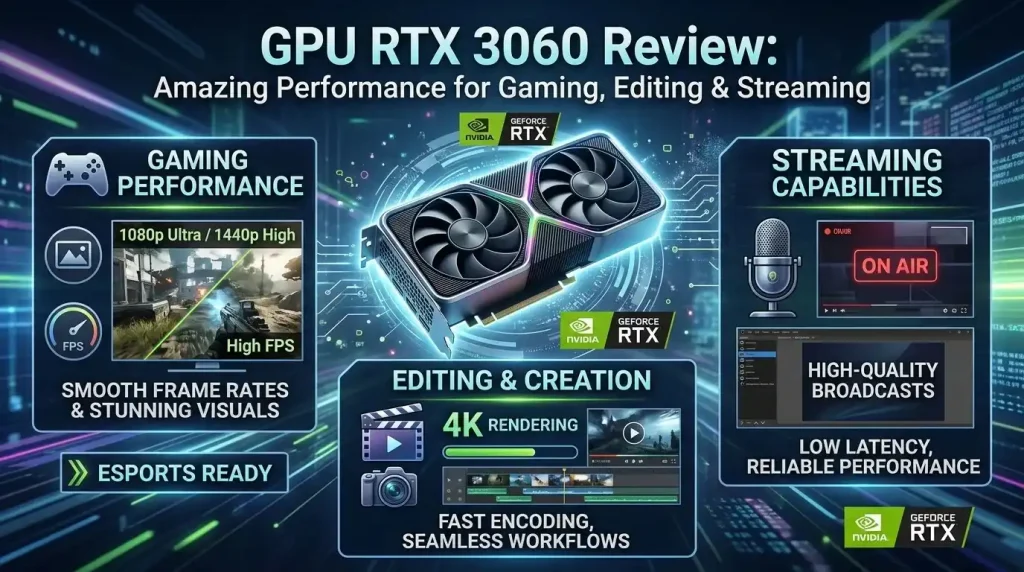
NVIDIA’s GeForce RTX 3060 entered the market with an MSRP of $329, targeting price-conscious PC gamers looking for a capable upgrade. It was designed to offer a balance of performance and features, leveraging the NVIDIA Ampere architecture. This GPU was notable for its generous 12GB of GDDR6 memory, connected via a 192-bit memory interface, which was a significant talking point at its release, even surpassing the VRAM capacity of some higher-tier cards like the RTX 3060 Ti and RTX 3070. The card supports DirectX 12 Ultimate, ensuring compatibility with modern games and offering features like hardware-accelerated ray tracing and Variable Rate Shading.
The RTX 3060 was introduced during a period of high demand and supply shortages in the graphics card market, which often led to prices exceeding its suggested retail price. Despite these market conditions, its feature set, including NVIDIA DLSS (Deep Learning Super Sampling), NVIDIA Reflex, and NVIDIA Broadcast, aimed to provide a compelling experience for a broad range of users. Its emergence was particularly relevant for the large segment of gamers still utilizing GTX-class GPUs, offering a substantial performance leap.
Key Specifications and Architecture
The NVIDIA GeForce RTX 3060 is built on the 8nm process and utilizes the GA106 graphics processor, specifically the GA106-300-A1 variant. While the GA106 chip features up to 3,840 CUDA cores, the RTX 3060 desktop version is configured with 3,584 CUDA shading units. It also includes 112 Tensor Cores, designed to accelerate machine learning applications, and 28 Ray Tracing (RT) Cores for enhanced lighting and shadow effects in supported games.
A standout feature of the RTX 3060 is its 12GB of GDDR6 memory, which operates at 15 Gbps effective (1875 MHz) across a 192-bit memory interface, delivering a memory bandwidth of up to 360 GB/s. This generous VRAM capacity provides considerable headroom for high-resolution textures and demanding modern game titles, as well as complex content creation projects. The GPU’s base clock speed is 1320 MHz, boosting up to 1777 MHz.
For connectivity, the desktop RTX 3060 typically offers 1x HDMI 2.1 and 3x DisplayPort 1.4a outputs, supporting high-resolution displays including 8K HDR at 120Hz. It connects to the system via a PCI-Express 4.0 x16 interface and has a typical board power (TBP) rating of 170W, recommending a minimum 550W PSU. The Ampere architecture also brings an improved 5th generation video encoder (NVENC) for H.264 and H.265, and a 7th generation decoder, which now includes AV1 support.
Gaming Performance: 1080p, 1440p, and Ray Tracing
The NVIDIA GeForce RTX 3060 is primarily positioned as an excellent card for “no-compromises 1080p gaming” at ultra quality settings, capable of achieving 60 FPS or higher in many titles. For competitive gamers, it can push even higher refresh rates in less demanding games.
At 1080p, the RTX 3060 generally provides a smooth gaming experience. For instance, in titles like Red Dead Redemption 2 and Horizon Zero Dawn, it can run at max settings above 60 FPS. Benchmarks show it delivering around 129 FPS in Death Stranding at 1080p, matching the GTX 1080 Ti and RX 5700. However, while capable, its performance isn’t a massive leap over its predecessor, the RTX 2060, showing only a small performance difference in some lower resolution scenarios. Compared to the RTX 2060 Super, the RTX 3060 offers about 15% more performance.
Moving to 1440p, the RTX 3060 remains viable but often requires users to reduce graphics settings to maintain 60 frames per second, especially in demanding modern titles. For example, in Watch Dogs Legion, the RTX 3060 achieved 62 FPS at 1440p without DLSS. It performs similarly to the RTX 2070 and RX 5700 XT at this resolution in many games. While the 12GB VRAM is beneficial, the GPU’s raw processing power can be a limiting factor at higher resolutions with maximum settings.
Ray tracing performance on the RTX 3060 is a notable feature, thanks to its dedicated RT Cores. NVIDIA touts it as having 10x the ray-tracing performance of the GTX 1060. However, enabling ray tracing, particularly with maxed-out quality settings, can be very demanding. In games like Watch Dogs Legion with DXR (DirectX Raytracing) enabled, even at 1080p, frame rates can drop significantly, often necessitating the use of DLSS (Deep Learning Super Sampling) or reducing ray tracing settings to achieve playable frame rates. DLSS is a crucial technology here, boosting frame rates while maintaining image quality, and is available in over 25 games. With DLSS Quality mode, the RTX 3060 can offer a 30% boost in frame rates, making ray tracing at 1080p and sometimes 1440p viable.
RTX 3060 for Content Creation: Video Editing and 3D Rendering
For content creators, the RTX 3060 proves to be a strong mainstream GPU, particularly excelling in video editing and 3D rendering tasks. The generous 12GB of GDDR6 VRAM is a significant asset, allowing it to handle complex 4K timelines and medium-complexity GPU renders effectively. This ample memory helps prevent system crashes when applying heavy color correction or motion graphics in applications like Adobe Premiere Pro and DaVinci Resolve.
| Feature/Application | RTX 3060 Performance (Desktop) | Notes |
|---|---|---|
| CUDA Cores | 3,584 | Accelerates rendering tasks in compatible software. |
| VRAM | 12GB GDDR6 | Excellent for 4K timelines, prevents crashes with heavy effects. |
| Adobe Premiere Pro | Strong timeline performance, fast NVENC exports. Average 4K timeline playback at 40 FPS. | Benefits from a balanced CPU and 32GB+ RAM. |
| DaVinci Resolve | Capable for 4K footage, smooth timeline scrubbing. | Comparable to RTX 4060 Ti in some editing tasks. |
| Blender (OptiX) | Very good OptiX GPU render performance; 110 seconds for Blender Cycles classroom scene (single frame). | Generally faster than RTX 2060 Super, competitive with some AMD cards. |
| NVENC Encoder | Excellent for H.264/H.265 exports, reduces CPU utilization significantly. | Near x264 medium quality with lower CPU load. |
| Power Consumption | 170W TDP | Requires a minimum 550W PSU. |
NVIDIA’s CUDA cores play a crucial role, allowing software like Adobe Premiere Pro and Blender to optimize rendering tasks directly on the GPU, significantly reducing export times from hours to minutes. In Premiere Pro, the RTX 3060 delivers strong timeline performance and fast NVENC exports, achieving an average of 40 FPS for 4K timeline playback with GPU acceleration. Similarly, in DaVinci Resolve, it provides smooth timeline scrubbing with 4K footage.
For 3D rendering, particularly with Blender using OptiX, the RTX 3060 shows very good GPU render performance. For instance, it can render the Blender Cycles classroom scene in approximately 110 seconds for a single frame. While it might be slightly slower than some newer or higher-tier cards, its performance is still impressive for its segment, even outperforming older high-end cards like the RTX 2080 Ti in some heavy tests. The 12GB VRAM is particularly beneficial here, providing the necessary buffer for handling complex scenes and large textures.
The RTX 3060 also leverages NVIDIA’s Studio Drivers, which are optimized for creative and professional applications, ensuring stability and performance. This makes it a practical choice for freelancers, streamers, and small studios who need robust GPU acceleration without investing in more expensive professional GPUs. For a general overview of GPUs and their role in modern computing, one might consult Wikipedia’s comprehensive article on Graphics Processing Units.
Streaming Capabilities: NVENC and OBS Performance
The NVIDIA GeForce RTX 3060 is well-equipped for streaming, largely due to its dedicated 5th generation NVENC (NVIDIA Encoder). NVENC is a hardware encoder that offloads the encoding process from the CPU to a dedicated chip on the GPU, significantly reducing the impact on in-game frame rates and overall system performance during live streams.
When paired with NVENC-based workflows in OBS (Open Broadcaster Software), the RTX 3060 consistently delivers high perceptual stream quality at platform-appropriate bitrates (e.g., 4.5-6 Mbps for Twitch at 1080p60), with minimal CPU impact. Switching from software encoding (x264 medium) to NVENC can reduce CPU utilization by approximately 45 percentage points in demanding titles, preventing CPU bottlenecks and stuttering. This makes the RTX 3060 an excellent option for single-PC streaming setups, where the same system is used for both gaming and broadcasting.
The Ampere generation NVENC encoder on the RTX 3060 supports H.264 and H.265 (HEVC) encoding up to 8K resolutions with 10-bit color and B-frame support. While it does not support AV1 encoding (a feature introduced with the RTX 40 series), its H.264 performance is robust enough for high-quality 1080p60 and even some 1440p streaming. However, users attempting high-quality 4K recording at specific settings may encounter “encoder overloaded” messages, indicating that while capable of 4K, certain demanding presets can push the NVENC chip to its limits. Adjusting quality presets (e.g., from P7 to P4) can mitigate this.
Laptop versions of the RTX 3060 also offer strong portable streaming capabilities, although sustained performance can be influenced by thermal and Total Graphics Power (TGP) variations across different laptop models. Overall, the RTX 3060 provides a solid and reliable streaming experience for most mainstream users, allowing them to broadcast their gameplay or creative work without significant compromises.
Value Proposition and Competitive Landscape
At its launch, the NVIDIA GeForce RTX 3060 was introduced at a starting price of $329, intended to be an accessible entry point into the Ampere architecture. This made it significantly more affordable than the RTX 3060 Ti ($399) or the higher-end 30-series GPUs. The card’s generous 12GB of VRAM was a key selling point, offering a future-proof aspect for games and applications that increasingly demand more memory.
In terms of performance, the RTX 3060 sits comfortably above the previous generation’s RTX 2060, offering a noticeable uplift, typically around 15-20% faster than the RTX 2060 Super in many games. However, it is also about 20% slower than the RTX 3060 Ti and 27% slower than the RTX 3070. This performance segmentation means that while the RTX 3060 provides good value, the RTX 3060 Ti often offers a better performance-to-price ratio for those who can stretch their budget slightly.
From AMD’s side, the primary competitor to the RTX 3060 was often the Radeon RX 6600 XT. The RX 6600 XT can be decently faster than the RTX 3060 in rasterization performance in some scenarios, particularly at 1080p, and may offer a better value for pure gaming performance without ray tracing. However, the RTX 3060 maintains an edge in ray tracing performance due to NVIDIA’s second-generation RT cores and the significant advantage provided by DLSS, which AMD’s FSR (FidelityFX Super Resolution) aims to counter. Additionally, NVIDIA’s superior content creation and streaming ecosystem, driven by CUDA and NVENC, often gives the RTX 3060 an advantage for users with mixed workloads.
Looking forward, even in late 2025, the RTX 3060 12GB is considered a “very good and solid all-round GPU for both Gaming, AI and video editing” if acquired at a good price. Its 12GB VRAM is particularly beneficial for tasks like AI (e.g., Stable Diffusion) and ensuring ultra textures in games without overloading, though its raw power for 1440p gaming without DLSS can be limited compared to newer generations. The market constantly evolves with new releases like the RTX 40-series and AMD’s RDNA 3 cards, which bring further performance improvements and features like AV1 encoding in NVENC, but the RTX 3060 still holds its ground as a practical and cost-effective option for many.
Pros and Cons of the RTX 3060
Pros:
- Ample 12GB GDDR6 VRAM: Provides significant memory headroom for high-resolution textures in games and complex workloads in content creation software, making it quite future-proof in this aspect.
- Strong 1080p Gaming Performance: Capable of delivering smooth 60+ FPS at ultra settings in most modern AAA titles at 1080p, and higher refresh rates in less demanding games.
- Capable 1440p Gaming with Tweaks: Can handle 1440p gaming, though some settings adjustments or DLSS might be needed to maintain 60 FPS in more demanding titles.
- Excellent for Content Creation: Its CUDA cores and 12GB VRAM make it a strong performer for video editing (e.g., Premiere Pro, DaVinci Resolve) and 3D rendering (e.g., Blender with OptiX), significantly speeding up workflows.
- Efficient Streaming with NVENC: The dedicated NVENC encoder ensures high-quality streaming at 1080p60 with minimal impact on gaming performance, making it ideal for single-PC setups.
- Ray Tracing and DLSS Support: Offers hardware-accelerated ray tracing and the performance-boosting DLSS technology, enhancing visual fidelity in supported games.
- PCIe 4.0 Support: Compatible with modern motherboard interfaces for optimal data transfer.
Cons:
- Moderate Ray Tracing Performance: While it supports ray tracing, achieving high frame rates with maxed-out ray tracing settings often requires DLSS or significant sacrifices in graphical quality.
- Not a Huge Generational Leap over RTX 2060: In some standard rasterization benchmarks, the performance uplift over the RTX 2060 or 2060 Super isn’t as dramatic as seen in other 30-series cards compared to their predecessors.
- Outperformed by RTX 3060 Ti: The RTX 3060 Ti generally offers a better performance-per-dollar ratio, being significantly faster for a slightly higher price.
- No AV1 Encoding: Unlike the newer RTX 40-series GPUs, the RTX 3060’s NVENC encoder does not support AV1, which offers better compression efficiency for streaming at lower bitrates.
- 4K Recording Limitations: While streaming 4K to 1080p works, high-quality 4K recording can sometimes overload the NVENC encoder at certain demanding settings.
Conclusion
The GPU RTX 3060 remains a highly relevant and capable graphics card, even several years after its initial release. It carves out a strong niche for itself as a versatile mainstream option that delivers robust performance across gaming, content creation, and streaming.
For gamers, it provides an excellent 1080p experience, capable of handling modern AAA titles at high settings with smooth frame rates. While 1440p gaming is achievable, it often benefits from DLSS or minor graphical adjustments to maintain optimal performance. Its ray tracing capabilities, when paired with DLSS, offer a glimpse into next-generation visuals, although it’s not a powerhouse for maxed-out RT settings.
Content creators, particularly those involved in video editing and 3D rendering, will find the 12GB of VRAM and NVIDIA’s CUDA acceleration immensely beneficial. It efficiently handles 4K timelines, accelerates exports, and performs admirably in GPU-intensive rendering tasks, making it a valuable tool for professionals and enthusiasts on a budget.
Streamers, too, are well-catered for, thanks to the dedicated NVENC encoder. This hardware solution enables high-quality 1080p60 streaming with minimal performance overhead, making single-PC streaming setups highly effective.
In summary, the RTX 3060 offers a compelling package of features and performance, particularly for users seeking a balanced GPU that can competently handle a diverse range of tasks without breaking the bank. Its combination of generous VRAM, ray tracing, DLSS, and robust encoding capabilities ensures it continues to be a solid choice for a comprehensive PC experience in 2026.