6 Signs GPU Prices Are Dropping – Market Trends Every Gamer Should Know

Table of Contents
GPU Prices Dropping is a question on the minds of many gamers, enthusiasts, and PC builders worldwide, eagerly hoping for a return to more affordable graphics card markets. After years of unprecedented volatility, fueled by a perfect storm of supply chain disruptions, cryptocurrency booms, and soaring demand, the market for Graphics Processing Units (GPUs) remains a complex and often challenging landscape. While some anticipated a significant downturn in prices following the crypto crash, the reality in 2026 presents a more nuanced picture. Instead of widespread drops, many high-end GPU prices are, in fact, experiencing renewed upward pressure, largely driven by an entirely new and insatiable demand source: artificial intelligence (AI) and data centers. This article delves into the intricate market trends shaping GPU availability and pricing, providing every gamer with the essential knowledge to navigate the current environment.
The Current GPU Landscape: A Shifting Paradigm
The GPU market of early 2026 is far from the stable, predictable cycles once familiar to PC enthusiasts. Reports indicate that graphics cards are generally becoming more expensive, a trend largely attributed to the exploding demand for AI hardware. This pressure is building from the fundamental components of the supply chain upwards. Memory chipmakers, for instance, are grappling with a global supply crunch as AI infrastructure accelerates, leading manufacturers to prioritize high-bandwidth memory (HBM) over other memory products crucial for consumer GPUs. This prioritization directly impacts the cost of video memory, which can account for over 80% of a GPU’s manufacturing cost, subsequently driving up retail prices.
While a brief period in late 2024 and early 2025 offered some relief, with certain gaming GPUs seeing prices at or below their Manufacturer Suggested Retail Price (MSRP), this normalization proved short-lived. By early 2026, many regions, particularly the U.S., observed price increases, with some high-end cards like the NVIDIA RTX 5090 selling significantly above its launch price. This indicates a systemic shift where the underlying cost structure and demand drivers have fundamentally changed, making a broad return to pre-2020 pricing unlikely for many models.
The AI Boom and its Unprecedented Impact on GPU Supply
The most significant factor influencing GPU prices in the current market is the explosion of Artificial Intelligence. AI models, with their increasing size and complexity, require vast amounts of computational power and memory, leading to an unprecedented demand for specialized chips, particularly high-performance GPUs. Major tech giants are investing hundreds of billions of dollars into AI systems and data centers, with GPUs representing the primary hardware cost.
High-Bandwidth Memory (HBM) Scarcity
A critical bottleneck in the supply chain is the scarcity of High-Bandwidth Memory (HBM). Industry executives have warned that the supply of HBM is sold out until at least 2026, and the squeeze could last through 2027. This intense demand from AI data centers means memory vendors are reallocating their production capacity towards these higher-margin products, leaving less for traditional consumer GPUs. This directly translates to higher manufacturing costs for gaming graphics cards, as memory constitutes a substantial portion of their bill of materials. Even less trendy memory types used in everyday electronics are seeing tightened supplies and increased prices due to the AI boom. The memory crunch has reached a point where it directly bleeds into the consumer market, making GPUs more expensive due to rising memory costs. Reuters reported on January 5, 2026, that memory chipmakers are prioritizing HBM for AI, causing a global supply crunch.
Manufacturing Priorities and Capacity Diversion
The global semiconductor manufacturing capacity is struggling to keep pace with AI demand. While wafer fabs are producing record volumes of advanced chips, capacity growth lags behind exponential inference workloads. Companies like NVIDIA, AMD, and Intel are all vying for the same production slots, leading to a significant diversion of manufacturing capacity towards AI servers. This has a direct impact on the availability and pricing of consumer-grade components. For instance, NVIDIA’s AI GPU supply chain has seen drastic recovery and plans to “flood” markets with shipments, but these are primarily for AI accelerators, not necessarily for consumer gaming GPUs. This shift means that while overall GPU production may increase, a smaller proportion is dedicated to the gaming segment, thereby maintaining or increasing prices for gamers.
Consumer Gaming GPUs: A Diverging Path
Amidst the AI-driven surge, the consumer gaming GPU market is experiencing a diverging path. High-end gaming GPUs often find themselves competing directly with AI accelerators for shared components, pushing their prices upwards. However, the mid-range and budget segments might offer some relative stability or even slight reductions in specific scenarios.
New Releases and Generational Pricing
The period of late 2024 and early 2025 saw the introduction of new generations of GPUs, including NVIDIA’s RTX 50-series and AMD’s Radeon RX 9000-series. While these new cards offer cutting-edge performance, they often come with premium pricing and limited availability. For example, the NVIDIA GeForce RTX 5090, with an MSRP of $2,499, frequently sells for $2,500-$3,000, and some speculate it could hit $5,000 before the end of 2026. The RTX 5080 and 5070 also launched with significant price tags. This trend of high launch prices, exacerbated by ongoing supply pressures and AI demand, means that gamers seeking top-tier performance must be prepared for substantial investments. NVIDIA’s market dominance, holding approximately 94% market share by the final quarter of 2025, further solidifies its pricing power, with AMD’s share decreasing to 5%.
Mid-Range and Budget Options
In contrast to the high-end, the mid-range and budget GPU markets present a different dynamic, albeit still influenced by broader trends. AMD, for instance, has been focusing on the more popular mid-range segment with its Radeon RX 9000-series, aiming to boost market share and offer more cost-effective solutions. Intel’s entry into the discrete GPU market with its Arc series, particularly models like the B570 and B580, has also created competitive offerings in the budget segment for 1080p gaming, filling a price sweet spot that NVIDIA and AMD have somewhat abandoned.
However, even these segments are not immune. Tom’s Hardware reported in June 2026 that while Intel Arc GPUs offer competitive pricing, availability can be limited. Finding NVIDIA’s RTX 5060 and 5060 Ti variants with 8GB VRAM at near MSRP is possible, but higher-tier cards like the RTX 5070 Ti and 5080 remain in poor supply at reasonable prices. For AMD, finding RX 9000-series cards at MSRP can also be a struggle due to rising memory prices. This suggests that while more affordable options exist, securing them at their intended price points often requires vigilance and quick action from consumers. Demand for affordability is strong, with nearly half of gamers (45%) having opted for used or older models, and a significant portion (22%) using drop trackers to monitor price changes.
The Fading Shadow of Crypto Mining
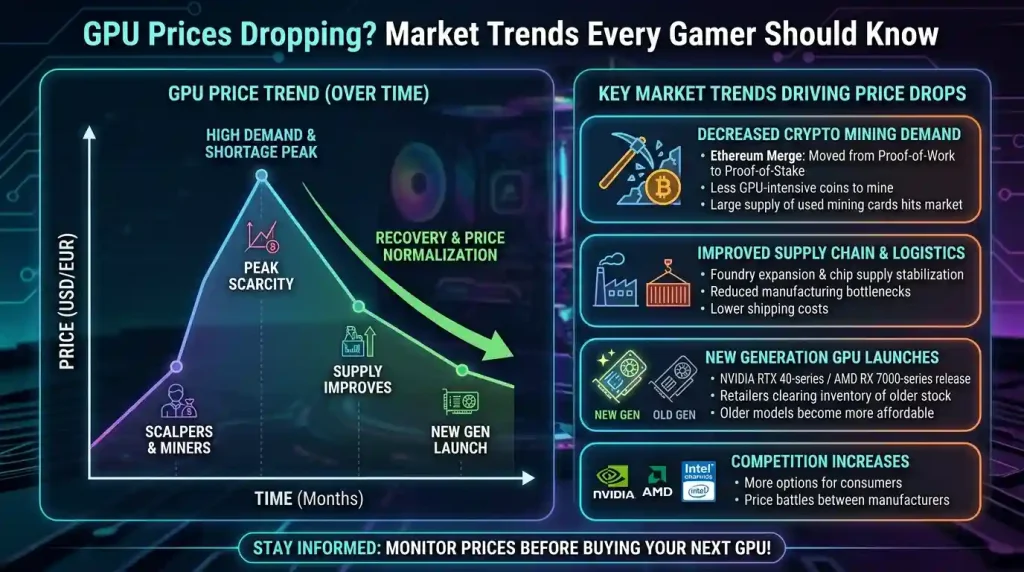
For several years, cryptocurrency mining was a dominant force, artificially inflating GPU prices and making them scarce for gamers. The profitability of mining, particularly Ethereum, drove individuals and commercial entities to acquire vast numbers of high-performance graphics cards, leading to a lucrative secondary market driven by speculators. Prices on second-hand markets exploded as new GPUs became impossible to find, with some cards selling for three times their retail price.
However, the influence of crypto mining has significantly waned. The cryptocurrency market crashed in 2022, and Ethereum’s transition to a ‘proof-of-stake’ model made GPU mining significantly less profitable. This led to a large influx of used GPUs onto the market, helping to stabilize prices somewhat and return them closer to MSRP in 2022. While some minimal mining activity may persist, it is no longer the primary driver of market volatility. The current AI boom has largely overshadowed crypto mining as the main external force distorting GPU prices. Therefore, while gamers can breathe a sigh of relief from the crypto mining frenzy, a new and even more formidable force has taken its place.
Navigating the Second-Hand Market: Opportunities and Pitfalls
With new GPU prices often at a premium, the second-hand market has become an attractive avenue for budget-conscious gamers. Around 45% of gamers have chosen used or older models to meet their needs. Platforms like eBay and Amazon show robust demand for renewed and used GPUs. The NVIDIA RTX 3060, for example, released with an MSRP of $329, was observed selling for $199.03 used on eBay in late 2025, demonstrating significant depreciation for used models and making them an appealing option.
However, the 2026 used GPU market presents unique challenges and risks. The influx of cards previously used for AI training, as opposed to gaming or even crypto mining, has introduced different wear patterns. GPUs used for AI workloads operate at 100% utilization, continuously stressing VRAM at maximum bandwidth for extended periods. This intense usage can lead to accelerated memory degradation and increased error rates, even if initial benchmarks appear normal. Cards that look like “deals” (e.g., an RTX 4080 priced 40% below market average) might actually be AI-worn, posing a risk of underperforming or failing prematurely. Experts advise caution, suggesting that paying a slight premium for a verified gaming-used card or opting for new budget options might offer better long-term value than gambling on suspiciously cheap former data center hardware. Buyers should be wary of bulk sellers offering multiple identical high-end cards, as this often signals a data center origin.
| GPU Model (Approx. Release) | Original MSRP (USD) | Current Market Price Trend (Early 2026) | Primary Market Influencer |
|---|---|---|---|
| NVIDIA RTX 5090 (Jan 2025) | $2,499 | Often $2,500 – $3,000+; rising | AI demand, limited supply, premium pricing |
| NVIDIA RTX 5080 (Jan 2025) | ~$1,500 | Poor supply at reasonable prices; elevated | AI demand, limited supply |
| AMD Radeon RX 9070 XT (Mar 2025) | $599 | Struggling to find at MSRP; rising | Memory price hikes, high demand |
| NVIDIA RTX 40-series (2022-2023) | Varied | Stock dwindling, prices higher than they should be | New generation releases, AI demand for components |
| Intel Arc B570/B580 (Late 2024/Early 2025) | Competitive budget pricing | Competitive, but limited stock/manufacturer variety | Budget segment competition |
| NVIDIA RTX 3060 (2021) | $329 | Used: around $199 on eBay (late 2025) | Age, secondary market dynamics, AI-worn risks |
Economic Headwinds and Consumer Spending
Beyond the direct dynamics of GPU supply and demand, broader economic factors are also shaping the market. Tariffs and economic uncertainty continue to impact the consumer technology industry, potentially leading to higher costs for consumers. In the U.S., consumer tech revenue is projected to reach $565 billion in 2026, but overall global consumer tech spending is expected to flatten or even contract slightly after strong growth in 2025. This suggests a cautious consumer environment where discretionary spending, including on PC upgrades, may be impacted.
Rising energy prices and general inflation are significant budgetary impacts on average households, potentially delaying demand for discretionary purchases. Many gamers are operating on tight budgets, with a quarter willing to spend only up to $500 on a new GPU, and another 27% up to $699. Over half of PC gamers (57%) have been prevented from buying a GPU due to price hikes or scalping, and 43% have delayed or canceled purchases due to financial obligations like rent or bills. This indicates that even if prices were to stabilize, consumer affordability remains a major hurdle.
Future Outlook: What to Expect in the Coming Years
The GPU market is likely to remain volatile, influenced by ongoing supply chain issues, rapid technological advancements, and the relentless demand from AI. NVIDIA GPU prices are projected to rise significantly from 2024 to 2029. The global GPU market itself is experiencing substantial growth, projected to reach $102.8 billion in 2026 and $652 billion by 2033, primarily driven by AI, machine learning, and high-performance computing.
While some forecasts for 2025 suggested a potential 20% decrease in prices for *certain gaming graphics cards* due to increased production and competition, the reality of 2024 and early 2026 indicates persistent premiums fueled by shortages and AI demand. The consumer desire for value is intensifying, pushing demand towards cost-effective alternatives, including used or mid-range options. The long-term outlook emphasizes the importance of strategic sourcing and investment for both businesses and consumers, as new GPU prices are expected to continue their upward trend. For gamers, this means careful consideration of needs versus budget, and potentially focusing on specific price points or waiting for opportunistic deals rather than expecting broad price drops.
Conclusion
The question of “GPU Prices Dropping?” in 2026 yields a complex answer. While the era of crypto mining’s direct influence has largely passed, its void has been more than filled by the insatiable demand from the artificial intelligence sector. This AI boom, particularly its hunger for High-Bandwidth Memory, is driving manufacturing priorities and component costs upwards, impacting new GPU prices across the board. For gamers, especially those eyeing high-end cards, the expectation should lean more towards continued premium pricing and volatility rather than significant drops.
However, opportunities still exist. The mid-range and budget segments, particularly with competitive offerings from AMD and Intel, may present more accessible options. The used market offers potential savings, but buyers must exercise extreme caution to avoid AI-worn cards with compromised longevity. Ultimately, success in navigating the current GPU market hinges on staying informed, setting realistic budget expectations, and carefully evaluating the value proposition of each purchase. For now, widespread, sustained GPU price drops for enthusiast-level hardware appear to be a distant prospect as AI continues to redefine the economics of graphics processing units.