GPU 4000 Series Overview: Best NVIDIA RTX 40 Series Cards
Table of Contents
The GPU 4000 Series, specifically NVIDIA’s GeForce RTX 40 Series cards, represents a significant leap in graphics processing power, designed to deliver unparalleled performance for gamers, creators, and professionals alike. Launched starting in late 2022 with the flagship RTX 4090, this generation of GPUs brought forth a new era of neural rendering and real-time ray tracing, powered by the innovative Ada Lovelace architecture. These cards have reshaped expectations for high-fidelity gaming at resolutions up to 4K and even 8K, alongside accelerating demanding content creation and AI-driven workloads.
Introduction to the NVIDIA RTX 40 Series
NVIDIA’s RTX 40 Series, based on the Ada Lovelace architecture, succeeded the RTX 30 Series and was officially announced on September 20, 2022, with the RTX 4090 hitting shelves on October 12, 2022. This generation focuses heavily on enhancing ray tracing capabilities, improving AI-accelerated graphics, and boosting raw compute workloads. The cards range from the enthusiast-grade RTX 4090 to the more mainstream RTX 4060, catering to a wide spectrum of users and budgets. A mid-life refresh in January 2024 saw the introduction of “SUPER” variants—the RTX 4070 SUPER, RTX 4070 Ti SUPER, and RTX 4080 SUPER—which aimed to offer improved specifications or better value propositions compared to their non-SUPER predecessors. This series is renowned for introducing DLSS 3, a revolutionary AI-powered performance multiplier that dramatically boosts frame rates by generating entirely new frames.
The Ada Lovelace Architecture: Foundation of the 40 Series
At the heart of every RTX 40 Series card is NVIDIA’s Ada Lovelace microarchitecture, named after the 19th-century mathematician Ada Lovelace. This architecture is fabricated on TSMC’s custom 4N process, specifically designed for NVIDIA, which provides significant improvements in power efficiency and transistor density over previous generations. The Ada Lovelace architecture integrates specialized processing units within its Streaming Multiprocessors (SMs), each containing 128 CUDA cores, fourth-generation Tensor Cores, and third-generation RT Cores.
- CUDA Cores: These are the workhorses for general-purpose computing and traditional rasterization. Ada Lovelace’s CUDA cores are an evolution from the Ampere architecture, offering concurrent FP32 and INT32 execution for increased efficiency.
- Third-Generation RT Cores: These dedicated cores significantly accelerate ray tracing workloads, offering up to twice the ray-triangle intersection throughput compared to Ampere’s second-generation cores. This enables more realistic lighting, reflections, and shadows in real-time gaming. New features like Shader Execution Reordering (SER) further optimize ray tracing efficiency by dynamically reorganizing shading workloads.
- Fourth-Generation Tensor Cores: Critical for AI acceleration, these Tensor Cores introduce FP8 precision support, leading to up to 4x higher inference performance over the previous generation. They are instrumental in powering features like DLSS 3, enabling faster AI inference for applications beyond gaming, such as generative AI and natural language processing.
The architecture also features a revamped Level 2 cache, with the flagship AD102 GPU boasting 98304 KB of L2 cache, a 16x improvement over the GA102 in the Ampere generation. Furthermore, Ada Lovelace GPUs incorporate dual NVIDIA Encoders (NVENC) with AV1 video processing support, offering up to 40% better encoding efficiency compared to H.264, which is a boon for streamers and video editors.
Key Technologies and Innovations
Beyond the architectural improvements, the RTX 40 Series brings several groundbreaking technologies that define its performance and user experience:
- DLSS 3 (Deep Learning Super Sampling 3): This is a major highlight, exclusive to RTX 40 Series cards. DLSS 3 combines DLSS Super Resolution (upscaling technology from DLSS 2) with a new “Optical Multi Frame Generation” AI technology and NVIDIA Reflex low-latency technology. It uses AI to generate entirely new frames, rather than just upscaling existing ones, which can lead to a massive boost in frame rates—up to 4x faster compared to traditional rendering in some scenarios. This is particularly beneficial in CPU-bound scenarios, where the GPU can generate new frames independently of the CPU, effectively doubling frame rates.
- Ray Tracing Enhancements: With third-generation RT Cores and innovations like Shader Execution Reordering (SER), the RTX 40 Series delivers significantly improved ray tracing performance, making real-time cinematic rendering more achievable and immersive.
- NVIDIA Reflex: Integrated with DLSS 3, NVIDIA Reflex helps reduce system latency, making games feel more responsive.
- Dual AV1 Encoders: The inclusion of dual AV1 encoders provides superior video encoding efficiency, benefiting live streamers and video content creators with higher quality streams at lower bitrates.
These technologies collectively contribute to the “beyond fast” performance narrative NVIDIA has championed for the RTX 40 Series, pushing the boundaries of what’s possible in PC graphics. To learn more about the intricacies of DLSS 3, you can consult Wikipedia’s detailed explanation of Deep Learning Super Sampling.
NVIDIA RTX 4090: The Pinnacle of Gaming Performance
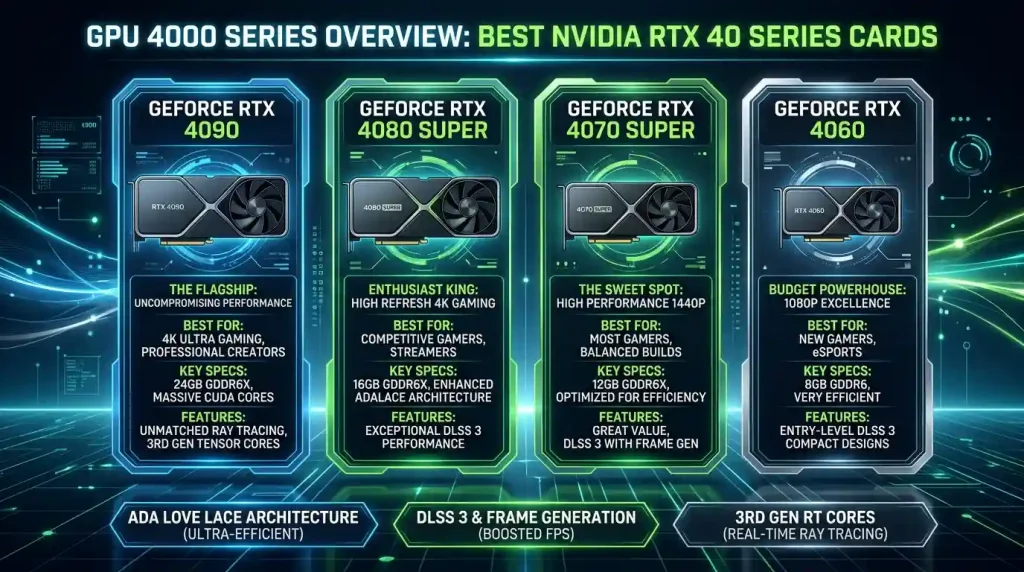
The NVIDIA RTX 4090, launched on October 12, 2022, stands as the undisputed flagship of the RTX 40 Series and is widely regarded as the fastest gaming GPU in the world. Built on the AD102 GPU die, it features an astonishing 16,384 CUDA cores, 512 Tensor Cores, and 128 RT Cores. It is equipped with 24GB of GDDR6X memory on a 384-bit bus, delivering a memory bandwidth of 1.01 TB/s.
With a 450W TDP, the RTX 4090 is designed for enthusiasts who demand the absolute best performance for 4K and even 8K gaming at maximum settings, especially with full ray tracing enabled and DLSS 3 leveraged. Its raw power allows for up to 4x faster performance in full ray-traced games with DLSS 3 compared to the previous-generation RTX 3090 Ti with DLSS 2. While its launch price was $1,599, street prices can vary significantly. The RTX 4090 excels not only in gaming but also in demanding creative applications and AI/ML workloads due to its massive memory and high core count.
NVIDIA RTX 4080 SUPER: High-End Power for Demanding Users
The NVIDIA RTX 4080 SUPER, released on January 31, 2024, replaced the original RTX 4080 and aimed to offer a more competitive price-to-performance ratio. Based on the AD103 GPU, it features 10,240 CUDA cores, 320 Tensor Cores, and 80 RT Cores. It comes with 16GB of GDDR6X memory on a 256-bit interface, delivering improved memory speed at 23 Gbps effective, compared to the original RTX 4080’s 22 Gbps.
With a launch price of $999, the RTX 4080 SUPER is $200 cheaper than its predecessor, making it a more attractive option for high-end 4K gaming with ray tracing. While the performance uplift over the original RTX 4080 is often marginal, around 3-5%, the significant price reduction makes it a much better value. It is recommended for maxed-out 4K gaming with full ray tracing and DLSS 3.
| Model | Architecture | CUDA Cores | VRAM | Memory Bus | TDP | Launch Price (MSRP) |
|---|---|---|---|---|---|---|
| RTX 4090 | Ada Lovelace (AD102) | 16,384 | 24 GB GDDR6X | 384-bit | 450W | $1,599 |
| RTX 4080 SUPER | Ada Lovelace (AD103) | 10,240 | 16 GB GDDR6X | 256-bit | 320W | $999 |
| RTX 4070 Ti SUPER | Ada Lovelace (AD103) | 8,448 | 16 GB GDDR6X | 256-bit | 285W | $799 |
| RTX 4070 SUPER | Ada Lovelace (AD104) | 7,168 | 12 GB GDDR6X | 192-bit | 220W | $599 |
| RTX 4070 | Ada Lovelace (AD104) | 5,888 | 12 GB GDDR6X | 192-bit | 200W | $599 (initially) / $549 (post-SUPER) |
| RTX 4060 Ti 16GB | Ada Lovelace (AD106) | 4,352 | 16 GB GDDR6 | 128-bit | 165W | $499 |
| RTX 4060 Ti 8GB | Ada Lovelace (AD106) | 4,352 | 8 GB GDDR6 | 128-bit | 160W | $399 |
| RTX 4060 | Ada Lovelace (AD107) | 3,072 | 8 GB GDDR6 | 128-bit | 115W | $299 |
NVIDIA RTX 4070 SUPER, 4070 Ti SUPER, and 4070: The Performance Sweet Spot
This segment of the RTX 40 Series aims to provide excellent performance for 1440p and entry-level 4K gaming, offering a balance between price and power. The introduction of the SUPER refresh significantly altered the landscape here.
The RTX 4070 Ti SUPER, launched on January 24, 2024, replaced the original RTX 4070 Ti and brought a notable upgrade. It moved to the larger AD103 chip (the same as the RTX 4080/4080 SUPER) and boosted VRAM from 12GB to 16GB GDDR6X with a wider 256-bit memory bus. With 8,448 CUDA cores and a launch price of $799, it offers a more compelling package for demanding 1440p and respectable 4K gaming.
The RTX 4070 SUPER, released on January 17, 2024, significantly upgraded the original RTX 4070’s specifications while maintaining its $599 launch price. It features 7,168 CUDA cores, a 20% increase over the original 4070, and retains 12GB of GDDR6X memory on a 192-bit bus. This card is a strong performer for high refresh rate 1440p gaming and can handle 4K at acceptable frame rates, especially with DLSS 3.
The original RTX 4070, launched on April 13, 2023, with 5,888 CUDA cores and 12GB GDDR6X, has seen a price reduction to $549 following the SUPER refresh. While still a capable card for 1440p gaming, its value proposition is now somewhat overshadowed by the RTX 4070 SUPER. However, it continues to be a viable option for those seeking the benefits of the Ada Lovelace architecture at a slightly lower cost.
NVIDIA RTX 4060 Ti and 4060: Mainstream Gaming Excellence
For mainstream gamers looking for excellent 1080p performance and solid 1440p capabilities, the RTX 4060 Ti and RTX 4060 offer accessible entry points into the Ada Lovelace generation.
The RTX 4060 Ti was released in two variants: an 8GB version on May 24, 2023, and a 16GB version on July 18, 2023. Both utilize the AD106 GPU with 4,352 CUDA cores. The 8GB model launched at $399, while the 16GB model came in at $499. The 4060 Ti is particularly strong for 1080p gaming, delivering high frame rates and leveraging DLSS 3 for further performance boosts. However, its 128-bit memory bus (even with 16GB VRAM) can be a limiting factor at higher resolutions, leading to some debate over its value for 1440p and 4K.
The RTX 4060, launched on June 29, 2023, is the most budget-friendly card in the desktop RTX 40 Series, starting at $299. It uses the AD107 GPU with 3,072 CUDA cores and 8GB of GDDR6 memory on a 128-bit bus. This card is primarily designed for excellent 1080p gaming performance, offering the benefits of DLSS 3 and enhanced ray tracing at a more accessible price point.
Considerations Before Investing in an RTX 40 Series GPU
While the NVIDIA RTX 40 Series offers impressive performance and groundbreaking technologies, several factors should be considered before making a purchase:
- Pricing and Availability: While MSRPs were set at launch, actual street prices can fluctuate. The “SUPER” refresh in early 2024 brought more competitive pricing for certain models, particularly the RTX 4080 SUPER. However, some 40-series GPUs are no longer being produced, leading to potentially higher prices for remaining stock or second-hand purchases.
- Power Supply Requirements: High-end cards like the RTX 4090 require substantial power (450W TDP), necessitating a robust power supply unit (PSU). Ensure your existing PSU can accommodate the chosen card.
- DLSS 3 Game Support: DLSS 3 is a powerful feature, but its effectiveness depends on game implementation. While support is growing, not all games fully utilize its frame generation capabilities.
- VRAM Capacity: While cards like the RTX 4090 boast 24GB of VRAM, some lower-tier cards like the RTX 4060 Ti 8GB faced criticism for limited VRAM in an era of increasingly demanding game textures, particularly at higher resolutions.
- Future-Proofing: Investing in a newer generation GPU generally offers better future-proofing due to architectural advancements and support for upcoming technologies. The Ada Lovelace architecture’s efficiency and dedicated RT/Tensor cores position the 40 Series well for future gaming and AI trends.
Conclusion
The NVIDIA RTX 40 Series GPUs, built on the Ada Lovelace architecture, represent a monumental achievement in graphics technology. From the unmatched power of the RTX 4090 to the balanced performance of the RTX 4070 SUPER and the accessible entry points of the RTX 4060 series, there’s an Ada Lovelace card designed for nearly every segment of the market. The introduction of DLSS 3 and significant advancements in ray tracing redefine what’s possible in real-time graphics, offering users a truly immersive and “beyond fast” experience. While considerations around pricing and VRAM capacity for certain models exist, the overall generational leap in performance and efficiency makes the RTX 40 Series a compelling choice for anyone looking to build or upgrade a high-performance PC today.