6 Shocking GPU Stock Updates – Scarcity & Price Hikes in 2026
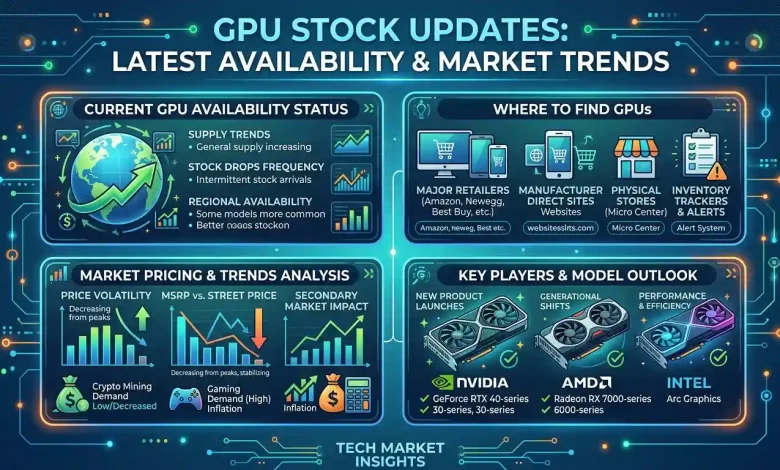
Table of Contents
GPU Stock Updates in mid-2026 present a challenging and dynamic picture for both consumers and businesses. The market is currently characterized by persistent shortages, escalating prices, and significant strategic shifts by major manufacturers like NVIDIA, AMD, and Intel. These trends are not mere short-term disruptions but appear to be structural changes driven by an unprecedented surge in demand, primarily from the artificial intelligence (AI) sector, coupled with critical supply constraints in high-bandwidth memory (HBM), GDDR, and DRAM. Understanding these intricate market forces is crucial for anyone looking to acquire or invest in Graphics Processing Units in the foreseeable future.
Persistent Shortages and Rising Prices: A Market Under Strain
The GPU market is experiencing a rapid tightening, a scenario that analysts indicate will persist through at least mid-2026. GPU pricing is on an upward trajectory across all major product lines. For instance, NVIDIA’s Blackwell GPUs have seen price increases of 15-23%, while Ada GPUs are up 5-10%. This significant rise in cost is accompanied by extended lead times, which now range from 3 to 7 months, with unstable allocation limiting overall availability. The consensus among industry experts is that there is no near-term relief in sight for these price increases or supply constraints.
This inflationary trend is not a speculative bubble but a direct consequence of both supply-side limitations and strategic pricing decisions by manufacturers. The market is witnessing a fundamental shift, where demand continues to outpace supply, creating a seller’s market for virtually all GPU segments. This environment necessitates that buyers plan much further ahead than usual, often 3-6 months, and remain flexible regarding the specific SKUs they intend to purchase. Monitoring pricing trends weekly has become a necessity, as delays can quickly translate into significantly higher costs.
The challenges are particularly acute for high-capacity VRAM models. New GPU prices were expected to rise by 10-20% in Q1 2026, with models featuring more than 16GB of VRAM seeing the highest increases, while cards with less than 12GB are less affected. This disparity further complicates purchasing decisions for gamers and professionals requiring substantial video memory for modern applications and high-resolution gaming. The overall sentiment suggests that patience might not be a virtue in this market; rather, securing supply sooner rather than later is often advisable to mitigate the impact of continued price hikes and dwindling availability.
The AI Revolution and Its Impact on GPU Supply
The single most significant factor driving the current GPU market dynamics is the insatiable demand from the artificial intelligence and enterprise sectors. Data centers and AI infrastructure are consuming vast quantities of GPUs, with enterprise demand consistently outpacing available supply. The data center GPU market alone has exploded to an estimated $48.39 billion in 2026, fueled by major cloud providers pouring over $450 billion into AI infrastructure investments. This long-term, sustained AI demand represents a structural shift in the market, fundamentally different from previous speculative booms like cryptocurrency mining.
The computational requirements of AI workloads, including machine learning training and inference, demand specialized, high-performance GPUs with substantial memory. This has led to manufacturers prioritizing these higher-margin products over consumer-grade graphics cards. For example, NVIDIA is reportedly prioritizing its Blackwell GPUs for AI applications, which consequently places more constraints on the availability of its lower-tier gaming products. This prioritization means that even if silicon for gaming GPUs is theoretically available, production capacity and memory allocation are often diverted to the more lucrative AI segment.
The rapid expansion of the AI GPU rental market and GPU-as-a-service models further underscores this trend. These platforms aggregate compute capacity from multiple providers, enabling organizations to procure and deploy computational resources more efficiently. The GPU-as-a-service sector alone is projected to reach $12.26 billion by 2030, up significantly from $3.79 billion in 2023. This growing ecosystem provides critical infrastructure for AI development but simultaneously intensifies the demand for high-end GPUs, further limiting their availability in traditional retail channels. For a deeper dive into market trends, a comprehensive report on the overall Graphics Processing Unit market offers valuable insights into its projected growth and influencing factors.
Memory Bottlenecks: The Critical Chokepoint
At the heart of the current GPU availability crisis are severe and persistent shortages of memory components, particularly High-Bandwidth Memory (HBM), GDDR, and DRAM. These memory types are directly dependent on high-bandwidth availability, and their scarcity is the primary constraint on GPU production. HBM demand, in particular, has outstripped supply by a historic margin. Modern AI accelerators require exponentially more HBM than their predecessors, with each gigabyte of HBM consuming significantly more wafer capacity than standard DRAM.
Leading memory manufacturers like Micron and SK Hynix have reported that their HBM capacity for both calendar years 2025 and 2026 is fully booked. SK Hynix has committed substantial investments through 2028, allocating 80% to HBM production, yet supply struggles to keep pace with demand. Furthermore, both Samsung and SK Hynix raised HBM3E supply prices by nearly 20% for 2026 contracts, reflecting the intense demand and limited supply.
Beyond memory chips themselves, the advanced packaging technology known as CoWoS (Chip-on-Wafer-on-Substrate) is another significant bottleneck. CoWoS is essential for modern AI accelerators, and TSMC, a key producer, has confirmed that its CoWoS capacity is very tight and remains sold out through 2025 and into 2026. NVIDIA, a dominant player in AI GPUs, has reportedly secured over 60% of TSMC’s total 2026 CoWoS output, indicating a strategic move to secure crucial production capabilities for its high-margin AI products. These multi-faceted memory and packaging constraints mean that even if GPU silicon is available, the ability to assemble and ship finished products is severely hampered.
NVIDIA’s Strategic Moves: RTX 5000 Series and the RTX 3060 Relaunch
NVIDIA’s strategy in 2026 is a complex interplay of prioritizing high-end AI accelerators while attempting to manage the consumer gaming market amid severe component shortages. The highly anticipated GeForce RTX 5000 series, codenamed Blackwell, was announced at CES 2025, with models such as the RTX 5090 and RTX 5080 beginning to ship by late January 2025. These new-generation cards feature GDDR7 memory, PCIe 5.0 support, and advanced AI technologies like DLSS 4, promising significant performance improvements. However, the rollout has not been without its challenges.
Recent reports suggest that NVIDIA plans heavy cuts to its GeForce RTX 50 series graphics card production, potentially reducing supply by 30-40% in the first half of 2026 compared to the previous year. These cuts are attributed to shortages of memory, specifically GDDR7 and other memory types. The impact is expected to be felt most acutely in mid-range models, such as the rumored RTX 5070 Ti and RTX 5060 Ti 16GB, which could see significant supply-side restrictions. Furthermore, rumors indicate that RTX 5000 Super refreshes, initially expected earlier, might be delayed until Q3 2026 due to the scarcity of GDDR7 video RAM modules.
In a surprising move to address the needs of budget-conscious gamers and component shortages, NVIDIA is reportedly relaunching its older RTX 3060 12GB graphics card in June 2026. This strategic decision aims to fill a gap in the market, providing a more affordable option with a respectable 12GB VRAM buffer, even if it lacks the latest DLSS 4 Frame Generation and advanced ray tracing performance of the Ada Lovelace and Blackwell architectures. This relaunch highlights the company’s efforts to navigate memory costs and maintain some presence in the mainstream gaming segment amidst the AI boom.
AMD’s Response: RDNA 4 and Global Availability
AMD, NVIDIA’s primary competitor in the GPU space, is also contending with the same market pressures of high demand and constrained supply. AMD reportedly implemented aggressive GPU price hikes in January 2026, following the broader market trend. The company had confirmed that its next-generation RDNA 4 GPUs would launch in early 2025, aiming to deliver improved performance and features.
At Computex 2026, AMD made significant announcements regarding its RDNA 4 lineup and platform commitments. The company introduced the global rollout of the Radeon RX 9070 GRE graphics card, an RDNA 4-based offering targeting QHD (1440p) gaming. This card, featuring 12GB of memory and next-generation Ray Accelerators, became available worldwide starting June 2nd, with a suggested etail price of US $549. Reviews from Chinese technology news outlets suggest the RX 9070 GRE performs better than NVIDIA’s GeForce RTX 5060 Ti 16GB but falls short of the RTX 5070.
AMD’s strategy seems to focus on solidifying its position in the mid-range and enthusiast gaming segments by offering competitive performance at strategic price points. The company also announced extended support for its Socket AM5 platform through 2029, emphasizing a long-term commitment to upgradability and investment protection for PC builders. Furthermore, AMD is expanding FSR 4.1 support to older GPUs, including RDNA 3 this summer and RDNA 2 in early 2027, aiming to enhance value for existing card owners. This demonstrates a dual approach of releasing new hardware while also improving the software ecosystem for its installed base.
Intel’s Entry and Innovative Memory Approaches
Intel has emerged as a significant third player in the discrete GPU market with its Arc series, challenging the long-standing duopoly of NVIDIA and AMD. While still building its presence in the consumer gaming space, Intel is making notable strides in the data center and AI acceleration segments, particularly at Computex 2026.
At the event, Intel unveiled more details about its next-generation Data Center GPU product, code-named Crescent Island. This GPU is built on Intel’s Xe3P architecture and is specifically designed for “agentic AI” workloads, supporting a broad range of data types from FP4 to FP64. A key differentiator for Crescent Island is its innovative approach to memory. To combat the global HBM crisis, Intel has chosen to forgo traditional GDDR or HBM memory in favor of LPDDR5X. The reference design for Crescent Island includes 160GB of LPDDR5X, with partners having the flexibility to build accelerators with up to 480GB of memory. This decision aims to leverage more readily available LPDDR5X modules to circumvent the severe HBM and GDDR shortages plaguing the industry.
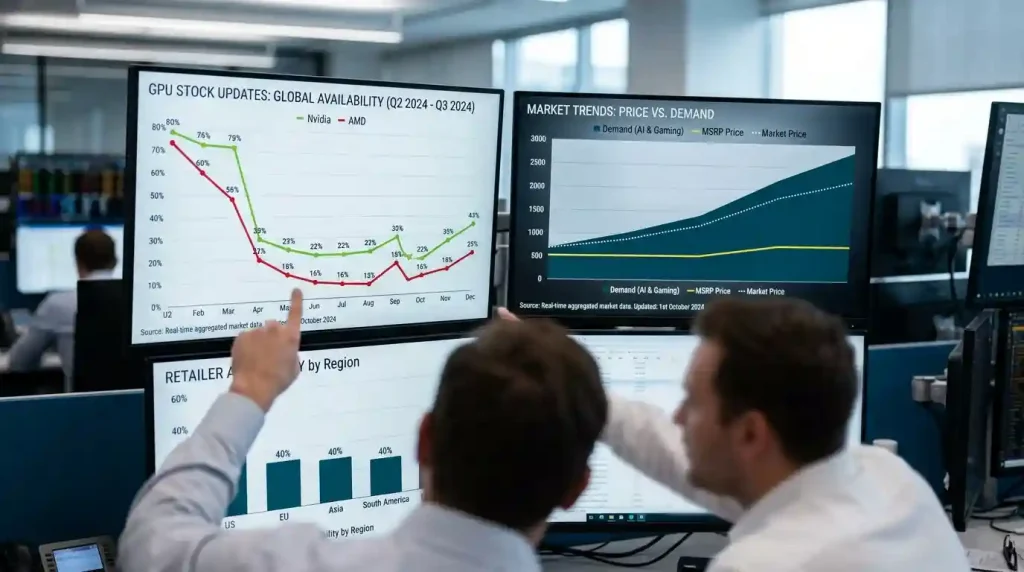
Intel expects Crescent Island to launch in the second half of 2026, positioning itself as a powerful solution for AI inference and agentic workloads in data centers. This strategic choice of memory technology could potentially provide Intel with a unique advantage in securing supply for its enterprise-grade AI accelerators, offering a different pathway for scaling compute capacity in a memory-constrained world. The ongoing development of its oneAPI software stack also aims to provide a robust ecosystem for developers utilizing Intel’s hardware for AI workloads.
Implications for Consumers and Businesses
The confluence of AI-driven demand, pervasive memory shortages, and strategic manufacturer shifts has significant implications for various market segments. For the average consumer and gamer, the outlook for GPU purchases remains challenging. Expect to encounter higher prices, limited model availability, and a potential “8GB bottleneck” for modern gaming at higher resolutions or with ray tracing enabled. While 8GB of VRAM is considered a baseline for 1080p gaming in 2026, 12GB offers more headroom for texture-heavy titles and light modding.
The re-introduction of older cards like the RTX 3060 12GB, while potentially offering a more budget-friendly option, highlights the scarcity of current-generation mid-range GPUs. Consumers are advised to plan purchases well in advance, remain flexible with their choices, and closely monitor pricing trends. Some market watchers even suggest that now might be the best time to buy a GPU to avoid further disappointment and higher costs later in the year. The competitive pressure among cloud providers, however, is leading to broader hardware choices and improved service quality in the GPU rental market, benefiting developers by making advanced hardware more accessible and affordable.
For businesses, particularly those in AI, data processing, and high-performance computing, securing GPU supply is a critical strategic imperative. Lead times for high-end AI GPUs can stretch beyond 30 weeks, and key components like HBM and CoWoS packaging are essentially sold out through 2026. Companies are increasingly turning to GPU marketplaces and reserved capacity options to ensure access to computational resources, which can significantly cut costs compared to on-demand cloud instances. Diversifying sourcing strategies and engaging directly with manufacturers or specialized suppliers are becoming increasingly critical to navigate this tight, supply-constrained market.
Conclusion: A Tightly Controlled and Evolving Market
The GPU market in mid-2026 is at a pivotal juncture, shaped by an unprecedented surge in AI demand and severe, structural memory shortages. This has led to a landscape of rising prices, extended lead times, and strategic prioritization by manufacturers towards enterprise-grade AI accelerators. While NVIDIA continues to dominate the high-end with its Blackwell series, it faces challenges in supplying its gaming lineup, prompting decisions like the RTX 3060 relaunch. AMD is pushing its RDNA 4 architecture into global markets with offerings like the RX 9070 GRE, aiming to secure its position in the gaming segment. Intel, with its innovative LPDDR5X-based Crescent Island GPU, is carving out a niche in the data center AI market by sidestepping the HBM crisis.
For consumers, the advice remains clear: act proactively, be prepared for higher prices, and consider the value proposition of older, re-released cards or those with ample VRAM. For businesses, securing GPU access requires strategic foresight, long-term planning, and potentially leveraging emerging GPU marketplaces. The current market conditions are not merely a temporary blip but rather a reflection of a profound, long-term shift in technology and industrial priorities. The future of GPU availability and pricing will continue to be dictated by the relentless demands of artificial intelligence and the industry’s ability to overcome fundamental component bottlenecks.