7 Best AMD GPUs for Gaming & Content Creation – Complete Buying Guide
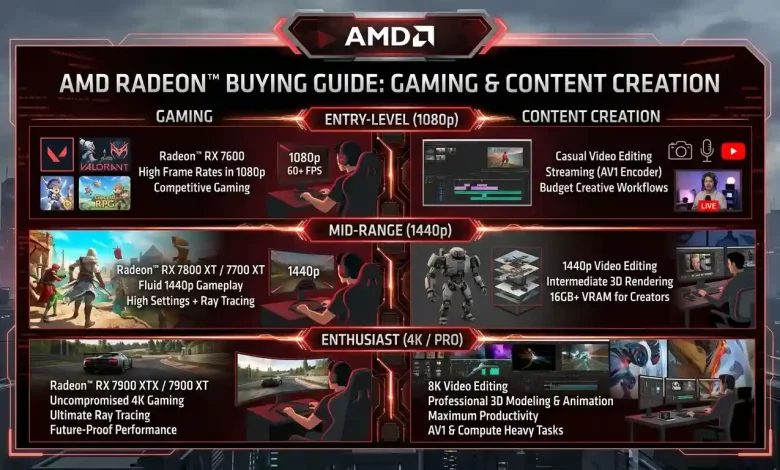
Table of Contents
AMD GPU selection for gaming and content creation has become a critical decision for enthusiasts and professionals alike, offering a compelling blend of performance, value, and innovative features. With the rapid evolution of graphics technology, understanding the nuances of AMD’s Radeon lineup, from the current RX 7000 series to the newer RX 9000 series, is essential for making an informed purchase that aligns with your specific needs and budget. This comprehensive guide aims to demystify the process, providing in-depth insights into AMD’s architectural advancements, signature technologies, and practical recommendations tailored for various gaming resolutions and demanding creative workloads.
Understanding AMD’s GPU Architectures: RDNA 3 and RDNA 4
At the heart of modern AMD Radeon graphics cards lie the RDNA architectures, with RDNA 3 currently powering the RX 7000 series and the newer RDNA 4 architecture driving the latest RX 9000 series. The RDNA 3 architecture introduced significant advancements over its predecessor, RDNA 2, including a groundbreaking chiplet design that combines 5nm and 6nm process nodes optimized for specific tasks. This design delivers up to 54% more performance per watt than RDNA 2 architecture. RDNA 3 features new unified compute units, second-generation AMD Infinity Cache technology, and up to 24 GB of high-speed GDDR6 memory. It also boasts dedicated AI acceleration and second-generation raytracing, providing up to 2.7 times more AI performance and up to 1.8 times more raytracing performance compared to RDNA 2. These enhancements contribute to a performance uplift of up to 1.7 times in select titles at 4K resolutions.
The RDNA 3 architecture also brought improvements in clock speeds, with the front end operating at up to 2.5 GHz and shaders at 2.3 GHz, contributing to power savings. Furthermore, it includes a new “Radiance Display Engine” supporting DisplayPort 2.1 UHBR 13.5, which delivers up to 54Gbps bandwidth for high refresh rates at 4K (up to 480Hz) and 8K (up to 165Hz). A dedicated media engine, based on VCN 4.0, also supports AV1 encoding and decoding, comparable in quality to NVIDIA’s NVENC AV1 encoder, and can handle a higher number of simultaneous encoding streams. For content creators, RDNA 3’s advanced AI and compute features accelerate machine learning capabilities, benefiting professional applications like content creation and scientific computing.
Moving forward, the RX 9000 series, based on the RDNA 4 architecture, further refines these capabilities, aiming for enhanced efficiency and performance. While specific detailed comparisons of RDNA 4 vs. RDNA 3 are still emerging, the RDNA 4 architecture continues AMD’s focus on powerful raytracing and AI accelerators, as well as improved visual quality for video streaming and recording. This ongoing architectural evolution ensures that AMD GPUs remain competitive and future-ready for the demands of modern gaming and content creation workflows.
Key AMD Technologies for Enhanced Performance
Beyond raw architectural power, AMD integrates several key technologies to further boost performance and user experience:
- AMD FidelityFX Super Resolution (FSR): FSR is an open-source upscaling technology designed to deliver smoother frame rates and higher resolutions without necessarily requiring the latest, most powerful hardware. It works by rendering games at a lower resolution and then intelligently upscaling the image to match the display’s target resolution, resulting in a visually sharp image that is close to native resolution but with significantly higher frame rates. Unlike NVIDIA’s DLSS, FSR is hardware agnostic, meaning it works on both AMD Radeon and NVIDIA GeForce graphics cards, as well as older cards and APUs, making it widely compatible. FSR offers multiple quality presets, including Ultra Quality, Quality, Balanced, and Performance, allowing users to balance visual fidelity and frame rates. The latest iteration, FSR 4, is being integrated into newer GPUs like the Radeon RX 9060 XT and offers ML-powered upscaling. This technology is particularly beneficial for enabling ray tracing and playing at 4K on mid-range hardware without a major performance hit.
- AMD Smart Access Memory (SAM): Smart Access Memory (SAM) is a technology that allows AMD Ryzen processors to gain immediate and full access to the AMD Radeon graphics memory, improving data transfer efficiency and reducing latency between the CPU and GPU. Traditionally, CPUs could only access a limited 256MB portion of GPU VRAM at any given time, creating a potential bottleneck. SAM addresses this by enabling full access to the graphics frame buffer, which can result in noticeable performance gains, especially in games that handle large assets and at higher resolutions like 1440p and 4K, where memory transfers are more critical. Performance benefits vary by game and resolution, typically ranging from 0% to 15%, with an average improvement of 3-7%. SAM is particularly effective in newer games optimized for these technologies.
Choosing the Right AMD GPU for Gaming
Selecting the ideal AMD GPU for gaming largely depends on your desired resolution, refresh rate, and the graphical intensity of the games you play:
- 1080p Gaming: For smooth 1080p gaming, especially if you aim for high refresh rates in esports titles or comfortable frame rates in AAA games with medium to high settings, several AMD GPUs offer excellent value. The AMD Radeon RX 9060 XT (16GB) is a strong contender, delivering potent frame rates across many game types and serving as a sweet spot for 1080p and light 1440p play. An 8GB variant of the RX 9060 XT is also available for a more budget-friendly option, performing admirably at 1080p. Even older generations like the Radeon RX 6600, though released in 2021, can still keep up with PC games at 1080p, especially if ray tracing isn’t a primary concern.
- 1440p Gaming: The 1440p resolution offers a fantastic balance between visual fidelity and performance. AMD particularly shines in this segment, delivering excellent performance for the money. The AMD Radeon RX 9070 is highly recommended for 1440p, offering 100+ FPS on average in demanding games. The RX 9070 XT is also an excellent choice, capable of chewing through 1440p at max settings and even handling 4K with minor tweaks. The RX 7800 XT with 16GB GDDR6 memory is another very capable option that challenges NVIDIA in this tier. These cards provide ample VRAM (12GB or more is recommended for 1440p, especially with ultra textures and ray tracing) to handle modern titles without lag.
- 4K Gaming: For an immersive 4K gaming experience, you’ll need a powerful GPU with substantial VRAM. The AMD Radeon RX 7900 XTX is a flagship-class GPU that easily powers most AAA games at 4K max settings. It comes with 24GB of GDDR6 memory and RDNA 3 architecture, offering excellent 4K performance at a competitive price point. The RX 9070 XT is also cited as offering excellent 4K performance. The RX 7900 XT is another strong option, providing impressive frame rates in popular titles at 4K, especially for those looking for a balance of performance and value. Using FSR with these cards can further boost performance, allowing for 80+ FPS on average in high-demanding games at 4K.
AMD GPUs for Content Creation: Powering Your Creative Workflow
AMD GPUs are increasingly robust options for content creators, offering strong performance in various professional applications, though some considerations remain compared to competitors like NVIDIA due to software optimization and specific acceleration features.
- Video Editing: For video editing, particularly with high-resolution footage, VRAM is crucial. The AMD Radeon RX 7900 XTX, with its 24GB of GDDR6 memory, is a compelling option for creators working with complex layered timelines and 4K content, and can even handle edge-case 8K footage. The RX 7900 XT, with 20GB of VRAM, also offers a significant advantage for applications that can leverage the additional memory. For 1080p editing, such as vlogs or social clips, the RX 9060 XT with 16GB of video memory provides strong performance for its price, handling common codecs and maintaining smooth editing. While AMD’s RDNA 3 architecture has improved video editing performance, some applications, especially those heavily reliant on NVIDIA’s CUDA cores, might still show a preference for NVIDIA GPUs. However, for DaVinci Resolve color grading, the AMD RX 9070 XT is highly regarded due to its OpenCL optimization and high VRAM, offering better value than similarly priced NVIDIA cards.
- 3D Rendering and Design: AMD GPUs are well-suited for 3D rendering and design, particularly in open-source workflows. The AMD Radeon RX 7900 XTX shows excellent results in Blender’s HIP renderer, competing favorably with higher-priced NVIDIA cards. For real-time work in Unreal Engine, the RX 7900 XTX handles complex scenes smoothly, though its ray tracing performance may lag behind NVIDIA’s dedicated RT cores. For professional workstation-grade demands, such as CAD, BIM, and architectural visualization, the AMD Radeon PRO W7900 stands out with 48GB of memory. The RX 7000 series and PRO W7000 series also offer improved Blender Cycles rendering performance with HIP RT. The RDNA 3 architecture, with its advanced AI and compute features, also benefits these GPU-intensive tasks.
- Streaming: The RDNA 3 architecture includes a redesigned media engine with AV1 encoding, optimized for streaming applications like OBS, ensuring high-quality video streaming and recording.
Navigating the AMD Radeon Lineup: RX 7000 vs. RX 9000 Series
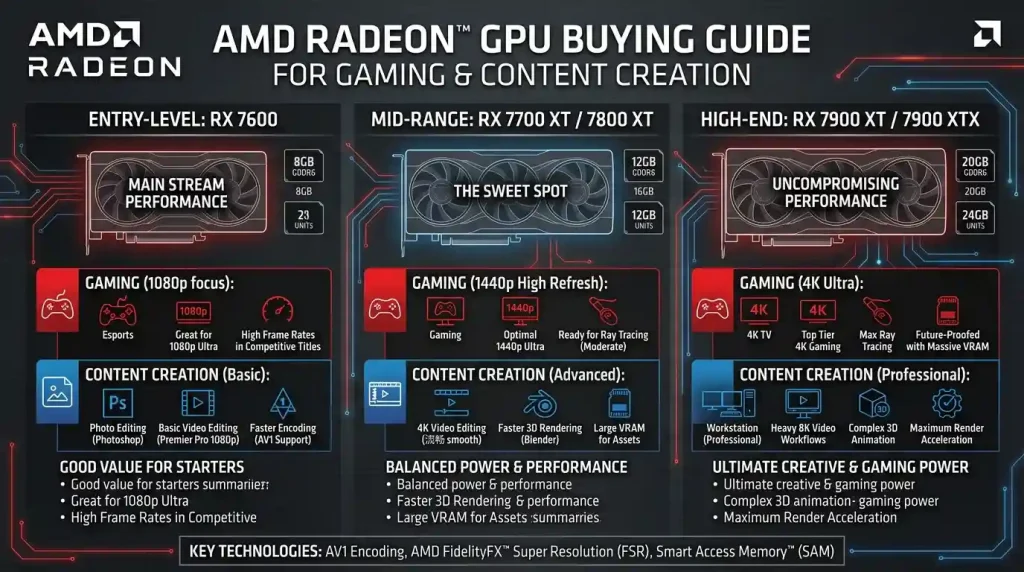
AMD’s recent and upcoming GPU releases present a spectrum of choices for different budgets and performance tiers. The RX 7000 series, built on RDNA 3, offers robust performance, while the newer RX 9000 series, based on RDNA 4, represents the latest advancements.
AMD Radeon RX 7000 Series:
The RX 7000 series, launched in late 2022, brought significant performance uplifts over the RDNA 2 generation. Key models include:
- RX 7900 XTX: This is the enthusiast-tier card, designed for demanding 4K gaming and high-quality content creation. It features 24GB of GDDR6 memory and offers top-tier performance for both gaming and creative tasks. It provides excellent value for 4K editing and handles complex timelines reliably.
- RX 7900 XT: A high-end option offering a balance of performance and price, suitable for excellent 1440p and capable 4K gaming. It typically comes with 20GB of GDDR6 memory, giving it an advantage in memory-intensive games and applications compared to some competitors.
- RX 7800 XT: Positioned for strong 1440p gaming, this card offers competitive performance and typically comes with 16GB of GDDR6 VRAM, making it a solid choice for its price point.
- RX 7600/XT: These cards are generally aimed at 1080p gaming, offering good performance at that resolution. The RX 7600 XT with 16GB of GDDR6 VRAM is highlighted as an ultimate value play for 1080p dominance and entry-level 1440p with medium settings, with good future-proofing for VRAM.
AMD Radeon RX 9000 Series (RDNA 4):
The RX 9000 series, featuring RDNA 4 architecture, represents the latest generation with further refinements in performance and efficiency. These cards launched in late 2024 to early 2025. Prominent models include:
- RX 9070 XT: Often cited as one of the best AMD graphics cards for most people, it provides excellent 4K performance without a high price tag. It’s also an excellent 1440p card and offers greatly improved ray tracing performance over last-gen GPUs. For video editing, it’s considered a strong value pick.
- RX 9070: A strong contender for 1440p gaming and a good value option for 4K. It typically comes with 16GB of VRAM and delivers high frame rates in demanding titles. It’s noted as the best overall AMD card for most PC gamers.
- RX 9060 XT: Delivering one of the largest generational performance leaps, the RX 9060 XT (16GB) is a sweet spot for 1080p and light 1440p play. Its 16GB of VRAM offers good future-proofing at an aggressive price point. An 8GB version is also available as a budget-friendly choice for 1080p.
When comparing generations, the RX 7900 XTX and RX 7900 XT clearly surpassed anything from AMD’s previous RDNA 2 generation due to more CUs, VRAM, and memory bandwidth. However, for mid-range cards like the RX 7800 XT versus RX 6800 XT, the performance uplift can be more incremental, around 5% faster due to higher clocks and architectural improvements. The RX 9000 series aims to build on these foundations with RDNA 4.
| AMD GPU Model | Target Resolution (Gaming) | VRAM | Key Strengths | Ideal Use Case (Content Creation) |
|---|---|---|---|---|
| AMD Radeon RX 9070 XT | 4K / High-Refresh 1440p | 16GB+ GDDR6 | Excellent 4K performance, improved ray tracing, strong value. | 4K Video Editing, Advanced 3D Rendering |
| AMD Radeon RX 9070 | High-End 1440p / Entry 4K | 16GB GDDR6 | Best overall for most PC gamers, great 1440p, good 4K value. | 4K Video Editing, Mid-range 3D Rendering |
| AMD Radeon RX 7900 XTX | Enthusiast 4K | 24GB GDDR6 | Top-tier 4K performance, high VRAM, excellent for demanding tasks. | Complex 4K/8K Video Editing, High-end 3D Rendering |
| AMD Radeon RX 7900 XT | 4K / High-End 1440p | 20GB GDDR6 | Good balance of performance and price, abundant VRAM for applications. | 4K Video Editing, Mid-to-High 3D Rendering |
| AMD Radeon RX 7800 XT | 1440p | 16GB GDDR6 | Very capable 1440p gaming, competitive performance. | 1440p Video Editing, Casual 3D Work |
| AMD Radeon RX 9060 XT (16GB) | 1080p / Light 1440p | 16GB GDDR6 | Excellent performance for its price, good VRAM for future-proofing. | 1080p Video Editing, Entry-level Content Creation |
Essential Considerations Before You Buy
Beyond the core GPU model, several other factors play a crucial role in your AMD GPU buying decision:
- VRAM (Video Random Access Memory): VRAM is your GPU’s dedicated memory, holding textures, lighting data, and other assets. Adequate VRAM is crucial for smooth performance, especially at higher resolutions and with demanding games or content creation tasks. For 1080p, 8GB of GDDR6 is often sufficient, but for 1440p or light 4K, 12GB or more is highly recommended, particularly if you use ultra textures or ray tracing. For 4K and 8K video editing or complex 3D rendering, 16GB to 24GB or more is ideal. Cards like the RX 7900 XTX with 24GB or RX 9070 XT with 16GB+ offer significant headroom.
- Power Supply Unit (PSU): A robust and reliable PSU is vital to ensure stable operation. Higher-end AMD GPUs, especially the RX 7900 XTX and RX 9070 XT, require substantial power. Always check the recommended PSU wattage for your chosen GPU to avoid system instability or performance issues. Investing in a good quality PSU can save you headaches in the long run.
- Cooling Solution: Effective cooling is essential for maintaining optimal performance and longevity of your GPU, especially during extended gaming sessions or heavy rendering workloads. Many AMD cards come with robust custom cooling solutions from board partners like Sapphire, XFX, and PowerColor. Consider models with triple-fan designs for better thermal management, particularly for higher-tier GPUs.
- Display Connectivity: Ensure your chosen AMD GPU supports the display outputs required for your monitor setup. Modern AMD Radeon RX 7000 and 9000 series GPUs feature DisplayPort 2.1, which is crucial for achieving ultra-high refresh rates at 4K and 8K resolutions. This future-proof connectivity is a significant advantage for those investing in high-end monitors.
- Ecosystem Compatibility: If you already own an AMD Ryzen CPU, combining it with an AMD Radeon GPU can unlock synergistic benefits through technologies like Smart Access Memory. While not strictly necessary, an all-AMD system can sometimes offer optimized performance and a more streamlined user experience.
- Budget and Value: AMD is often lauded for its strong price-to-performance ratio, particularly in the mid-range and high-end segments. Always consider the overall value proposition—how much performance you get for your money—rather than just the raw price. GPUs like the RX 9070 XT and RX 9060 XT are frequently highlighted for offering exceptional value.
For more detailed technical specifications on various GPU architectures, including RDNA, it’s always helpful to consult authoritative resources such as Wikipedia’s entry on RDNA microarchitecture, which provides a comprehensive overview of AMD’s design principles and generational improvements.
Conclusion
Choosing the right AMD GPU in 2026 involves a careful evaluation of your specific needs for gaming and content creation, balanced against your budget. AMD’s RDNA 3 and the newer RDNA 4 architectures offer compelling performance, enhanced efficiency, and a suite of innovative features like FSR and Smart Access Memory. Whether you’re aiming for immersive 4K gaming with the Radeon RX 7900 XTX or RX 9070 XT, seeking a sweet spot for 1440p with the RX 9070 or RX 7800 XT, or looking for excellent value in 1080p with the RX 9060 XT, AMD provides a diverse and competitive lineup. By considering factors like VRAM, power requirements, cooling, and display connectivity, you can confidently select an AMD Radeon GPU that will power your digital experiences for years to come, ensuring smooth gameplay and efficient creative workflows.