7 Best NVIDIA RTX GPUs in 2026 – Performance & Value Compared
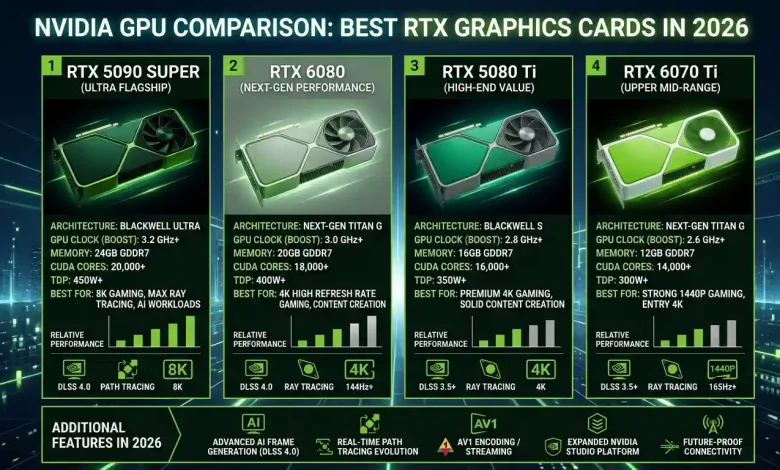
Table of Contents
NVIDIA GPU comparison in 2026 reveals a landscape transformed by continuous innovation, particularly within the RTX series. As we navigate the mid-point of the decade, graphics processing units (GPUs) are no longer just about rendering pixels; they are sophisticated engines driving advancements in AI, professional content creation, and hyper-realistic gaming experiences. NVIDIA’s RTX lineup, powered primarily by the Blackwell architecture in 2026, continues to set benchmarks, integrating groundbreaking technologies like advanced ray tracing and highly evolved Deep Learning Super Sampling (DLSS) to deliver unparalleled performance and visual fidelity across a spectrum of user needs. This comprehensive article delves into the best RTX graphics cards available in 2026, offering insights into their performance, features, and target applications to help you make an informed decision.
The Evolving Landscape of Graphics Technology in 2026
The year 2026 marks a significant inflection point in graphics technology. The demand for GPUs extends far beyond traditional gaming, now encompassing complex AI model training, real-time rendering, virtual reality, and scientific simulations. NVIDIA, a perennial leader in this space, has responded with architectures that are more versatile and powerful than ever before. Key trends driving this evolution include the maturation of ray tracing, the omnipresence of AI-driven upscaling technologies, and the increasing integration of specialized cores for AI workloads directly into consumer-grade GPUs. The Blackwell architecture, which underpins the majority of NVIDIA’s 2026 RTX consumer cards, is a testament to this integrated approach, featuring redesigned streaming multiprocessors, fifth-generation RT Cores, and fourth-generation Tensor Cores. These advancements are crucial for handling the immense computational demands of modern applications and games, ensuring that visual experiences are not only stunning but also highly efficient.
Decoding NVIDIA’s 2026 RTX Lineup: The Blackwell Generation
By 2026, NVIDIA’s consumer GPU offerings are largely defined by its Blackwell architecture, which succeeds the Ada Lovelace architecture. While Ada Lovelace was revolutionary at its launch, Blackwell introduces significant improvements across the board, particularly in AI performance, ray tracing throughput, and overall energy efficiency. The Blackwell GPUs are designed with a focus on accelerating generative AI models and enhancing graphics rendering capabilities. NVIDIA’s roadmap, as revealed at events like Computex 2026, outlines the continued commitment to new generations of platforms, including the RTX Spark “superchip” for laptops and desktops, hinting at a future that deeply integrates CPU and GPU technologies. The RTX 50 series, built on this Blackwell foundation, offers a range of cards from enthusiast-grade powerhouses to more accessible mainstream options, each designed to cater to specific performance tiers and user requirements. This generation sees the debut of GDDR7 memory in many high-end models, offering substantially faster data transfer speeds compared to previous GDDR6X iterations.
Flagship Dominance: The RTX 5090
The NVIDIA GeForce RTX 5090 stands as the undisputed champion of consumer graphics cards in 2026. Launched in early 2025, this GPU is a beast, featuring a massive core count, up to 32GB of GDDR7 VRAM, and the cutting-edge Blackwell architecture. It delivers unparalleled 4K frame rates, even with ray tracing fully enabled, making it the definitive choice for enthusiasts seeking a no-compromise gaming and content creation experience. Expected to provide a significant performance leap over its predecessor, the RTX 4090, early benchmarks suggested it could be 27-35% faster in most 4K gaming scenarios, with some ray tracing workloads seeing up to a 50% improvement. For professionals, the RTX 5090’s enhanced AI and rendering throughput, combined with its substantial memory bandwidth (around 1.79 TB/s), makes it a powerhouse for complex AI workloads and real-time 3D rendering. While its price tag often exceeds $2,000 and it has a considerable power draw of around 575W, for those who demand the absolute best, the RTX 5090 remains the top choice.
High-End Workhorses: The RTX 5080 and RTX 5070 Ti
Stepping down from the flagship, the RTX 5080 and RTX 5070 Ti offer an impressive balance of performance and value for high-end gaming and professional tasks. The NVIDIA GeForce RTX 5080, also based on the Blackwell architecture, is considered an excellent 4K card that provides better value than the 5090. It features 16GB of GDDR7 memory, offering a substantial memory bandwidth increase over the RTX 4080 (960 GB/s versus 717 GB/s). With 10,752 CUDA cores and 84 fourth-generation RT cores, it boasts improved ray tracing capabilities and fifth-generation Tensor Cores for enhanced AI acceleration. The RTX 5080 typically offers around 55-60% of the RTX 5090’s raw performance at roughly half the price, making it a “sweet spot” for many 4K gamers. It supports DLSS 4 and Multi-Frame Generation, ensuring smooth frame rates even in the most demanding titles. The RTX 5080’s thermal design has also seen improvements, allowing for quieter operation despite a higher TDP of 360W.
The NVIDIA GeForce RTX 5070 Ti is another strong contender for high-refresh-rate 1440p gaming and even entry-level 4K. With 16GB of GDDR7 VRAM, it’s designed to handle competitive games at 240Hz and AAA titles above 100 FPS at 1440p. It also benefits from DLSS 4 and NVIDIA Reflex for reduced latency, making it an ideal choice for competitive gamers.
Mid-Range Powerhouses: RTX 5070 and RTX 5060
For the majority of gamers and creators, the mid-range RTX cards in 2026 offer compelling performance without the premium price tag of their higher-end siblings. The NVIDIA GeForce RTX 5070 is widely regarded as the definitive 1440p GPU for 2026. Built on the Blackwell architecture and featuring 12GB of GDDR7 memory, it delivers performance comparable to the previous generation’s RTX 4080 at a significantly lower price point. It provides comfortable headroom for 1440p ultra textures with ray tracing enabled, especially when paired with DLSS 4’s Multi-Frame Generation.
The NVIDIA GeForce RTX 5060 caters to the budget-conscious market, offering excellent 1080p performance and viable 1440p gaming with DLSS. It typically comes with 8GB of GDDR7 VRAM and delivers a noticeable performance increase over the RTX 4060 at a similar price. The RTX 5060 Ti, with 16GB of GDDR7 VRAM, offers even better value for reliable 1440p performance. These cards ensure that even at more accessible price points, users can still experience the benefits of NVIDIA’s latest architectural advancements and AI-powered features.
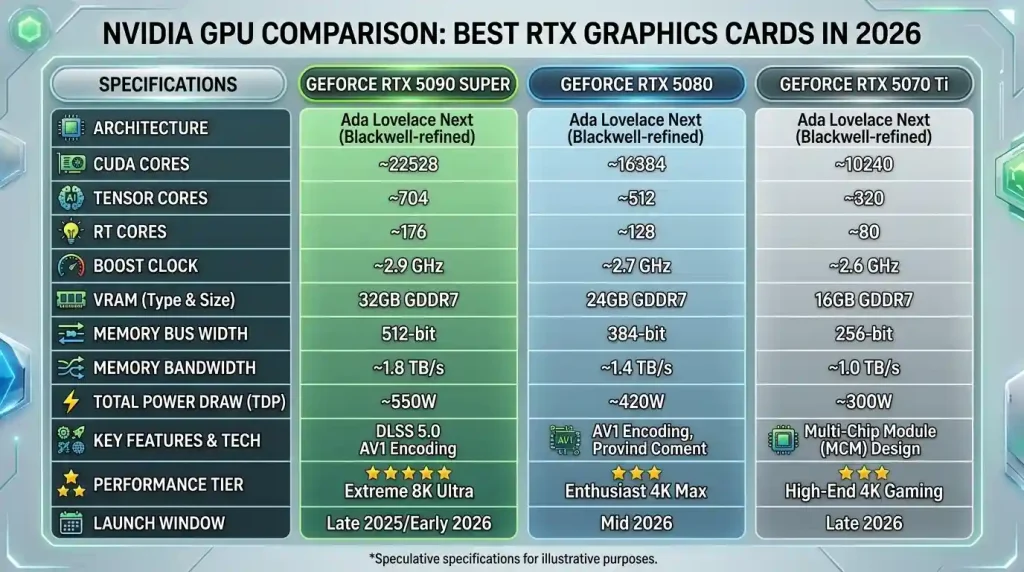
| Model (Hypothetical) | Architecture | VRAM (Type) | Memory Bus | Key Features (2026) | Target Resolution & Use | Approximate TDP |
|---|---|---|---|---|---|---|
| RTX 5090 | Blackwell | 32GB GDDR7 | 512-bit | 5th-Gen Tensor Cores, 5th-Gen RT Cores, DLSS 4.5, Ray Reconstruction, Multi-Frame Generation, AI Acceleration | Ultra 4K Gaming, Path Tracing, Professional Content Creation, AI/ML | 575W |
| RTX 5080 | Blackwell | 16GB GDDR7 | 256-bit | 5th-Gen Tensor Cores, 4th-Gen RT Cores, DLSS 4.5, Ray Reconstruction, Multi-Frame Generation, AI Acceleration | High-Refresh 4K Gaming, High-End 1440p, Advanced Content Creation | 360W |
| RTX 5070 Ti | Blackwell | 16GB GDDR7 | 256-bit | 5th-Gen Tensor Cores, 4th-Gen RT Cores, DLSS 4.5, Multi-Frame Generation | High-Refresh 1440p Gaming, Entry 4K Gaming, VR | 280W |
| RTX 5070 | Blackwell | 12GB GDDR7 | 192-bit | 5th-Gen Tensor Cores, 4th-Gen RT Cores, DLSS 4.5, Multi-Frame Generation | 1440p Gaming, Mainstream Content Creation | 220W |
| RTX 5060 Ti | Blackwell | 16GB GDDR7 | 128-bit | 5th-Gen Tensor Cores, 4th-Gen RT Cores, DLSS 4.5, Multi-Frame Generation | Solid 1440p Gaming, High-End 1080p | 180W |
| RTX 5060 | Blackwell | 8GB GDDR7 | 128-bit | 5th-Gen Tensor Cores, 4th-Gen RT Cores, DLSS 4.5, Multi-Frame Generation | 1080p Gaming, Entry 1440p | 150W |
Key Technologies Defining RTX in 2026
The true power of NVIDIA’s RTX cards in 2026 lies not just in raw hardware specifications, but in the intelligent integration of several key technologies. These features work in concert to deliver superior visual experiences and accelerate demanding workloads:
- Advanced Ray Tracing: Ray tracing has matured significantly, offering hyper-realistic lighting, reflections, and shadows in games and professional renderings. With fifth-generation RT Cores in Blackwell, performance in ray-traced scenes is dramatically improved, allowing for full path tracing at high resolutions without aggressive upscaling. NVIDIA continues to enhance real-time ray tracing, making it a cornerstone of modern graphics.
- DLSS (Deep Learning Super Sampling) 4.5 and Ray Reconstruction: DLSS remains a critical component of the RTX ecosystem. By 2026, we are seeing DLSS 4.5, which includes a second-generation Transformer AI model for sharper textures, cleaner edges, and improved handling of fast motion. Furthermore, DLSS 4.5 introduces Ray Reconstruction, a neural rendering technique that significantly enhances image quality in ray-traced and path-traced scenes by replacing traditional denoisers with an AI network trained to generate higher-quality pixels. This technology, featuring an improved transformer architecture and an expanded training dataset, aims to deliver superior ray-traced image quality for all GeForce RTX gamers.
- AI Acceleration (Tensor Cores): NVIDIA’s Tensor Cores are specialized processing units designed to accelerate AI workloads. With fifth-generation Tensor Cores in Blackwell-based GPUs, AI performance receives a substantial boost, enabling features like DLSS 4.5, AI-assisted video editing, 3D rendering, and local AI model execution. This focus on AI acceleration extends beyond gaming, powering breakthroughs in generative AI and other compute-intensive applications. For a deeper understanding of this transformative technology, you can explore how ray tracing works on Wikipedia.
- Multi-Frame Generation: DLSS 4.5 introduces Dynamic Multi Frame Generation, offering 5x and 6x multipliers that dynamically adjust to ensure the smoothest gameplay experience. This technology intelligently generates additional frames, further boosting frame rates in supported titles.
- DisplayPort 2.1b: Many 2026 RTX cards are equipped with DisplayPort 2.1b, offering significantly higher bandwidth than previous standards and enabling support for higher resolutions and refresh rates, crucial for future-proof display technology.
Performance Benchmarks and Real-World Scenarios
In 2026, NVIDIA’s RTX 50 series, particularly the RTX 5090 and RTX 5080, continues to deliver exceptional performance across various demanding scenarios. For 4K gaming, the RTX 5090 consistently provides frame rates well over 150 FPS in top AAA titles with ray tracing enabled at max settings. The RTX 5080, while slightly behind, still offers robust 4K performance, often reaching the performance ceiling most users require. At 1440p, cards like the RTX 5070 and RTX 5070 Ti excel, maintaining high refresh rates even in competitive esports titles. The integration of DLSS 4.5 with its advanced Super Resolution and Multi-Frame Generation capabilities plays a crucial role in these performance figures, allowing for higher frame rates with minimal perceived image quality loss. Professional applications, including 3D rendering, video editing, and scientific simulations, also see substantial gains due to the enhanced Tensor Cores and GDDR7 VRAM. The RTX 5090, with its 32GB GDDR7, is particularly adept at handling large AI models and data-intensive tasks. However, it’s worth noting that early benchmarks for the RTX 5090 and 5080 showed a driver issue that impacted AI performance, suggesting that real-world performance will likely improve further with software optimizations.
Competition and Market Dynamics
While NVIDIA continues to dominate the high-end GPU market, the competitive landscape in 2026 is robust. AMD’s RDNA 4 architecture, powering their Radeon RX 9000-series cards, presents a compelling challenge, especially in price-to-performance and VRAM capacity in certain tiers. AMD has significantly closed the gap in ray tracing performance with RDNA 4 and introduced FSR 4, its first machine-learning upscaling model, which now produces image quality rivaling DLSS Quality mode. Intel’s Arc platform is also maturing, offering credible budget options. This increased competition benefits consumers, driving innovation and offering more choices across various price points. However, market dynamics in 2026 also indicate potential challenges, such as graphics card price increases and supply constraints due to high AI wafer demand crowding out gaming GPU production. This could make certain high-end RTX 50-series cards more expensive than their initial MSRPs. Despite this, NVIDIA’s strong ecosystem, including CUDA, DLSS, and its leadership in AI hardware, maintains its dominant position, especially for AI training and professional workloads.
Conclusion
The NVIDIA RTX graphics card lineup in 2026 showcases a formidable blend of raw power and intelligent technology. The Blackwell architecture has propelled performance to new heights, particularly in 4K gaming, ray tracing, and AI acceleration. From the uncompromising might of the RTX 5090 to the balanced excellence of the RTX 5080 and RTX 5070, and the accessible performance of the RTX 5070 and RTX 5060, there is an RTX card tailored for nearly every user and budget. The continuous evolution of technologies like DLSS 4.5 with Ray Reconstruction ensures that visual fidelity remains cutting-edge while maintaining playable frame rates. As the industry moves further into an era where AI and graphics are inextricably linked, NVIDIA’s RTX series stands as a leader, offering not just exceptional gaming experiences but also powerful tools for creators and professionals. While competition from AMD and Intel is intensifying, NVIDIA’s robust ecosystem and relentless innovation position its RTX GPUs as a top choice for those seeking the best in graphics technology in 2026.