7 Best GPUs of 2026 Ranked – Performance & Value Compared
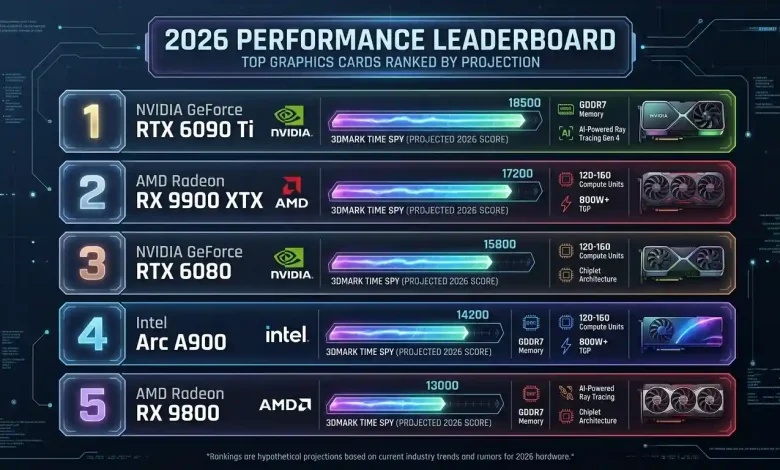
Table of Contents
Best GPU in 2026: The graphics processing unit (GPU) market in 2026 stands as a testament to relentless innovation and intense competition, driven by the ever-increasing demands of gaming, artificial intelligence (AI), and professional content creation. This year, consumers are faced with an intricate landscape of choices, each offering a unique blend of raw power, advanced features, and efficiency. From bleeding-edge architectures pushing the boundaries of realism to more accessible options delivering exceptional value, selecting the ideal graphics card requires a nuanced understanding of current technologies and future trends. The industry continues its rapid evolution, with manufacturers like NVIDIA, AMD, and Intel introducing new generations that redefine what’s possible in visual computing. This comprehensive article delves into the top graphics cards of 2026, ranking them by their performance across various workloads and highlighting the critical factors that will influence purchasing decisions for enthusiasts and professionals alike.
Introduction to the 2026 GPU Landscape
The year 2026 finds the GPU market in a dynamic state, characterized by significant advancements and persistent challenges. Demand for graphics cards continues its robust growth, primarily fueled by the gaming industry, technological breakthroughs, and the escalating needs of professional sectors such as AI and data centers. Recent reports indicate a projected global graphics card market size of $27.64 billion in 2026, with continued growth expected. However, this growth is not without its hurdles; memory shortages, particularly in HBM, GDDR, and DRAM, remain a primary constraint on GPU production, leading to rising prices and extended lead times. This has influenced pricing strategies, with NVIDIA, for example, prioritizing higher-margin Blackwell GPUs, which can lead to constraints on lower-tier products.
Despite these supply-side pressures, innovation is flourishing. NVIDIA has cemented its Blackwell architecture as a cornerstone, with the RTX 5000 series dominating high-end consumer and professional segments. AMD’s RDNA 4 architecture, powering its RX 9000 series, offers strong competition, particularly in rasterization performance and improved ray tracing. Intel, while a newer entrant in the discrete GPU space, continues to expand its Arc lineup, demonstrating a commitment to becoming a formidable third player. The focus extends beyond raw frame rates; AI integration, enhanced ray tracing, and power efficiency are now central to GPU design and performance evaluation. The market is evolving, and understanding these shifts is crucial for anyone looking to invest in the best graphics card in 2026.
Key Factors to Consider When Choosing a GPU in 2026
Selecting the ideal graphics card in 2026 goes beyond simply looking at the largest number on a benchmark chart. A nuanced understanding of various performance metrics and features is essential to make an informed decision that aligns with individual needs and budget.
- Rasterization Performance (FPS): For most gamers, traditional frame rate performance, measured in frames per second (FPS), remains the highest priority, especially at 1080p and 1440p resolutions. This metric reflects how quickly a GPU can render and display images on a monitor. Higher FPS translates to smoother gameplay and a more responsive experience.
- Ray Tracing and Path Tracing Capabilities: Ray tracing technology, which simulates the physical behavior of light, has become a standard feature in modern GPUs, enabling incredibly realistic lighting, shadows, and reflections. In 2026, advanced ray tracing and even early forms of path tracing are more mainstream, making dedicated RT cores and their efficiency crucial for immersive visual experiences.
- AI & Upscaling Technologies (DLSS, FSR, XeSS): Artificial intelligence plays a pivotal role in boosting performance and image quality. Technologies like NVIDIA’s Deep Learning Super Sampling (DLSS), AMD’s FidelityFX Super Resolution (FSR), and Intel’s Xe Super Sampling (XeSS) use AI to render games at lower resolutions and then upscale them to higher resolutions, often with frame generation capabilities, significantly improving FPS with minimal perceptible quality loss. These features are increasingly important for high-resolution and high-refresh-rate gaming.
- VRAM (Video Random Access Memory): The amount and speed of VRAM are critical, especially for gaming at higher resolutions (1440p, 4K), using ultra texture settings, and in professional applications. Larger framebuffers are necessary to handle the increasing complexity of game assets and larger datasets. Memory shortages, particularly in HBM and GDDR, are a concern in 2026, impacting availability and pricing.
- Power Efficiency and Thermals: As GPUs become more powerful, their power consumption can increase significantly. Power efficiency is vital for managing electricity costs, reducing heat output, and ensuring quieter operation. Efficient designs also allow for more compact systems and reduce the strain on power supply units. Manufacturers are focusing on optimizing power consumption while maintaining high performance.
- GPU Clock Speeds and Architecture: The GPU’s core clock speed and the underlying architecture (e.g., NVIDIA Blackwell, AMD RDNA 4, Intel Xe3P) directly influence its raw processing power. Microarchitectural innovations, such as Tensor Cores for AI operations and RT cores for ray tracing, define the efficiency and capabilities of a GPU.
- Driver Stability and Software Ecosystem: Robust and frequently updated drivers, along with a comprehensive software ecosystem (e.g., NVIDIA GeForce Experience, AMD Adrenalin Edition), contribute significantly to the overall user experience, offering optimization tools, streaming features, and long-term support.
NVIDIA GeForce RTX Series: Dominance Through Innovation
NVIDIA continues to be a formidable force in the GPU market in 2026, particularly with its latest Blackwell architecture and the RTX 50-series graphics cards. This generation builds upon the success of its predecessors, pushing boundaries in raw performance, ray tracing, and AI acceleration. The company’s strategy involves a multi-tier approach, catering to both data center AI applications and high-end consumer gaming.
The flagship of the consumer lineup is the NVIDIA GeForce RTX 5090. Launched in 2024, it remains the pinnacle of gaming performance, offering unparalleled rasterization capabilities and significantly enhanced ray tracing. It features advanced 4th-gen RT cores, delivering double the ray tracing throughput compared to the previous Ada Lovelace generation. Furthermore, its 5th-gen Tensor Cores accelerate AI denoising, frame generation, and neural texture decompression, making it ideal for demanding titles with path tracing and the latest DLSS 4.5 and anticipated DLSS 5 technologies. With GDDR7 memory, the RTX 5090 boasts immense bandwidth, enabling faster data movement and supporting higher resolutions and texture detail.
Stepping down, the RTX 5080 and RTX 5070 Ti offer compelling performance for 4K and high-refresh-rate 1440p gaming, respectively. The RTX 5070 Ti, for instance, provides an excellent blend of high performance and cutting-edge graphics technology, with full support for NVIDIA’s DLSS 4 upscaling and Multi-Frame Generation, and a generous 16GB of VRAM. For the mid-range and budget segments, cards like the RTX 5070, RTX 5060, and RTX 5050 provide strong options, leveraging the same architectural benefits though with scaled-down specifications. NVIDIA’s RTX Spark platform is also emerging, targeting laptops and small desktop PCs, promising a new era of personal AI agents and gaming.
Looking ahead, NVIDIA’s roadmap for data centers includes the “Rubin” architecture (potentially the RTX 6000 series for consumers), expected to ship in H2 2026 for hyperscalers, with workstation variants trailing later. This highlights NVIDIA’s continued focus on advancing AI compute, which often trickles down to consumer GPU technologies. NVIDIA’s leadership in AI integration, coupled with robust software support like DLSS, gives its cards a significant edge in games and applications that leverage these technologies.
AMD Radeon RX Series: Strong Contention and Value
AMD’s Radeon RX series, powered by the RDNA 4 architecture, continues to provide a strong alternative in the 2026 GPU market, often excelling in raw rasterization performance per dollar and making significant strides in ray tracing and AI capabilities. While NVIDIA tends to dominate the absolute high-end and AI-specific benchmarks, AMD consistently offers compelling value across various price points.
The AMD Radeon RX 9070 XT stands out as one of the most well-rounded graphics cards from AMD in years. It delivers raw performance comparable to, and often very close to, NVIDIA’s high-end offerings like the RTX 5070 Ti, but often at a more competitive price point. The RDNA 4 architecture has addressed previous weaknesses in ray tracing and AI acceleration, bringing AMD’s performance in these areas much closer to NVIDIA’s latest cards. This card, along with the RX 9070, is a strong contender for high-performance 1440p and entry-level 4K gaming, offering a solid balance of power and features.
For the mainstream market, the AMD Radeon RX 9060 XT 16GB is lauded for offering excellent performance for its price, particularly for 1080p and 1440p gaming. Its 16GB of VRAM ensures ample memory for modern games at high settings, reducing concerns about VRAM bottlenecks in the future. AMD’s FSR 4 upscaling technology provides a viable alternative to DLSS, allowing gamers to boost performance with a small image quality hit in supported titles. Although FSR Frame Generation may not always match NVIDIA’s Multi-Frame Generation in output frame rate, it still contributes to a smoother gaming experience. AMD also introduced the Radeon RX 9070 GRE globally in June 2026, further extending its RDNA 4 gaming performance and value to more players.
However, the future of AMD’s next-generation consumer GPUs (RDNA 5) appears to be later than previously anticipated. Reports from Computex 2026 suggest that RDNA 5 might not arrive until late 2027 or even early 2028, with the current RDNA 4 series expected to carry the market for longer than the typical two-year cycle, partly due to ongoing memory shortages. Despite this, AMD continues to innovate, especially in the data center space with its Instinct MI400-series AI accelerators.
Intel Arc Graphics: A Growing Challenger
Intel, a relatively newer player in the dedicated GPU market, continues to solidify its position in 2026 with its evolving Arc graphics lineup. While not yet challenging the absolute top-tier performance of NVIDIA and AMD, Intel’s steady progress and strategic integrations are making it a notable third contender, particularly in the mid-range and entry-level segments.
Intel’s GPU architecture, notably Xe3P, is expected to feature prominently in its “Next Gen PC” offerings. The company’s roadmap for 2026 includes the launch of Nova Lake desktop CPUs in the latter half of the year, which are expected to integrate advanced graphics capabilities. This push is part of Intel’s broader strategy to enhance its integrated and discrete graphics solutions, aiming to compete more effectively with AMD’s strong integrated GPU designs.
Intel’s focus also extends to the AI data center market, with the Crescent Island inference-focused data center GPU expected to enter customer testing in the second half of 2026. This indicates a dual strategy: improving consumer-facing graphics while also addressing the burgeoning demand for AI acceleration. While specific consumer discrete GPU releases for 2026 beyond the existing Arc series are less clear in terms of brand-new generations, continuous driver optimizations and feature enhancements are expected to boost the performance and competitiveness of their current and forthcoming integrated solutions. Intel’s entry has undeniably added more competition to the market, which can ultimately benefit consumers through greater innovation and potentially more varied pricing.
| GPU Model (Hypothetical 2026 Release/Availability) | Architecture | Typical Gaming Resolution Target | Key Strengths | Approximate VRAM | Anticipated Price Range (USD) |
|---|---|---|---|---|---|
| NVIDIA GeForce RTX 5090 | Blackwell | 4K Ultra, High Refresh Rate | Unparalleled Ray/Path Tracing, DLSS 4/5, Raw Performance, AI Acceleration | 24GB GDDR7 | $1600 – $2500+ |
| AMD Radeon RX 9070 XT | RDNA 4 | 1440p/4K High | Excellent Rasterization, Improved RT, FSR 4, Value Proposition | 16GB GDDR6X | $650 – $900 |
| NVIDIA GeForce RTX 5070 Ti | Blackwell | 1440p Ultra, Entry 4K | Strong RT, DLSS 4, Power Efficiency, Feature Set | 16GB GDDR7 | $900 – $1300 |
| AMD Radeon RX 9060 XT 16GB | RDNA 4 | 1080p/1440p High | Strong Rasterization, 16GB VRAM, Value for Money | 16GB GDDR6 | $450 – $600 |
| NVIDIA GeForce RTX 5050 | Blackwell | 1080p Mid/High | Entry-Level Ray Tracing, DLSS 4, Power Efficient | 8GB GDDR7 (or 9GB) | $290 – $380 |
| Intel Arc A770 (Refreshed/Successor) | Xe3P | 1080p Mid | Good Value, XeSS, AV1 Encoding | 8-12GB GDDR6 | $250 – $350 |
Emerging Technologies and Future Trends in GPUs
The landscape of graphics technology in 2026 is continuously shaped by several emerging trends that promise to redefine performance and user experience. Beyond incremental improvements in raw power, the integration of advanced technologies like AI, neural rendering, and a relentless pursuit of energy efficiency are at the forefront of GPU innovation.
AI Integration and Neural Rendering: Artificial intelligence is no longer just a buzzword in the GPU world; it’s a fundamental pillar. AI integration in graphics cards is optimizing rendering processes and improving real-time data processing, leading to smarter solutions for gaming and professional applications. Neural rendering, which moves rendering from traditional horsepower to intelligence, is transforming how visuals are produced. This involves AI-assisted rendering techniques and neural network-based approaches to create, simulate, and scale visuals more efficiently. Techniques like Neural Texture Compression (NTC), introduced with NVIDIA’s Blackwell architecture, significantly extend VRAM capacity by compressing textures using Tensor Cores, effectively making larger, more detailed scenes possible.
Advanced Upscaling and Frame Generation: DLSS, FSR, and XeSS will continue to evolve, offering even greater performance boosts and image quality. NVIDIA’s DLSS 4.5 and the anticipated DLSS 5 will further refine upscaling algorithms and multi-frame generation, becoming indispensable for pushing high resolutions and frame rates. AMD’s FSR 4 will also see continued improvements, making high-fidelity gaming more accessible across a wider range of hardware.
Power Efficiency and Sustainable Computing: With the increasing computational demands of GPUs, particularly in data centers for AI workloads, energy efficiency has become a critical design priority. Research shows that optimizing GPU operating parameters can significantly reduce energy consumption without compromising performance. The industry is moving towards designs that offer better performance per watt, driven by both environmental concerns and the economic realities of large-scale deployments. Multi-module GPUs, while offering performance scaling, present challenges for energy efficiency, necessitating new metrics and architectural solutions.
Memory Technologies (HBM4, GDDR7): The continuous demand for higher bandwidth and capacity drives the evolution of memory technologies. GDDR7, already seen in some 2026 GPUs, offers increased bandwidth. High Bandwidth Memory (HBM), particularly HBM4, is becoming crucial for high-performance data center GPUs like NVIDIA’s Rubin architecture, promising massive memory bandwidth. The interplay between GPU logic and memory integration is becoming more complex, with partnerships like NVIDIA and SK Hynix focusing on co-developed systems to overcome the physics problems limiting AI scalability.
Heterogeneous Computing and XPUs: While GPUs remain central, there’s a growing trend towards specialized accelerators and heterogeneous compute architectures, often referred to as XPUs (accelerated processing units). These are designed to meet the specific needs of AI-driven workloads. A Futurum survey in late 2025 indicated that enterprises plan to increase XPU spending more than GPU spending in 2026, particularly among data center operators facing pressure for low-latency services. This suggests a diversification of compute solutions, where GPUs are part of a broader ecosystem of specialized hardware. For a deeper understanding of Graphics Processing Units and their evolution, consult the Wikipedia article on GPUs.
Ranking the Top GPUs in 2026 by Performance
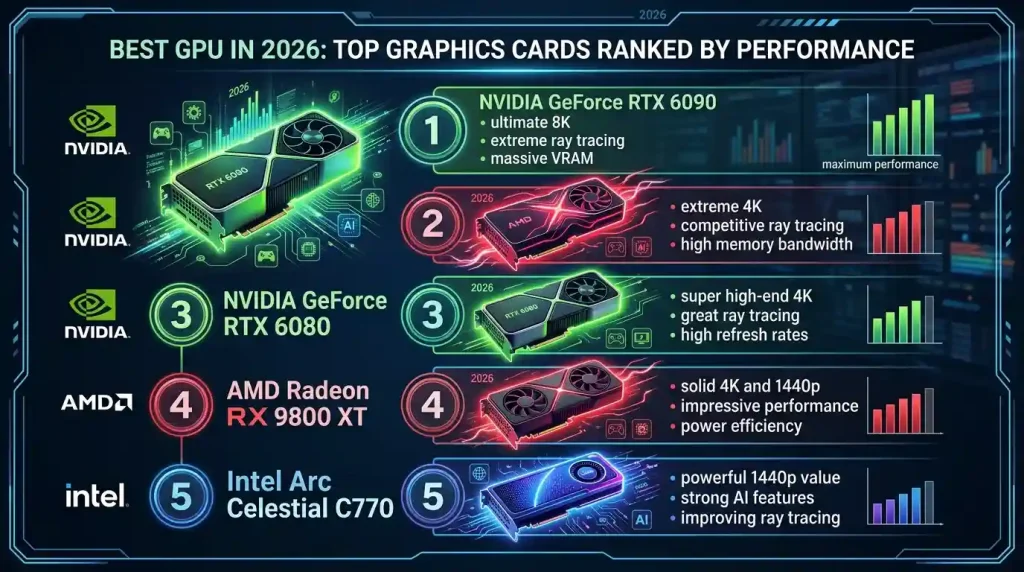
Ranking the “best” GPUs in 2026 requires considering a blend of raw power, feature set, efficiency, and value. Based on the latest architectural advancements and market offerings, here’s a performance-oriented ranking of the top graphics cards available or widely accessible in 2026, catering to different segments:
- NVIDIA GeForce RTX 5090: Unquestionably the performance king, the RTX 5090 sets the benchmark for 4K gaming and high-end professional workloads. Its unparalleled ray/path tracing capabilities, combined with DLSS 4/5 and superior AI acceleration, deliver the most immersive and graphically intensive experiences available. If budget is no object, this is the definitive choice for uncompromising performance.
- AMD Radeon RX 9070 XT: Offering exceptional rasterization performance that often rivals or exceeds NVIDIA’s second-tier offerings, the RX 9070 XT provides a compelling package. Its significantly improved ray tracing and FSR 4 capabilities make it an outstanding choice for 1440p and high-refresh-rate 4K gaming, especially for those seeking strong performance-per-dollar.
- NVIDIA GeForce RTX 5080 / RTX 5070 Ti: These cards represent NVIDIA’s strong contenders for high-end 1440p and entry-level 4K gaming. The RTX 5070 Ti, in particular, offers a fantastic blend of performance, DLSS 4 features, and power efficiency, making it a highly desirable GPU for many enthusiasts.
- AMD Radeon RX 9070: A slightly scaled-down version of the 9070 XT, this card still delivers excellent performance for 1440p gaming. It maintains AMD’s strong rasterization prowess and benefits from the RDNA 4 architecture’s enhancements, providing a solid mid-to-high-range option.
- NVIDIA GeForce RTX 5070: Positioned for premium 1440p gaming, the RTX 5070 offers access to NVIDIA’s full suite of features including advanced ray tracing and DLSS 4, making it a well-rounded choice for gamers who prioritize visual fidelity and AI-enhanced performance.
- AMD Radeon RX 9060 XT 16GB: For mainstream gamers targeting 1080p and 1440p, the RX 9060 XT 16GB stands out for its strong rasterization performance and generous VRAM, ensuring longevity and smooth gameplay in a wide range of titles. Its value proposition is particularly strong amidst ongoing memory shortages.
- NVIDIA GeForce RTX 5060 / RTX 5050: These GPUs cater to the budget and entry-level segments, offering solid 1080p gaming performance with the benefit of DLSS and basic ray tracing. They are power-efficient options for casual gamers or those building more affordable systems.
- Intel Arc A770 (Refreshed/Successor): While not competing at the very top, Intel’s improved Arc series provides a viable option in the budget to mid-range. With good value, XeSS upscaling, and excellent media capabilities (like AV1 encoding), it serves as a competent choice for gamers looking for alternatives and productivity users.
Conclusion
The GPU market in 2026 is a vibrant and competitive arena, continually pushing the boundaries of visual computing. NVIDIA, with its formidable RTX 50-series and upcoming Rubin architecture, maintains its lead in absolute performance and AI-driven innovations. AMD’s Radeon RX 9000 series, leveraging its RDNA 4 architecture, offers compelling rasterization performance and improved ray tracing, often delivering superior value across various segments. Intel, though a newer entrant, is steadily carving out its niche with the Arc series, providing a strong third option in the mid-range and integrated graphics space.
Choosing the best GPU in 2026 ultimately depends on a blend of individual needs, target resolution, budget, and desired features. Whether prioritizing cutting-edge ray tracing and AI upscaling, raw rasterization power, or overall value, the market offers a diverse range of high-performance graphics cards. Despite challenges such as ongoing memory shortages and rising prices, the relentless pace of innovation promises an exciting future for visual experiences, making 2026 a significant year for graphics technology enthusiasts.