7 Powerful A100 GPU Benchmarks for AI & Machine Learning Performance
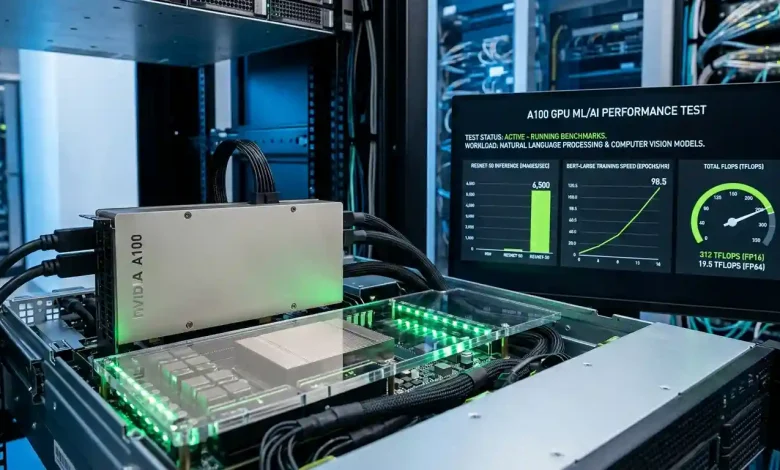
Table of Contents
A100 GPU performance testing for AI and machine learning workloads reveals why this NVIDIA Tensor Core GPU has been a cornerstone of modern data centers since its launch in May 2020. Designed explicitly for high-performance computing (HPC) and artificial intelligence applications, the A100, powered by the NVIDIA Ampere architecture, delivers unprecedented acceleration across various scales. It has established itself as a critical enabler for researchers and developers pushing the boundaries of AI, from training massive deep learning models to accelerating complex scientific simulations.
Introduction to NVIDIA A100 for AI and Machine Learning
The NVIDIA A100 Tensor Core GPU represents a significant leap forward in accelerator technology, purpose-built to address the escalating computational demands of AI and machine learning. Its architecture and advanced features enable it to handle the most demanding workloads, offering dramatic performance gains over previous generations. The A100 is not merely a faster GPU; it’s a versatile platform designed for elastic data centers, capable of dynamically adjusting to shifting workload demands by scaling up or partitioning its resources. This adaptability makes it an ideal choice for a wide spectrum of AI applications, from intricate language models to sophisticated computer vision tasks.
The A100’s impact on the AI landscape is profound. It has become the workhorse for organizations undertaking serious AI and HPC endeavors, enabling faster iteration and experimentation for researchers and quicker deployment of solutions into production. Its ability to accelerate a full range of precision, from FP32 to INT4, coupled with innovative features like Multi-Instance GPU (MIG) and structural sparsity, positions it as a leading accelerator for both deep learning training and inference.
Ampere Architecture and Third-Generation Tensor Cores
At the heart of the A100’s exceptional performance lies the NVIDIA Ampere architecture. This architecture introduced several groundbreaking improvements over its predecessor, Volta, specifically enhancing capabilities for deep learning workloads. The A100 features 6,912 CUDA cores and 432 third-generation Tensor Cores, fabricated on a 7nm process. These Tensor Cores are specialized processing units that significantly accelerate matrix multiplications and tensor operations, which are fundamental to deep learning.
The third-generation Tensor Cores in the A100 offer remarkable performance improvements. They provide up to 20 times higher performance for deep learning training and inference compared to NVIDIA Volta GPUs. A key innovation is the support for TensorFloat-32 (TF32), a new precision format that allows major speed-ups without requiring code changes for existing FP32 models. TF32 combines the range of FP32 with the precision of FP16, enabling a 10x speedup over standard FP32 operations on Volta GPUs with zero code changes, and an additional 2x boost with automatic mixed precision and FP16. Beyond TF32, the A100’s Tensor Cores also support BFloat16 (BF16), FP16, FP64, INT8, and INT4 data types, offering unparalleled versatility for various AI and HPC workloads requiring different levels of precision. The introduction of double precision Tensor Cores was a particularly significant development, delivering the biggest leap in HPC performance since the introduction of GPUs.
Memory Bandwidth and Capacity: Fueling Large Models
Modern AI and machine learning models, especially large language models and vision models, demand colossal memory capacity and bandwidth to load parameters, activations, and process large batches of data. The NVIDIA A100 addresses this critical need with its high-bandwidth memory (HBM2e).
The A100 is available in two primary memory configurations: 40 GB and 80 GB of HBM2e VRAM. The 80GB model, in particular, was notable for debuting the world’s fastest memory bandwidth at over 2 terabytes per second (TB/s) at its release, significantly exceeding the 1.6 TB/s of the 40GB variant. This immense memory pool and bandwidth are crucial for training giant neural networks that can easily consume tens of gigabytes for model parameters and activations, as well as for data-intensive HPC tasks.
This enhanced memory bandwidth, approximately 1.7x higher than the previous generation, plays a vital role in preventing data bottlenecks that can starve the GPU’s processing cores, especially in applications like scientific simulations. The ability of the A100 to handle very large model states and huge datasets allows researchers to tackle models and batch sizes that would otherwise overflow smaller GPUs, leading to faster iteration and experimentation.
Performance Benchmarks in AI Training
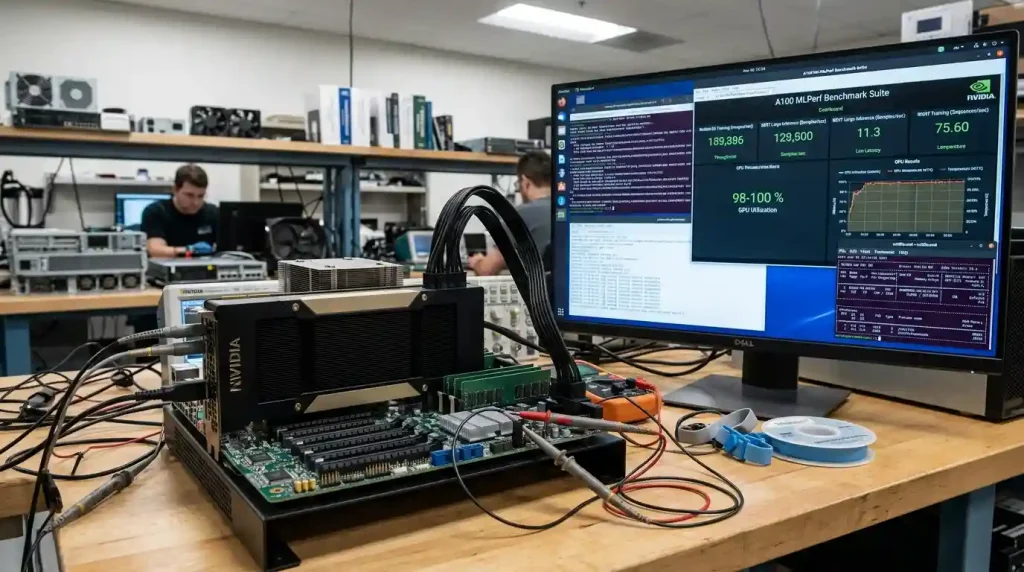
The A100 GPU has consistently demonstrated superior performance in AI training benchmarks, showcasing its capabilities across a range of complex models. Compared to its predecessor, the NVIDIA V100, the A100 offers significant speedups. For instance, in language model training, the A100 can be approximately 1.95x to 2.5x faster than the V100 when using FP16 Tensor Cores. NVIDIA’s own benchmarks indicate up to 20x higher performance over the prior generation in deep learning training.
A training workload like BERT can be solved in under a minute by 2,048 A100 GPUs, a world record for time to solution. For deep learning recommendation models (DLRM) with massive data tables, the A100 80GB can deliver up to a 3x throughput increase over the A100 40GB variant. Meta, for example, utilized 16,000 NVIDIA A100 GPUs to train its Llama and Llama 2 models, processing terabytes of data and facilitating high-speed matrix computations essential for large language models. This demonstrates the A100’s scalability and efficiency in handling some of the world’s most advanced AI models.
| Feature/Metric | NVIDIA A100 (80GB SXM) | NVIDIA V100 (32GB) | NVIDIA H100 (80GB SXM) |
|---|---|---|---|
| Architecture | Ampere (7nm) | Volta (12nm) | Hopper |
| FP32 Performance | 19.5 TFLOPS | 15.7 TFLOPS | 67 TFLOPS (approx.) |
| TF32 Tensor Core Performance | 156 TFLOPS (312 TFLOPS with sparsity) | N/A (FP32 only) | 989 TFLOPS (1979 TFLOPS with sparsity) |
| FP16 Tensor Core Performance | 312 TFLOPS (624 TFLOPS with sparsity) | 125 TFLOPS | 1979 TFLOPS (3958 TFLOPS with sparsity) |
| GPU Memory | 80GB HBM2e | 32GB HBM2 | 80GB HBM3 |
| Memory Bandwidth | 2,039 GB/s (approx. 2.0 TB/s) | 900 GB/s | 3.35 TB/s |
| NVLink Bandwidth | 600 GB/s | 300 GB/s | 900 GB/s |
| TDP | 400W | 300W | 700W |
Deep Learning Inference and Multi-Instance GPU (MIG)
Beyond training, the A100 introduces groundbreaking features to optimize inference workloads, accelerating a full range of precision from FP32 to INT4. On state-of-the-art conversational AI models like BERT, the A100 accelerates inference throughput up to 249x over CPUs. In MLPerf Inference 0.7 benchmarks, the A100 outperformed the latest CPUs by up to 237x in recommender tests, demonstrating that a single NVIDIA DGX A100 system can match the performance of approximately 1,000 dual-socket CPU servers for AI recommender models.
A significant innovation for inference and mixed workloads is Multi-Instance GPU (MIG) technology. MIG allows a single A100 GPU to be partitioned into as many as seven independent GPU instances, each with its own high-bandwidth memory, cache, and compute cores. This feature maximizes GPU utilization, enabling multiple networks or users to operate simultaneously on a single A100, providing guaranteed quality of service and up to 7x higher throughput than V100 with simultaneous instances per GPU. MIG is particularly beneficial for scenarios involving multiple inference jobs with small batch sizes, low-latency models, Jupyter notebooks for model exploration, and multi-tenant setups, improving the return on investment by preventing idle GPU time.
The A100 also supports structural sparsity, which can deliver up to 2x more performance for sparse models. Many deep learning models naturally contain a significant number of “zero” or unused weights. The A100 can exploit this sparsity in hardware, improving speed, especially for inference, when models are designed to take advantage of it. This feature, while more beneficial for inference, can also enhance model training performance.
A100 in High-Performance Computing (HPC)
Beyond AI and machine learning, the A100 GPU is a powerful accelerator for high-performance computing (HPC) applications. Its double-precision (FP64) Tensor Cores deliver a significant boost in HPC performance, allowing researchers to tackle complex scientific simulations more efficiently. For instance, combining the A100 with 80GB of fast GPU memory can reduce a 10-hour, double-precision simulation to under four hours.
HPC applications can also leverage TF32 to achieve up to 11x higher throughput for single-precision, dense matrix-multiply operations. For HPC applications dealing with the largest datasets, the A100 80GB’s additional memory can deliver up to a 2x throughput increase with applications like Quantum Espresso, a materials simulation. The A100’s robust FP64 performance, ranging from 9.7 TFLOPS to 19.5 TFLOPS, makes it ideal for scientific simulations where precision is paramount, surpassing consumer GPUs like the RTX 4090 which offers only 1.29 TFLOPS in FP64. Researchers can use A100 GPUs to accelerate workloads in frameworks like CUDA or with HPC libraries, dramatically cutting down experiment times. Wikipedia’s entry on High-Performance Computing further elaborates on the critical role of such powerful hardware in scientific discovery.
Optimizing A100 Performance for AI Workloads
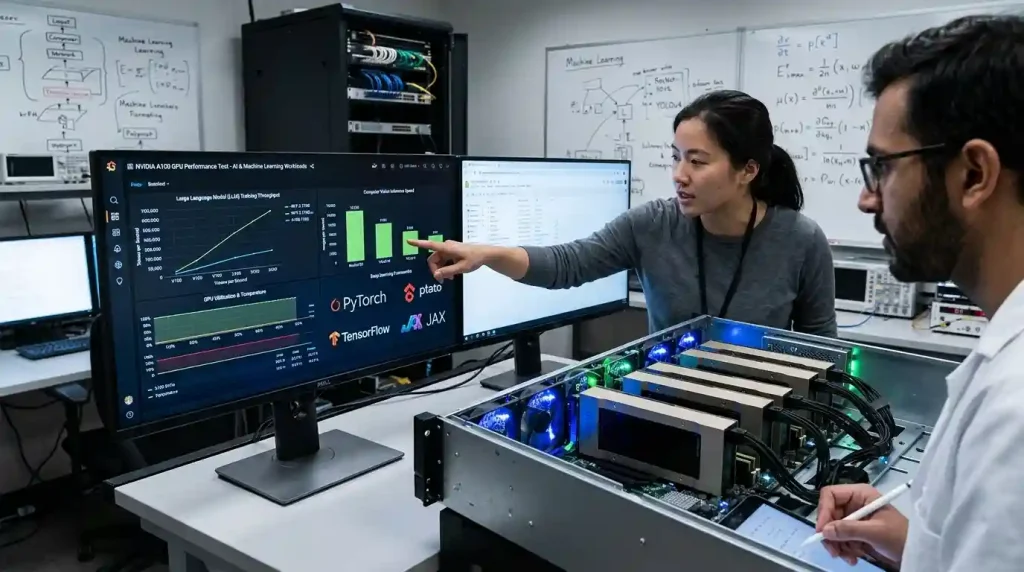
To fully harness the A100’s potential, several optimization strategies can be employed for AI and machine learning workloads:
- Precision Selection: Utilize the lowest possible precision data format through Automatic Mixed Precision (AMP), typically Half-Precision (FP16) or BFloat16, to increase throughput. For FP16, gradient scaling with tools like `torch.cuda.amp.GradScaler` is often necessary. The A100’s Tensor Cores efficiently handle mixed-precision operations, providing significant speedups.
- TensorFloat-32 (TF32): Leverage TF32 for FP32 workloads. The A100 automatically converts FP32 numbers to TF32 within its Tensor Cores, offering substantial performance gains without code modifications.
- Structural Sparsity: Design models to incorporate structural sparsity. The A100 can exploit this in hardware to achieve up to 2x performance improvement, particularly for inference.
- Multi-Instance GPU (MIG): For multi-tenant environments or smaller, varied workloads, partitioning the A100 into multiple MIG instances can improve GPU utilization and ROI.
- Memory Bandwidth Utilization: Optimize CUDA kernels to effectively utilize the A100’s massive memory bandwidth (up to 2 TB/s). Proper tiling strategies can also leverage the 40MB L2 cache.
- NVLink for Multi-GPU Scaling: When scaling to multiple GPUs or multi-node workloads, NVLink provides high-speed GPU-to-GPU communication, reducing bottlenecks in distributed training. The A100 supports NVLink with up to 600 GB/s total bandwidth.
- Data Layout: For convolutional neural networks, converting model and batched data to ‘channels last’ (NHWC for 2D, NDHWC for 3D) format can enhance performance on A100 GPUs, especially in PyTorch.
- Batch and Channel Sizes: Whenever possible, use batch sizes, channel sizes, vocabulary sizes, sequence lengths, and in/output sizes of linear layers that are multiples of 8 to align with Tensor Core operations. For convolutions, ensure the channel dimension size is a multiple of 8 and ideally greater than or equal to 32.
While the A100 remains a highly capable GPU, newer GPUs like the NVIDIA H100 offer further architectural improvements and features such as FP8 precision support, which can dramatically enhance throughput for specific AI workloads, particularly large language models. However, the A100 continues to offer an excellent balance of cost and performance for businesses optimizing their AI investments, especially with the availability of refurbished options. For many large-scale AI training and inference tasks, the A100 remains a highly effective and strategic choice.
Conclusion
The NVIDIA A100 GPU stands as a testament to NVIDIA’s commitment to advancing AI and machine learning. Its robust Ampere architecture, coupled with third-generation Tensor Cores, prodigious memory bandwidth, and innovative features like MIG and structural sparsity, has solidified its position as a cornerstone for high-performance computing and AI data centers. From accelerating the training of massive language models to revolutionizing deep learning inference and powering complex scientific simulations, the A100 delivers unparalleled performance and versatility. While newer generations of GPUs continue to emerge, the A100’s enduring capabilities, combined with ongoing software optimizations, ensure its relevance as a formidable accelerator for a vast array of AI and machine learning applications, driving innovation and enabling breakthroughs across diverse industries. Its ability to offer a strong balance of performance and efficiency makes it a compelling choice for organizations seeking to elevate their AI and machine learning capabilities into the foreseeable future.