GPU 3080 Benchmarks: RTX 3080 Gaming Performance Tested

Table of Contents
GPU 3080 benchmarks remain a hot topic for gamers and PC enthusiasts alike, even years after its initial release. Launched in September 2020, the NVIDIA GeForce RTX 3080 quickly established itself as a high-end graphics card, delivering a significant generational leap in performance. Built on NVIDIA’s Ampere architecture, it promised exceptional gaming experiences, particularly at 1440p and 4K resolutions. As we delve into mid-2026, the question persists: how well does the RTX 3080 hold up against the latest titles and hardware, and what kind of gaming performance can users realistically expect today? This comprehensive article will explore the RTX 3080’s capabilities, its performance across various resolutions and game types, and its continued relevance in a rapidly evolving hardware landscape.
Introduction: The Enduring Appeal of the RTX 3080
The NVIDIA GeForce RTX 3080, based on the GA102 graphics processor and built on an 8 nm process, debuted as an enthusiast-class graphics card on September 1, 2020. With a launch price of $699 USD, it offered compelling performance for its time, featuring 8704 shading units, 272 texture mapping units, and 96 ROPs. It also included 272 Tensor Cores for machine learning applications and 68 RT (Ray Tracing) Cores for accelerated ray tracing. The card was initially paired with 10 GB of GDDR6X memory, connected via a 320-bit memory interface, operating at an effective 19 Gbps. A later 12 GB version also emerged, offering slightly enhanced performance due to higher TDP and memory bandwidth.
Even in 2026, the RTX 3080 continues to be a viable option for many gamers. Performance-wise, it typically positions itself between an RTX 5060 Ti and an RTX 4070, making it capable of handling demanding titles comfortably at 1440p resolution. Its enduring appeal lies in its robust raw power, especially for those looking for value in the secondhand market, where prices for RTX 3080s were observed between $300 and $400 in early 2026.
RTX 3080: Core Specifications and Architecture
The RTX 3080 leverages NVIDIA’s Ampere architecture, which introduced significant improvements over its Turing predecessor. Key architectural enhancements included advanced 2nd generation RT Cores, 3rd generation Tensor Cores, and new streaming multiprocessors, all contributing to higher throughput. These components are crucial for features like real-time ray tracing and DLSS (Deep Learning Super Sampling), which dynamically boost frame rates with AI rendering while maintaining image quality.
The GA102 chip itself is a substantial piece of silicon, with a die area of 628 mm² and 28,300 million transistors. The card supports DirectX 12 Ultimate, ensuring compatibility with modern games and advanced graphics features such as hardware-accelerated ray tracing and variable-rate shading. Power consumption is rated at a maximum of 320 W, requiring a 1x 12-pin power connector. The physical design typically features a dual-slot cooling solution to manage the heat generated by its powerful components. The 10 GB GDDR6X memory configuration, while once considered ample, has become a point of discussion with the increasing VRAM demands of newer, graphically intensive titles.
1440p Gaming Performance: The RTX 3080’s Sweet Spot
The 1440p (2560×1440) resolution is widely considered the RTX 3080’s ideal operating environment for a balanced high-fidelity and high-frame-rate gaming experience. At launch, the GPU was hailed as an “amazing 1440p graphics card,” capable of running “extremely demanding PC games with more than 60fps” on Ultra settings. Even several years later, in 2026, the sentiment holds true, with many users and benchmarks confirming its strong performance at this resolution.
For instance, in early 2026, the RTX 3080 was noted to achieve around 100 FPS on high settings at 1440p in many titles. Specific game benchmarks from early 2026 illustrate this:
- In Cyberpunk 2077 (High preset, DLSS Quality), the RTX 3080 averaged 72 fps at 1440p, though with some stutter and 1% lows at 43 fps. GPU usage was over 90% at this resolution, indicating it was GPU-bound.
- For Fortnite (High preset, Nanite/Lumen off, DLSS Quality), the card maintained a high average of 149 fps at 1440p, with 1% lows at 72 fps.
- Red Dead Redemption 2 (Balanced preset, low grass, DLSS Quality) showed impressive results, averaging 89 fps at 1440p.
- The Finals (High settings, Dynamic RTX Global Illumination High, DLSS Quality) delivered an average of 103 fps at 1440p, with 1% lows at 61 fps.
- In Far Cry 6, the RTX 3080 achieved around 115 FPS at 1440p, even on ultra settings.
These benchmarks suggest that the RTX 3080 still comfortably delivers smooth, high-frame-rate gameplay at 1440p across a wide range of modern titles, often with settings turned up high or even to ultra. The 12GB version of the RTX 3080 is often recommended for even better performance, especially regarding VRAM capacity.
4K Gaming Performance: Pushing the Limits
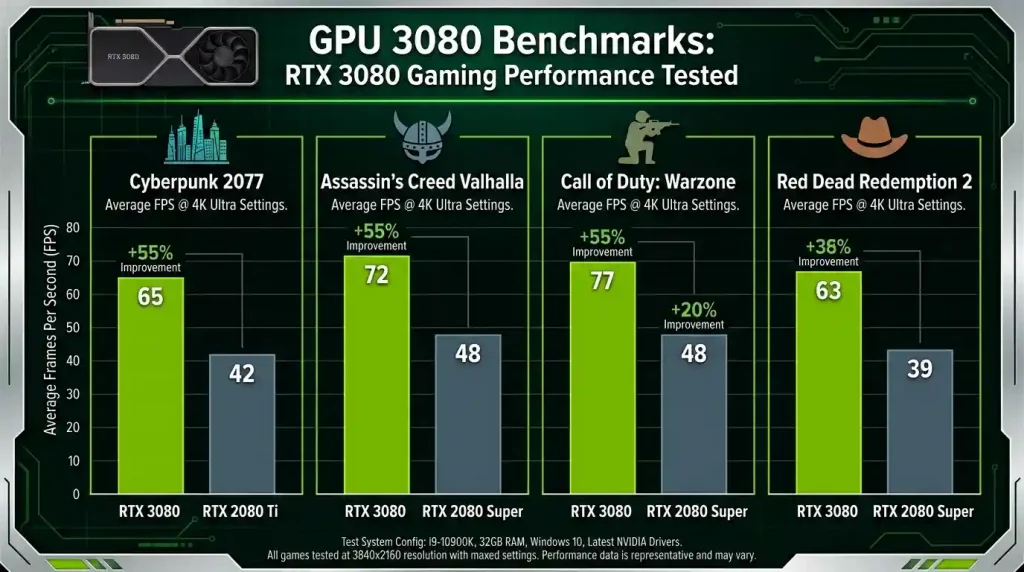
While 1440p is its strong suit, the RTX 3080 was also marketed for 4K (3840×2160) gaming. At its release, it showed commendable performance at 4K, often surpassing the RTX 2080 Ti by a significant margin. However, achieving consistent 60 FPS at 4K on Ultra settings, especially in newer, graphically demanding titles, has always been a more challenging endeavor for the card.
Early benchmarks from late 2020 indicated that many demanding games ran below 60 fps at 4K/Ultra on the RTX 3080, suggesting that for future titles, DLSS or highly optimized game engines would be necessary to hit that target. By 2026, this prediction largely holds true. The RTX 3080 can still handle 4K gaming, but often requires compromises in settings or the active use of upscaling technologies like DLSS.
Recent tests show varying results depending on the game:
- In Cyberpunk 2077 (High preset, DLSS Quality), the RTX 3080 managed an average of 60 fps at 4K, with 1% lows around 40 fps. With ray tracing enabled at 4K, performance drops significantly, often to an “unplayable” 15 fps without DLSS, but DLSS can bring it up to a “still fairly unplayable” 42 fps, though newer generation cards like the RTX 4080 achieve better results.
- For Fortnite (High preset, DLSS Quality), the RTX 3080 surprisingly delivered an average of 99 fps at 4K, with 1% lows at 42 fps, showcasing its strong computational power and memory bandwidth even at high resolutions.
- Red Dead Redemption 2 (Balanced preset, DLSS Quality) maintained a “still good” average of 72 fps at 4K, with 1% lows at 57 fps.
- In Far Cry 6, the RTX 3080 could achieve around 65 FPS at 4K resolutions on ultra settings.
The main challenge for the 10GB RTX 3080 at 4K, particularly in newer titles with high-resolution textures, is often the VRAM capacity. While 10GB GDDR6X is substantial, some modern games can push its limits, potentially requiring users to lower texture settings. The 12GB version of the RTX 3080 or the 3080 Ti offers a slight advantage here, with more VRAM and often higher TDP.
Ray Tracing and DLSS Capabilities
The RTX 3080 was a pioneer in mainstreaming real-time ray tracing, a demanding graphical technique that simulates light more accurately for enhanced realism. Its dedicated 2nd generation RT Cores were designed to accelerate these calculations. However, ray tracing comes with a significant performance cost, especially at higher resolutions.
To mitigate this performance hit, NVIDIA developed DLSS, an AI-powered upscaling technology that uses Tensor Cores to render frames at a lower resolution and then intelligently reconstruct them to a higher resolution, boosting frame rates without a substantial loss in image quality. The RTX 3080 supports DLSS 2, which is still highly effective in many games.
For example, in Cyberpunk 2077, a title notorious for its demanding ray tracing implementation, the RTX 3080 often requires DLSS to achieve playable frame rates with ray tracing enabled, especially at 1440p and 4K. Without DLSS, ray tracing at 4K can lead to very low frame rates.
While the RTX 3080 performs admirably with DLSS 2, newer generations like the RTX 4070 benefit from DLSS 3, which includes Frame Generation technology. DLSS 3 can provide even larger frame rate boosts, a feature that the RTX 3080 inherently lacks. This generational difference becomes particularly apparent in games optimized for DLSS 3 and its frame generation capabilities.
RTX 3080 vs. Newer Generations: A Value Proposition in 2026
Comparing the RTX 3080 to newer NVIDIA cards, such as the RTX 40 series and the anticipated 50 series, reveals its position as a strong value contender, particularly in the used market. In 2026, the RTX 30 series, including the 3080, is quietly becoming recognized for its value, offering dependable performance at more accessible prices.
| Feature | RTX 3080 (10GB) | RTX 4070 | RTX 4080 |
|---|---|---|---|
| Architecture | Ampere (GA102) | Ada Lovelace (AD104) | Ada Lovelace (AD103) |
| CUDA Cores | 8704 | 5888 | 9728 |
| Boost Clock | 1710 MHz | 2475 MHz | 2505 MHz |
| VRAM | 10GB GDDR6X | 12GB GDDR6X | 16GB GDDR6X |
| Memory Interface | 320-bit | 192-bit | 256-bit |
| TDP | 320W | 200W | 320W |
| Ray Tracing Cores | 2nd Gen | 3rd Gen | 3rd Gen |
| DLSS Support | DLSS 2 | DLSS 3 | DLSS 3 |
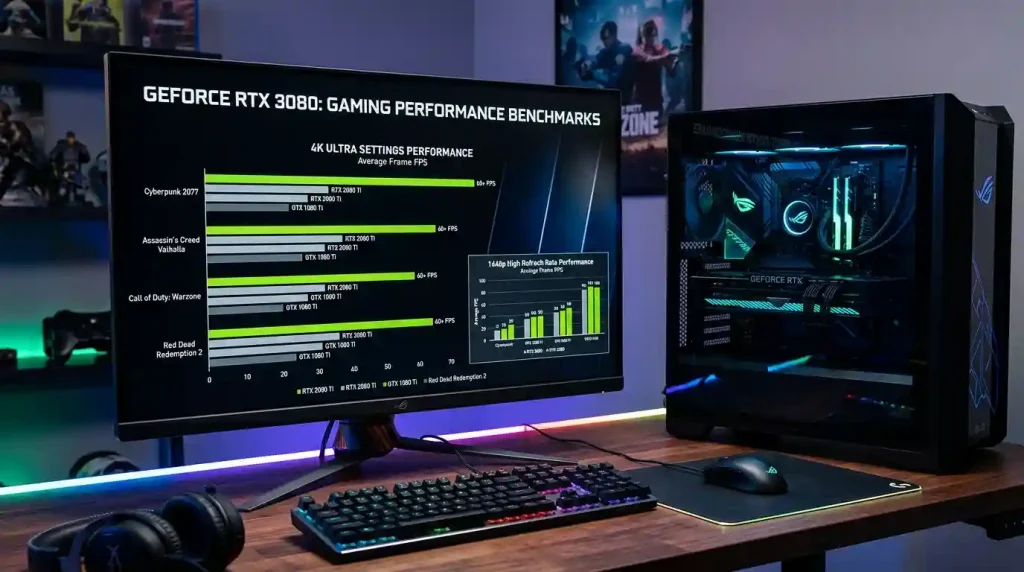
When directly comparing the RTX 3080 with the RTX 4070, the 3080 often shows a 5-10% performance increase in raw rasterization at 4K resolution, particularly in gaming-intensive scenarios, due to its higher CUDA core count and memory bandwidth. However, the RTX 4070 gains an advantage in titles optimized for DLSS 3 and ray tracing, thanks to its newer Ada Lovelace architecture, faster boost clocks, and the inclusion of Frame Generation. The RTX 4070 is also significantly more power efficient, with a TDP of 200W compared to the RTX 3080’s 320W.
Against the RTX 4080, the RTX 3080 naturally falls behind. The RTX 4080, despite having a similar TDP, often doubles or more the performance metrics of the RTX 3080, especially with DLSS 3.0 and ray tracing. For instance, in a ray-traced Cyberpunk 2077 at 4K, the RTX 3080 might yield an “unplayable” 15fps, which the RTX 4080 boosts to a “still fairly unplayable” 29fps, or 66fps with DLSS. The RTX 4080 also brings higher VRAM (16GB) to the table, making it more future-proof.
Looking further ahead, the performance gap widens considerably with the anticipated RTX 50 series. Early benchmarks from a comparison involving an unreleased RTX 5080 showed it roughly doubling the frame rates of the RTX 4080 in titles like Marvel Rivals, and providing significantly higher performance in Cyberpunk 2077 and Black Myth Wukong, especially with frame generation technology. The RTX 3080 was described as “basically unplayable at 40 fps in 4K” in Cyberpunk 2077 in comparison. This illustrates that while the RTX 3080 holds its own against current-gen mid-range cards, it cannot compete with the top-tier performance of the latest generations.
The crucial factor for the RTX 3080 in 2026 is its value. For gamers on a budget or those primarily targeting 1440p resolution, a used RTX 3080 can offer excellent performance for its price, especially if one is willing to compromise on some ray tracing settings or utilize DLSS. Its raw rasterization power is still very capable, making it a “great entry point for new PC gamers”.
VRAM Considerations and Future-Proofing
The 10 GB GDDR6X VRAM of the original RTX 3080 has become one of its most debated aspects, particularly in the context of future-proofing. While 10 GB was considered generous at its launch, modern AAA titles, especially at higher resolutions with ultra texture settings and ray tracing enabled, can demand more.
Reports from 2026 suggest that while the 10GB VRAM will generally be “fine,” some newer games at 1440p or 4K might require users to “lower textures” to avoid VRAM bottlenecks. The 12GB version of the RTX 3080 or the RTX 3080 Ti, with its 12 GB GDDR6X VRAM and 384-bit memory bus, offers a more comfortable buffer for these scenarios. Even the 12GB GDDR6X VRAM of the RTX 3080 Ti is deemed “sufficient for most professional workflows” and 4K gaming in mid-2026.
Despite potential VRAM limitations in the most extreme cases, the RTX 3080’s overall performance, combined with NVIDIA’s continued driver support, means it remains a highly capable card. NVIDIA has committed to full driver updates for Ampere cards through at least Q3 2026. This ongoing support is critical for ensuring compatibility and optimized performance in new game releases. For an international perspective on GPU technology and its evolution, Wikipedia’s article on graphics cards provides an excellent resource.
Conclusion: Is the RTX 3080 Still a Gaming Powerhouse?
In conclusion, the NVIDIA GeForce RTX 3080, while no longer the absolute top-tier GPU, remains a remarkably potent graphics card in mid-2026. Its Ampere architecture continues to deliver excellent rasterization performance, making it a fantastic choice for 1440p gaming where it can still provide high frame rates on demanding titles with high settings. Even at 4K, the RTX 3080 is capable, especially when paired with NVIDIA’s DLSS technology, though some compromises in graphical settings or a reliance on DLSS become more necessary.
The emergence of newer generations like the RTX 40 and 50 series highlights the RTX 3080’s limitations, particularly concerning advanced features like DLSS 3’s Frame Generation and the ever-increasing VRAM demands of certain cutting-edge titles. However, for its current market value, especially on the secondary market, the RTX 3080 offers an exceptional performance-per-dollar ratio. It provides a robust, high-fidelity gaming experience that few other cards in its price bracket can match, making it a compelling option for those seeking high-end performance without breaking the bank on the very latest hardware. The RTX 3080 has solidified its place as a enduring gaming powerhouse, capable of driving immersive experiences for years to come.