UserBenchmark GPU Rankings: 7 Powerful Graphics Cards Ranked & Compared
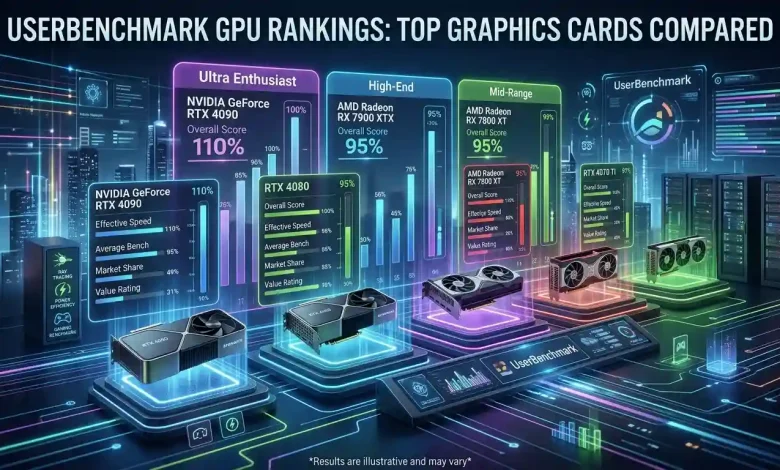
Table of Contents
UserBenchmark GPU Rankings serve as a popular, though at times contentious, resource for comparing the performance of graphics cards. In the dynamic world of PC hardware, where new GPUs are consistently pushing boundaries, understanding these rankings is crucial for anyone looking to build a new system or upgrade an existing one. As of mid-2026, the market is vibrant with cutting-edge offerings from NVIDIA, AMD, and Intel, each vying for supremacy across various performance and price segments. This comprehensive guide delves into how UserBenchmark operates, why GPU rankings are vital, and highlights the top graphics cards available today, considering their performance across different tiers.
Understanding UserBenchmark and Its Methodology
UserBenchmark is a free online benchmarking tool designed to test various components of a PC, including the CPU, GPU, RAM, and storage. It provides performance scores and allows users to compare their hardware against a vast database of other systems. The process typically involves downloading and running a small utility that conducts a series of tests on your system’s components. For GPUs, these tests involve rendering complex graphics and stressing video memory bandwidth to measure performance. After the benchmark completes, a detailed results page opens in your browser, showcasing your system’s performance metrics and comparing them to aggregated data from millions of other users worldwide.
The strength of UserBenchmark lies in its simplicity and the sheer volume of user-submitted data, offering a quick snapshot of relative performance. However, it’s important to approach its rankings with a degree of critical awareness. The platform has faced criticism regarding its scoring methodology, particularly concerning how it weights different aspects of performance and for cross-brand comparisons, especially between CPUs. Some argue that its synthetic scores don’t always accurately reflect real-world gaming or application performance, and results can be skewed by overclocked systems. Therefore, while UserBenchmark can be a useful starting point for a general overview, it is often recommended to cross-reference its findings with other dedicated benchmarking tools like 3DMark or Cinebench, and comprehensive reviews from reputable tech publications, for a more nuanced understanding of GPU performance.
Why GPU Rankings Matter: Beyond Raw Performance
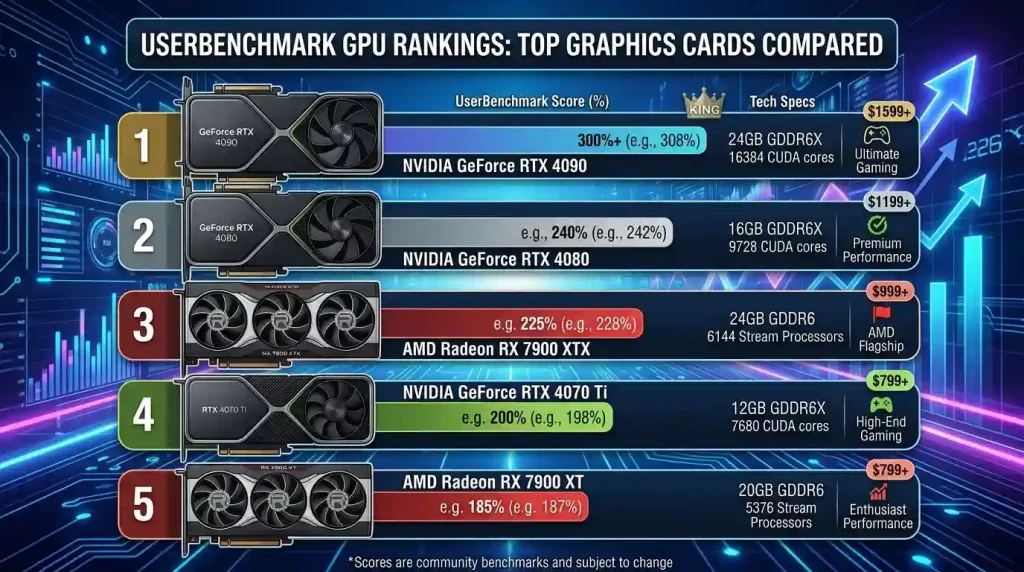
Graphics Processing Units (GPUs) are the heart of any modern gaming PC or creative workstation, responsible for rendering visuals, accelerating computations, and enabling immersive experiences. Understanding GPU rankings is paramount for making an informed purchasing decision for several key reasons:
- Performance Expectations: Rankings provide a clear hierarchy of which cards offer superior performance, helping users set realistic expectations for frame rates and graphical fidelity in games or rendering times in professional applications.
- Value for Money: By comparing performance against price, rankings help identify GPUs that offer the best value, ensuring you get the most out of your investment, especially in the competitive mid-range and budget segments.
- Compatibility and Future-Proofing: A highly-ranked GPU indicates a card capable of handling current and future demands. However, it’s not just about raw power; factors like ample VRAM (Video RAM) and support for modern APIs and technologies are crucial for long-term relevance.
- Specific Use Cases: Different GPUs excel in different areas. While one card might lead in raw rasterization (traditional 3D rendering), another might offer superior ray tracing performance or be optimized for content creation tasks like video editing or 3D rendering due to specific architectural advantages or software integrations like NVIDIA’s CUDA or AMD’s ROCm.
- Ecosystem Features: Modern GPUs come bundled with proprietary technologies that significantly impact the user experience. NVIDIA’s DLSS (Deep Learning Super Sampling) and AMD’s FSR (FidelityFX Super Resolution) are AI-powered upscaling techniques that can dramatically boost frame rates, while ray tracing enhances visual realism. The effectiveness of these features can heavily influence a card’s real-world appeal, even if its raw benchmark score isn’t the absolute highest.
The Evolving Landscape of GPUs: A 2026 Snapshot
The graphics card market is in a constant state of evolution, with NVIDIA, AMD, and Intel continually pushing technological boundaries. As of mid-2026, we’ve seen significant advancements, particularly with the widespread availability of NVIDIA’s GeForce RTX 50 series and AMD’s Radeon RX 9000 series. These new generations have redefined performance expectations, especially at the high-end, and introduced further refinements to ray tracing and upscaling technologies.
NVIDIA’s Blackwell architecture powers the latest RTX 50 series, offering substantial generational leaps in both raw rasterization and ray tracing capabilities, often accompanied by advancements in their DLSS technology. AMD, with its RDNA 4 architecture in the RX 9000 series, continues to deliver compelling rasterization performance and improve its FSR framework, often providing strong value propositions across various price points. Intel, having entered the discrete GPU market with its Arc series, is also a growing contender, particularly in the budget and mid-range segments, offering competitive performance with its XeSS upscaling technology.
This competitive environment means that consumers have a wider array of choices than ever before, but it also necessitates a careful comparison of features, performance metrics, and price-to-performance ratios to find the ideal GPU for their specific needs. The market trends indicate a strong focus on enhancing visual fidelity through ray tracing, improving efficiency, and leveraging AI for performance boosts, making the decision more complex but ultimately more rewarding for consumers.
High-End Powerhouses: The Pinnacle of Performance (2026)
For enthusiasts and professionals demanding uncompromised performance, the high-end GPU market in mid-2026 is dominated by a few colossal contenders. These cards are engineered to deliver exceptional frame rates at 4K resolution and beyond, handle intensive ray tracing effects, and accelerate demanding creative workloads.
- NVIDIA GeForce RTX 5090: Unquestionably the king of the hill, the RTX 5090, powered by NVIDIA’s Blackwell architecture, set a new benchmark for gaming performance when it launched in early 2025. It offers unparalleled rasterization and ray tracing capabilities, making it the go-to choice for maximum graphical fidelity in any game at 4K and even for high-refresh-rate 8K setups. Its integration with DLSS 4.0 provides further performance headroom, ensuring it remains dominant for years to come.
- NVIDIA GeForce RTX 5080: A step down from the absolute flagship but still a formidable card, the RTX 5080 offers exceptional 4K gaming performance with strong ray tracing abilities. It presents a more “sensible” high-end option for those who want top-tier performance without the RTX 5090’s extreme price premium.
- AMD Radeon RX 9070 XT: AMD’s flagship, the Radeon RX 9070 XT, is a powerhouse known for its outstanding raw rasterization performance at 4K. While it typically trails NVIDIA in ray tracing, its strong traditional performance, coupled with a generous VRAM configuration and AMD’s FSR 4.0 technology, makes it a highly competitive option for many gamers and content creators, often at a more attractive price point.
- NVIDIA RTX PRO 6000 Blackwell: For professional workstations, cards like the NVIDIA RTX PRO 6000 Blackwell series offer enterprise-grade performance, stability, and features specifically tailored for complex simulations, AI development, and 3D rendering. These cards prioritize raw computational power, massive VRAM, and certified drivers for professional applications over consumer gaming benchmarks.
These high-end GPUs represent the cutting edge of graphics technology, providing an unrivaled experience for those who prioritize maximum performance above all else. However, such power comes with a significant investment, making careful consideration of individual needs crucial.
Mid-Range Marvels: Balancing Performance and Price (2026)
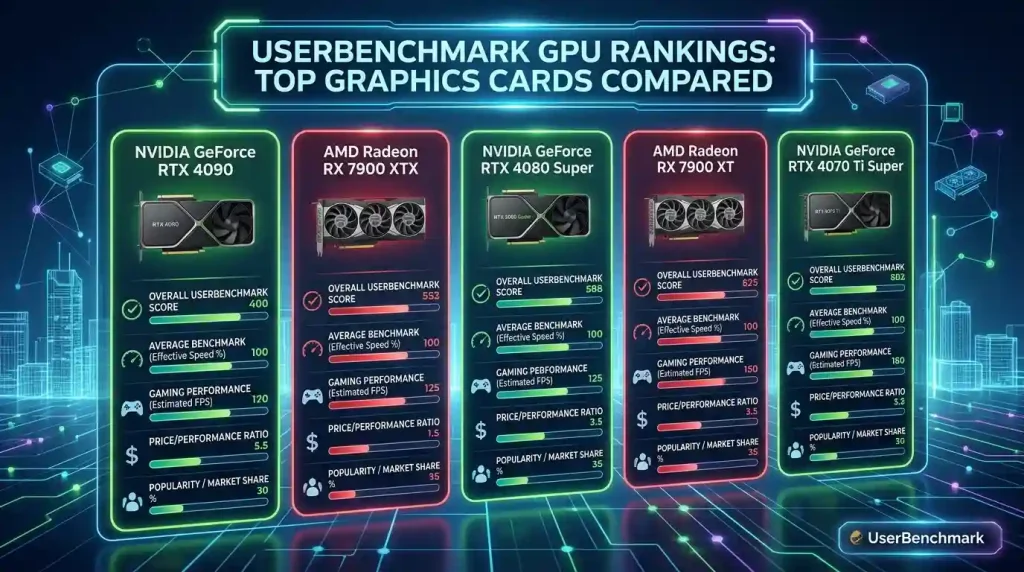
The mid-range GPU market is often the most competitive and exciting, as it aims to strike the perfect balance between performance and affordability. For 2026, this segment offers excellent choices for 1440p gaming and solid 1080p high-refresh-rate experiences.
| GPU | Manufacturer | Performance Tier | Target Resolution | Key Features | Approximate Price (USD) |
|---|---|---|---|---|---|
| NVIDIA GeForce RTX 5090 | NVIDIA | Flagship | 4K+ | Ultimate Raster/RT, DLSS 4.0 | $1999+ |
| NVIDIA GeForce RTX 5080 | NVIDIA | High-End | 4K | Excellent Raster/RT, DLSS 4.0 | $999+ |
| AMD Radeon RX 9070 XT | AMD | High-End | 4K | Strong Raster, FSR 4.0, High VRAM | $799 – $999 |
| NVIDIA GeForce RTX 5070 | NVIDIA | Mid-High | 1440p / Entry 4K | Strong RT, DLSS 4.0 | $599 – $799 |
| AMD Radeon RX 9060 XT | AMD | Mid-Range | 1440p | Great Value Raster, FSR 4.0 | $380 – $550 |
| NVIDIA GeForce RTX 5060 Ti 16GB | NVIDIA | Mid-Range | 1440p | DLSS 4.0, Good RT, 16GB VRAM | $430 – $500 |
| AMD Radeon RX 7800 XT | AMD | Mid-Range (Previous Gen) | 1440p | Excellent 1440p Raster, FSR 3.0, 16GB VRAM | $450 – $500 |
- NVIDIA GeForce RTX 5070: This card stands out as a strong performer for 1440p gaming, often capable of venturing into entry-level 4K gaming with DLSS. Its ray tracing capabilities are impressive for its price point, making it a well-rounded option for those seeking a balance of fidelity and frame rates.
- AMD Radeon RX 9060 XT: Offering exceptional value for 1440p gaming, the RX 9060 XT often provides superior rasterization performance compared to its direct NVIDIA counterparts in some titles, particularly for its price. Its generous VRAM configuration also makes it more future-proof for upcoming games with higher texture demands.
- NVIDIA GeForce RTX 5060 Ti 16GB: The 16GB variant of the RTX 5060 Ti is particularly noteworthy for its combination of solid 1440p performance, ray tracing, and ample VRAM. This makes it a compelling choice for gamers who want to enjoy modern titles with high settings and some level of future-proofing without breaking the bank.
- AMD Radeon RX 7800 XT: Though from the previous generation, the RX 7800 XT remains a highly relevant card in mid-2026 for 1440p gaming. It consistently delivers strong rasterization performance, often outperforming newer cards in its price range from NVIDIA in raw FPS, and boasts a substantial 16GB of VRAM. For many, it still represents an excellent value proposition.
The mid-range market is where competition truly heats up, with both AMD and NVIDIA offering compelling features. Choosing between them often comes down to specific game preferences, the importance of ray tracing, and the overall value of their respective software ecosystems.
Budget-Friendly Options: Accessible Gaming for All (2026)
Gaming shouldn’t be exclusive to those with large budgets. The budget GPU segment offers accessible entry points for 1080p gaming, often allowing for solid performance with a few compromises on ultra settings or ray tracing. While new generations often focus on the high-end first, previous generation cards and entry-level current-gen options continue to provide excellent value.
- NVIDIA GeForce RTX 4060 / 5060: The RTX 4060 (and its successor, the RTX 5060, which offers improved performance) remains a popular choice for 1080p gaming. It provides good performance in most titles, benefits from DLSS, and has acceptable ray tracing capabilities for its price point. The 5060 variant, especially the 8GB version, is noted as offering the best GPU value at 1080p based on FPS per dollar.
- AMD Radeon RX 7600 XT: This card offers a significant step up for 1080p gaming, often capable of handling some titles at 1440p with FSR. Its 16GB of VRAM is particularly noteworthy for a budget card, providing excellent future-proofing for textures and modding. The RX 7600, a slightly less powerful but still capable option, also stands out for its value.
- AMD Radeon RX 6600: Even in 2026, the AMD Radeon RX 6600 continues to be a strong contender for budget-conscious gamers. It delivers reliable 1080p gaming performance, often at 60fps or higher, in many modern titles without requiring users to sacrifice too much visual fidelity. Its excellent price-to-performance ratio makes it a standout choice for those on a strict budget.
- Intel Arc A750 / A580: Intel’s entry into the discrete GPU market has brought competitive options to the budget space. The Arc A750 and A580 offer surprisingly good rasterization performance for their price, often competing with or surpassing similarly priced AMD and NVIDIA cards in raw performance in well-optimized titles. They also support Intel’s XeSS upscaling technology, providing a performance boost. However, early generations sometimes faced driver optimization challenges, though these have largely improved over time.
When choosing a budget GPU, it’s particularly important to consider your monitor’s resolution and refresh rate, and to be realistic about performance expectations. These cards are perfect for 1080p gaming, with some capable of light 1440p duties, ensuring that gaming remains accessible to a wider audience.
Factors Beyond Benchmarks to Consider
While UserBenchmark and other tools provide valuable performance metrics, a GPU’s ranking is just one piece of the puzzle. Several other crucial factors should influence your purchasing decision to ensure optimal system compatibility and a satisfactory user experience:
- VRAM (Video RAM): The amount of dedicated memory on your graphics card is increasingly important, especially for gaming at higher resolutions (1440p and 4K) and with high-resolution textures. Modern games, and particularly future titles, are becoming more VRAM-hungry. While 8GB might suffice for 1080p, 12GB or 16GB is often recommended for 1440p and above for better future-proofing.
- Power Consumption and PSU Requirements: High-performance GPUs are power-hungry components. You must ensure your Power Supply Unit (PSU) has sufficient wattage and the correct PCIe power connectors (e.g., 6-pin, 8-pin, or the newer 12VHPWR connector for some RTX 40/50 series cards) to support your chosen GPU. Underpowering a GPU can lead to instability and performance issues.
- Physical Size and Case Compatibility: Modern GPUs, especially high-end models, can be massive. Always check the dimensions of the graphics card and compare them against the available space in your PC case. Pay attention to both length and height, and ensure there’s adequate room for airflow to prevent overheating.
- Cooling Solution: A robust cooling system is essential for maintaining optimal GPU temperatures and preventing thermal throttling, which can degrade performance. Look for cards with efficient heatsinks and multiple fans, especially for higher-tier models.
- Monitor Resolution and Refresh Rate: The GPU you choose should align with your monitor’s capabilities. A powerful 4K GPU will be underutilized on a 1080p monitor, and conversely, a budget 1080p card won’t drive a high-refresh-rate 4K display effectively. Matching your GPU to your display resolution and target frame rate is crucial for a balanced system.
- CPU Bottlenecking: A powerful GPU can be bottlenecked by an older or less capable CPU, preventing the graphics card from reaching its full potential. Strive for a balanced system where your CPU and GPU complement each other, although a slight GPU bottleneck is generally preferable to a CPU bottleneck for gaming. You can use online tools for a rough assessment of potential bottlenecks.
- Graphics Processing Unit (GPU)
- Software Ecosystem: Beyond raw hardware, consider the software features offered by each manufacturer. NVIDIA’s DLSS and AMD’s FSR are excellent for boosting performance with minimal image quality loss, while NVIDIA’s Broadcast for streamers and content creators or AMD’s Adrenalin Software suite offer additional value. Intel also offers its XeSS upscaling technology.
Conclusion
UserBenchmark GPU rankings provide a quick and accessible snapshot of graphics card performance, acting as a valuable starting point for any PC enthusiast or builder. As we navigate the mid-2026 landscape, NVIDIA’s RTX 50 series and AMD’s RX 9000 series stand at the forefront, pushing the boundaries of what’s possible in gaming and professional applications. From the unbridled power of the RTX 5090 to the balanced efficiency of the RX 9060 XT and the accessible performance of budget-friendly options like the RX 6600 and Intel Arc A750, there’s a GPU for every need and budget.
However, an elite SEO editor understands that raw rankings tell only part of the story. A truly informed decision goes beyond raw benchmark scores to consider the nuanced interplay of VRAM, power requirements, physical size, cooling, and the compatibility with your monitor and other system components. Furthermore, embracing the unique software ecosystems and features like DLSS, FSR, and ray tracing can significantly enhance your overall experience.
Ultimately, the “top” graphics card is the one that best suits your specific requirements, budget, and desired gaming or workload experience. By combining a critical understanding of benchmark data with a holistic view of all influencing factors, you can confidently choose the ideal GPU to power your digital endeavors for years to come. Remember to always cross-reference information and consider comprehensive reviews, much like when optimizing your gaming PC or carefully choosing the right CPU, to ensure a truly balanced and high-performing system.