4070 GPU Review: RTX 4070 Powerful Gaming Benchmarks and Amazing Features
Table of Contents
4070 GPU, specifically the NVIDIA GeForce RTX 4070, entered the market on April 13, 2023, positioning itself as a compelling option for high-performance 1440p gaming and even capable 4K experiences, especially when leveraging NVIDIA’s advanced technologies. Launched with an MSRP of $599, this GPU aimed to deliver a significant upgrade over previous generations, primarily focusing on enhanced efficiency and the transformative power of its Ada Lovelace architecture. This article delves into a comprehensive review of the RTX 4070, exploring its core features, detailed gaming benchmarks across various resolutions, power efficiency, and its standing against key competitors.
Introduction to the NVIDIA GeForce RTX 4070 GPU
The NVIDIA GeForce RTX 4070 was introduced as a high-end graphics card, designed to cater to enthusiasts seeking an exceptional gaming experience without the premium price tag of its higher-tier siblings. It launched as part of NVIDIA’s GeForce 40 series, building upon the innovations of its predecessors. This dual-slot card, based on the AD104 graphics processor, quickly garnered attention for its promise of delivering top-tier 1440p performance and surprisingly capable 4K gaming, particularly when paired with NVIDIA’s proprietary upscaling technologies. Its release marked a crucial point in the mainstream GPU market, offering a blend of raw power, advanced features, and improved efficiency that set it apart from previous generations.
The Ada Lovelace Architecture: A Deep Dive
At the heart of the RTX 4070 lies NVIDIA’s cutting-edge Ada Lovelace architecture, fabricated on a 5 nm process. This architecture is a significant leap forward from the “Ampere” architecture of the RTX 30 Series, bringing substantial improvements in overall performance, clock speeds, and particularly ray tracing capabilities. The AD104 graphics processor, specifically the AD104-250-A1 variant, powers the RTX 4070. It features 5888 CUDA cores, 184 texture mapping units, and 64 ROPs. For AI processing and advanced rendering, it incorporates 184 4th Generation Tensor Cores and 46 3rd Generation RT Cores, which are crucial for ray tracing acceleration.
The card is equipped with 12 GB of GDDR6X memory, connected via a 192-bit memory interface, providing a memory bandwidth of up to 504.2 GB/s. The GPU operates with a base clock of 1920 MHz and can boost up to 2475 MHz. These specifications collectively allow the RTX 4070 to handle modern game engines and complex graphical workloads with remarkable efficiency, making it a robust choice for both gaming and creative applications.
Key Features and Technologies: DLSS 3 and Ray Tracing
The RTX 4070 distinguishes itself through its support for NVIDIA’s advanced features, most notably DLSS 3 and 3rd Generation Ray Tracing Cores.
- DLSS 3 (Deep Learning Super Sampling 3): This revolutionary AI-powered graphics technology generates additional high-quality frames, massively boosting performance. DLSS 3, which includes Frame Generation, is a significant advantage for Ada Lovelace GPUs, offering a tremendous performance uplift, especially in graphically demanding titles. For example, games like A Plague Tale: Requiem, Dying Light 2 Stay Human, and Microsoft Flight Simulator can run at over 100 frames per second with DLSS 3 enabled. This technology allows the RTX 4070 to achieve frame rates that would otherwise be impossible at native resolutions, effectively making it a more capable card for future titles.
- 3rd Generation Ray Tracing Cores: The RTX 4070’s dedicated RT Cores provide up to 2x ray tracing performance compared to previous generations, enabling incredibly detailed and realistic virtual worlds. While ray tracing is computationally intensive, the 4070’s hardware acceleration ensures playable frame rates, particularly when combined with DLSS. In games with heavy ray tracing loads like Cyberpunk 2077, DLSS 3 and Frame Generation allow the RTX 4070 to maintain strong frame rates, often exceeding 100 FPS.
Other notable features include 4th Generation Tensor Cores for AI processing, Shader Execution Reordering (SER) to improve ray tracing operations, and support for AV1 encoding, which is beneficial for streamers and content creators. These technologies collectively make the RTX 4070 a forward-looking GPU, ready for the next generation of gaming and content creation.
Gaming Benchmarks: Dominating 1440p
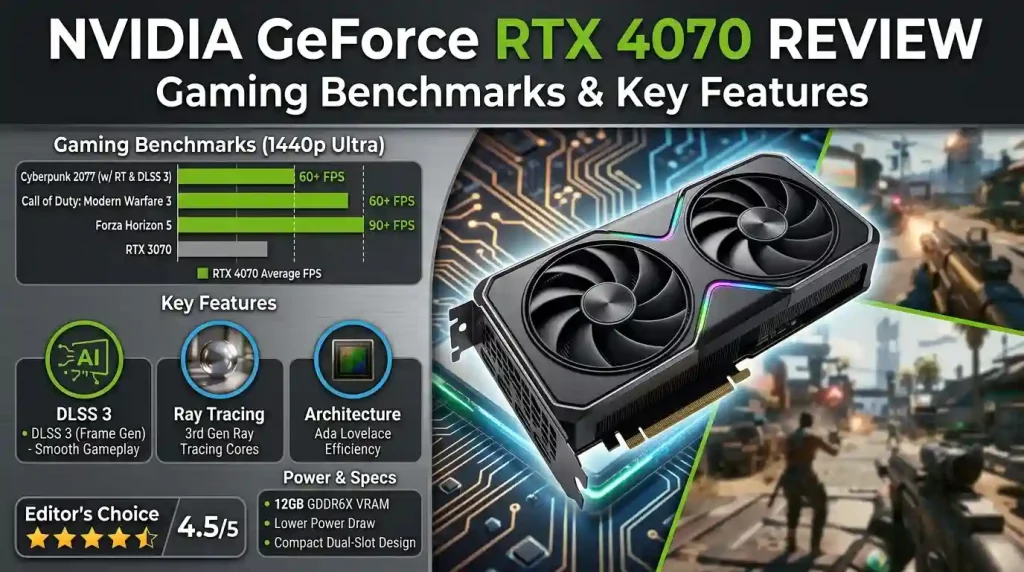
The NVIDIA GeForce RTX 4070 truly shines at 1440p resolution, establishing itself as an excellent choice for high-refresh-rate gaming. Reviewers consistently highlight its ability to deliver smooth and high frame rates in most modern titles at this resolution, often pushing past 120 frames per second.
In rasterized games without advanced features like ray tracing or DLSS, the RTX 4070 performs comparably to or slightly better than the previous generation’s RTX 3080. For instance, in a 13-game suite at 1440p, the RTX 4070 averaged around 126 FPS. When DLSS 3 with Frame Generation is enabled, the performance gains are even more substantial. In titles like Cyberpunk 2077 and Control, with DLSS-supported modes, the RTX 4070 can deliver over 100 FPS comfortably.
Compared to its predecessor, the RTX 3070, the RTX 4070 offers a significant performance boost at 1440p. Benchmarks indicate that the 4070 is approximately 22% to 30% faster on average than the RTX 3070. In some scenarios, particularly where VRAM becomes a bottleneck for the 8GB RTX 3070, the 12GB RTX 4070 can show even larger leads, sometimes up to 49% faster, as seen in games like Resident Evil 4 Remake at higher settings. This makes the RTX 4070 an ideal candidate for gamers looking to upgrade to a high-refresh 1440p monitor.
Gaming Benchmarks: Pushing the Boundaries at 4K
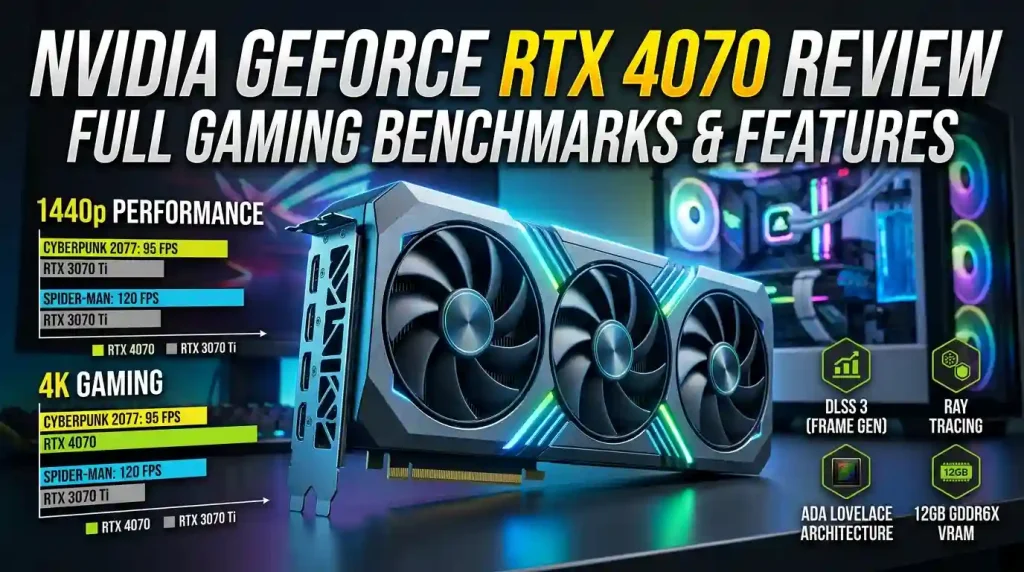
While the RTX 4070 is primarily marketed for 1440p gaming, it demonstrates surprising capability at 4K resolution, especially when leveraging DLSS and Frame Generation. Native 4K performance for the RTX 4070 typically hovers around 69-74 FPS in many titles, making it playable but not always ideal for ultra-high refresh rates without assistance. For example, in Shadow of the Tomb Raider at 4K on highest quality, it delivers around 74 FPS on average, competing with RTX 3080 and Radeon 6800 XT class performance.
However, the true potential of the RTX 4070 for 4K gaming emerges with DLSS 3 enabled. With this technology, the card can often achieve 60+ FPS in many demanding 4K titles, transforming the experience from merely playable to genuinely smooth. Games like F1 22, Starfield, and Tomb Raider yield consistent high-FPS results when DLSS is enabled or when 1440p is upscaled to 4K.
Even with ray tracing enabled at 4K, DLSS 3 allows for respectable performance. While pushing native 4K with RT Ultra settings can still be challenging for the 4070, activating DLSS helps significantly. For instance, in Cyberpunk 2077 with DLSS 3, it can maintain strong frame rates. This makes the RTX 4070 a viable option for those who occasionally dabble in 4K gaming and are willing to utilize NVIDIA’s intelligent upscaling solutions.
Power Efficiency and Thermal Performance
One of the most impressive aspects of the RTX 4070 is its exceptional power efficiency, a hallmark of the Ada Lovelace architecture. The card has a Total Graphics Power (TGP) of 200W, significantly lower than many of its predecessors and competitors. This low power draw translates into several benefits for users.
During average gaming, the RTX 4070 often consumes even less power, with some reports indicating an average gaming wattage of around 186W. This makes it vastly more efficient than its RTX 30 series counterparts, such as the RTX 3070 Ti, which uses 23% more power while offering slower performance with DLSS 3. The RTX 4070’s power consumption is comparable to that of an RTX 2070 from 2018, while delivering the raw compute performance closer to an RTX 3080.
This efficiency contributes to cooler operating temperatures and quieter operation, as the cooling solutions required are less strenuous. Many custom RTX 4070 cards feature dual-fan designs that effectively manage heat, leading to a cool-running and well-built video card. The lower power demands also mean less strain on the power supply unit (PSU), potentially reducing the need for costly PSU upgrades for users with older systems. NVIDIA recommends a 550W PSU for the RTX 4070. This focus on efficiency makes the RTX 4070 a compelling choice for gamers concerned about energy consumption and system thermals.
RTX 4070 vs. Competitors: A Generational Leap?
When evaluating the RTX 4070, it’s crucial to compare its performance against both its direct predecessor and AMD’s offerings.
RTX 4070 vs. RTX 3070
The RTX 4070 presents a clear performance upgrade over the RTX 3070. Benchmarks generally show the RTX 4070 to be approximately 20-30% faster in rasterization performance. The generational leap is further pronounced by the RTX 4070’s 12 GB GDDR6X VRAM compared to the 3070’s 8 GB GDDR6, which can become a bottleneck in modern, VRAM-intensive titles at higher resolutions. The RTX 4070 also benefits from the Ada Lovelace architecture’s superior ray tracing capabilities and the inclusion of DLSS 3, features not available on the RTX 3070. In games where VRAM is a limiting factor, the performance gap can widen significantly, sometimes reaching up to a 49% lead for the 4070.
RTX 4070 vs. RX 6700 XT
Against AMD’s Radeon RX 6700 XT, the RTX 4070 typically offers a superior performance profile. In aggregated benchmarks, the RTX 4070 can be around 36% to 39.3% faster than the RX 6700 XT. Specifically, at 4K resolution across multiple games, the RTX 4070 has been shown to be about 30.3% faster in average framerates. The RTX 4070 also holds a significant advantage in ray tracing performance. Furthermore, the RTX 4070 is considerably more energy-efficient, drawing less power while delivering higher performance, making it a smarter choice in terms of power consumption.
Here’s a comparative overview of some key specifications and performance aspects:
| Feature | NVIDIA GeForce RTX 4070 | NVIDIA GeForce RTX 3070 | AMD Radeon RX 6700 XT |
|---|---|---|---|
| Architecture | Ada Lovelace | Ampere | RDNA 2 |
| CUDA Cores / Stream Processors | 5888 | 5888 | 2560 (Stream Processors) |
| VRAM | 12 GB GDDR6X | 8 GB GDDR6 | 12 GB GDDR6 |
| Memory Interface | 192-bit | 256-bit | 192-bit |
| Memory Bandwidth | ~504.2 GB/s | ~448 GB/s | ~384 GB/s |
| Boost Clock | ~2475 MHz | ~1725 MHz | ~2581 MHz |
| TDP | 200 W | 220 W | 230 W |
| Launch Price (MSRP) | $599 | $499 | $479 |
Pricing and Value Proposition
The NVIDIA GeForce RTX 4070 launched with an MSRP of $599 on April 13, 2023. This pricing positioned it $100 higher than its predecessor, the RTX 3070, which launched at $499. Despite the higher launch price, the RTX 4070 offered a compelling value proposition due to its superior performance, enhanced efficiency, and advanced features like DLSS 3 and improved ray tracing.
Many reviews highlight that the RTX 4070, with its performance often matching or exceeding the RTX 3080 while consuming significantly less power, represents a strong value for its price segment. The average gaming wattage of under 200W makes it significantly more efficient than its RTX 30 series counterparts.
While the RTX 4070 offers clear performance advantages, the market has evolved since its launch. NVIDIA later introduced the RTX 4070 Super in January 2024, which offered a significant performance boost (around 15-19% faster than the original 4070 at 1440p) at the same $599 price point. This led to the original RTX 4070 seeing price adjustments, often dropping to around $550 or even $500 to remain competitive with AMD’s offerings like the Radeon RX 7800 XT.
Ultimately, the value of the RTX 4070 depends on current market prices and specific user needs. For gamers prioritizing excellent 1440p performance, ray tracing, and DLSS 3 at a controlled power budget, the RTX 4070 remains a strong contender, particularly if found at a discounted price. It offers a solid blend of efficiency and modern features for high-refresh gaming without reaching flagship pricing levels. You can learn more about graphics card technologies and their impact on gaming performance through reliable resources like Wikipedia’s entry on graphics cards.
Conclusion
The NVIDIA GeForce RTX 4070, launched in April 2023, firmly establishes itself as a highly capable graphics card, particularly excelling in the 1440p gaming segment. Built on the efficient Ada Lovelace architecture, it delivers strong rasterization performance, often matching or surpassing the RTX 3080, while consuming remarkably less power. Its inclusion of cutting-edge technologies like DLSS 3 with Frame Generation and enhanced 3rd Generation Ray Tracing Cores provides a significant advantage, enabling higher frame rates and more immersive visual experiences, even making 4K gaming a possibility in many titles with upscaling.
Compared to its predecessor, the RTX 3070, the 4070 offers a substantial generational leap in both raw performance and feature set, making it a compelling upgrade. Against AMD’s RX 6700 XT, the RTX 4070 generally delivers superior performance and notably better power efficiency. While the introduction of the RTX 4070 Super has shifted the market landscape, the original RTX 4070 continues to offer a strong value proposition, especially at current, often reduced, prices. Its blend of performance, efficiency, and advanced features positions the RTX 4070 as an excellent choice for gamers seeking a powerful and future-proof GPU for high-refresh 1440p gaming and accessible 4K experiences.