7 Best Budget & Premium GPUs of 2026 – Price & Performance Compared
Table of Contents
GPU prices in 2026 continue to be a dynamic and often challenging landscape for consumers, shaped by an intricate interplay of technological advancements, surging demand from artificial intelligence (AI), and persistent supply chain complexities. While the market has seen some stabilization compared to the extreme volatility of earlier years, a new equilibrium has emerged where high-end components command significant premiums, and budget-friendly options strive to deliver value amidst ongoing cost pressures. This article will delve into the current state of the graphics card market, offering a comprehensive comparison between budget and premium GPUs to help consumers make informed purchasing decisions in June 2026.
The Evolving GPU Market in 2026
The global GPU market in 2026 is characterized by robust growth, driven primarily by the escalating demands of gaming, AI, and data centers. Forecasts project the market to reach substantial figures, with some reports estimating a market size of $27.64 billion in 2026, growing to $97.4 billion by 2034 at a compound annual growth rate (CAGR) of 17.05%. This expansion is largely fueled by continuous advancements in AI and machine learning, the increasing popularity of cloud gaming, virtual reality, and the pervasive need for high-performance computing across various industries.
However, this growth is not without its complexities. The year 2026 is increasingly being remembered for capacity limitations rather than just technological breakthroughs. The market is currently experiencing a structural shift where artificial intelligence has become the dominant consumer of computing hardware. Large language models and generative AI systems are driving an unprecedented demand for GPUs, leading to a tightening market and upward pressure on prices, particularly for enterprise-grade hardware. This intense demand from data centers and AI infrastructure is consuming vast volumes of GPUs, often outpacing supply for consumer-oriented cards.
Despite these challenges, improvements in supply chains have largely resolved the severe availability constraints that plagued the market in 2023-2024, contributing to more stable pricing and increased accessibility in certain segments. The competitive landscape remains concentrated, with NVIDIA, AMD, and Intel being the major players continuously innovating their architectures, cooling solutions, and power efficiency. The introduction of new hardware, such as NVIDIA’s Blackwell series and AMD’s RDNA 4 cards, is reshaping the pricing landscape, with demand gradually shifting and, in some cases, lowering the cost of previous generations like the A100 and H100 in the rental market.
Key Factors Influencing GPU Prices
Several critical factors are converging to influence GPU prices in 2026, creating a complex environment for both manufacturers and consumers.
- AI-Driven Demand: This is arguably the most significant factor. Data centers and AI companies are voraciously buying up high-end GPUs like NVIDIA’s Blackwell B200 and H100, often signing multi-year contracts for entire production outputs. This prioritization by manufacturers, especially NVIDIA, towards higher-margin AI accelerators means a reduced allocation of memory and production capacity for consumer gaming GPUs. This structural, long-term demand from AI is pushing prices up and extending lead times for many products.
- Memory Shortages: A critical shortage of high-bandwidth memory (HBM), GDDR7, and even DDR5 DRAM is severely limiting GPU production capacity. Memory components are being prioritized for data centers and AI deployments, where each system consumes significantly more memory than a typical consumer PC. This has a direct impact on the bill of materials (BOM) cost for GPUs, with memory accounting for a substantial portion. NVIDIA, for instance, has reportedly reduced its GeForce RTX 50 series production by 30-40% in the first half of 2026 due to GDDR7 memory scarcity.
- Next-Generation Hardware Releases: The launch of new architectures, such as NVIDIA’s Blackwell and AMD’s RDNA 4, brings performance improvements but also often comes with higher initial price tags. As of June 2026, NVIDIA’s RTX 50 series and AMD’s RX 9000 series are the latest generations impacting the market. While new releases can eventually lead to price reductions for older generations, the current environment sees high demand for the latest tech.
- Manufacturing Capacity & Bottlenecks: Despite record investments in chip manufacturing, the semiconductor industry’s ability to expand supply is limited by bottlenecks in extreme ultraviolet (EUV) lithography, HBM production, and advanced 2.5D packaging (CoWoS). While advanced chipmaking capacity is growing, reaching over one million wafers per month in 2026, the demand for 2nm and below nodes, primarily driven by AI, is aggressively scaling.
- Geopolitical Factors and Production Costs: Geopolitical tensions and high production costs due to reliance on expensive materials and advanced fabrication nodes continue to influence prices and availability. These factors can lead to increased tariffs and production costs, potentially resulting in higher retail prices and limited availability.
Budget Graphics Cards: Performance for the Savvy Buyer
In 2026, the budget GPU segment is more critical than ever, catering to gamers and general users who prioritize value without sacrificing too much performance. A budget GPU in this market typically aims to deliver solid 1080p gaming performance, with some stretching into capable 1440p territory at reasonable settings.
Current top contenders in the budget space, as of June 2026, include the NVIDIA GeForce RTX 5050 and RTX 5060, along with AMD’s Radeon RX 9060 XT and Intel’s Arc B570/B580.
- NVIDIA GeForce RTX 5050: Often cited as the best all-around budget pick for 1080p gaming. It offers stable software support and access to NVIDIA’s features like DLSS 4 and frame generation, making it a safe recommendation for many. With an MSRP around $299, it provides decent performance for its price point.
- NVIDIA GeForce RTX 5060: This card, built on the Blackwell architecture, offers significant improvements over its predecessor, the RTX 4060, in rasterization, ray tracing, and AI performance. It features 8GB of fast GDDR7 VRAM and DLSS 4 Multi Frame Generation, making 1080p gaming effortless and capable of light 1440p play. It often retails around $350-$380.
- AMD Radeon RX 9060 XT: This is AMD’s competitive offering, often praised for its value, VRAM, and rasterization performance. Available with 16GB of GDDR6 memory, it’s a strong choice for those who want more VRAM headroom for texture-heavy games, modding, or light 1440p gaming. While it might trail NVIDIA slightly in ray tracing, its FSR 4 support is strong. Its price point typically falls around $419-$430, making it an excellent value proposition.
- Intel Arc B580: Intel continues to establish its presence, with the Arc B580 offering a wildcard value option, particularly for AI inference workloads where it can lead on pure value at approximately $1.02 per INT8 TOP.
Despite the “budget” label, these cards benefit from advancements in upscaling technologies like DLSS 4 and FSR 4, which can significantly boost frame rates with minimal quality loss, further enhancing their value for money.
Premium Graphics Cards: Uncompromised Power and Innovation
The premium segment of the GPU market in 2026 is where cutting-edge technology, raw performance, and advanced features converge, albeit at a significantly higher cost. These cards are designed for enthusiasts seeking uncompromised 4K gaming, high-refresh-rate 1440p experiences, professional content creation, and local AI workloads.
The top-tier offerings largely consist of NVIDIA’s RTX 50 series and AMD’s RX 9000 series.
- NVIDIA GeForce RTX 5090: Positioned as the best graphics card for gaming in 2026, the RTX 5090 features 32GB of GDDR7 VRAM and NVIDIA’s Blackwell architecture, delivering unmatched 4K frame rates with ray tracing fully enabled. DLSS 4 with Multi-Frame Generation further boosts performance, making demanding titles incredibly smooth. However, its price has seen dramatic increases. While it launched around $1,999, reports suggest it could reach as high as $5,000 by the end of 2026 due to AI demand and memory shortages. Custom AIB models are often seen retailing for $2,900 to over $5,000.
- NVIDIA GeForce RTX 5080 & 5070 Ti: These cards offer excellent 4K and high-refresh 1440p performance respectively, often seen as strong alternatives to the 5090 for those who want high-end NVIDIA features without the flagship’s extreme price and power draw. The RTX 5070 Ti, with 16GB of GDDR7, shows substantial performance gains over previous generations and is competitively priced at MSRP, though street prices have been volatile. The RTX 5080, while powerful, has also experienced significant price spikes, making its value proposition challenging.
- AMD Radeon RX 9070 XT & RX 9070: AMD’s RDNA 4 architecture powers these high-end options, offering strong rasterization performance that is highly competitive with NVIDIA’s latest in raw frames. The RX 9070 XT, often with 16GB of GDDR6 VRAM, is considered the strongest AMD option for 4K in 2026 and offers a better price-to-performance ratio compared to the RTX 5080. Its MSRP was around $599, but prices have fluctuated. The RX 9070 targets the mid-range to high-end, providing excellent 1440p performance for around $499-$600. AMD also globally launched the RX 9070 GRE in June 2026, targeting QHD gaming with 12GB of VRAM at an MSRP of $549.
The premium segment is particularly susceptible to the memory shortages and AI demand, as these cards often require the latest and most advanced memory technologies like GDDR7 and HBM, which are in high demand for AI accelerators.
Finding the Performance-to-Price Sweet Spot
Navigating the GPU market in 2026 means carefully weighing performance against price, especially given the current market dynamics. The “sweet spot” varies significantly depending on a user’s target resolution, desired frame rates, and specific use cases beyond gaming.
For 1080p gaming, the NVIDIA RTX 5060 and AMD RX 9060 XT are consistently highlighted as offering excellent value. The RTX 5060 provides strong overall performance with NVIDIA’s feature set (DLSS 4, ray tracing), while the RX 9060 XT offers competitive rasterization and a generous 16GB VRAM buffer at a similar or slightly lower price point, making it ideal for those who prioritize VRAM or prefer AMD’s ecosystem.
Moving to 1440p, the AMD RX 9070 GRE, launched globally in June 2026 at $549, aims to bridge the gap and offer strong QHD gaming performance. Similarly, the NVIDIA RTX 5070 and AMD RX 9070 are considered strong contenders, balancing performance and price for this resolution. The RTX 5070 is often cited as a solid overall pick based on current prices and performance. The RX 9060 XT with 16GB VRAM also holds its own for 1440p, offering good price-to-performance.
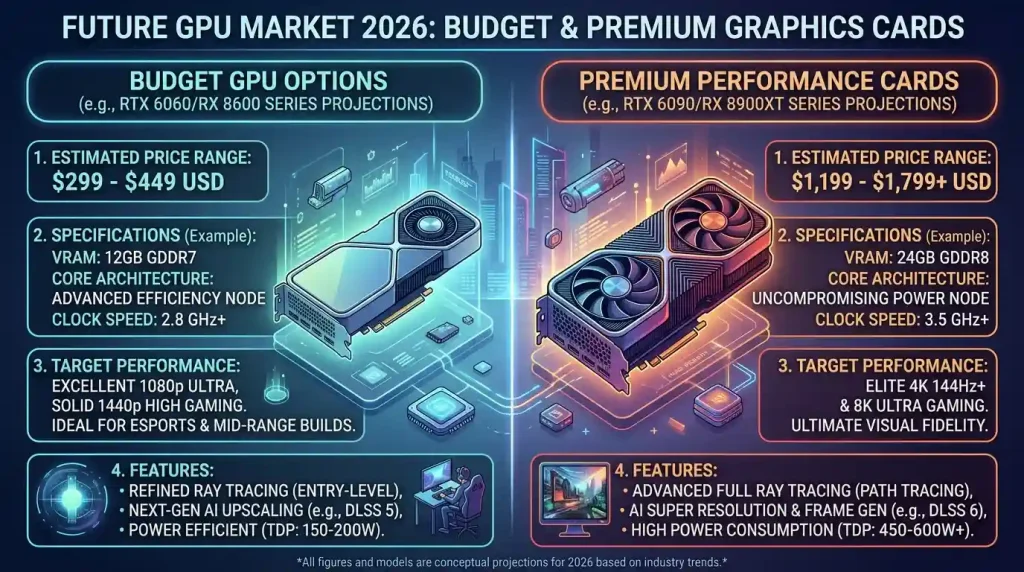
At 4K, the market becomes more concentrated at the premium end. The AMD RX 9070 XT is frequently recommended as the best value pick among high-end GPUs, providing strong 4K performance that is competitive with NVIDIA’s offerings but often at a more accessible price. For those seeking the absolute pinnacle of 4K performance, the NVIDIA RTX 5090 remains unparalleled, albeit with a price tag that pushes it into an exclusive category.
It’s crucial for buyers to consider the entire ecosystem, including upscaling technologies (DLSS 4, FSR 4), ray tracing performance, and power efficiency, as these can significantly impact the perceived value and longevity of a graphics card.
To help visualize the market, here’s a comparative overview of some popular budget and premium graphics cards in 2026. Please note that prices are indicative and subject to change based on market fluctuations, retailer promotions, and regional availability.
| GPU Model (Hypothetical/Current) | Target Resolution (Primary) | VRAM | Key Features | Approx. Price Range (USD – June 2026) | Notes |
|---|---|---|---|---|---|
| NVIDIA GeForce RTX 5050 | 1080p | 8GB GDDR7 | DLSS 4, Ray Tracing, AI Acceleration | $290 – $320 | Solid entry-level for 1080p gaming, strong NVIDIA feature set. |
| AMD Radeon RX 9060 XT | 1080p, 1440p (light) | 16GB GDDR6 | FSR 4, Strong Rasterization | $419 – $460 | Excellent value, high VRAM for future-proofing, competitive raster. |
| NVIDIA GeForce RTX 5060 | 1080p, 1440p (capable) | 8GB GDDR7 | DLSS 4 (Multi Frame Generation), Blackwell Arch. | $350 – $380 | Best overall for 1080p, good efficiency, strong upscaling. |
| AMD Radeon RX 9070 GRE | 1440p | 12GB GDDR6 | RDNA 4 Arch., FSR 4, Ray Accelerators | $549 | Global launch June 2026, aims for competitive QHD gaming. |
| NVIDIA GeForce RTX 5070 | 1440p | 12GB/16GB GDDR7 (variants) | DLSS 4, Advanced Ray Tracing, AI Performance | $599 – $670 | Strong mid-range Blackwell, excellent for high-refresh 1440p. |
| AMD Radeon RX 9070 XT | 1440p (high refresh), 4K (entry) | 16GB GDDR6 | RDNA 4 Arch., FSR 4, Value 4K | $699 – $769 | Best value for high-end gaming, strong against NVIDIA in raw frames. |
| NVIDIA GeForce RTX 5090 | 4K (uncompromised) | 32GB GDDR7 | Blackwell Arch., DLSS 4 (Multi Frame Generation), Ultimate RT/AI | $2,900 – $5,000+ | Absolute flagship, unparalleled performance, extreme price premium due to AI demand. |
Note: The “Approx. Price Range” reflects typical retail street prices observed in June 2026, which can deviate significantly from MSRP, especially for high-end cards affected by AI demand.
Future Outlook and Emerging Technologies
The GPU market in 2026 is at a pivotal juncture, with several trends and emerging technologies poised to shape its future. Continued innovation in GPU architecture, ray tracing capabilities, and AI-driven enhancements will lead to even more powerful and efficient GPUs. We can expect further advancements in upscaling technologies, with DLSS 4.5 and FSR 4.0 already playing significant roles in boosting frame rates and image quality.
One of the most defining aspects of the future outlook is the increasing integration of AI capabilities directly into GPU design. GPUs are not just for graphics anymore; their parallel processing power makes them ideal for AI workloads, transforming them into general-purpose computing units. This convergence means that future GPUs will likely feature even more dedicated AI accelerators and optimized architectures for machine learning tasks, blurring the lines between gaming and professional applications.
The growth of the GPU rental market and GPU-as-a-service models is democratizing access to high-performance computing, making advanced GPUs more accessible to a wider range of users, including startups and researchers. This trend could alleviate some pressure on consumer GPU availability as more AI workloads shift to cloud-based solutions. However, it also means that enterprise demand will continue to influence manufacturing priorities.
Supply chain improvements are ongoing, leading to more consistent production capacity and component availability, which should reduce volatility. However, bottlenecks in advanced packaging and memory (HBM3e, GDDR7) capacity are expected to persist through at least Q3 2026. Memory vendors are prioritizing high-margin AI chips, which may continue to impact the availability and pricing of consumer GPUs, particularly those with higher VRAM capacities. Organizations like SEMI forecast significant growth in advanced chipmaking capacity through 2028, with 2nm technology projected to reach mass production by 2026, which may eventually ease some supply pressures.
Ultimately, the market is moving towards a future where efficiency, utilization, and software optimization will be as crucial as raw hardware power, especially as AI infrastructure hits GPU scalability walls. Consumers will need to remain vigilant about market trends and be strategic in their purchasing decisions. For a deeper understanding of the foundational technology, exploring the history and evolution of the Graphics Processing Unit on Wikipedia can provide valuable context.
Conclusion
The GPU market in June 2026 presents a fascinating blend of technological innovation and market challenges. While next-generation graphics cards from NVIDIA, AMD, and Intel offer unprecedented levels of performance and efficiency, their pricing is heavily influenced by the insatiable demand from the AI sector and ongoing memory supply constraints. Budget-conscious buyers can still find excellent value in cards like the NVIDIA RTX 5050 or AMD RX 9060 XT for 1080p and even light 1440p gaming, benefiting from advanced upscaling technologies that extend their lifespan. For those pursuing uncompromised 4K performance and bleeding-edge features, premium options like the NVIDIA RTX 5090 and AMD RX 9070 XT deliver, albeit with price tags that reflect their scarcity and the high demand from AI workloads. Understanding these market dynamics, prioritizing needs (resolution, frame rate, AI capabilities), and staying informed about price fluctuations and new releases are key to navigating the complex GPU landscape of 2026 and securing a graphics card that best suits individual requirements and budget.