GPU RTX Comparison: Which NVIDIA RTX Card Should You Buy? 10 Best Picks for Every Gamer

Table of Contents
GPU RTX Comparison is an essential undertaking for anyone looking to upgrade their PC or build a new system in 2026. NVIDIA’s GeForce RTX graphics cards have become synonymous with cutting-edge visual fidelity and performance, largely due to their groundbreaking advancements in real-time ray tracing and AI-powered upscaling technologies. GPU RTX Comparison With the recent introduction of the RTX 50 series, based on the advanced Blackwell architecture, and the continued strong presence of the RTX 40 series from the Ada Lovelace generation, consumers are presented with a diverse and powerful range of options. Navigating this landscape requires a clear understanding of each card’s capabilities, its target audience, and how it stacks up against its peers in terms of price, performance, and features. This comprehensive guide aims to demystify the choices, providing a detailed comparison to help you determine which NVIDIA RTX card is the perfect fit for your specific needs, whether you’re a hardcore gamer, a professional content creator, or a casual enthusiast.
Introduction to NVIDIA RTX Graphics Cards
GPU RTX Comparison NVIDIA’s RTX lineup has revolutionized the graphics card market since its inception with the RTX 20 series, bringing hardware-accelerated ray tracing and Deep Learning Super Sampling (DLSS) to the forefront. These technologies fundamentally changed how games look and perform, setting new benchmarks for realism and efficiency. The RTX architecture integrates specialized cores: RT Cores for handling complex light calculations necessary for ray tracing, and Tensor Cores for accelerating AI tasks, most notably DLSS. This unique combination allows RTX cards to render stunning, lifelike graphics while maintaining high frame rates through intelligent upscaling. As we move into 2026, the evolution of these technologies continues, offering increasingly sophisticated visual experiences and more efficient performance across a broader range of applications.
Understanding NVIDIA’s Core RTX Technologies: Ray Tracing and DLSS
At the heart of every NVIDIA RTX graphics card are two pivotal technologies: Ray Tracing and Deep Learning Super Sampling (DLSS). These innovations work in tandem to deliver unparalleled visual experiences and performance.
- Ray Tracing: The Quest for PhotorealismRay tracing is an advanced rendering technique that simulates the physical behavior of light to produce incredibly realistic shadows, reflections, and global illumination. Unlike traditional rasterization, which approximates lighting, ray tracing tracks individual light rays as they bounce around a scene, interacting with objects. This results in visuals that are far more true-to-life and immersive. NVIDIA’s RTX cards feature dedicated RT Cores (Ray Tracing Cores) that are specifically designed to accelerate these complex calculations, making real-time ray tracing in games and professional applications a reality. The latest generations of RTX cards, particularly the Ada Lovelace (RTX 40 series) and Blackwell (RTX 50 series) architectures, have significantly improved RT Core performance, offering up to twice the ray-triangle intersection throughput compared to previous generations.
- DLSS: AI-Powered Performance BoostDeep Learning Super Sampling (DLSS) is NVIDIA’s AI-powered upscaling technology designed to boost frame rates while maintaining, or even enhancing, image quality. DLSS works by rendering frames at a lower resolution and then using AI to intelligently upscale them to a higher target resolution. This reduces the computational load on the GPU, leading to significantly higher frame rates, especially in graphically demanding titles and when ray tracing is enabled. The technology has seen several iterations, with DLSS 3.0 introducing AI Frame Generation for RTX 40 series GPUs, which creates entirely new, high-quality frames using an Optical Flow Accelerator, further boosting performance. DLSS 3.5, introduced in 2023, brought Ray Reconstruction, an AI model that replaces traditional hand-tuned denoisers in ray-traced scenes, leading to higher quality and more accurate lighting, reflections, and shadows for all RTX GPUs. With the RTX 50 series, NVIDIA has introduced DLSS 4, which includes Multi Frame Generation and further refinements, enhancing both image quality and performance. An upcoming update in August 2026, DLSS 4.5 Ray Reconstruction, promises even better ray tracing quality across all RTX GPUs by using a second-generation transformer model trained on a broader dataset.
NVIDIA’s Generational Leap: Ada Lovelace (RTX 40 Series) vs. Blackwell (RTX 50 Series)
NVIDIA’s recent history is marked by two groundbreaking architectures: Ada Lovelace, powering the RTX 40 series, and the newer Blackwell, which forms the foundation of the RTX 50 series. Understanding the differences between these generations is crucial for making an informed purchase decision.
The Ada Lovelace architecture, released in 2022, represented a significant leap forward from the previous Ampere generation (RTX 30 series). Built on a custom TSMC 4N process, Ada Lovelace focused on enhancing real-time ray tracing and AI-driven performance. Key innovations included third-generation RT Cores, fourth-generation Tensor Cores with FP8 precision support, and the introduction of DLSS 3 with AI Frame Generation. This architecture brought substantial performance and efficiency gains, with the RTX 4090, for instance, delivering up to a 70.7% uplift in performance over the RTX 3090 at 4K resolution with only a modest increase in power consumption. Cards like the RTX 4070 Ti offered performance close to the RTX 3090 Ti at a lower price point, making high-end gaming more accessible.
The Blackwell architecture, which debuted with the RTX 50 series starting in January 2025, builds upon Ada Lovelace’s successes, pushing the boundaries even further. Blackwell introduces fifth-generation Tensor Cores and fourth-generation RT Cores, along with the latest DLSS 4.5 technology, including Dynamic Multi Frame Generation. These advancements translate to enhanced raw performance, improved ray tracing capabilities, and even more efficient AI acceleration. The RTX 50 series also features GDDR7 memory and PCIe Gen 5 support, providing higher bandwidth and faster data transfer rates. For content creators, Blackwell GPUs like the RTX 5090 promise lightning-fast rendering, advanced AI capabilities, and seamless integration with modern AI tools, making workflows faster and smarter. Gaming benchmarks show significant improvements, with the RTX 5090 leading the RTX 4090 by approximately 27% in native rasterization at 4K and an even wider gap in ray tracing workloads.
In essence, while the RTX 40 series remains highly capable, particularly with its support for DLSS 3.5’s Ray Reconstruction (available for all RTX GPUs), the RTX 50 series (Blackwell) represents the pinnacle of NVIDIA’s current technology, offering superior performance, efficiency, and future-proofing, especially for users who prioritize the absolute latest in gaming and content creation capabilities.
Deep Dive into the RTX 50 Series: Models and Performance Tiers
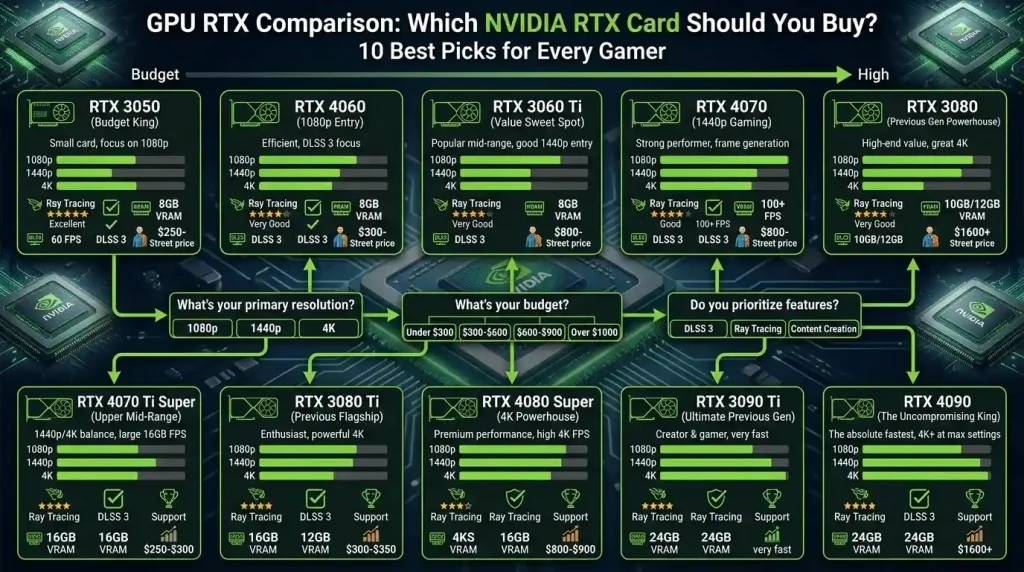
The NVIDIA GeForce RTX 50 series, powered by the Blackwell architecture, currently represents the cutting edge of consumer graphics processing. Launched starting in early 2025, this lineup offers a range of cards catering to various budgets and performance demands, from enthusiast-grade 4K gaming to high-refresh-rate 1440p experiences.
- RTX 5090: The Undisputed FlagshipThe RTX 5090 stands as the pinnacle of current GPU technology. With 21,760 CUDA Cores, 32GB of GDDR7 memory, and a 575W TDP, it’s designed for uncompromising 4K gaming at max settings and even entry-level 8K gaming. Reviews consistently praise its unmatched power, massive VRAM, and cutting-edge DLSS 4 support, making it the ultimate choice for those seeking extreme frame rates and future-proofing. The RTX 5090 delivers an average of 169 FPS at 4K in benchmarks and leads the RTX 4090 by roughly 27% in native rasterization at 4K and 17-27% in ray tracing. However, this top-tier performance comes with a significant price tag, often exceeding its MSRP due to demand, and it requires a robust power supply (1000W+) and adequate cooling.
- RTX 5080: High-End 4K Gaming Sweet SpotFor gamers who desire serious 4K performance without the flagship price, the RTX 5080 is often considered NVIDIA’s sweet spot. Equipped with 10,752 CUDA Cores and 16GB of GDDR7 memory, it delivers smooth, high-resolution gaming and full support for DLSS 4. The RTX 5080 excels at 4K, often outrunning its like-priced competitors and previous-generation cards. It’s ideal for pushing high refresh rates at 1440p or comfortable 4K gaming, especially when leveraging DLSS.
- RTX 5070 Ti: Best Value for 4K/High-Refresh 1440pThe RTX 5070 Ti strikes an excellent balance between price and performance, making it a highly recommended option for both 1440p and 4K gaming. With 8,960 CUDA Cores and 16GB of GDDR7 memory, it averages around 98 FPS at 4K, making most modern games well within playable range. It offers a strong blend of high performance and cutting-edge graphics tech, including full DLSS 4 support, making it a compelling choice for enthusiast gamers.
- RTX 5070: Solid 1440p Performer, Entry 4KThe RTX 5070, featuring 6,144 CUDA Cores and 12GB of GDDR7 memory, is a powerful GPU for smooth 1440p gaming at high to ultra settings, especially benefiting from DLSS 4 and its Multi-Frame Generation technologies. While it can handle entry-level 4K gaming, its 12GB VRAM may be a limitation for some demanding 4K titles or future games without significant DLSS intervention.
- RTX 5060 Ti: Budget-Friendly 1440p GamingFor gamers seeking reliable 1440p performance without breaking the bank, the RTX 5060 Ti (especially the 16GB GDDR7 variant) is a fantastic value. With 4,608 CUDA Cores, it delivers strong performance at 1080p and can handle most games at 60-100 FPS at 1440p with DLSS 4. It’s considered the best all-rounder graphics card for 1080p and 1440p gaming.
- RTX 5060: The 1080p ChampionThe RTX 5060, equipped with 3,840 CUDA Cores and 8GB of GDDR7 memory, is an excellent entry-level card primarily aimed at 1080p gaming in 2026. It provides strong performance for full HD gaming, making it ideal for those upgrading from older GTX or RTX cards who want the latest Blackwell features at an accessible price.
The Enduring Value of the RTX 40 Series
While the RTX 50 series represents NVIDIA’s latest and greatest, the RTX 40 series, built on the Ada Lovelace architecture, continues to offer compelling options, particularly for those seeking excellent performance at potentially more attractive price points. The RTX 40 series brought significant generational improvements over the RTX 30 series in both performance and power efficiency.
- RTX 4090: Still a Performance BehemothDespite the arrival of the RTX 5090, the RTX 4090 remains an exceptionally powerful card, often lauded as the “ultimate choice for gamers who want extreme frame rates in 4K”. Upon its release, its performance received widespread praise, delivering substantial generational improvements over the RTX 3090. While it has been succeeded, its raw power, 24GB of GDDR6X VRAM, and support for DLSS 3 Frame Generation mean it still easily crushes 4K gaming and demanding creative workloads. For many, it will still deliver an ultra-high FPS experience at 4K.
- RTX 4080 Super / RTX 4080: High-End 4K CapabilitiesThe RTX 4080 Super, a refreshed version of the original RTX 4080, offers strong 4K capabilities with 16GB of GDDR6X VRAM. It received positive reviews for its power efficiency and performance, often outperforming the RTX 3090 Ti. The 4080 Super is a “4K luxury cruiser” that handles ray tracing beautifully and delivers smooth gameplay in demanding titles even at 4K, especially with DLSS Frame Generation. While the RTX 5080 surpasses it, the RTX 4080 Super still provides an excellent high-end 4K experience for those not needing the absolute latest technology or seeking a better deal.
- RTX 4070 Ti Super / RTX 4070 Ti: The 1440p/Entry 4K ChampionThe RTX 4070 Ti and its later Super variant are highly regarded for 1440p gaming and even entry into 4K. The RTX 4070 Ti, for instance, offered a significant performance uplift over the RTX 3070 Ti and came close to the RTX 3090 Ti’s performance. It handles ray tracing beautifully and is considered a “1440p Champion” for high-refresh-rate monitors. With 12GB (or 16GB for the Super) of GDDR6X VRAM, these cards offer a strong balance of performance and features, making them a solid choice for a premium 1440p experience or a compromise-free entry into 4K gaming when paired with DLSS.
- RTX 4070 Super / RTX 4070: The 1440p Sweet SpotThe RTX 4070 Super and the original RTX 4070 hit a sweet spot for 1440p gaming. The RTX 4070, with 12GB of GDDR6X, excels at 1080p and 1440p and benefits greatly from DLSS 3.5. The RTX 4070 Super further improved upon this, often matching or slightly exceeding the performance of the original RTX 4070 Ti while being more power efficient. These cards are excellent choices for gamers with 144Hz 1080p or 60Hz 1440p monitors, providing a smooth and visually rich experience without the premium price of higher-tier cards.
- RTX 4060 Ti / RTX 4060: Entry-Level RTX for 1080pThe RTX 4060 Ti and RTX 4060 serve as the entry points into the RTX 40 series, primarily targeting 1080p gaming. The RTX 4060 is considered an efficient GPU for 1080p, sipping power while delivering smooth performance in most modern games and supporting DLSS 3. The RTX 4060 Ti (especially the 16GB variant) can extend this to 1440p with DLSS, making it a good all-rounder for that resolution in a budget-conscious build. While not as powerful as their higher-end siblings, these cards bring the benefits of ray tracing and DLSS to a more accessible price range, making them ideal for casual gamers or those on a tighter budget.
Matching Your NVIDIA RTX GPU to Your Use Case
Choosing the right NVIDIA RTX card heavily depends on your primary activities. Different cards excel in different scenarios, making it crucial to align your GPU choice with your specific use case.
Gaming
For gamers, the target resolution, desired frame rate, and the importance of ray tracing are paramount.
- 1080p Gaming: For smooth 1080p gaming, especially at high refresh rates, the RTX 5060 or RTX 4060 are excellent choices. The RTX 5060 is the clear best-in-class option for 1080p in 2026, with the RTX 4060 being an outstanding budget pick if found discounted.
- 1440p Gaming: The sweet spot for 1440p gaming includes the RTX 5070, RTX 5060 Ti (16GB), and the RTX 4070 Super / RTX 4070 Ti. The RTX 5070 is a powerful GPU for smooth AAA titles at high settings, thanks to DLSS 4. The RTX 5060 Ti 16GB is noted as the best budget pick for 1440p gaming, capable of 60-100 FPS with DLSS 4. For high-refresh 1440p monitors, the RTX 4070 Ti is a strong contender.
- 4K Gaming: If you’re aiming for uncompromised 4K gaming, especially with ray tracing, you’ll need a top-tier card. The RTX 5090 is the ultimate power pick, delivering jaw-dropping 4K performance with flawless Ray Tracing and unmatched future-proofing. The RTX 5080 is the next best option for serious 4K performance without the flagship price. Even the RTX 5070 Ti offers a strong value for 4K gaming, averaging 98 FPS at 4K. The previous generation’s RTX 4090 and RTX 4080 Super are also excellent for 4K, especially if you can find them at a good price.
Content Creation and Professional Workloads
NVIDIA RTX GPUs are not just for gaming; they are powerful tools for content creators, designers, engineers, and data scientists. Their Tensor Cores accelerate AI tasks crucial for many creative applications, while RT Cores boost rendering performance.
- Video Editing and 3D Rendering: GPUs with higher VRAM and more powerful Tensor/RT Cores are essential. The RTX 5090 is set to redefine expectations for content creation, promising lightning-fast rendering, advanced AI capabilities, and features catering to every creative workflow. The RTX 50 series, in general, with its Blackwell architecture, is designed to accelerate creative workflows, handling large-scale 3D models, 8K footage, and real-time effects with precision. Dedicated ray tracing cores render complex 3D scenes at lightning speed, and NVIDIA OptiX AI denoising provides real-time, photorealistic lighting previews.
- AI, Data Science, and Machine Learning: The specialized Tensor Cores in RTX cards are critical for accelerating AI development, inference, and data science workloads. While professional-grade RTX (e.g., RTX 6000 Ada Generation or RTX Pro Blackwell Generation) cards are designed for enterprise data centers and demanding AI applications, consumer RTX cards like the RTX 5090 and RTX 5080 still offer substantial AI acceleration for individual creators and developers.
- Streaming and Broadcasting: NVIDIA’s NVENC encoder, found in RTX cards, provides high-quality video encoding with minimal performance impact, making them ideal for livestreamers. The RTX 50 series GPUs, with improved NVIDIA encoders, can host up to 3x more video streams concurrently than the previous generation.
Key Factors When Choosing Your RTX Card
Beyond raw performance and intended use, several practical factors should influence your decision when selecting an NVIDIA RTX graphics card.
Budget
Your budget is arguably the most significant limiting factor. NVIDIA offers a spectrum of RTX cards, from entry-level options around $300 (RTX 5060) to enthusiast-grade cards exceeding $2,000 (RTX 5090). It’s crucial to establish a realistic budget first and then explore the best price-to-performance ratio within that range. While high-end cards offer the best performance, diminishing returns can be observed, especially for resolutions below 4K.
Monitor Resolution and Refresh Rate
The capabilities of your monitor should directly influence your GPU choice.
- 1080p Monitors: An RTX 5060 or RTX 4060 will be more than sufficient for high frame rates. Overspending on a high-end card for 1080p might lead to your CPU becoming the bottleneck rather than the GPU.
- 1440p Monitors: This is a popular sweet spot for many gamers. Cards like the RTX 5070, RTX 5060 Ti, RTX 4070 Super, or RTX 4070 Ti are ideal for smooth gameplay at 1440p, especially at high refresh rates (120Hz+).
- 4K Monitors: For native 4K gaming, especially with ray tracing, you’ll want the most powerful cards you can afford. The RTX 5090, RTX 5080, or RTX 4090 are designed to deliver high frame rates at this resolution. For value-focused 4K, the RTX 5070 Ti is a strong contender.
CPU Pairing
A powerful GPU needs to be paired with a capable CPU to avoid bottlenecks. An underpowered CPU can prevent your graphics card from reaching its full potential, leading to lower overall performance. Generally, modern mid-to-high-end CPUs from Intel or AMD are recommended to accompany RTX cards from the 40 and 50 series to ensure balanced system performance. For example, a CPU like the Ryzen 7 9800X3D was used in benchmarks for RTX 40 series cards, indicating the level of CPU power needed to truly test these GPUs.
Power Supply Unit (PSU)
High-performance GPUs require substantial power. Always check the recommended PSU wattage for your chosen RTX card. For instance, the RTX 5090 demands a 575W TDP and often requires a 1,000W+ power supply. Even cards like the RTX 4080 Super recommend a 750W+ PSU. Insufficient PSU wattage can lead to system instability, crashes, or prevent your card from boosting to its full potential.
Case Size and Cooling
Modern high-end GPUs, especially the RTX 4090 and RTX 5090, can be physically massive, sometimes occupying up to four PCIe slots. Ensure your PC case has adequate space to accommodate the card’s dimensions and sufficient airflow for cooling. Overheating can lead to thermal throttling and reduced performance. A well-ventilated case and potentially additional cooling solutions (like liquid cooling for top-tier cards) are crucial for sustained performance.
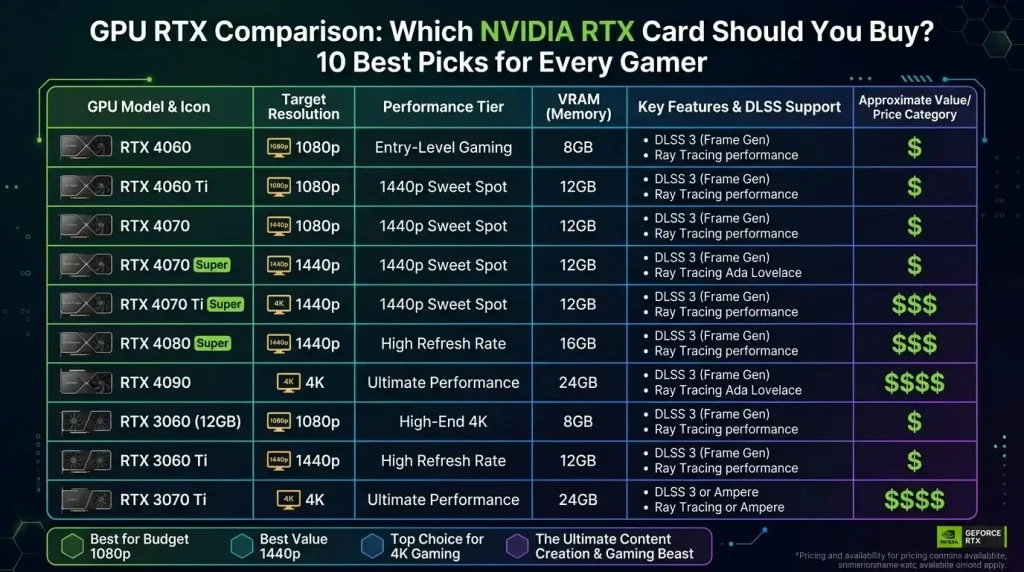
The table below offers a comparison of key specifications for selected NVIDIA RTX 50 and 40 series cards to aid in your decision-making. Please note that “Real-world price” can fluctuate significantly based on market demand and retailer.
| GPU Model | Architecture | CUDA Cores | VRAM | Memory Type | TDP | MSRP (approx.) | Best For |
|---|---|---|---|---|---|---|---|
| RTX 5090 | Blackwell | 21,760 | 32GB | GDDR7 | 575W | $2,499 | Ultimate 4K/8K Gaming, Pro Content Creation, AI |
| RTX 5080 | Blackwell | 10,752 | 16GB | GDDR7 | 360W | $999 | High-End 4K Gaming, Content Creation |
| RTX 5070 Ti | Blackwell | 8,960 | 16GB | GDDR7 | 300W | $749 | Value 4K, High-Refresh 1440p Gaming |
| RTX 5070 | Blackwell | 6,144 | 12GB | GDDR7 | 250W | $549 | 1440p Gaming, Entry 4K |
| RTX 4090 | Ada Lovelace | 16,384 | 24GB | GDDR6X | 450W | $1,599 | Extreme 4K Gaming, Pro Content Creation, AI |
| RTX 4080 Super | Ada Lovelace | 10,240 | 16GB | GDDR6X | 320W | $999 | High-End 4K Gaming, VR, Content Creation |
| RTX 4070 Ti Super | Ada Lovelace | 8,448 | 16GB | GDDR6X | 285W | $799 | Premium 1440p, Entry 4K Gaming |
| RTX 4070 Super | Ada Lovelace | 7,168 | 12GB | GDDR6X | 220W | $599 | Solid 1440p Gaming, Enthusiast 1080p |
| RTX 4060 Ti (16GB) | Ada Lovelace | 4,352 | 16GB | GDDR6 | 160W | $429 | Budget 1440p Gaming, High-Refresh 1080p |
| RTX 4060 | Ada Lovelace | 3,072 | 8GB | GDDR6 | 115W | $299 | 1080p Gaming, Entry-Level RTX |
Note: MSRPs are approximate launch prices and real-world availability and pricing may vary. TDP (Thermal Design Power) indicates typical power consumption. CUDA Cores and VRAM are key indicators of raw processing power and memory capacity.
For more in-depth technical specifications on NVIDIA’s architectures and their evolution, you can refer to the Wikipedia page on Ada Lovelace microarchitecture, which provides a detailed breakdown of the technological advancements from previous generations.
Conclusion: Making Your NVIDIA RTX Choice
The NVIDIA RTX ecosystem in 2026 offers a compelling range of graphics cards, each tailored to different performance expectations, resolutions, and budget considerations. Whether you prioritize uncompromised 4K gaming, high-refresh-rate competitive play, or demanding content creation workflows, there’s an RTX card designed to meet your needs.
For those seeking the absolute pinnacle of performance and willing to invest in the latest technology, the RTX 50 series, spearheaded by the dominant RTX 5090 and the high-end RTX 5080, delivers unmatched power, especially when leveraging the advancements of DLSS 4 and Blackwell architecture. These cards are ideal for enthusiasts pushing the boundaries