GPU Cost Breakdown: Why Graphics Cards Are So Expensive – 7 Key Reasons Explained

Table of Contents
GPU Cost Breakdown: Graphics cards, or Graphics Processing Units (GPUs), have become an increasingly significant, and often frustratingly expensive, component for PC enthusiasts, gamers, and professionals alike. Once a niche piece of hardware, their critical role in everything from high-fidelity gaming to complex artificial intelligence computations has propelled them into the spotlight, alongside a substantial price tag. Understanding why graphics cards are so expensive requires a deep dive into a multifaceted ecosystem of advanced manufacturing, immense research and development, intricate supply chains, market forces, and even global economic shifts. The journey of a GPU from raw silicon to a consumer’s gaming rig is fraught with costs at every turn, ultimately impacting the final price consumers pay.
The Complexities of Semiconductor GPU Cost Breakdown
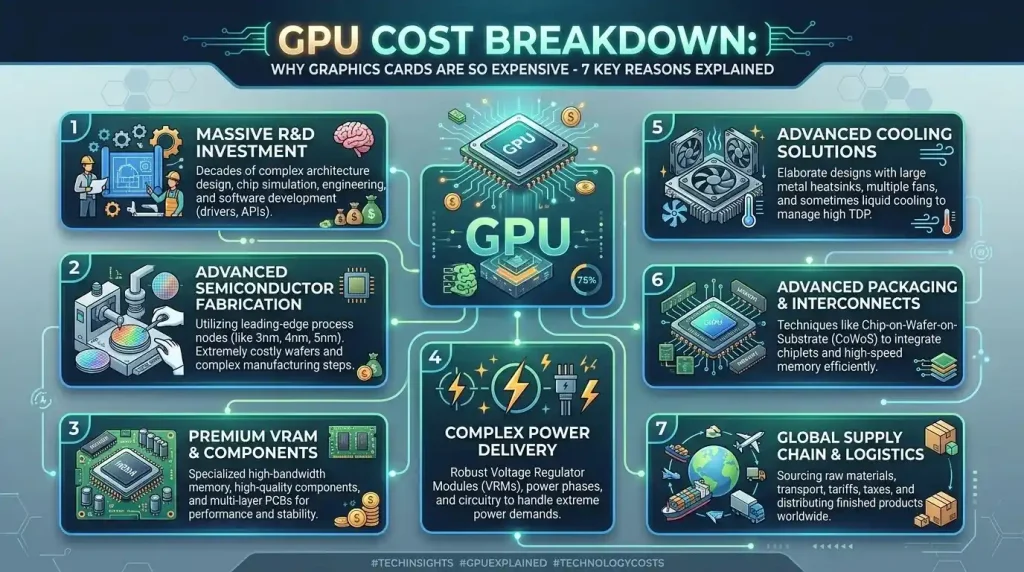
At the heart of every graphics card lies the GPU chip itself, a marvel of modern engineering. The manufacturing process of these complex semiconductors is extraordinarily intricate and expensive. It begins with ultra-pure silicon, extracted from quartz sand and refined to an astonishing 99.9999% purity. This electronic-grade silicon is then melted and grown into massive, single-crystal cylinders called ingots, which can weigh over 100kg. These ingots are then sliced into incredibly thin, polished discs known as wafers, which serve as the canvas for hundreds of future GPUs.
The fabrication of circuits on these wafers involves a process called photolithography, which is akin to an advanced photographic printing process operating at a microscopic scale. This process is repeated dozens of times, with chemical etching and the addition of various materials, to build billions of transistors that form the complex brain of a modern GPU.
The cost of operating a semiconductor manufacturing plant (fab) is staggering. Modern “gigafabs” can cost anywhere from five to twenty billion dollars to build. A significant portion of this capital expenditure goes towards high-tech equipment like lithography machines, vacuum chambers, and etching tools, with some extreme ultraviolet (EUV) lithography machines costing up to $150 million each, or even up to 120 million euros per system. The operational costs are equally high, with factories consuming immense amounts of electricity, heat, and water – a single fab can use as much electricity as a small city. The wafer itself can cost anywhere from $1,000 to $3,000 and above, depending on the diffusion process. For advanced 3nm chips, wafer fabrication costs can range from $20,000 to $25,000 per wafer. The advanced packaging processes, such as Chip-on-Wafer-on-Substrate (CoWoS), essential for high-performance AI GPUs, also add significant costs, with CoWoS-S packaging costing approximately $70 per unit. These high fixed and operational costs are inevitably factored into the final price of each GPU.
Research & Development: The Unseen Investment
Before a single GPU chip is manufactured, countless hours and billions of dollars are poured into research and development (R&D). Companies like NVIDIA and AMD invest massive sums to design new architectures, develop more efficient processing techniques, and push the boundaries of graphical fidelity and computational power. For instance, NVIDIA’s annual R&D expenses for 2026 were $18.497 billion, a 43.23% increase from 2025. This significant investment allows them to maintain a 4-5 year development cycle, with multiple design teams working sequentially.
Developing a new GPU architecture requires a vast team of engineers, with NVIDIA reportedly employing 2,000 to 3,000 engineers working on a new architecture, at an average wage of $100,000 per year per engineer. This fundamental investment in innovation is crucial for staying competitive in a rapidly evolving market, but it represents a substantial upfront cost that must be recouped through product sales. The continuous drive for smaller transistors, higher clock speeds, and more efficient power consumption necessitates constant innovation, making R&D a perpetual and escalating expense.
Supply Chain Dynamics and Geopolitical Factors
The global supply chain for GPUs is incredibly complex and susceptible to disruptions. From the sourcing of raw materials to the final assembly and distribution, numerous factors can impact costs and availability. The production of GPUs relies on a diverse range of raw materials, some of which are sourced from specific regions, making the supply chain vulnerable to geopolitical instability, natural disasters, and logistical challenges.
Manufacturing bottlenecks are a persistent issue, particularly in advanced semiconductor fabrication plants. The production of cutting-edge GPUs relies heavily on a few key players like TSMC, which requires immense capital investment and years to build new facilities. These limited capacities create bottlenecks, especially for advanced packaging processes like CoWoS, which remain “sold out through 2025 and into 2026”. Even with expansions, demand, particularly from major tech companies for AI applications, continues to outpace manufacturing capacity.
Geopolitical tensions, such as U.S.-China tariff regimes, also play a significant role in inflating GPU prices and reducing availability, as higher costs are often passed on to consumers. Furthermore, logistical complexities involved in transporting sensitive, high-value electronic components across continents add to the overall cost, with any disruptions in shipping or customs processes leading to delays and increased expenses.
Raw Materials and Component Costs
Beyond the silicon die, a graphics card is composed of numerous other expensive components. These include:
- Copper: Used for the main electrical routes on the Printed Circuit Board (PCB).
- Gold/Silver: Interchangeable and used for connections and switches due to their high resistance to variable temperatures and heat. Gold is preferred but more expensive.
- Aluminum: Commonly used in heatsinks for cooling.
- Tin and Zinc: Other metals used in various components.
- Fiberglass or ABS: Used to layer the copper traces on the PCB. Fiberglass is better but more expensive.
- Tantalum and Palladium: Used in transistors and capacitors.
- Video Memory (VRAM): High-bandwidth memory (HBM) can be a dominant cost component for AI chips, with 6-8 stacks of HBM3E adding $700-$1,500 to the manufacturing cost of a GPU.
The cost of these raw materials, along with the sophisticated processes required to refine and integrate them, contributes significantly to the overall production expense. The silicon wafer alone typically accounts for 10-15% of the total production cost.
Market Demand, Speculation, and Scalper Culture
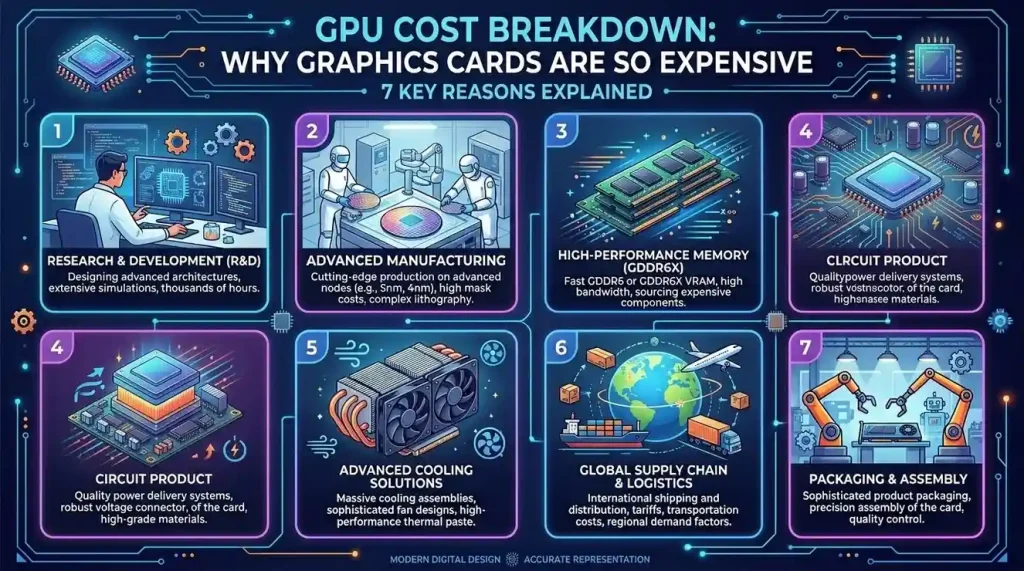
The GPU market is highly sensitive to demand fluctuations, which can lead to significant price volatility. The increasing popularity of PC gaming, the rise of AI development, and historical surges in cryptocurrency mining have all driven up demand for high-performance GPUs. When demand outstrips supply, prices inevitably rise. The global GPU market is projected to expand substantially, reaching $592.18 billion by 2033 from $63.22 billion in 2024, with a Compound Annual Growth Rate (CAGR) of 28.22% from 2025 to 2033.
Scalper culture has also played a significant role in inflating GPU prices, particularly during periods of high demand and limited supply. Scalpers use automated bots to purchase large quantities of GPUs as soon as they become available, then resell them on secondary markets like eBay and StockX at exorbitant prices. This practice creates artificial shortages, making it difficult for genuine consumers to acquire cards at their Manufacturer Suggested Retail Price (MSRP). For example, the RTX 5090, despite its MSRP, has been listed by scalpers for up to $7,000. Even system integrators have reported being “scalped” by distributors, paying inflated prices for GPUs. This phenomenon exacerbates price inflation and frustrates consumers.
Here’s a breakdown of estimated manufacturing costs for some high-end GPUs:
| Component | NVIDIA H100 SXM5 (Estimated Cost) | AMD MI300X (Estimated Cost) |
|---|---|---|
| Logic Die | ~$300 | ~$600 |
| HBM Memory | ~$1.4K | ~$2.9K |
| Packaging | ~$750 | ~$1.2K |
| Test & Assembly | ~$920 | ~$600 |
| Total Manufacturing Cost | ~$3.3K | ~$5.3K |
| Estimated Sell Price | ~$28.0K | ~$15.0K |
| Gross Margin | ~88.1% | ~64.7% |
(Data sourced from Silicon Analysts, estimates are directional and may vary)
The Impact of Cryptocurrency Mining
For several years, cryptocurrency mining significantly impacted GPU prices. GPUs are highly efficient at “mining” proof-of-work cryptocurrencies like Bitcoin and (formerly) Ethereum. The profitability of mining led to a surge in demand, with miners buying large quantities of GPUs, driving street prices to double, and in some cases, quadruple their MSRP during crypto bubbles. Analysts estimated that 25% of GPUs shipped in the first quarter of 2021 went to cryptocurrency miners and speculators.
The correlation between Bitcoin prices and GPU prices has been observed, with GPU prices often mimicking Bitcoin’s fluctuations after a delay. While the shift of Ethereum to a ‘proof-of-stake’ model in 2022 made GPU mining significantly less profitable for that cryptocurrency, and a subsequent crash in cryptocurrency prices led to GPUs returning closer to their MSRP, the historical impact was profound. The consumer market was negatively affected, making it challenging to purchase GPUs at reasonable prices.
Branding, Marketing, and Retail Markups
Beyond the fundamental costs of manufacturing and R&D, branding, marketing, and retail markups contribute to the final price consumers pay. NVIDIA and AMD invest heavily in branding and marketing campaigns to create desire and differentiate their products. These costs are embedded in the final price.
Retailers and Add-in-Board (AIB) partners also add their markups. While MSRP is intended as a suggested price, market demand, limited supply, and “hype launches” can drive prices significantly higher. Retailers are not legally required to sell at MSRP, and they often capitalize on high demand by listing cards above the suggested price for larger margins. In some cases, retailers may even bundle GPUs with unwanted items to increase the overall cost. Historically, profit margins for AIBs and retailers have been lower than those of the GPU manufacturers themselves, but in times of shortage, these margins can increase substantially. Reports indicate that average margins on GPUs can be less than 5% for retailers, but in other cases, they might aim for around 15% above the distributor’s price. However, in highly constrained markets, these can rise significantly.
For consumers in regions like India, additional factors such as import duties, Goods and Services Tax (GST), logistics, and currency fluctuations further inflate prices, often resulting in GPUs selling for 20-35% over global MSRP.
The Road Ahead: Future Outlook and Affordability
The future of GPU prices remains a subject of considerable debate. Several factors suggest that high prices may persist. The insatiable demand for high-performance GPUs, particularly from the booming artificial intelligence sector and data centers, continues to outpace manufacturing capacity. Data centers are growing at a 29%+ CAGR and consuming GPUs at a scale that consistently outpaces what foundries can supply. Major tech companies are securing large portions of available GPU capacity, potentially limiting availability for consumer applications. This structural supply imbalance means that consumer GPU shortages are not just a supply problem, but a priority problem.
NVIDIA’s H100, for instance, has an estimated manufacturing cost of around $3,320, but it is sold to end customers for a price ranging from $25,000 to $40,000. This significant markup highlights the intense demand and value placed on these high-end AI accelerators. Lead times for data center GPUs can stretch past a year, and advanced packaging capacity remains “structurally oversubscribed”. Rising memory prices are also expected to contribute to increased GPU costs, especially for models with more than 16GB of memory.
While some reports suggest GPU prices stabilized around MSRP in late 2025, the underlying demand drivers from AI are likely to keep prices elevated, particularly for high-end cards. Companies are planning to continue raising GPU prices, with some reports indicating potential increases of 10-20% in Q1 2026. The market for renewed and used GPUs also shows strong demand, indicating that consumers are actively seeking more affordable options. It seems that, for the foreseeable future, consumers will need to navigate a market where graphics cards continue to be a premium investment.
Conclusion
The high cost of graphics cards is not attributable to a single factor but rather a complex interplay of cutting-edge technology, significant investments in research and development, intricate global supply chains, intense market demand, and the dynamics of speculation and retail pricing. From the extreme precision and capital-intensive nature of semiconductor manufacturing to the billions spent on innovation by industry giants, every stage of a GPU’s lifecycle adds to its final price. Coupled with periods of unprecedented demand from gaming, cryptocurrency mining, and increasingly, artificial intelligence, the market has seen prices driven far beyond their manufacturing cost. As the demand for computational power continues to grow, particularly from data centers and AI development, the pressures on GPU supply and pricing are unlikely to abate entirely. Consumers hoping to acquire the latest and most powerful graphics cards will likely need to continue factoring in these numerous cost drivers when making their purchasing decisions.