GPU Card Comparison: NVIDIA vs AMD in 2026 – 10 Exciting Insights for Gamers

Table of Contents
GPU Card Comparison between NVIDIA and AMD in 2026 reveals a dynamic and increasingly complex market. The perennial rivalry between these two tech giants continues to shape the graphics processing unit (GPU) landscape, with each company pushing the boundaries of performance, efficiency, and innovative features. In 2026, the discussion extends far beyond raw teraflops, encompassing advanced AI integration, sophisticated upscaling techniques, and specialized architectures catering to diverse user needs, from high-fidelity gaming to demanding professional workloads. The industry is experiencing significant shifts, influenced by burgeoning AI demand and persistent supply chain challenges, particularly concerning memory components. This comprehensive article delves into the intricacies of NVIDIA and AMD’s offerings, examining their architectural philosophies, performance benchmarks, feature sets, and market positioning to help consumers make informed decisions in a rapidly evolving technological environment.
Market Dominance and GPU Card Comparison
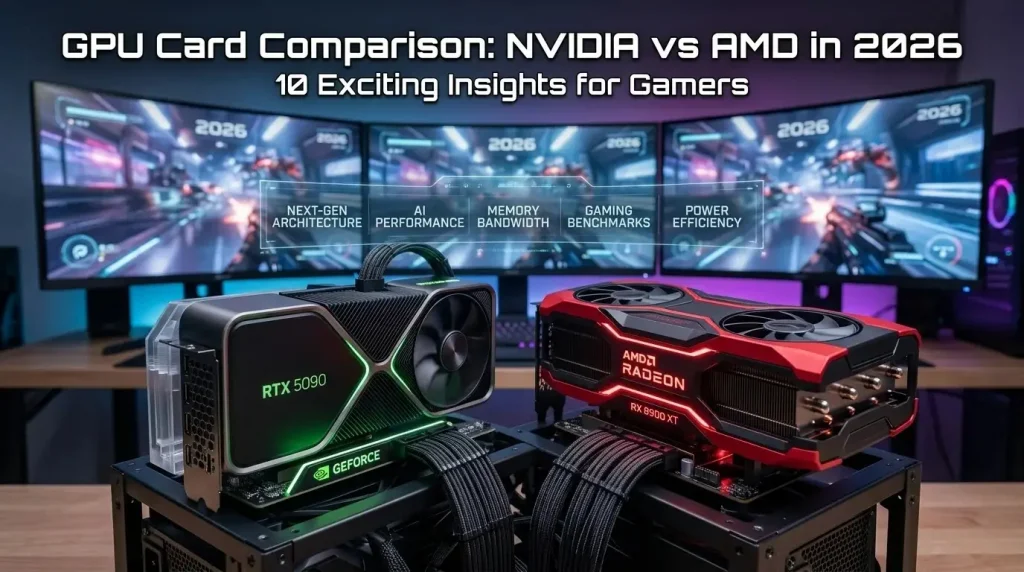
The GPU market in 2026 is characterized by NVIDIA’s continued dominance, especially in the Artificial Intelligence (AI) and high-end gaming sectors. As of Q4 2025, NVIDIA held a commanding 94% share of the AIB (add-in-board) GPU market, representing a significant 10-point increase from the previous year. This dominance is largely driven by its strong presence in AI accelerators, where NVIDIA commands approximately 80% of the market by revenue in 2026, with data center revenue reaching an impressive $193.7 billion in FY2026. The company’s data center business has seen extraordinary growth, fueled by the success of its Hopper (H100/H200) and Blackwell (B200/GB200) architectures.
Conversely, AMD’s market share in discrete GPUs has seen a decline, falling to just 5% in Q4 2025. However, in the AI accelerator market, AMD’s Instinct GPU line generated an estimated $7–8 billion in 2025, capturing roughly 5–7% market share. While this is a considerably smaller slice compared to NVIDIA, AMD remains a credible second source, demonstrating aggressive innovation and price competition to keep the market dynamic. The competitive landscape is further nuanced by the rise of hyperscaler custom silicon (such as Google TPU and AWS Trainium), which collectively represents a larger and faster-growing threat to NVIDIA than AMD in the AI sector. The global graphics card market is projected for substantial growth, expected to reach $548.07 billion by 2031, with a compound annual growth rate (CAGR) of 32.1% from 2024, driven by advancements in AI, machine learning, cloud gaming, and virtual reality. However, this growth is met with challenges, as GPU pricing is rising across all major product lines due to memory shortages (HBM, GDDR, DRAM) and sustained AI demand, causing supply conditions to tighten further into 2026.
NVIDIA: The RTX 50 Series and Beyond
NVIDIA’s strategy in 2026 continues to center around a highly specialized, closed ecosystem, emphasizing premium features, superior ray tracing, and its advanced DLSS (Deep Learning Super Sampling) technology. The current GeForce RTX 50-series, built on the Blackwell architecture (though Ada Lovelace is still prevalent in many segments), forms the backbone of its consumer offerings. The RTX 50-series, introduced in 2025, emphasizes DLSS 4, AI-assisted rendering, frame generation, and multi-frame generation. Notable cards include the flagship RTX 5090, RTX 5080, and RTX 5070 Ti, with the RTX 5060 and 5060 Ti also present in the lineup. The RTX 5090, while the performance leader, faces high demand in the AI sector, pushing street prices to enthusiast-only levels.
NVIDIA’s Ada Lovelace architecture, launched in 2022, was a significant leap forward, introducing third-generation RT Cores and fourth-generation Tensor Cores. These enhancements deliver up to 2X the ray-tracing performance and significantly accelerate AI technologies like DLSS 3, generative AI, and natural language processing. The architecture also brought improvements in power efficiency, leveraging TSMC’s custom 4N process. For professionals, NVIDIA’s CUDA architecture remains the industry standard for scientific simulations, advanced 3D design, and AI workloads. The company’s focus is aggressively shifting towards agentic AI, reasoning models, hyperscale data centers, and AI factories, exemplified by the upcoming Rubin GPU Architecture, which will feature next-generation HBM4 memory, advanced Transformer Engines, and sixth-generation NVLink technology.
AMD: The Radeon RX 9000 Series and RDNA 4
AMD, in 2026, continues to position itself as the high-efficiency alternative, advocating for open standardization and pure rasterization efficiency. The company’s latest consumer offerings are based on the RDNA 4 architecture, with the Radeon RX 9000 series leading the charge. Key models include the RX 9070 XT, RX 9070, and RX 9060 XT. AMD’s RDNA 4 lineup is designed to appeal to gamers who prioritize strong native performance and competitive pricing, often delivering generous VRAM configurations for the money. For instance, the RX 9070 XT is a strong contender for “best GPU for most people,” offering 16GB of VRAM and competitive performance, while the RX 9060 XT is highlighted as the “best mainstream GPU”. AMD recently launched the Radeon RX 9070 GRE globally, an RDNA 4 card targeting mainstream 1440p gamers with 12GB of memory and a suggested retail price of $549.
AMD’s architectural approach often involves a chiplet-based design that prioritizes massive VRAM and native rasterization performance. The company’s FidelityFX Super Resolution (FSR) technology, now in its FSR 4 iteration (released late 2025), is an open standard that benefits the entire industry, working across NVIDIA, Intel, and AMD GPUs, and even consoles. FSR 4 represents a significant leap for AMD, adopting a transformer-based machine-learning model that analyzes temporal information, similar to NVIDIA’s DLSS, leading to comparable output quality in most scenarios for 2025-2026 titles. AMD’s software support through ROCm has also significantly improved, making it a viable choice for many professional workloads. While there are rumors of AMD potentially skipping RDNA 5 in favor of a “UDNA” architecture focused on AI-accelerated technologies for a 2026 production, RDNA 5 is still anticipated around mid-2027, with RDNA 4 focusing on entry-to-mid-range markets.
Gaming Performance: Rasterization and Ray Tracing
When it comes to raw rasterization performance—the traditional method of rendering 3D graphics—AMD and NVIDIA are often neck-and-neck at overlapping price points in 2026. AMD’s RDNA 4 architecture has focused on delivering strong native gaming performance and a superior price-to-performance ratio in this area. For many games without ray tracing, AMD cards frequently offer more frames per dollar. The Radeon RX 9070 XT, for example, is noted for its excellent raster performance.
However, the narrative shifts significantly when ray tracing is introduced. NVIDIA continues to hold a clear lead in ray tracing performance and features. This advantage is attributed to NVIDIA’s dedicated RT cores and the maturity of its ray tracing implementation, which provides much higher ray-traced FPS and better stability with multiple RT effects. While AMD has made considerable improvements with its RDNA 4 architecture, and modern Radeon GPUs do support ray tracing, the performance gap remains visible, especially in heavier RT games at 1440p and 4K. Some sources suggest that while AMD’s new RX 9000 series is getting closer to NVIDIA’s equivalent cards in RT performance in many titles, NVIDIA still maintains a lead in path tracing. The integration of DLSS also significantly boosts NVIDIA’s ray tracing performance, further widening the gap.
AI and Upscaling Technologies: DLSS vs. FSR
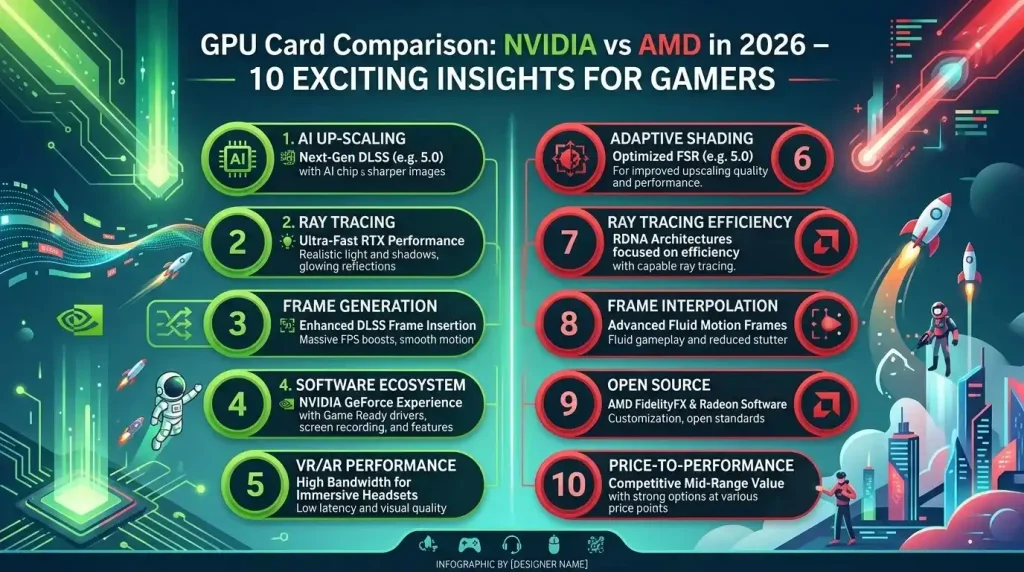
AI-based upscaling technologies have become a critical factor in GPU purchasing decisions in 2026, redefining what “GPU performance” means in practice. NVIDIA’s Deep Learning Super Sampling (DLSS) and AMD’s FidelityFX Super Resolution (FSR) are the two primary contenders, both leveraging AI and advanced reconstruction algorithms to boost frame rates and image quality at lower rendering costs.
NVIDIA’s DLSS 4.5, the current version as of 2026, continues to be a benchmark for image quality, frame generation, and lower latency. DLSS 4 introduced multi-frame generation capabilities and improved transformer models, with DLSS 4.5 further refining these features for better motion handling and reduced artifacts. DLSS requires NVIDIA’s Tensor Cores, dedicated AI hardware on RTX GPUs, which contributes to its superior image quality and performance. NVIDIA also integrates Reflex 2.0 directly into the DLSS pipeline, minimizing end-to-end latency, a crucial advantage in competitive gaming. DLSS supports over 400 games and applications, making it the most widely adopted AI upscaling solution.
AMD’s FSR 4, released in late 2025, represents AMD’s most serious challenge to DLSS dominance. For three generations, FSR relied on spatial algorithms, but FSR 4 adopted a transformer-based machine-learning model, analyzing temporal information alongside spatial data, similar to DLSS. This has led to a significant quality improvement, with FSR 4 Quality mode now producing output comparable to DLSS Quality mode in most scenarios in 2025-2026 titles. A key advantage of FSR has always been its open-source nature and universal compatibility, working on NVIDIA cards, Intel GPUs, and consoles, not just AMD hardware. However, in 2026, FSR 4 has become less universal, with AMD reserving AI features for its latest GPUs, similar to NVIDIA’s approach. While DLSS generally delivers superior image quality and lower latency, FSR 4 has made enormous progress and provides massive gains, especially for AMD gamers, in some well-optimized titles.
Power Efficiency and VRAM Considerations
Power efficiency has emerged as a critical consideration for GPUs in 2026, impacting electricity bills, thermal management, and system noise. High-end GPUs now push 400W+ TDPs, and the demand for power-hungry AI data center parts (like NVIDIA’s B200 and B300 generations, expected to exceed 1,000W per chip) has downstream effects on consumer GPU design.
NVIDIA has historically set a high standard for power efficiency in its mid-range cards, with expectations for the RTX 50-series “xx60” and “xx50” cards to continue this trend, delivering high frame rates under 150W by leveraging DLSS. However, some NVIDIA Founders Edition models have improved heat management, though their power draw can remain among the highest in the market.
AMD, with its chiplet-based architecture, prioritizes massive VRAM configurations, often offering more VRAM per dollar than NVIDIA at similar price points. This generous VRAM is vital for large models, high-resolution textures, and demanding professional applications. Power consumption ratings for AMD’s RDNA 4 cards, such as the RX 9070 GRE at 220W Total Board Power, indicate a focus on suitability for mainstream gaming systems. Both companies are striving for efficiency, as AI-augmented rendering techniques (denoising, frame interpolation) reduce the total compute required, thereby lowering energy consumption for equivalent quality output. The effective VRAM capacity of current GPUs is also expected to increase substantially with broader adoption of Neural Texture Compression, extending the relevance of cards like the RTX 5090 beyond its 32 GB hardware limit.
Key GPU Comparison: NVIDIA RTX 5070 Ti vs. AMD Radeon RX 9070 XT (Approximate 2026 Mid-Range)
| Feature | NVIDIA GeForce RTX 5070 Ti | AMD Radeon RX 9070 XT |
|---|---|---|
| Architecture | Blackwell (or advanced Ada Lovelace) | RDNA 4 |
| Target Resolution | 1440p High Refresh Rate / Entry 4K | 1440p High Refresh Rate |
| VRAM (Typical) | 16GB GDDR7 (e.g., RTX 5080 has 16GB GDDR7) | 16GB GDDR6 (e.g., RX 9070 XT has 16GB GDDR6) |
| Ray Tracing Performance | Superior | Improved, but still behind NVIDIA |
| Upscaling Technology | DLSS 4.5 (Proprietary, AI-accelerated) | FSR 4 (Open-source, Machine-Learning based) |
| AI Acceleration | Dedicated Tensor Cores, strong for AI/ML | Second-generation AI Accelerators |
| Power Consumption (TBP) | Generally higher for top-tier cards | Competitive, often lower for equivalent raster performance |
| Ecosystem | Closed, CUDA-centric (strong for creators/pro) | Open, ROCm improving (good value for many) |
| General Price Position | Premium segment, higher entry cost | Value-oriented, strong price-to-performance |
Pricing, Availability, and Value Proposition
The GPU market in 2026 is grappling with significant price increases and availability challenges, primarily driven by surging demand from AI data centers and ongoing memory shortages. This has impacted both NVIDIA’s and AMD’s product lines, leading to higher street prices, particularly for high-end and AI-focused GPUs.
NVIDIA’s RTX 50-series GPUs, especially the high-end models, tend to occupy the premium segment of the market. While NVIDIA’s cards often come with a higher price tag, the company’s value proposition lies in its superior ray tracing, advanced DLSS features, and the unmatched CUDA ecosystem, which adds significant value for content creators, AI researchers, and professional users. The RTX 5090, for instance, despite being the flagship, faces street prices that cater predominantly to enthusiasts due to high AI demand. In Q4 2025, NVIDIA’s Blackwell (RTX 50-series) GPU prices saw an increase of 15-23%, while Ada (RTX 40-series) increased by 5-10%.
AMD, on the other hand, continues to emphasize a strong value proposition, frequently offering a better price-to-performance ratio, particularly in raw rasterization. AMD cards often provide very strong raw performance and generous memory options at lower costs, making them an attractive choice for budget-conscious gamers and startups. For instance, the AMD Radeon RX 9070 XT is recognized as the “best GPU for most” due to its competitive price and 16GB of VRAM. The newly launched RX 9070 GRE is positioned as a mainstream 1440p gaming card at an accessible price of $549, claiming to be faster than the RTX 5060 Ti in internal testing. While NVIDIA prioritizes higher-margin Blackwell GPUs, making lower-tier Ada products more constrained, AMD’s strategy often includes more aggressive pricing and memory configurations per dollar. The overall trend for 2026 indicates persistent GPU shortages and upward pricing, especially for AI-focused GPUs, with memory constraints remaining a significant unresolved factor. However, for consumers, Wikipedia’s overview of graphics cards highlights the continuous innovation driving competition, offering a range of choices across various price points and performance tiers.
Conclusion: Choosing Your Champion in 2026
In 2026, the GPU market remains a fiercely contested arena, with NVIDIA and AMD each offering compelling reasons for users to choose their respective platforms. NVIDIA, with its dominant market share, proprietary CUDA ecosystem, and superior ray tracing and DLSS technologies, continues to be the premium choice for those seeking cutting-edge features, robust AI acceleration, and unparalleled performance in professional applications and graphically demanding titles. The RTX 50-series, particularly the high-end models, exemplifies NVIDIA’s commitment to pushing the boundaries of what’s possible in visual computing and AI inference.
AMD, while holding a smaller market share, has solidified its position as the value leader, offering excellent raw rasterization performance per dollar and generous VRAM configurations with its RDNA 4-based RX 9000 series. The significant advancements in FSR 4, now leveraging machine learning to deliver image quality comparable to DLSS in many scenarios, further strengthen AMD’s appeal. For gamers prioritizing strong native performance and excellent value, or professionals who benefit from AMD’s more open software approach (ROCm), AMD presents a highly competitive alternative.
Ultimately, the choice between NVIDIA and AMD in 2026 is less about a single “winner” and more about aligning the GPU with individual needs, budget, and priorities. If cutting-edge ray tracing, a mature AI software ecosystem (CUDA), and the absolute best in high-end features are paramount, NVIDIA remains the frontrunner. However, if strong rasterization performance, superior price-to-performance, ample VRAM, and an open-source philosophy are more appealing, AMD’s offerings provide exceptional value and capabilities. Both companies are driving innovation, and as the GPU market continues to evolve with the increasing demands of AI and advanced gaming, consumers have more powerful and specialized options than ever before.