7 Powerful Reasons the RTX 3070 is the Best Mid-Range GPU
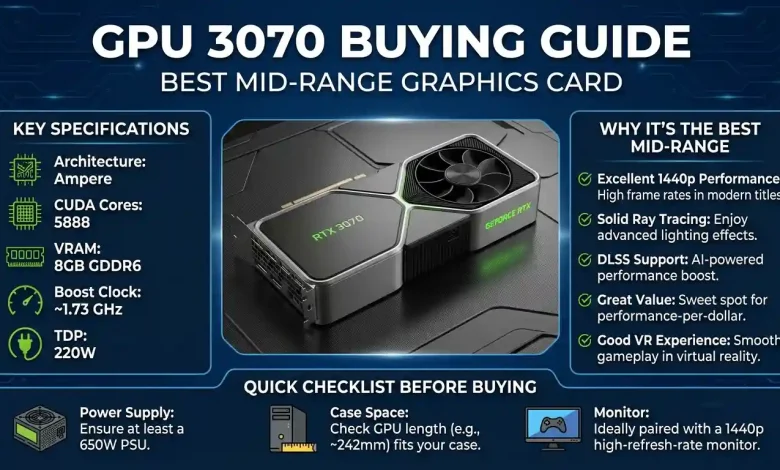
Table of Contents
The GPU 3070, or NVIDIA GeForce RTX 3070, launched in September 2020, quickly established itself as a formidable graphics card, aiming to deliver high-end performance at a more accessible price point than its higher-tier siblings. Built on the NVIDIA Ampere architecture, it was designed to offer excellent 1440p gaming and even capable 4K performance, making it a strong contender for the “best mid-range graphics card” title during its prime and remaining relevant for many gamers even today. This comprehensive buying guide delves into everything you need to know about the RTX 3070, from its core specifications and performance metrics to its standing against modern competitors and crucial factors to consider before making a purchase in 2026.
Understanding the NVIDIA GeForce RTX 3070
The NVIDIA GeForce RTX 3070 was introduced as part of the RTX 30 series, powered by the Ampere architecture, which brought significant advancements in ray tracing and AI-powered DLSS (Deep Learning Super Sampling) technologies. At its launch price of $499, the RTX 3070 was positioned to offer performance comparable to the previous generation’s flagship, the RTX 2080 Ti, but at less than half the cost. This made it an incredibly attractive option for gamers looking to upgrade to a ray-tracing-capable GPU without breaking the bank.
The card supports DirectX 12 Ultimate, which includes features like hardware-accelerated ray tracing, variable-rate shading, and more, ensuring compatibility with the latest and upcoming games. While it was considered a high-end graphics card at launch, its classification has shifted over time due to the release of newer generations. However, it continues to be a very capable GPU for gaming at 1440p and even entry-level 4K, particularly when paired with NVIDIA’s DLSS technology to boost frame rates.
Key Specifications of the RTX 3070
The RTX 3070 is based on the GA104 graphics processor, utilizing an 8 nm manufacturing process. It features 5888 CUDA cores, 184 Tensor Cores, and 46 Ray Tracing (RT) Cores, which are crucial for accelerating AI workloads and realistic lighting effects in games, respectively.
For memory, the RTX 3070 comes with 8 GB of GDDR6 VRAM, connected via a 256-bit memory interface, providing a memory bandwidth of 448 GB/s. The GPU operates with a base clock of 1500 MHz, boosting up to 1725 MHz, while the memory runs at 1750 MHz (14 Gbps effective). It’s a dual-slot card with a typical board power (TBP) or Thermal Design Power (TDP) of 220 W.
The card typically draws power from a 1x 12-pin power connector, though many aftermarket cards use standard 8-pin PCIe power connectors, often requiring one or two 8-pin connectors. Display outputs usually include 1x HDMI 2.1 and 3x DisplayPort 1.4a, offering ample connectivity for modern monitors.
Performance Benchmarks: Gaming and Productivity
The RTX 3070 delivers strong performance across a wide range of games, particularly at 1440p resolution. It excels in delivering smooth frame rates in demanding AAA titles with high settings. When it launched, it provided performance that was “faster than the RTX 2080 Ti”. For competitive gaming, it can easily achieve high refresh rates at 1080p and 1440p.
In productivity tasks, the Tensor Cores accelerate AI and machine learning applications, while the CUDA cores provide significant computational power for video editing, 3D rendering, and other creative workloads. Its 8GB of GDDR6 memory is generally sufficient for 1440p gaming and many creative applications, though some very demanding tasks or future games at higher resolutions might benefit from more VRAM. NVIDIA’s DLSS technology also plays a crucial role in boosting performance, especially when ray tracing is enabled, by rendering games at a lower resolution and then upscaling them using AI, often resulting in performance gains without significant image quality loss.
RTX 3070 vs. Competitors: A Comparative Analysis
When considering the RTX 3070 today, it’s important to compare it not only to its direct rivals from AMD but also to newer generations from NVIDIA itself.
RTX 3070 vs. AMD RX 6700 XT
The AMD Radeon RX 6700 XT was a direct competitor to the RTX 3070 at launch, often priced similarly. The RTX 3070 generally holds a minor lead in traditional rasterization performance and a more significant lead when ray tracing is enabled, especially with DLSS. The RX 6700 XT, however, comes with 12GB of GDDR6 VRAM compared to the RTX 3070’s 8GB, which could be an advantage in VRAM-intensive titles at higher resolutions. Despite the VRAM difference, in aggregate benchmarks, the RTX 3070 tends to outperform the RX 6700 XT by about 12% and generally offers better value for money by a small margin.
RTX 3070 vs. RTX 3060 Ti
The RTX 3060 Ti, also an Ampere card, sits just below the 3070 in NVIDIA’s stack. The RTX 3070 is consistently faster, offering anywhere from a 10-18% performance uplift depending on the game, with larger differences in more graphically intense titles. Both cards share the same 8GB GDDR6 VRAM capacity and 256-bit bus, so the performance difference comes down to the higher core count and clock speeds of the RTX 3070. If budget is a primary concern, the RTX 3060 Ti offers excellent value, but the 3070 provides a noticeable performance boost for a reasonable price increase.
RTX 3070 vs. RTX 4060 Ti
Comparing the RTX 3070 to the newer generation RTX 4060 Ti (8GB variant) is particularly interesting. While the RTX 4060 Ti benefits from the newer Ada Lovelace architecture and features like DLSS 3 (which includes frame generation), the raw performance in many rasterization games often sees the RTX 3070 performing similarly or even slightly better. The RTX 3070 Ti, for example, on average, performs about 7.7% better than the RTX 4060 Ti in gaming tests. The RTX 4060 Ti, however, boasts significantly better power efficiency, consuming much less power during benchmarks. If power efficiency and the latest DLSS 3 features are paramount, the 4060 Ti might be appealing, but for raw gaming performance at a similar price point (especially in the used market), the RTX 3070 can still be a strong contender.
| Feature | NVIDIA GeForce RTX 3070 | AMD Radeon RX 6700 XT | NVIDIA GeForce RTX 4060 Ti (8GB) |
|---|---|---|---|
| Architecture | Ampere (8nm) | RDNA 2 (7nm) | Ada Lovelace (5nm) |
| CUDA/Stream Processors | 5888 CUDA Cores | 2560 Stream Processors | 4352 CUDA Cores |
| Memory | 8 GB GDDR6 | 12 GB GDDR6 | 8 GB GDDR6 |
| Memory Bus | 256-bit | 192-bit | 128-bit |
| Memory Bandwidth | 448 GB/s | 384 GB/s | 288 GB/s |
| Boost Clock (Approx.) | 1725 MHz | 2581 MHz | 2535 MHz |
| TDP | 220 W | 230 W | 160 W |
| Ray Tracing Cores | 46 (2nd Gen) | 40 (1st Gen) | 34 (3rd Gen) |
| Tensor Cores | 184 (3rd Gen) | N/A | 136 (4th Gen) |
| DLSS Support | DLSS 2 | FSR (Software) | DLSS 3 (Frame Gen) |
| Launch Price (MSRP) | $499 USD | $479 USD | $399 USD (8GB) |
Factors to Consider Before Buying an RTX 3070
When purchasing an RTX 3070, especially in the current market, several factors should influence your decision:
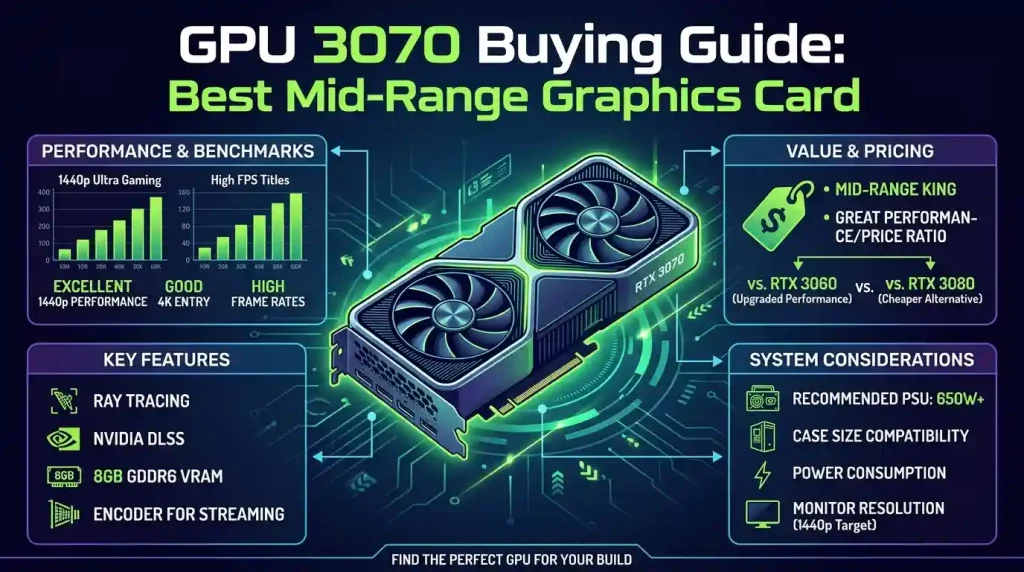
- Price and Availability: While the MSRP was $499, market prices fluctuate significantly. As of June 2026, the average new price for an RTX 3070 is around $549 on Amazon, with used prices hovering around $200-$260 on eBay and other marketplaces. Availability of new cards can be limited, making the used market a primary source. Price trends show a neutral trend over the last year, with average prices around $671 for new cards.
- VRAM Capacity (8GB GDDR6): The 8GB of GDDR6 VRAM was sufficient for most games at 1440p when it launched. However, some newer, very demanding AAA titles, particularly with high-resolution textures and ray tracing enabled at 1440p or 4K, can push or exceed this limit, potentially leading to performance bottlenecks.
- Cooling Solution: Aftermarket RTX 3070 cards come with various cooling solutions. Brands like ASUS (TUF Gaming OC, Strix), Gigabyte (Aorus Master, Gaming OC), EVGA (FTW3), and MSI (Gaming X Trio) generally offer robust coolers that ensure good thermal performance and lower noise levels, even under load. It’s advisable to check reviews for specific models.
- Power Consumption: The RTX 3070 has a TDP of 220W. This is relatively efficient for its performance tier, but ensure your power supply unit (PSU) can comfortably handle it.
- Your Current System: Consider your existing CPU, motherboard, and PSU to avoid bottlenecks. A powerful GPU like the RTX 3070 needs a balanced system to deliver its full potential.
- PCIe Generation: The RTX 3070 utilizes a PCI-Express 4.0 x16 interface. While it will work with PCIe 3.0 motherboards, a PCIe 4.0 slot can offer optimal performance, especially in bandwidth-intensive scenarios.
Optimal System Requirements for the RTX 3070
To get the most out of an RTX 3070, ensure your system meets these recommendations:
- CPU: Pairing the RTX 3070 with a modern CPU is crucial to avoid bottlenecks. Recommended CPUs include AMD Ryzen 5 5600X or newer (like the Ryzen 5 9600X, Ryzen 7 9700X) or Intel Core i5-12600KF/i7-12700K or newer (like the i5-14600K). These processors offer sufficient single-core and multi-core performance to keep up with the GPU, especially at 1440p and higher refresh rates.
- RAM: A minimum of 16GB DDR4 RAM is recommended, with 32GB being ideal for more demanding games and multitasking. Aim for RAM speeds of 3200MHz or higher for optimal performance with most modern CPUs.
- Power Supply Unit (PSU): NVIDIA recommends a 650W power supply or greater for the RTX 3070. While a high-quality 600W PSU might suffice depending on other system components, a 650W or 750W PSU offers more headroom and stability, especially for systems with power-hungry CPUs or during transient power spikes.
- Storage: An NVMe SSD is highly recommended for faster game loading times and overall system responsiveness.
The Current Market: Availability and Pricing Trends
As a previous-generation card, the availability of new RTX 3070 units has become more limited. While some retailers might still have stock, the focus has shifted towards the used market. In June 2026, the average new price for an RTX 3070 hovers around $549 on platforms like Amazon, whereas used units are typically found for $200-$260 on eBay.
Pricing trends over the last year have been relatively neutral, with the average new price fluctuating between $626 and $713. However, it’s worth noting that the RTX 3070 saw significant price drops (around 35%) over 2023 as newer generations like the RTX 40 series were released. This makes the used market particularly attractive for budget-conscious buyers seeking excellent performance per dollar. When buying used, always exercise caution and verify the card’s condition and seller’s reputation.
Making the Right Decision: Is the RTX 3070 for You?
The RTX 3070 remains an excellent graphics card for 1440p gaming, capable of running nearly all modern titles at high settings with smooth frame rates. Its support for ray tracing and DLSS 2.0 (which can significantly boost performance in supported titles) means it still provides a premium gaming experience. For users aiming for consistent 60+ FPS at 1440p or high refresh rates at 1080p, the RTX 3070 is a strong contender, particularly if found at a good price in the used market.
However, if you’re building a brand-new PC and budget allows for the latest generation, newer cards like the RTX 4060 Ti offer better power efficiency and DLSS 3 with Frame Generation, which can provide a different kind of performance boost in supported games. The 8GB VRAM might also become a limitation for future AAA titles at very high settings or 4K.
Ultimately, the RTX 3070 is an ideal choice for:
- Gamers prioritizing strong 1440p performance.
- Those looking for excellent value in the used GPU market.
- Users who want to experience ray tracing and DLSS without the premium cost of top-tier cards.
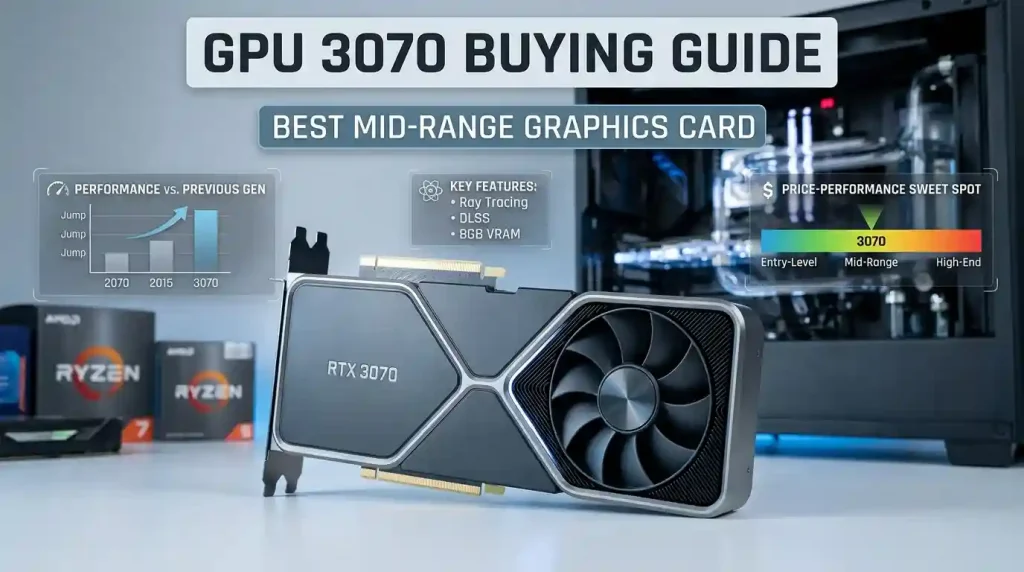
For those seeking a solid, proven performer that continues to deliver a fantastic gaming experience for a reasonable investment, especially on the secondary market, the NVIDIA GeForce RTX 3070 is undoubtedly still one of the best mid-range graphics cards you can buy. For more details on NVIDIA’s GPU technologies, you can visit their official GeForce page.
Conclusion
The NVIDIA GeForce RTX 3070, while no longer the newest kid on the block, continues to hold its own as a highly capable graphics card. Its Ampere architecture provides robust performance for 1440p gaming, with commendable ray tracing abilities enhanced by DLSS. By carefully considering its specifications, comparing it against current alternatives, and understanding market trends, you can make an informed decision on whether this enduring mid-range champion is the right GPU for your setup.