Best Value GPU for Gaming and Video Editing 45
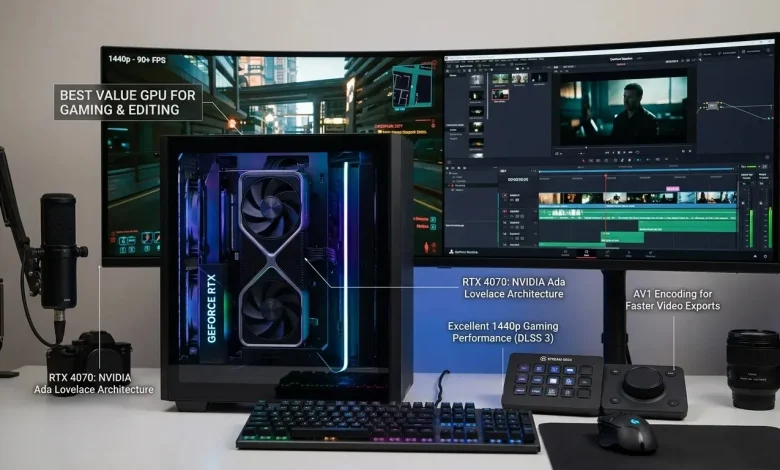
Table of Contents
Best Value GPU for Gaming and Video Editing has become a hotly contested title in the ever-evolving world of PC hardware. For many users, a graphics card isn’t just for one task; it’s a versatile engine expected to deliver smooth frame rates in the latest AAA titles and accelerate demanding creative workloads like 4K video editing. The challenge lies in finding a GPU that excels in both areas without breaking the bank. This article delves into the critical factors, key specifications, and top contenders to help you identify the ultimate value GPU that caters to both your gaming escapades and professional content creation needs in 2026.
Understanding GPU Fundamentals: What Matters Most?
Before diving into specific recommendations, it’s crucial to understand the fundamental specifications that dictate a GPU’s performance in both gaming and video editing. While some metrics are universally important, their priority can shift slightly depending on the primary use case.
- VRAM (Video Random Access Memory): This is perhaps the most critical specification for both tasks, especially as resolutions increase. VRAM stores textures, frame buffers, and other visual data, allowing the GPU to access them quickly. For 1440p gaming or video editing, a minimum of 12-16GB of VRAM is recommended, while 4K workflows and professional rendering benefit significantly from 24GB or more. Insufficient VRAM can lead to stuttering, blurry textures, and performance bottlenecks, particularly in modern AAA games and high-resolution video projects.
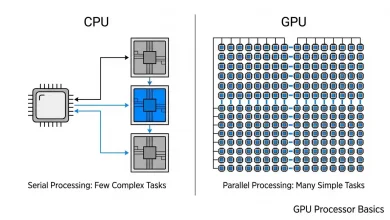
- CUDA Cores (NVIDIA) / Stream Processors (AMD): These are the GPU’s processing units responsible for handling parallel computations. More cores generally translate to better performance. NVIDIA’s CUDA cores are often optimized for professional creative applications, giving them an edge in software like Adobe Premiere Pro. AMD’s Stream Processors offer strong rasterization performance, making them highly competitive in gaming.
- Clock Speed: Measured in MHz or GHz, clock speed indicates how many cycles the GPU’s cores can complete per second. Higher clock speeds generally mean faster processing.
- Memory Bus Width and Bandwidth: The memory bus width (measured in bits) and bandwidth (measured in GB/s) determine how quickly the GPU can move data to and from its VRAM. A wider bus and higher bandwidth are crucial for handling large textures and complex scenes efficiently.
- Architecture: The underlying design of the GPU (e.g., NVIDIA’s Ada Lovelace, AMD’s RDNA 3) dictates its efficiency, feature set (like ray tracing, DLSS/FSR), and overall performance. Newer architectures generally offer significant generational improvements in performance and power efficiency.
Gaming vs. Video Editing: Overlap and Differences in GPU Needs
While both gaming and video editing demand robust GPU performance, their specific needs have some distinctions:
Gaming Requirements:
- High Frame Rates and Resolution: Gamers prioritize smooth frame rates at their desired resolution (1080p, 1440p, or 4K). For 1440p gaming, at least an RTX 4070 Super or RX 7800 XT is often recommended for high settings. For 4K gaming, GPUs like the RTX 4080 Super or RTX 5080 are considered excellent.
- Ray Tracing: Modern games increasingly utilize ray tracing for more realistic lighting, reflections, and shadows. NVIDIA GPUs, with their dedicated RT cores, generally offer superior ray tracing performance.
- Upscaling Technologies (DLSS/FSR/XeSS): Technologies like NVIDIA’s DLSS, AMD’s FSR, and Intel’s XeSS use AI to upscale lower-resolution images to higher resolutions, significantly boosting frame rates without a drastic loss in visual quality. These are becoming essential for demanding titles, especially at higher resolutions.
- VRAM for Textures: Games with high-resolution textures, especially at 1440p and 4K, demand substantial VRAM. 12-16GB is often the sweet spot for modern AAA titles.
Video Editing Requirements:
- VRAM for Large Files and Effects: Video editing, particularly with 4K or 8K footage and multiple effects layers, is extremely VRAM-intensive. 12GB is a common recommendation for 4K editing, with 16GB being ideal for professional workflows. Cards with 24GB or more are essential for 8K editing and advanced rendering.
- GPU Acceleration: Most modern video editing software (e.g., Adobe Premiere Pro, DaVinci Resolve) heavily utilizes GPU acceleration for real-time playback, rendering previews, applying effects (like color grading, noise reduction, transitions), and encoding/decoding various codecs (H.264, H.265, AV1).
- Codec Support: Hardware-accelerated decoding and encoding of codecs like H.265 and AV1 are crucial for smooth workflow and faster export times. Intel Arc GPUs, for instance, are noted for their robust Xe Media Engine with AV1 encode support.
- Software Optimization: NVIDIA’s CUDA platform often provides better optimization and performance in many professional video editing applications, especially Adobe products. However, AMD has made strides in DaVinci Resolve and other open-source workflows.
The ideal “value” GPU, therefore, strikes a balance, offering sufficient VRAM and processing power to handle both 1440p/entry-level 4K gaming and 1080p/mid-range 4K video editing efficiently. For a seamless experience in both domains, a GPU with at least 12GB of VRAM is a strong starting point.
NVIDIA GPUs for Value: Ray Tracing and CUDA Power
NVIDIA has long been a dominant force in the GPU market, particularly known for its strong performance in ray tracing and its CUDA core architecture, which is widely adopted by creative applications. For users seeking a balance of gaming prowess and content creation capabilities, certain NVIDIA cards offer excellent value.
The NVIDIA GeForce RTX 4070 Super stands out as a strong contender for its value proposition. Released as part of the RTX 40 series refresh, it offers a significant boost in shader cores over the standard RTX 4070 at a competitive price point, making it faster than an RTX 3090 in many scenarios. With 12GB of GDDR6X VRAM, it’s well-suited for high-refresh 1440p gaming and even entry-level 4K gaming with DLSS. For video editing, its ample CUDA cores and efficient Ada Lovelace architecture provide solid acceleration for various tasks in Premiere Pro and DaVinci Resolve.
Moving up slightly, the NVIDIA GeForce RTX 4070 Ti Super (which succeeded the RTX 4070 Ti) also presents a compelling case. It offers 16GB of GDDR6X VRAM, a crucial upgrade for more demanding 4K video editing workflows and future-proofing for games. This card is positioned as a 1440p champion, capable of handling ray tracing beautifully and offering near-4K power without the higher price tag of the RTX 4080 Super. For content creators, the increased VRAM and CUDA cores make it an ideal choice for heavier workloads, including complex timelines and GPU-accelerated effects.
While the flagship RTX 4090 offers unparalleled performance, its premium price tag generally places it outside the “best value” category for most users. However, for professionals seeking the absolute best for 4K/8K editing and rendering, the RTX 4090 remains a powerhouse, offering an excellent balance of performance and value for serious 3D work despite being a previous-generation product by 2026.
AMD Radeon GPUs for Value: Rasterization Performance and VRAM
AMD’s Radeon GPUs, built on the RDNA architecture, have consistently offered strong rasterization performance and competitive pricing, often providing more VRAM at certain price points compared to their NVIDIA counterparts. These characteristics make them attractive for gamers and content creators looking for excellent value.
The AMD Radeon RX 7800 XT is widely regarded as one of the best value GPUs for most users. It offers 16GB of GDDR6 VRAM, which is a significant advantage for 1440p gaming with high texture settings and for handling moderate 4K video editing tasks. Its RDNA 3 architecture provides robust gaming performance, particularly excelling in traditional rasterization, and also offers improved ray tracing performance over previous generations. For video editing, the 16GB VRAM pool allows for smoother handling of larger project files and GPU-accelerated effects in various applications.
For users on a tighter budget, the AMD Radeon RX 7700 XT and RX 7600 XT are worth considering. The RX 7700 XT typically comes with 12GB of VRAM, offering a solid experience for 1440p gaming and 1080p/light 4K video editing. The RX 7600 XT, often featuring 16GB of VRAM, is a strong budget-friendly option for 1080p gaming and can handle basic 4K proxy workflows, making it suitable for beginners in video editing. While its raw performance for 4K editing might be limited, the generous VRAM can be a game-changer for loading larger assets.
AMD’s FidelityFX Super Resolution (FSR) technology provides an open-source alternative to DLSS, offering performance gains across a wider range of GPUs. This further enhances the value proposition of Radeon cards for gamers.
| GPU Model | VRAM | Typical Use Case (Gaming) | Typical Use Case (Video Editing) | Key Features for Value |
|---|---|---|---|---|
| NVIDIA RTX 4070 Super | 12GB GDDR6X | 1440p High Refresh, Entry 4K w/DLSS | 1080p/1440p editing, moderate 4K acceleration | Strong ray tracing, DLSS 3, CUDA acceleration |
| NVIDIA RTX 4070 Ti Super | 16GB GDDR6X | 1440p High Refresh, Solid 4K w/DLSS | 4K editing, advanced effects, future-proofing | Excellent ray tracing, more VRAM, CUDA leader |
| AMD Radeon RX 7800 XT | 16GB GDDR6 | 1440p High Refresh, Entry 4K w/FSR | 1080p/1440p editing, good 4K acceleration | High VRAM, strong rasterization, competitive pricing |
| AMD Radeon RX 7600 XT | 16GB GDDR6 | 1080p High Refresh, Entry 1440p | 1080p editing, basic 4K proxy workflows | Generous VRAM for its price, FSR support |
| Intel Arc A770 / Arc B580 | 16GB GDDR6 (A770) / 12GB GDDR6 (B580) | 1080p High, 1440p Medium/High | 1080p/1440p editing, AV1 encoding | Excellent media engine, AV1 encode/decode, XeSS |
Intel Arc GPUs: An Emerging Contender
Intel’s entry into the discrete GPU market with its Arc series has introduced a new dynamic, particularly in the value segment. While initially facing driver challenges, Intel Arc GPUs have matured, offering compelling features for both gamers and content creators.
The Intel Arc A770, particularly the 16GB variant, has impressed with its performance-per-dollar, especially in media-centric workloads. It features a powerful Xe Media Engine, offering hardware-accelerated AV1 encoding and decoding, which is a significant advantage for streamers and video editors working with modern codecs. For gaming, the A770 provides solid 1080p and respectable 1440p performance, especially with XeSS upscaling. Its 16GB VRAM buffer is also a strong point for future-proofing and demanding creative tasks.
The Intel Arc B580, a more recent offering, has emerged as a standout in the budget-friendly category, often available at an aggressively affordable price. Equipped with 12GB of VRAM and a 192-bit memory interface, it efficiently handles textures for 1080p and even 1440p gaming. For video editing, it delivers solid performance in Premiere Pro, DaVinci Resolve, and After Effects, especially with GPU effects, making it competitive with some NVIDIA RTX 4060 variants in creative workflows. The Arc B580 represents a compelling option for those seeking excellent value at the lower end of the mid-range.
Intel’s continued investment in driver optimization and features like XeSS make Arc GPUs an increasingly viable option for users who prioritize both gaming and content creation on a budget. Their media engine capabilities are particularly noteworthy, making them excellent for streaming and video production. To learn more about the advancements in GPU architectures and their impact on performance, you can refer to comprehensive resources like Wikipedia’s entry on Graphics Processing Units.
Choosing the Right GPU for Your Budget and Workflow
Selecting the best value GPU ultimately depends on your specific budget, primary usage, and the resolutions you target for gaming and editing. Here’s a breakdown to help guide your decision:
Budget-Conscious (Under $400 USD approx.):
- Consider the AMD Radeon RX 7600 XT (16GB) or Intel Arc B580 (12GB). The RX 7600 XT offers generous VRAM for its price, making it capable for 1080p gaming and basic 4K video editing (using proxies). The Arc B580 provides competitive 1080p and light 1440p gaming performance with excellent media encoding capabilities. For users prioritizing streaming and video encoding, the Arc B580 might offer slightly better value due to its advanced media engine.
Mid-Range (Approx. $400 – $700 USD):
- This is where the “best value” often lies. The NVIDIA GeForce RTX 4070 Super (12GB) and AMD Radeon RX 7800 XT (16GB) are fierce competitors.
- The RTX 4070 Super excels in ray tracing and typically offers stronger performance in CUDA-optimized applications like Adobe Premiere Pro. It’s a fantastic card for high-refresh 1440p gaming and entry-level 4K.
- The RX 7800 XT provides more VRAM (16GB) and strong traditional rasterization performance, making it a powerful choice for 1440p gaming at ultra settings and more demanding 4K video editing tasks where VRAM capacity is key.
Upper Mid-Range / Enthusiast Value (Approx. $700 – $1000 USD):
- The NVIDIA GeForce RTX 4070 Ti Super (16GB) is a standout in this tier. Its 16GB of VRAM makes it significantly more capable for 4K video editing and ensures a longer lifespan for demanding games at higher resolutions. For gaming, it offers near-4K performance and excellent ray tracing. This card is an ideal choice for serious content creators and gamers who want a strong balance of performance without venturing into flagship pricing.
Beyond these price points, cards like the RTX 4080 Super and RTX 4090 offer exceptional performance but typically move beyond the strict definition of “best value” for most users, appealing more to high-end professionals and enthusiasts with less budget constraint. The RTX 50 series, while newer, often comes with higher price tags, making previous-generation “Super” variants of the RTX 40 series more appealing for value. Similarly, older generation AMD RX 6000 series cards might offer good value if found at substantial discounts.
Conclusion: Striking the Perfect Balance
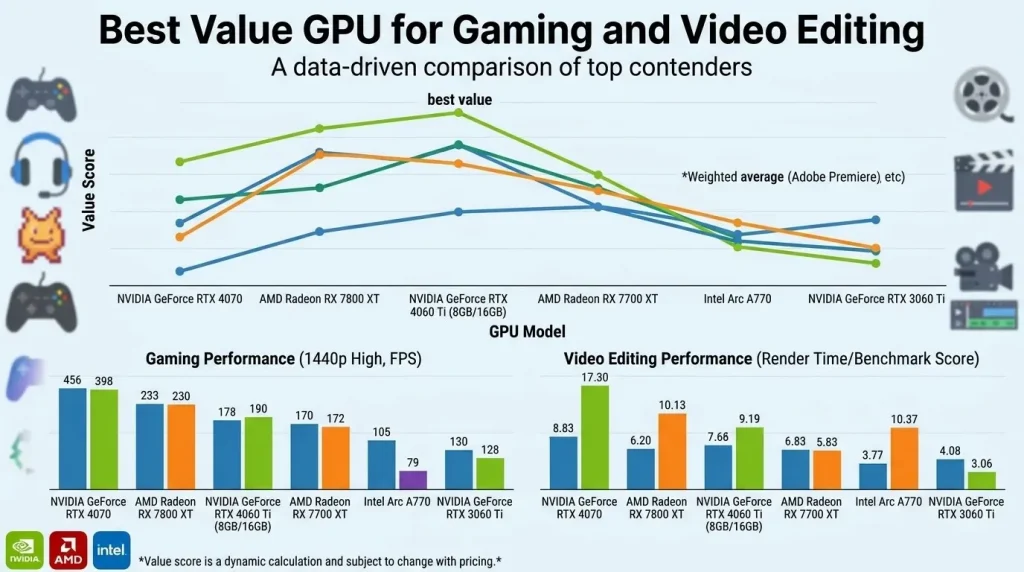
Finding the best value GPU for gaming and video editing in 2026 requires a careful consideration of VRAM, processing power, and software optimization relative to your budget. For the sweet spot that balances price and performance across both demanding tasks, the NVIDIA GeForce RTX 4070 Super and AMD Radeon RX 7800 XT emerge as top contenders in the mid-range, each with its own strengths. The RTX 4070 Super, with its strong ray tracing and CUDA performance, is often favored for specific creative applications. The RX 7800 XT, offering generous 16GB VRAM and excellent rasterization, provides a robust platform for both gaming and VRAM-intensive video workflows.
For those with a slightly higher budget seeking greater future-proofing and more seamless 4K editing, the NVIDIA GeForce RTX 4070 Ti Super (16GB) stands out as a compelling option. On the more budget-friendly end, Intel’s Arc GPUs, particularly the Intel Arc B580, offer surprisingly good value, especially for media creation and 1080p/light 1440p gaming, benefiting from their advanced media engine.
Ultimately, the “best value” is subjective and should align with your specific needs. Assess the resolutions you play and edit at, the software you primarily use, and your budget. With the market constantly evolving, keeping an eye on sales and benchmarks for the latest releases will ensure you secure the most powerful and efficient GPU for your gaming and video editing endeavors.