7 Surprising Reasons Intel Arc GPUs Are Beating NVIDIA & AMD
Table of Contents
Intel Arc GPUs represent a significant and ambitious stride by Intel into the fiercely competitive discrete graphics card market, historically dominated by NVIDIA and AMD. For decades, Intel was synonymous with integrated graphics, providing basic visual output for countless systems. However, with the launch of its Arc “Alchemist” series in 2022, followed by the “Battlemage” generation, Intel signaled its intent to challenge the established duopoly, aiming to offer compelling alternatives for gamers and content creators alike. This entry has stirred the “GPU Wars” to unprecedented heights, making the competition between the three giants a defining industry narrative.
The Dawn of Arc: Intel’s Entry into Discrete GPUs
Intel’s decision to enter the discrete GPU market was not taken lightly. For years, NVIDIA and AMD have carved out distinct niches, with NVIDIA often leading in high-end performance and features, and AMD offering strong value propositions across various segments. Intel’s entry in 2022 with the Arc Alchemist series was met with both anticipation and skepticism. The initial launch faced challenges, primarily concerning inconsistent drivers, sub-optimal performance in older APIs, and early software instability. However, Intel has maintained its commitment to the Arc project, asserting that GPUs remain a “super important” part of the company’s PC lineup.
The goal was clear: to disrupt a market segment that had seen rising prices and limited competition, particularly in the mainstream and budget categories. Intel aimed to bring “balance back to the GPU market” by offering competitive performance at aggressive price points.
Intel Arc GPU Lineup and Specifications
Intel’s Arc Alchemist series introduced a range of cards, with the Arc A770 and A750 being the flagship offerings. The Arc A770, Intel’s top-tier Alchemist card, launched with 32 Xe Cores, 512 XMX matrix processors, and 4,096 unified shaders, available with 8GB or 16GB of GDDR6 memory on a 256-bit bus. The Arc A750, positioned slightly below, featured 28 Xe Cores (3,584 shaders) and 8GB of GDDR6 memory. More recently, the “Battlemage” generation has seen cards like the Arc B580 and B570, primarily focusing on the entry-level and mid-range segments.
| GPU Model | Xe Cores | XMX Engines | Memory (GDDR6) | Memory Interface | TDP (W) | Launch Price (USD) |
|---|---|---|---|---|---|---|
| Intel Arc A770 | 32 | 512 | 8GB / 16GB | 256-bit | 225 | $329 – $349 |
| Intel Arc A750 | 28 | 448 | 8GB | 256-bit | 225 | $289 |
| Intel Arc A580 | 24 | 384 | 8GB | 256-bit | 175 | N/A (Launched later than A770/A750) |
| Intel Arc A380 | 8 | 128 | 6GB | 96-bit | 75 | ~$139 |
| Intel Arc B580 | (Battlemage Gen) | (Battlemage Gen) | 12GB | 192-bit | N/A | ~$250 |
Performance Showdown: Arc vs. NVIDIA & AMD
Gaming Benchmarks: Where Arc Stands
Initial Arc GPUs, particularly the A770 and A750, were designed to compete with NVIDIA’s GeForce RTX 3060 and AMD’s Radeon RX 6600/6650 XT in the mainstream segment. Intel claimed that the A750 offered up to 53% more performance per dollar compared to the RTX 3060 in some scenarios. Reviews indicated that in modern titles utilizing DirectX 12 or Vulkan APIs, the Arc A700-series could trade blows with or even surpass the RTX 3060, while performance in older DirectX 11 games was less consistent at launch.
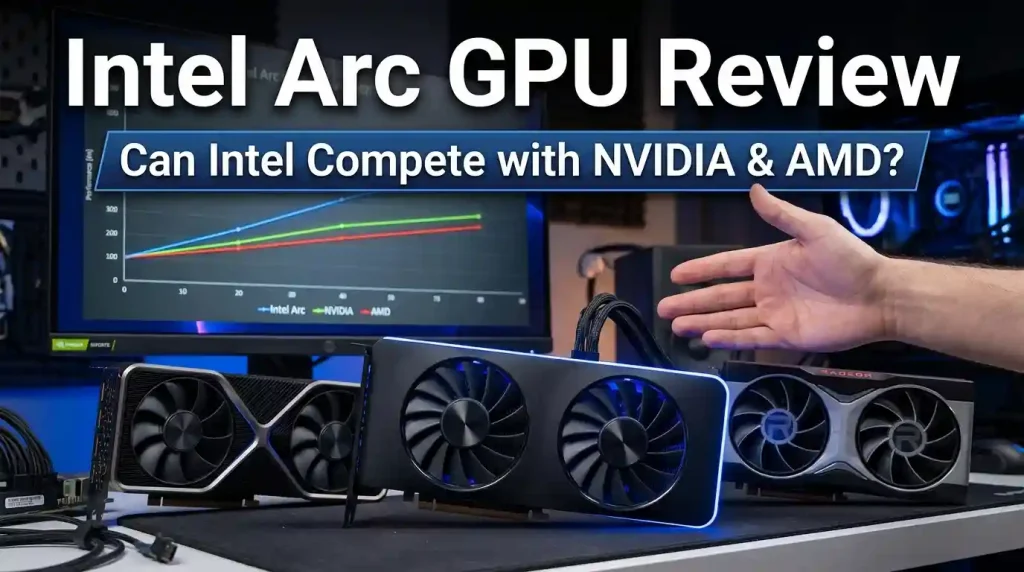
As of late 2024 and early 2025, newer Battlemage cards like the Arc B580 have emerged as strong contenders in the budget segment. The B580, with 12GB of VRAM, is noted for its solid 1080p and 1440p performance, often outperforming the RTX 4060 and RX 7600 XT on average while being more affordable. Some analyses even suggest it can beat NVIDIA’s RTX 4060 and AMD’s RX 7600 XT at its price point. However, the performance uplift in specific games can vary, with older titles sometimes still presenting challenges for Arc drivers. Linux users, however, have seen significant performance boosts with recent Mesa 26.1 driver updates for “Alchemist” GPUs, with one benchmark showing gains as high as 260% in NBA 2K23.
Creator and Productivity Performance
Beyond gaming, Intel Arc GPUs offer a mixed bag for content creation. While NVIDIA generally maintains dominance in GPU-dependent tasks and professional applications, Intel Arc shows promise in specific areas. For instance, in AI-focused tests like MLPerf Client, Arc GPUs have demonstrated unexpectedly strong performance in initial token generation. However, NVIDIA still leads in sustained token throughput and Unreal Engine benchmarks. AMD’s Radeon RX 9070 XT has shown strong results in some codec types, outperforming newer NVIDIA cards in certain LongGOP workloads. Intel’s Arc lineup offers “price-adjusted competitiveness” for creators, particularly at the entry level, especially when paired with its OpenVino toolkit. This suggests that Arc cards could serve as inexpensive options for experimental AI or secondary systems.
Features and Innovation: XeSS, Ray Tracing, and AV1
Intel Arc GPUs boast a suite of modern features designed to enhance gaming and media consumption:
- Xe Super Sampling (XeSS): Intel’s AI-based image reconstruction and super-sampling technique is a direct competitor to NVIDIA’s DLSS and AMD’s FSR. XeSS renders games at a lower internal resolution and then reconstructs the final image using machine-learning models to approximate a higher-resolution output. It offers two execution paths: an AI-accelerated mode for Intel Arc GPUs utilizing dedicated XMX units (similar to NVIDIA’s Tensor Cores) and a fallback “DP4a” mode for broader compatibility with other vendors’ GPUs. By 2026, XeSS typically offers competitive results, especially on Intel hardware, balancing good image quality and performance. While DLSS often leads in overall performance and clarity, and FSR excels in broad compatibility, XeSS provides a compelling option, often boosting FPS by 30-50% or more in many AAA titles at high resolutions.
- Ray Tracing: Arc GPUs support hardware-accelerated ray tracing, a key feature for modern graphics. Intel initially claimed that the A770 would offer 65% better peak performance in ray tracing than unspecified “competition” (likely the RTX 3060). While NVIDIA continues to build on its pioneering dominance in real-time ray tracing with enhanced cores and advanced algorithms, Intel’s inclusion of ray tracing at competitive price points helps it stay relevant in the feature set.
- AV1 Encoding: A significant advantage for Intel Arc GPUs is their inclusion of the first consumer hardware AV1 encoder. AV1 is a state-of-the-art codec that offers significantly better compression performance, with up to 50% smaller file sizes compared to H.264, without sacrificing quality. This feature is particularly beneficial for streamers and content creators, as Intel’s AV1 encoder has shown impressive results, outperforming NVIDIA’s NVENC and AMD’s AMF H.264 encoders at lower bitrates in some tests. This capability allows for higher quality streams at lower bandwidths, a crucial advantage for platforms that adopt AV1.
Driver Maturity and Software Experience
One of the most significant hurdles for Intel Arc at launch was its driver maturity. Early drivers were plagued with inconsistencies and performance issues, especially in older DirectX APIs. However, Intel has made substantial progress in addressing these concerns. Through consistent updates, Intel’s engineers have worked to optimize frame rates, reduce stuttering, enhance responsiveness, and fix numerous bugs. Linux users have noted substantial performance and stability improvements with recent Mesa driver updates. By late 2025, Intel’s drivers had “improved significantly,” though some reviewers still advised that users should be willing to do some troubleshooting. The focus on “Game On Driver” support for new titles and ongoing performance optimizations indicates Intel’s dedication to improving the user experience. Intel’s graphics software has also seen improvements in simplification and consolidation.
Pricing and Value Proposition
Intel’s strategy has heavily emphasized value. The Arc A770 launched with a starting price of $329 (for 8GB models) and $349 for the 16GB Limited Edition, directly targeting the NVIDIA RTX 3060, which at the time often retailed for over $400. Similarly, the Arc A750 was released at $289, aiming to undercut the RTX 3060 while offering comparable performance in many titles. More recent Battlemage offerings like the Arc B580 are available for around $250, often providing 12GB of VRAM, which offers better future-proofing compared to 8GB cards from competitors in that price bracket. This aggressive pricing, coupled with features like AV1 encoding and XeSS, positions Intel Arc as a strong value proposition, especially for budget-conscious gamers and creators. However, market prices are always in flux, and the value proposition can shift.
Challenges and Future Outlook
Despite significant improvements, Intel Arc faces an uphill battle against the entrenched dominance of NVIDIA and AMD. NVIDIA held a massive 92% share of the discrete GPU market in Q3 2025, while AMD held 7%, leaving Intel with a modest 1% market share. While this 1% represents a notable increase for Intel from its previous sub-1% figures, it highlights the scale of the challenge. The desktop graphics roadmap for Intel has also been somewhat unclear, with rumors about a more powerful Arc B770 card not materializing for the gaming market, instead being directed towards professional/workstation segments.
Intel’s recent GPU activity has also shifted towards integrated and mobile graphics, with announcements like Arc G3 processors for gaming handhelds. This could indicate a strategic pivot or diversification rather than a full abandonment of discrete desktop GPUs. Intel executives, however, continue to reiterate their commitment to having GPU product offerings. The broader GPU market is also facing volatility due to rising memory prices, AI demand, and potential inflationary pressures, which could impact all manufacturers.
The “GPU Wars” continue to evolve, with NVIDIA and AMD making their own advancements. AMD is driving growth through innovation in efficiency, affordability, and architecture improvements, with its RDNA 3 and upcoming RDNA 4 architectures focusing on power efficiency and performance-per-watt. NVIDIA continues to lead in AI and specialized GPU architectures, maintaining a technology and ecosystem advantage. The competition now extends beyond raw gaming performance, encompassing AI model development, live rendering, and enterprise-level computation, areas where all three companies are vying for leadership.
For Intel to truly compete long-term, it will need to continue its aggressive driver development, expand its market share beyond 1%, and potentially introduce higher-end desktop offerings that directly challenge NVIDIA’s and AMD’s performance leaders. The focus on value and features like AV1 encoding is a strong start, but sustained growth will require consistent execution and a clear long-term strategy in a dynamic market. For more insights into the broader technological landscape, consider resources such as Wikipedia’s comprehensive overview of Graphics Processing Units.
Conclusion
Intel Arc GPUs have undeniably made a significant entry into the discrete graphics market, injecting much-needed competition and offering compelling value propositions, particularly in the mid-range and budget segments. While the initial launch was bumpy due to driver maturity, Intel has shown strong commitment to improving its software stack, leading to notable performance and stability enhancements. The inclusion of cutting-edge features like XeSS and, especially, the best-in-class AV1 hardware encoder, provides distinct advantages for modern gaming and content creation workloads.
Can Intel compete with NVIDIA and AMD? The answer, as of mid-2026, is a resounding “yes,” but with important caveats. Intel has established itself as a viable third player, particularly for users prioritizing value and specific features. For those building a budget to mid-range PC, an Intel Arc GPU like the B580 can offer excellent performance per dollar, often surpassing more expensive alternatives from its rivals. However, NVIDIA and AMD retain their dominance at the high end, and their mature ecosystems and brand loyalty remain formidable barriers. Intel’s long-term success will hinge on its ability to consistently deliver performance improvements, expand its product stack into higher-tier segments, and continue refining its software experience to win over a larger share of the market.