7 Best Affordable GPUs for Gaming – Great Value Cards Compared
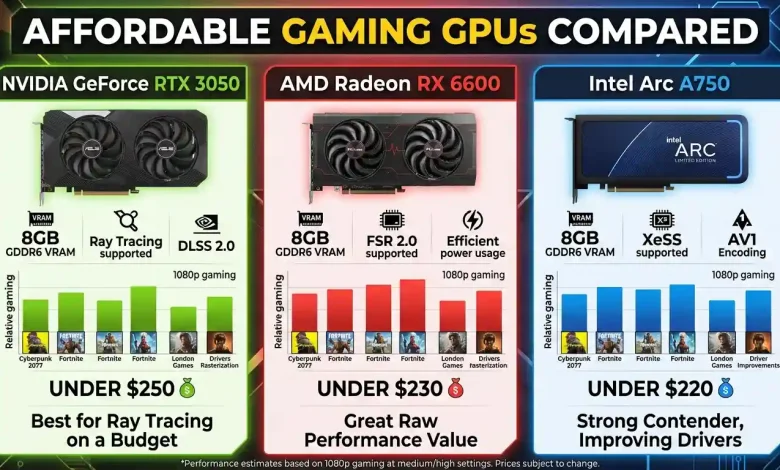
Table of Contents
Good GPU for Gaming performance doesn’t always require breaking the bank. In the dynamic world of PC hardware, finding an affordable graphics card that delivers a satisfying gaming experience is a perennial quest for many enthusiasts. As of mid-2026, the market continues to evolve, with new architectures emerging and older generations becoming more accessible. However, persistent demand from AI applications and memory shortages mean GPU pricing is generally trending upward, and value is more critical than ever. This comprehensive guide will navigate the landscape of budget-friendly GPUs, comparing their performance, features, and overall value to help you make an informed decision for your gaming rig.
Introduction to Affordable Gaming GPUs
The quest for a good gaming GPU often leads to the challenging dilemma of balancing performance with budget. While flagship cards push the boundaries of graphical fidelity, they often come with price tags well into the four figures. For the vast majority of gamers, particularly those targeting 1080p or 1440p resolutions, the sweet spot lies within the affordable and mid-range segments. These cards aim to provide excellent frame rates in modern titles without demanding an exorbitant investment, making PC gaming accessible to a broader audience. As of June 2026, the market sees a mix of NVIDIA’s RTX 50-series, AMD’s RX 9000-series, and Intel’s Arc B-series cards vying for the budget crown, alongside strong previous-generation options.
What Makes a Good Affordable GPU for Gaming?
Identifying a “good” affordable GPU involves more than just looking at the lowest price. Several key factors contribute to a card’s overall value proposition for gaming:
- Performance per Dollar: This is arguably the most crucial metric. A truly affordable GPU should deliver solid frame rates in popular games at your target resolution (typically 1080p or 1440p) without costing a fortune.
- VRAM Capacity: Video Random Access Memory (VRAM) is essential for storing game textures, models, and other graphical data. In 2026, 8GB is considered the effective minimum for 1080p gaming, with 12GB recommended for comfort and 16GB becoming the sweet spot for 1440p and future-proofing. Running out of VRAM can lead to severe stuttering and performance drops.
- Power Efficiency: A GPU that sips power not only saves on electricity bills but also runs cooler and quieter, potentially allowing for a less expensive power supply unit (PSU) and case cooling.
- Feature Set: Modern GPUs come with advanced features like ray tracing, DLSS (NVIDIA), FSR (AMD), and XeSS (Intel) for upscaling and frame generation. While ray tracing can be demanding for budget cards, upscaling technologies are vital for boosting performance in graphically intensive titles.
- Driver Support and Stability: Consistent driver updates from the manufacturer are crucial for optimal performance, bug fixes, and compatibility with new game releases.
- Longevity: An affordable GPU should ideally last several years, allowing you to play new titles without immediate upgrades, even if it means adjusting settings.
NVIDIA’s Affordable Contenders
NVIDIA has historically dominated the GPU market, and its current offerings in the budget and mid-range segments reflect a blend of previous and current generation technologies. While the RTX 50-series has brought significant advancements, older cards, particularly from the RTX 40-series, still offer compelling value when priced right.
The NVIDIA GeForce RTX 5060 has emerged as a strong contender for 1080p gaming in 2026, often touted as the “best-in-class” option if you can stretch to its price point. Built on the Blackwell architecture with GDDR7 memory and DLSS 4 support, it provides substantial improvements over its predecessor, the RTX 4060, particularly with its Multi Frame Generation capabilities. It typically offers about 30% more performance than the RTX 4060 at a similar price. While some variants might offer 8GB of VRAM, which is sufficient for 1080p, the market might see 12GB versions offering better long-term value.
The previous generation’s NVIDIA GeForce RTX 4060 remains a highly efficient choice for 1080p gaming. Despite being one generation old, its low 115W TDP and support for DLSS 3 make it a viable budget pick, especially if found at a discount. It delivers smooth performance in most modern games at 1080p.
The NVIDIA GeForce RTX 4060 Ti, available in both 8GB and 16GB VRAM configurations, also presents an option. While the 8GB version might prove disappointing compared to its price point, the 16GB version offers better VRAM headroom, which is increasingly important for higher settings and resolutions. Its ray tracing performance is notable thanks to the Ada Lovelace architecture, making it a good choice for 1080p with RT enabled.
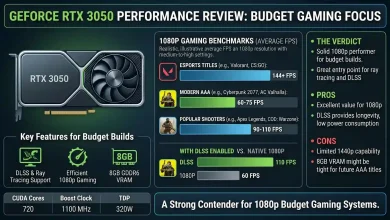
For those looking even further back, the NVIDIA GeForce RTX 3050 can still be found as a junior entry for 1080p play at a near-budget price. However, its limited VRAM (typically 8GB) and older architecture mean it’s less future-proof for demanding titles. Used RTX 3070s are also considered a good option in the $200-$220 range, offering performance between the RTX 4060 and 5060, often with 8GB VRAM.
AMD’s Value Champions
AMD has consistently offered strong price-to-performance ratios, especially in rasterization (traditional rendering) workloads. Their FSR (FidelityFX Super Resolution) technology also provides an excellent upscaling alternative to NVIDIA’s DLSS.
The AMD Radeon RX 9060 XT stands out as a compelling option, particularly the 16GB VRAM model, which offers excellent value for 1080p and light 1440p gaming. It delivers impressive frame rates across various game types. While its price has seen some fluctuations due to market conditions, it remains a top choice for its generous memory buffer and strong performance. It’s often cited as the best budget AMD graphics card, replacing the RX 7600.
The AMD Radeon RX 7600 XT, equipped with 16GB of GDDR6 VRAM, is another strong contender. This generous VRAM buffer is a significant advantage, especially for modded games, simulation titles, or streaming, making it a “best value” pick for many. While it might slightly trail the RTX 4060 in ray tracing, it holds its own in rasterization and supports FSR 4. However, it might be disappointing when purchased new at higher prices, with the RX 7700 XT offering significantly better 3DMark scores for a similar price.
For a slightly higher budget, the AMD Radeon RX 7700 XT (12GB) and RX 9070 / RX 9070 XT (up to 16GB) are excellent choices for 1440p gaming. The RX 7700 bridges the gap into the mid-range, offering 12GB of VRAM and solid 1080p and capable 1440p performance. The RX 9070 XT, in particular, delivers performance comparable to NVIDIA’s higher-tier cards at a more competitive price point, with significantly improved RT and AI acceleration over previous AMD generations.
Intel Arc’s Rising Star
Intel’s entry into the discrete GPU market has been met with both challenges and promising developments. Their Arc GPUs, particularly the B-series, are gaining traction as strong budget options with excellent feature sets.
The Intel Arc B580 is recognized as a winner in the budget graphics card segment, offering superb 1080p performance at around $249, with good ray-tracing capabilities and enough bandwidth for higher resolutions with adjusted settings. It has replaced the Arc A580 as a top budget Intel pick. For those with tighter budgets, the Intel Arc B570 is also a recommended option, often found under $300.
The previous generation Intel Arc A770, especially the 16GB variant, remains a compelling value proposition in 2026. Its generous 16GB VRAM buffer, combined with significantly matured drivers, makes it a solid mid-range option for 1440p or entry-level 4K gaming, especially if found at a discounted price (under $240). It excels in media processing with AV1 encoding support and can sometimes perform surprisingly well at 1440p compared to 1080p in certain games, indicating its modern architecture. However, it has a higher power draw than newer Battlemage (B-series) cards.
Understanding VRAM Requirements in 2026
Video RAM (VRAM) has become an increasingly critical specification when choosing a gaming GPU in 2026. Modern game engines, higher resolution textures, and demanding features like ray tracing are pushing VRAM consumption to unprecedented levels.
- For 1080p Gaming: While 8GB of VRAM can still handle many esports titles and lighter games, it’s considered the practical minimum and can be tight for modern AAA releases at high settings. 12GB offers more breathing room and is often recommended for a comfortable 1080p experience, especially with future titles.
- For 1440p Gaming: This resolution is increasingly popular, and VRAM requirements jump significantly here. 12GB of VRAM is now considered the minimum for smooth 1440p gaming at high settings, with 16GB being the recommended standard for 2026 and beyond, providing better headroom for demanding titles and ray tracing. Games like Cyberpunk 2077 and Hogwarts Legacy can push past 10GB VRAM at 1440p Ultra with ray tracing enabled.
- What Happens When VRAM Runs Out: If a GPU lacks sufficient VRAM, it will resort to using system RAM, a process known as VRAM overflow. This leads to severe stuttering, significant FPS drops, blurry textures, and can even cause game instability. Unlike system RAM, you cannot simply add more VRAM to your graphics card, making it a crucial specification to consider for longevity.
Therefore, when looking at affordable GPUs, prioritizing a card with at least 12GB of VRAM if you aim for 1440p, or an 8GB card only if you’re strictly sticking to 1080p with moderate settings, is a smart long-term strategy.
Affordable Gaming GPU Comparison Table
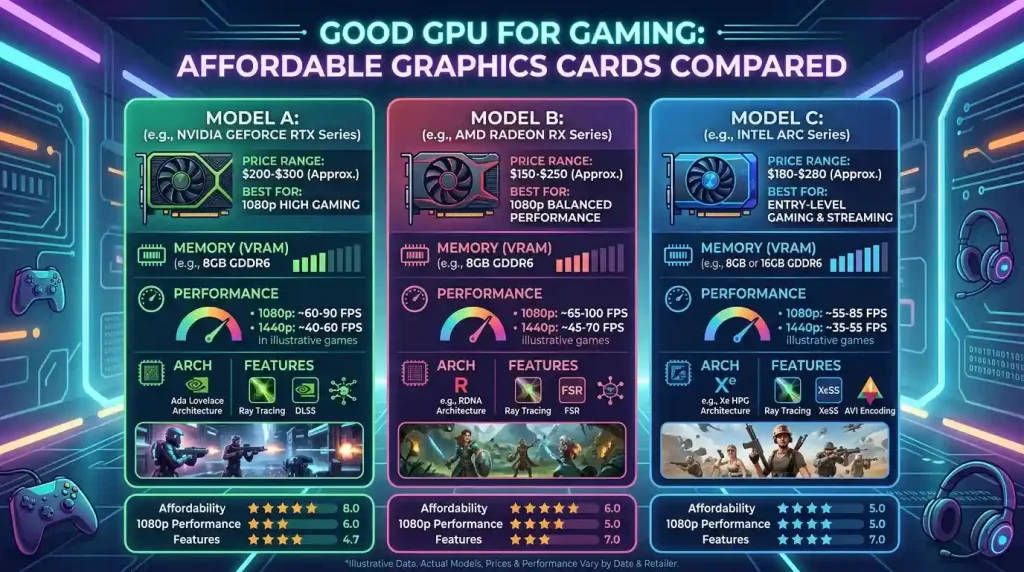
Below is a comparison of some of the best affordable gaming GPUs available or highly recommended in mid-2026, considering their typical performance tier, VRAM, and general price range. Prices are approximate and can fluctuate based on market conditions, retailer, and specific models.
| GPU Model | VRAM (GB) | Typical Resolution Target | Key Features / Strengths | Approx. Price Range (USD) |
|---|---|---|---|---|
| NVIDIA GeForce RTX 5060 | 8 GDDR7 | 1080p High / 1440p Medium | DLSS 4, Frame Generation, Good power efficiency, Blackwell architecture | $300 – $380 |
| AMD Radeon RX 9060 XT | 16 GDDR6 | 1080p Ultra / 1440p High | Excellent VRAM for price, Strong rasterization, FSR 4, Great value | $349 – $450 |
| Intel Arc B580 | 12-16 GDDR6 (estimated) | 1080p High / 1440p Medium | Superb 1080p performance for price, Good ray tracing, XeSS upscaling | $249 – $300 |
| NVIDIA GeForce RTX 4060 | 8 GDDR6 | 1080p High | DLSS 3, Good power efficiency, Ray tracing capabilities (with DLSS) | $270 – $320 |
| AMD Radeon RX 7600 XT | 16 GDDR6 | 1080p Ultra / 1440p Medium | Generous VRAM, Solid rasterization, FSR 4 support | $394 – $429 |
| Intel Arc A770 | 16 GDDR6 | 1080p Ultra / 1440p Entry | Large VRAM, Matured drivers, Competitive RT with XeSS, AV1 encoding | $240 – $329 (often on discount/refurbished) |
Factors Beyond Raw Power: Ecosystem and Features
While raw gaming performance is paramount, the overall ecosystem and additional features offered by NVIDIA, AMD, and Intel can significantly influence your choice, especially in the affordable segment where every advantage counts.
- Upscaling Technologies (DLSS, FSR, XeSS): These technologies dynamically render games at a lower resolution and then upscale them to your target resolution, often with AI-driven enhancements. This results in significantly higher frame rates with minimal perceived loss in image quality.
- NVIDIA’s DLSS (Deep Learning Super Sampling), particularly DLSS 3 with Frame Generation, is often lauded for its image quality and performance uplift.
- AMD’s FSR (FidelityFX Super Resolution) is open-source and compatible with a wider range of GPUs, including older AMD cards and even NVIDIA/Intel cards. FSR 4 has made significant strides in closing the gap with DLSS.
- Intel’s XeSS offers similar benefits and is a crucial feature for Arc GPUs to compete effectively.
- Ray Tracing: This advanced rendering technique simulates the physical behavior of light, resulting in incredibly realistic lighting, shadows, and reflections. While demanding, even affordable GPUs now offer some level of ray tracing capability, especially when combined with upscaling. NVIDIA generally holds an edge in ray tracing performance.
- Power Consumption and PSUs: Modern GPUs, even affordable ones, require adequate power. Efficient cards like the RTX 4060 (115W TDP) can save on PSU costs. However, some budget cards, like the Intel Arc A770 (225W) or AMD RX 7600 XT (190W), may require a more robust power supply, typically around 700-800 watts for the entire system, to handle transient power spikes and ensure stability.
- Driver Stability and Software Suites: All three manufacturers continuously release driver updates to optimize performance for new games and fix bugs. NVIDIA’s GeForce Experience, AMD’s Adrenalin Software, and Intel’s Arc Control offer various features for game optimization, monitoring, and streaming. Intel Arc’s drivers have significantly matured since their initial launch, improving performance and stability.
Market Trends and Smart Buying Advice
The GPU market in 2026 is characterized by several key trends that budget-conscious buyers should be aware of:
- Rising Prices and Shortages: GPU pricing is generally trending upward due to sustained demand from AI and data centers, coupled with memory constraints (HBM, GDDR, DRAM). This means the “budget” segment has shifted, and finding truly cheap new cards can be challenging.
- Generational Leaps: Newer generations, like NVIDIA’s RTX 50-series and AMD’s RX 9000-series, offer significant performance improvements over their predecessors, but often at a higher initial cost.
- Importance of VRAM: The increasing VRAM demands of modern games make cards with 12GB or 16GB significantly more future-proof, even at 1080p.
- Used Market: The used GPU market can offer excellent value, especially for previous-generation cards like the RTX 3070 or RX 6800 XT, which can still deliver strong performance for 1080p and 1440p gaming at a fraction of their original price. However, buying used comes with inherent risks regarding warranty and card condition.
- Refurbished Options: Reputable retailers or manufacturers sometimes offer refurbished cards with warranties, providing a middle ground between new and used purchases.
When looking to buy, it’s crucial to compare current prices from multiple retailers, read recent reviews and benchmarks (from mid-2026), and consider your long-term gaming goals. Don’t simply chase the highest theoretical performance; instead, focus on the best performance-per-dollar for your specific resolution and desired game settings.
Conclusion
Choosing a good GPU for gaming on an affordable budget in 2026 requires careful consideration of performance, VRAM, features, and market dynamics. While price hikes and shortages are a reality, both NVIDIA and AMD, along with Intel, offer compelling options that can deliver excellent gaming experiences without an exorbitant price tag. For 1080p gaming, the NVIDIA GeForce RTX 5060, AMD Radeon RX 9060 XT (16GB), and Intel Arc B580 present strong new choices, while previous generation cards like the RTX 4060 and RX 7600 XT can still be found as solid value picks. The increasing importance of VRAM cannot be overstated, with 12GB being a comfortable baseline for most new builds and 16GB offering excellent future-proofing for 1440p gaming. By prioritizing value, understanding your needs, and keeping an eye on market trends, you can find an affordable graphics card that will power your gaming adventures for years to come.