6 Powerful AMD GPU Features – RDNA 4 Performance & FSR 4 Explained
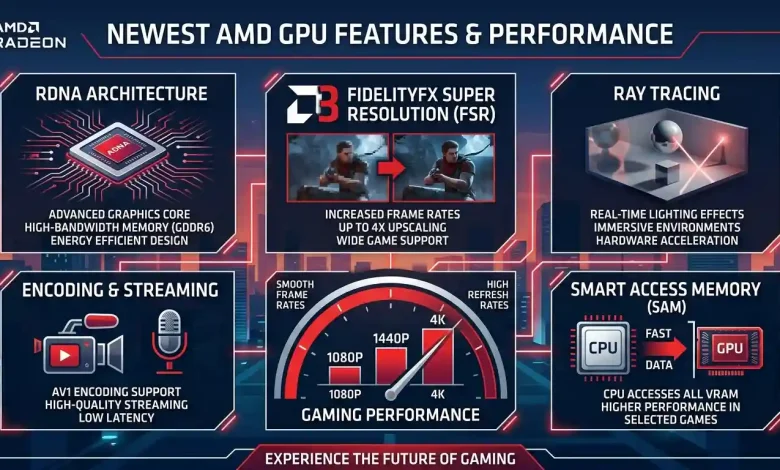
Table of Contents
Newest AMD GPU features represent a significant leap forward in graphics processing, offering substantial enhancements in performance, efficiency, and advanced capabilities for gamers, content creators, and professional users alike. AMD’s latest Radeon RX 7000 series, built upon the innovative RDNA 3 architecture, introduces a host of technological advancements designed to redefine the visual experience and push the boundaries of modern computing. This comprehensive article delves into the core features, architectural innovations, and real-world performance of AMD’s most recent graphics processing units, providing a detailed explanation of what makes them stand out in today’s competitive market.
The RDNA 3 Architecture: A Deep Dive into Chiplet Design and Efficiency
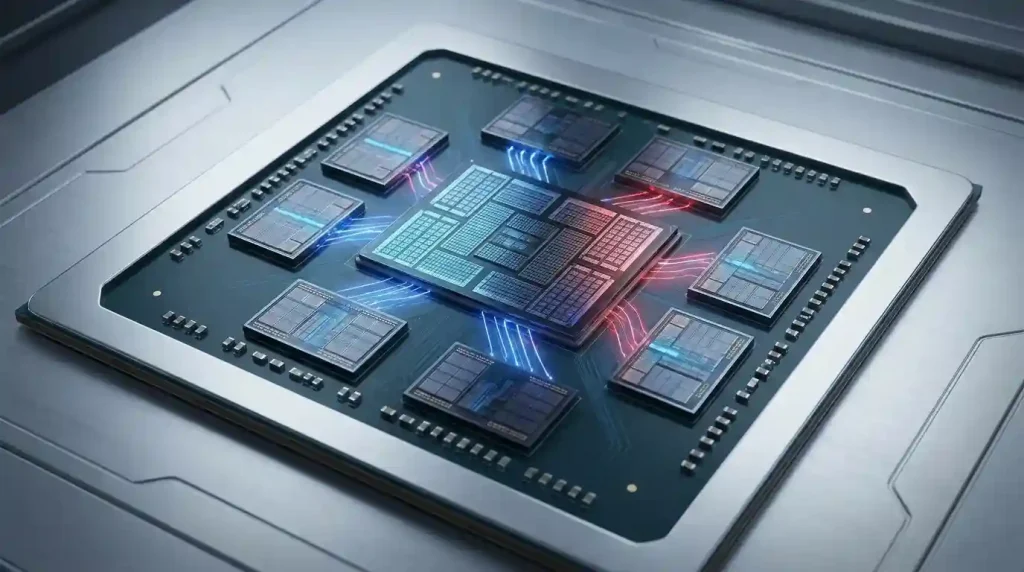
At the heart of AMD’s newest GPUs lies the RDNA 3 architecture, a groundbreaking design that marks a pivotal shift towards a chiplet-based approach for consumer graphics cards. This modular design, a first for gaming GPUs, echoes the success AMD has achieved with its Ryzen and Epyc CPUs, where chiplets have proven instrumental in delivering scalable performance and improved manufacturing efficiency. Unlike traditional monolithic GPU dies, RDNA 3 utilizes a Graphics Compute Die (GCD) fabricated on TSMC’s 5nm process, flanked by several Memory Cache Dies (MCDs) built on a 6nm process. This separation allows AMD to optimize each component for its specific task, enhancing overall efficiency and yield rates during manufacturing.
The GCD houses the main graphics processing logic, including the new compute units and second-generation ray tracing accelerators. Each RDNA 3 compute unit features dual-issue stream processors, effectively doubling the throughput for certain operations compared to the previous RDNA 2 architecture. This design choice allows for more efficient utilization of transistors and improved performance per watt, with AMD claiming up to a 54% increase in performance per watt over RDNA 2. The architecture also boasts increased clock speeds, with some RDNA 3 GPUs capable of achieving frequencies higher than their predecessors while consuming similar power.
Memory and cache subsystems have also seen significant upgrades. While RDNA 3 continues to use GDDR6 memory, the top-tier RX 7900 XTX features 24GB of GDDR6 memory on a 384-bit memory interface, delivering a substantial 960 GB/s of bandwidth. This wider memory interface, combined with second-generation AMD Infinity Cache technology, helps mitigate potential bandwidth bottlenecks even with a slightly reduced L3 Infinity Cache capacity compared to RDNA 2. The interconnect linking the GCD and MCDs operates at an astounding 5.3 TB/s, ensuring high-speed communication between these critical components and contributing to the overall performance uplift.
Key Features Enhancing Gaming and Content Creation
Beyond the architectural changes, AMD’s newest GPUs introduce several key features that directly translate into a superior experience for both gamers and professional content creators.
Advanced Ray Tracing Accelerators
Ray tracing, a computationally intensive rendering technique, has been significantly bolstered in RDNA 3. The new architecture features second-generation ray tracing accelerators, delivering up to a 1.8x performance uplift in ray tracing compared to RDNA 2. This improvement narrows the gap with competitors and provides a more immersive and visually stunning gaming experience with realistic lighting, shadows, and reflections. The new compute units also share resources between rendering, AI, and raytracing, ensuring efficient use of each transistor for faster, more efficient performance.
AI Accelerators for Enhanced Performance
A crucial addition to RDNA 3 is the inclusion of dedicated AI Accelerators. These specialized hardware units are designed to boost AI and machine learning workloads, which are becoming increasingly prevalent in modern gaming and professional applications. For instance, the AMD Radeon RX 9000 Series, based on the RDNA 4 architecture, is expected to deliver over 4X more AI compute than RDNA 3, with 2nd generation AI accelerators doubling FP16 and quadrupling INT8 matrix multiplication operations. This acceleration benefits features like image upscaling, noise reduction, and even in-game AI behaviors, leading to more intelligent and visually impressive experiences. AMD’s commitment to AI extends to its ROCm™ open software platform, which supports major machine learning frameworks like Microsoft DirectML, offering developers wide compatibility and powerful tools for AI model development.
DisplayPort 2.1 & HDMI 2.1a: Next-Gen Connectivity
AMD’s newest GPUs are at the forefront of display connectivity, incorporating the latest DisplayPort 2.1 and HDMI 2.1a standards. DisplayPort 2.1, particularly with UHBR 13.5 (Ultra-High Bit Rate), offers significantly increased bandwidth up to 54 Gbps, enabling support for ultra-high refresh rates at resolutions like 4K at 480Hz and 8K at 165Hz with Display Stream Compression (DSC). This provides future-proofing for next-generation monitors and ensures a smooth, tear-free visual experience for even the most demanding setups. The new AMD Radiance Display™ Engine also provides 12-bit-per-channel color, supporting over 68 billion colors for stunning visual fidelity.
Hardware AV1 Encoding/Decoding
For content creators and streamers, the inclusion of hardware-accelerated AV1 encoding and decoding is a major advantage. AV1 is an open, royalty-free video coding format that offers superior compression efficiency compared to older codecs like H.264 and H.265 (HEVC), allowing for higher quality video streams at lower bitrates. The dual media engine in RDNA 3 supports simultaneous encode or decode streams up to 8K60 for HEVC and includes AV1 encode capabilities, delivering up to 1.8x higher engine frequency than RDNA 2’s media engine. This is particularly beneficial for live streaming, video conferencing, and content creation workflows, as it reduces the load on the CPU and improves overall efficiency and quality.
AMD FidelityFX Super Resolution 3.1 (FSR 3.1) and HYPR-RX: Upscaling and Performance Boosts
AMD continues to refine its software ecosystem with innovations like FidelityFX Super Resolution (FSR) and HYPR-RX, designed to extract maximum performance and visual quality from its GPUs.
FidelityFX Super Resolution 3.1 (FSR 3.1)
FSR 3.1 is the latest iteration of AMD’s open-source spatial upscaling technology, building upon FSR 2 by integrating Frame Generation. FSR 3.1 offers significant advancements in image quality, with improvements in temporal stability, reduced flickering and shimmering, enhanced ghosting reduction, and better detail preservation. Crucially, FSR 3.1 decouples frame generation from upscaling, allowing users to combine FSR’s frame generation with other upscaling solutions like DLSS or XeSS, or even native resolution without upscaling. This offers unprecedented flexibility and expands the benefits of frame generation to a wider range of hardware, including older AMD GPUs and even competitor cards.
FSR 3.1 utilizes frame interpolation and optical flow to generate entirely new frames, effectively boosting frame rates in supported games. While FSR 3.1’s upscaling provides similar performance gains to FSR 2.2, the combined effect of upscaling and frame generation can lead to a substantial increase in FPS, particularly at higher resolutions. AMD recommends maintaining at least 60 FPS before frame generation for an optimal experience to mitigate any introduced latency.
HYPR-RX: One-Click Performance Optimization
HYPR-RX is an intelligent feature integrated into AMD Software: Adrenalin Edition drivers, designed to simplify performance optimization with a single click. It automatically enables and fine-tunes a suite of AMD technologies, including Radeon Super Resolution (RSR) or FSR, Radeon Anti-Lag, Radeon Boost, and Fluid Motion Frames (AFMF). This creates a comprehensive profile that significantly boosts frame rates and reduces input lag across a wide array of DirectX 11 and DirectX 12 games.
The latest iteration, AMD Fluid Motion Frames 2 (AFMF 2), represents a major advancement in frame-generation technology, introducing AI-driven enhancements, reduced latency, and improved performance across thousands of games. AFMF 2 is supported by AMD Radeon RX 6000 and 7000 series GPUs and select Ryzen processors with Radeon graphics, offering customizable settings and compatibility with features like Radeon Chill and borderless full screen. HYPR-RX simplifies the process of optimizing game settings, providing a consistent and enhanced gaming experience without the need for manual adjustments.
Performance Overview: AMD Radeon RX 7000 Series
The Radeon RX 7000 series, powered by the RDNA 3 architecture, delivers a compelling performance profile across various resolutions and workloads. The flagship RX 7900 XTX and RX 7900 XT models demonstrate significant generational improvements over their RDNA 2 predecessors, offering higher frame rates and improved efficiency.
Here’s a snapshot of key specifications for some prominent AMD Radeon RX 7000 series GPUs:
| GPU Model | Architecture | Compute Units (CUs) | VRAM | Memory Interface | Infinity Cache | Boost Clock Speed (up to) | Total Board Power (TBP) |
|---|---|---|---|---|---|---|---|
| Radeon RX 7900 XTX | RDNA 3 | 96 | 24GB GDDR6 | 384-bit | 96 MB | 2.5 GHz | 355W |
| Radeon RX 7900 XT | RDNA 3 | 84 | 20GB GDDR6 | 320-bit | 80 MB | 2.4 GHz | 315W |
| Radeon RX 7800 XT | RDNA 3 | 60 | 16GB GDDR6 | 256-bit | 64 MB | 2.43 GHz | 263W |
| Radeon RX 7700 XT | RDNA 3 | 54 | 12GB GDDR6 | 192-bit | 48 MB | 2.54 GHz | 245W |
| Radeon RX 7600 | RDNA 3 | 32 | 8GB GDDR6 | 128-bit | 32 MB | 2.66 GHz | 165W |
Performance Benchmarks and Real-World Gaming Experience
The real-world performance of AMD’s newest GPUs, particularly the Radeon RX 7000 series, demonstrates a strong focus on high-fidelity gaming at various resolutions. For 1440p gaming, the RX 7000 series excels, often delivering smooth frame rates in demanding AAA titles with high or ultra-settings. With the aid of FSR 3.1, frame rates can be boosted even further, allowing for a more fluid and responsive gaming experience.
At 4K resolution, the flagship RX 7900 XTX provides a robust gaming experience, often surpassing the performance of previous-generation AMD cards by a significant margin. For instance, the Radeon RX 7900 XTX graphics card can deliver up to 1.7X higher native 4K performance in select titles compared to the Radeon RX 6950 XT. While competitive in rasterization performance, AMD has also made considerable strides in ray tracing, with RDNA 3 offering a notable improvement over RDNA 2, though the gap with top-tier competitor cards in ray tracing can still exist in certain scenarios.
For professional applications, AMD’s newest GPUs, including the Radeon PRO W7000 series, offer significant advantages. The large VRAM capacities, such as 24GB on the RX 7900 XTX and up to 48GB on the Radeon PRO W7900, coupled with powerful RDNA 3 compute units, enable smooth playback of high-resolution videos, fast rendering times, and efficient handling of complex workloads in applications like DaVinci Resolve and Adobe Premiere Pro. The dedicated AI accelerators also contribute to accelerating AI features within these content creation tools, such as text-based editing, auto reframe, and color matching.
The overall user experience is also enhanced by the AMD Software: Adrenalin Edition, which provides a comprehensive suite of tools for performance tuning, monitoring, and game optimization. Features like Radeon Anti-Lag, Radeon Boost, and Radeon Chill work in conjunction with FSR and HYPR-RX to deliver a responsive and enjoyable gaming environment. The continuous development of these software features, including updates to FSR and AFMF, ensures that users can extract optimal performance and image quality from their AMD GPUs over time. An external resource for understanding the latest advancements in GPU technologies, including AMD’s offerings, can be found at Wikipedia’s Graphics Processing Unit page.
Power Efficiency and Thermal Management in New AMD GPUs
A key focus of the RDNA 3 architecture has been to improve power efficiency, delivering more performance per watt than its predecessors. AMD aimed for up to a 54% increase in performance per watt compared to RDNA 2, which is achieved through a combination of architectural optimizations and the use of advanced manufacturing processes. The chiplet design itself contributes to this efficiency by allowing different components to be fabricated on optimal process nodes, reducing overall power consumption and improving yields.
Despite the increased performance, the Total Board Power (TBP) of the top-tier RDNA 3 cards, such as the RX 7900 XTX, is somewhat higher than its RDNA 2 counterpart, reaching 355W compared to the RX 6950 XT’s 335W. However, this increase in power consumption is offset by the substantial gains in performance. AMD has carefully balanced frequency and power to deliver the best overall experience, with RDNA 3 GPUs capable of hitting higher frequencies while maintaining similar power levels or achieving similar frequencies at half the power of RDNA 2.
Thermal management is equally crucial for sustaining high performance. AMD’s partners have developed robust cooling solutions for the RX 7000 series, often featuring large heatsinks, multiple fans, and advanced vapor chambers to efficiently dissipate heat generated by the powerful GCD and MCDs. The AMD Software: Adrenalin Edition also provides granular control over fan curves, power limits, and clock speeds, allowing users to fine-tune their GPU’s thermal and power profile to suit their specific needs, whether prioritizing silence, maximum performance, or efficiency.
The improvements in power efficiency are not just beneficial for reducing electricity bills but also for enabling more compact and thermally constrained system designs, such as small form factor PCs. AMD’s ongoing efforts in optimizing both hardware and software aspects of power management ensure that their GPUs deliver a compelling balance of performance and efficiency across a wide range of use cases.
Conclusion: The Future of AMD Graphics
AMD’s newest GPUs, spearheaded by the RDNA 3 architecture and the Radeon RX 7000 series, represent a significant evolution in graphics technology. The adoption of a chiplet design for gaming GPUs is a bold move that has unlocked new levels of scalability, efficiency, and performance. Coupled with advancements in ray tracing, the integration of dedicated AI accelerators, and next-generation display connectivity like DisplayPort 2.1, these GPUs are well-equipped to handle the increasingly demanding workloads of modern gaming and content creation.
The continuous refinement of software features such as FidelityFX Super Resolution 3.1, with its decoupled frame generation, and the one-click optimization offered by HYPR-RX, further enhances the value proposition of AMD’s graphics cards. These software innovations ensure that users can achieve higher frame rates and improved visual quality across a broad spectrum of games and applications, extending the longevity and competitiveness of their hardware.
As the industry moves towards even more visually complex games and AI-driven applications, AMD’s strategic investments in these core technologies position them strongly for the future. The RDNA 3 architecture lays a solid foundation, and the ongoing development of subsequent architectures like RDNA 4, with even more powerful AI capabilities, promises continued innovation and a compelling alternative for consumers seeking cutting-edge graphics performance and features.