PS5 GPU Power Explained: 7 Powerful Comparisons With High-End PC GPUs
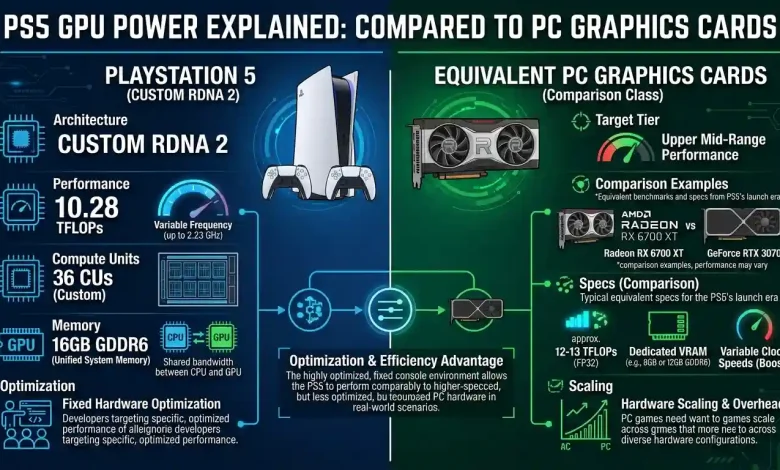
Table of Contents
PS5 GPU power has been a topic of intense discussion since its launch, with many gamers curious about how it stacks up against the ever-evolving world of PC graphics cards. While the PlayStation 5 boasts impressive specifications for a console, offering a compelling gaming experience, directly comparing its custom-designed GPU to the vast array of PC graphics cards is a nuanced task. This article delves into the technical aspects of the PS5’s graphical prowess, analyzes key metrics used in PC GPUs, and provides a comprehensive comparison to shed light on their respective strengths and limitations.
Understanding the PS5’s GPU Architecture: Custom RDNA 2
The heart of the PlayStation 5’s graphical capabilities lies in its custom System-on-a-Chip (SoC), developed by AMD in collaboration with Sony. The integrated GPU is based on AMD’s RDNA 2 architecture, a foundational technology also found in AMD’s Radeon RX 6000 series PC graphics cards and Microsoft’s Xbox Series X/S consoles. This shared architecture provides a common ground for understanding its potential.
Specifically, the PS5’s GPU features 36 Compute Units (CUs) and operates at a variable frequency, capable of reaching up to 2.23 GHz. This configuration delivers a theoretical peak performance of 10.28 teraFLOPS (TFLOPS). TFLOPS, or tera Floating-point Operations Per Second, are a common metric used to indicate the raw processing power of a GPU, representing trillions of floating-point operations it can perform per second.
Beyond raw TFLOPS, the RDNA 2 architecture brings several key features to the PS5:
- Hardware-Accelerated Ray Tracing: This advanced rendering technique simulates the physical behavior of light, resulting in more realistic lighting, shadows, and reflections in games. The PS5’s RDNA 2 GPU includes dedicated ray accelerators within each CU to handle these complex calculations efficiently.
- Variable Rate Shading (VRS): VRS allows the GPU to process different areas of a frame at varying levels of detail, allocating more shading resources to visually important areas and less to others. This can lead to significant performance gains without a noticeable drop in visual quality.
- Custom Geometry Engine: Sony’s custom implementation of RDNA 2 includes a dedicated Geometry Engine. This hardware block helps with efficient geometry processing, which is crucial for handling complex game worlds and detailed character models.
- GDDR6 Unified Memory: The PS5 utilizes 16 GB of GDDR6 SDRAM, shared between the CPU and GPU, connected via a 256-bit interface. This unified memory pool boasts a peak bandwidth of 448 GB/s. This high bandwidth is crucial for rapidly feeding data to the GPU, minimizing bottlenecks.
It’s important to note that while the PS5’s GPU is based on RDNA 2, it is a highly customized version. Sony made specific enhancements and, in some cases, omitted certain desktop RDNA 2 features that they deemed less beneficial for a console environment, replacing them with their own custom silicon work.
The Metrics of PC Graphics Cards: A Diverse Landscape
PC graphics cards exist in a highly diverse market, ranging from entry-level integrated solutions to ultra-high-end discrete GPUs. When evaluating their performance, several key metrics come into play, similar to those of the PS5 GPU but often on a much broader scale.
- TFLOPS: Like consoles, TFLOPS are a fundamental measure of a PC GPU’s raw computational power. High-end PC GPUs often boast significantly higher TFLOP counts than the PS5, particularly newer generations.
- Core Counts (CUDA Cores, Stream Processors): NVIDIA GPUs use CUDA Cores, while AMD GPUs use Stream Processors (within Compute Units). These are the individual processing units responsible for executing calculations. More cores generally translate to higher potential performance.
- Clock Speed (Boost Clock, Game Clock): This refers to the speed at which the GPU cores operate. Higher clock speeds allow for more operations per second. PC GPUs often have dynamic clock speeds that boost higher under optimal thermal conditions.
- Memory (VRAM) and Bandwidth: PC graphics cards typically feature dedicated GDDR6 or GDDR6X VRAM, with capacities ranging from 8GB to 24GB or even more in high-end cards. Memory bandwidth (GB/s) is critical for how quickly the GPU can access its dedicated memory, directly impacting performance at higher resolutions and texture settings.
- Architecture: Both NVIDIA (e.g., Ada Lovelace, Ampere) and AMD (e.g., RDNA 3, RDNA 4) continuously evolve their architectures, introducing new features, efficiency improvements, and performance enhancements with each generation.
- Ray Tracing Cores / Accelerators: Modern PC GPUs from both NVIDIA and AMD include dedicated hardware for ray tracing, similar to the PS5. NVIDIA’s RT Cores and AMD’s Ray Accelerators are specifically designed to speed up ray-traced effects.
- Upscaling Technologies (DLSS, FSR): NVIDIA’s Deep Learning Super Sampling (DLSS) and AMD’s FidelityFX Super Resolution (FSR) are AI-powered or spatial upscaling technologies that render games at a lower resolution and then intelligently upscale them to a higher resolution, significantly boosting frame rates while maintaining good image quality. These are major differentiators in performance, particularly for PC.
Direct TFLOPs Comparison: Why Raw Numbers Don’t Tell the Whole Story
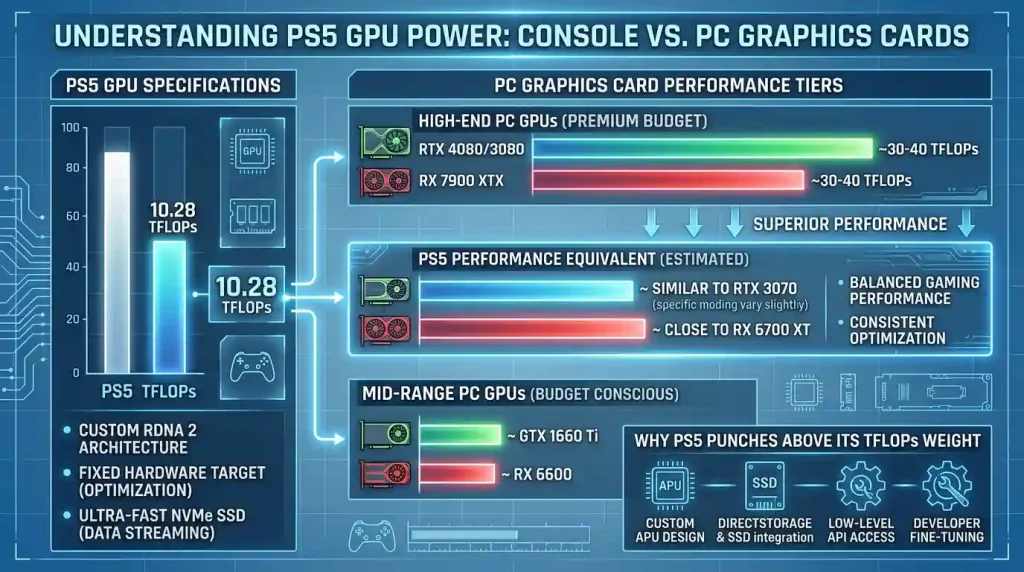
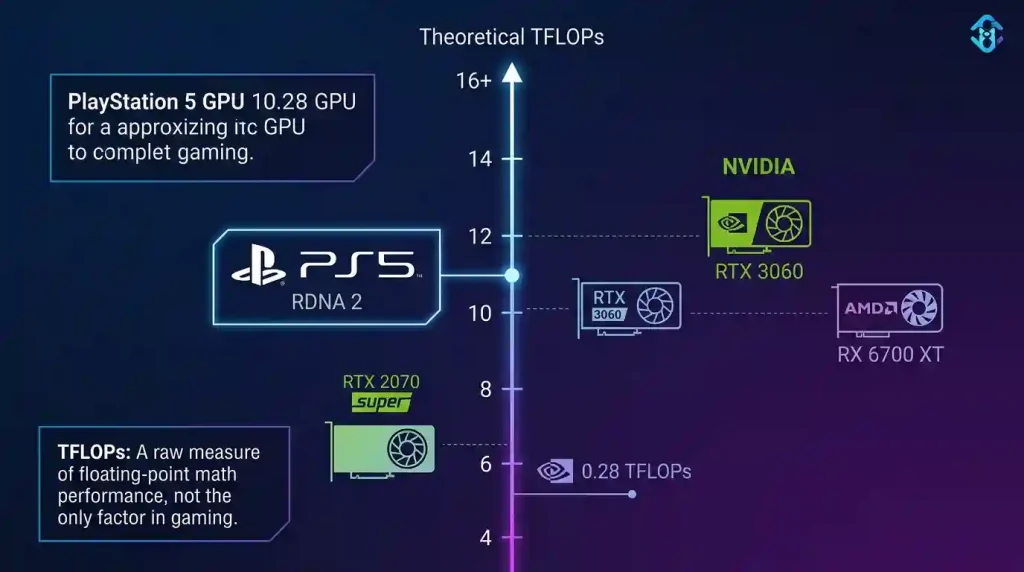
At first glance, comparing the PS5’s 10.28 TFLOPS to some high-end PC graphics cards might seem straightforward. For example, an NVIDIA GeForce RTX 3060 Ti typically offers around 16.2 TFLOPS (FP32), and an AMD Radeon RX 6700 XT is around 13.2 TFLOPS (FP32). This might lead one to conclude that these PC cards are simply “more powerful.” However, this is a simplistic view that overlooks crucial differences in their operating environments and design philosophies.
Sony, when detailing the PS5’s GPU, explicitly stated that TFLOPS alone do not account for all the factors that collectively impact GPU performance. The console’s custom silicon and tightly integrated ecosystem lead to efficiencies that are not always reflected in raw TFLOP numbers.
Key factors influencing this disparity include:
- Custom Silicon and Optimization: The PS5’s GPU is a custom-designed component, optimized specifically for the console’s unified architecture. Game developers can program directly to the hardware with a fixed target, allowing for much deeper optimization than is typically possible on the diverse PC platform.
- Unified Memory Architecture: The PS5’s CPU and GPU share a single, high-bandwidth GDDR6 memory pool. This eliminates the need for data transfers between separate CPU and GPU memory, reducing latency and increasing efficiency. PC GPUs, by contrast, rely on their own dedicated VRAM and communicate with system RAM via the CPU, which can introduce overhead.
- API Overhead: Consoles often have lower-level APIs (Application Programming Interfaces) that allow developers closer access to the hardware, reducing overhead. PC APIs like DirectX 12 Ultimate and Vulkan aim to achieve similar low-level access, but the sheer variety of PC hardware can still introduce inefficiencies.
- Fixed Hardware Target: Developers for the PS5 know exactly what hardware their games will run on. This enables them to extract every bit of performance through highly tailored optimizations, something that is challenging for PC developers who must cater to thousands of different hardware configurations.
Therefore, while a PC GPU might have a higher TFLOP count, the PS5’s optimized and integrated design allows it to punch above its weight, delivering performance that is often comparable to, or even exceeding, PC cards with higher theoretical specs in certain scenarios.
PS5’s Strengths: Optimization and Custom Integration
The PlayStation 5’s greatest strengths lie in its cohesive design and the resulting optimization potential. The custom AMD RDNA 2 GPU works in tandem with a custom 8-core Zen 2 CPU and a blazing-fast 825GB PCIe 4.0 NVMe SSD. This trifecta of tightly integrated components creates an environment where games can be developed to fully leverage every aspect of the hardware.
This custom integration manifests in several key advantages:
- Predictable Performance: For game developers, a fixed hardware target means predictability. They can optimize their game engines and assets knowing the exact capabilities and limitations of the PS5. This often results in more stable frame rates and fewer performance inconsistencies compared to the highly variable PC landscape.
- Reduced Overhead: The console’s low-level APIs and custom I/O complex minimize the overhead typically associated with operating systems and driver layers on PCs. Data can flow more directly and efficiently between the storage, CPU, and GPU.
- I/O Throughput: The PS5’s custom SSD controller and architecture are designed for exceptional data transfer speeds, reaching up to 5.5 GB/s raw and potentially over 10 GB/s with hardware-accelerated compression (Kraken). This allows for massive assets to be streamed into memory almost instantaneously, virtually eliminating loading screens and enabling new game design paradigms not easily replicated on standard PC storage.
- Thermal and Power Efficiency: By designing the SoC from the ground up, Sony could fine-tune power consumption and thermal management. This allows the GPU to consistently operate at its boost clock of 2.23 GHz, unlike some PC GPUs that might be limited by thermal throttling in less-than-ideal cooling setups.
These factors collectively contribute to a highly efficient gaming machine, where the sum is often greater than its individual parts.
PC’s Advantages: Scalability, Choice, and Cutting-Edge Innovation
While the PS5 excels in optimization for a fixed platform, PC gaming offers a fundamentally different set of advantages: unparalleled scalability, vast choice, and access to the bleeding edge of hardware innovation.
The modular nature of PC hardware means gamers are not locked into a specific set of specifications for the console’s lifecycle. Instead, they can:
- Upgrade Components: A PC user can upgrade their GPU, CPU, RAM, or storage independently as new technologies emerge or as their budget allows. This provides a path to continuously improve performance and visual fidelity, extending the lifespan of their gaming system far beyond that of a console.
- Sheer Performance Potential: High-end PC graphics cards consistently push the boundaries of performance, often surpassing consoles in raw processing power, especially at higher resolutions and frame rates. This translates to the ability to run games at native 4K resolution with higher frame rates, or at ultra-high refresh rates (e.g., 144Hz, 240Hz, or even 500Hz) at lower resolutions.
- Cutting-Edge Features: PC GPUs often introduce the latest architectural advancements and features before they make their way into consoles. This includes more advanced iterations of ray tracing, improved upscaling technologies like DLSS 3 with Frame Generation, and other proprietary features that enhance visual quality and performance.
- Customization and Flexibility: Beyond hardware, PC offers extensive customization of settings, allowing users to fine-tune graphics for their specific hardware and preferences. This granular control enables a balance between visual fidelity and performance that is largely absent in console gaming, which typically offers a limited set of performance or quality modes.
- Wider Ecosystem: PC gaming benefits from a broader ecosystem of peripherals, displays (including ultrawide and high refresh rate monitors), and software. It also offers a massive game library, often with better pricing flexibility, and a robust modding community that can extend the life and content of games.
Gaming Performance Realities: Console vs. PC in Action
In practical terms, how does the PS5’s GPU power translate to gaming performance compared to PC graphics cards?
The PS5 generally targets 4K resolution at 30-60 frames per second (fps) or 1440p/1080p at 60-120 fps, often utilizing techniques like dynamic resolution scaling or temporal upscaling to achieve these targets, especially in graphically demanding titles. Many console games now offer “performance” or “quality” modes, allowing players to prioritize either frame rate or visual fidelity. However, achieving 120fps on PS5 is not universal and is dependent on the specific game and its optimization.
For PC, the performance landscape is far more varied. A mid-range PC GPU from a few years ago might struggle to match the PS5’s consistent 60fps experience in modern titles, especially at higher resolutions. However, a modern high-end PC with a powerful GPU can easily surpass the PS5’s performance, delivering native 4K at consistently higher frame rates (e.g., 90-120+ fps) with all graphical settings maxed out, including advanced ray tracing.
For illustrative purposes, consider these comparisons with PC GPUs released around the PS5’s timeframe:
| Feature/Metric | PS5 GPU (Standard Model) | NVIDIA GeForce RTX 3060 Ti (8GB GDDR6) | AMD Radeon RX 6700 XT (12GB GDDR6) |
|---|---|---|---|
| Architecture | Custom AMD RDNA 2 | NVIDIA Ampere | AMD RDNA 2 |
| Theoretical Peak TFLOPS (FP32) | 10.28 TFLOPS | ~16.2 TFLOPS | ~13.2 TFLOPS |
| Compute Units / SMs | 36 CUs | 38 Streaming Multiprocessors (SMs) | 40 CUs |
| Boost Clock Speed | Up to 2.23 GHz (variable) | Up to 1.67 GHz | Up to 2.581 GHz |
| Memory (VRAM) | 16 GB GDDR6 (unified) | 8 GB GDDR6 | 12 GB GDDR6 |
| Memory Interface | 256-bit | 256-bit | 192-bit |
| Memory Bandwidth | 448 GB/s | 448 GB/s | 384 GB/s |
| Ray Tracing Hardware | Yes (Dedicated Accelerators) | 2nd Gen RT Cores | 1st Gen Ray Accelerators |
| Upscaling Technology | FSR (via software), Temporal upscaling | DLSS, FSR | FSR |
This table highlights that while the PS5’s TFLOPs are lower than these representative PC cards, its memory bandwidth is competitive. The RTX 3060 Ti generally offers stronger ray tracing performance, while the RX 6700 XT, with its larger 12GB VRAM, can sometimes handle higher texture settings better in certain games, particularly as titles become more demanding. However, the PS5’s unified memory approach provides an efficiency advantage that pure specification comparisons often miss.
In real-world gaming scenarios, a well-optimized PS5 title can often look and perform comparably to a PC running an RTX 3060 Ti or RX 6700 XT at similar resolution and graphical settings, especially considering the console’s consistent performance target. However, PC offers the headroom to push settings higher, achieve truly native 4K at very high frame rates, or enable more advanced ray tracing effects that might be dialed down on console for performance reasons.
Conclusion
The PS5 GPU, with its custom AMD RDNA 2 architecture and 10.28 TFLOPS of theoretical power, represents a remarkably capable piece of hardware. Its greatest strength lies in the cohesive and highly optimized ecosystem Sony has created, allowing developers to extract exceptional performance from a fixed hardware configuration. This translates to a consistent and polished gaming experience, often challenging PC graphics cards with higher raw specifications in real-world scenarios.
Conversely, PC graphics cards offer unparalleled scalability, choice, and access to the latest technological innovations. While a console provides a “plug-and-play” simplicity and excellent value, the PC platform empowers users with the ability to upgrade, customize, and push the boundaries of visual fidelity and frame rates, often surpassing console capabilities with high-end components.
Ultimately, the “better” GPU depends on individual priorities. For those who value a streamlined, optimized, and hassle-free gaming experience with a predictable performance profile, the PS5’s custom GPU delivers admirably. For enthusiasts who prioritize maximum performance, graphical customization, upgradeability, and access to the bleeding edge of gaming technology, a high-end PC with a powerful discrete graphics card remains the ultimate choice. Both platforms, powered by impressive GPU technology, offer fantastic gaming experiences, showcasing the diverse ways graphics processing power can be harnessed. For a deeper dive into the technicalities of console architecture and its comparison with PC, Wikipedia’s article on PlayStation 5 hardware provides extensive details.