4090 GPU Benchmarks: 10 Amazing RTX Gaming Performance Tests Revealed
Table of Contents
4090 GPU Benchmarks continue to astound the gaming and content creation communities, solidifying its position as the ultimate graphics card for enthusiasts seeking unparalleled performance. Since its launch in late 2022, the NVIDIA GeForce RTX 4090 has consistently delivered a level of graphical prowess previously unimaginable, especially for 4K gaming with ray tracing enabled. This comprehensive article delves into the benchmarks that define the RTX 4090’s ultimate performance, exploring its underlying architecture, raw gaming capabilities, revolutionary AI features like DLSS 3, and its standing against competitors.
Introduction: 4090 GPU Benchmarks
The NVIDIA GeForce RTX 4090 emerged as a game-changer in the GPU landscape, instantly becoming the flagship model of the RTX 40 series. It was designed to offer revolutionary performance for gamers and creators alike, delivering up to four times the performance of its predecessor, the RTX 3090 Ti, in certain scenarios, particularly with DLSS 3.0 activated. This monstrous leap in power is attributed to the cutting-edge NVIDIA Ada Lovelace architecture, which brought significant advancements in core technology and efficiency. For serious gamers targeting high-refresh-rate 4K gameplay with ray tracing, the RTX 4090 has redefined what is possible, consistently exceeding 100 FPS in many demanding titles.
NVIDIA Ada Lovelace Architecture: The Engine of Innovation
At the heart of the RTX 4090’s exceptional performance lies the NVIDIA Ada Lovelace architecture, named after the 19th-century mathematician Ada Lovelace. This microarchitecture, officially announced on September 20, 2022, represents a dramatic shift from the preceding Ampere architecture. Fabricated on TSMC’s custom 4N process, the Ada Lovelace architecture boasts significantly increased efficiency and transistor density.
Key architectural innovations include:
- New Streaming Multiprocessors (SMs): Ada Lovelace SMs offer up to 2x performance and power efficiency compared to previous generations, with each SM containing 128 CUDA Cores capable of concurrent FP32 and INT32 execution.
- Fourth-Generation Tensor Cores: These cores are crucial for accelerating AI technologies like DLSS 3, delivering up to 4x higher inference performance over the previous generation through structured sparsity and 8-bit floating point (FP8) precision. They increase throughput by up to 5x to 1.4 Tensor-petaFLOPS using the new FP8 Transformer Engine.
- Third-Generation RT Cores: Ada Lovelace features enhanced RT Cores with up to twice the ray-triangle intersection throughput, leading to over 2x RT-TFLOP performance. A new Shader Execution Reordering (SER) pipeline also improves ray tracing efficiency, boosting in-game frame rates by up to 25% and ray tracing performance up to 3x.
- Larger L2 Cache: The AD102 GPU, found in the RTX 4090, is equipped with a massive 98304 KB of L2 cache, a 16x improvement over the GA102 in the RTX 3090 Ti, reducing reliance on slower memory access.
These advancements collectively contribute to the RTX 4090’s ability to handle highly demanding workloads, from complex ray tracing scenes to AI-driven graphics and compute tasks.
Raw Performance Dominance: Beyond Traditional Rasterization
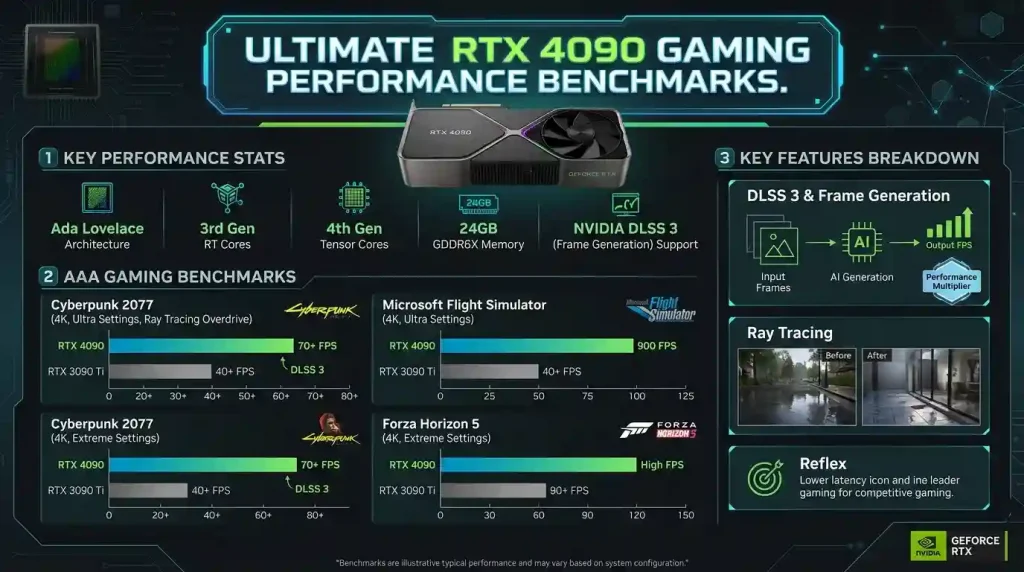
In terms of traditional rasterization, where games are rendered without advanced ray tracing effects, the RTX 4090 sets a new benchmark for performance. At 4K resolution with max settings (no DLSS), the RTX 4090 consistently averages over 100 FPS in many titles, delivering a high-refresh experience previously unheard of. For instance, it was found to be 63% faster than the RTX 3090 on average across 25 games at 4K resolution. Specific benchmarks highlight its supremacy:
- In Shadow of the Tomb Raider (1440p, Highest Quality), the RTX 4090 achieved an average of 194 FPS, outperforming the RTX 3090 Ti by approximately 54%.
- Across a 13-game average at 1440p, the RTX 4090 hit 219 FPS, roughly 44-45% faster than the 3090 Ti.
- In demanding titles like Cyberpunk 2077, even at native 4K with maximum settings, the RTX 4090 delivers playable frame rates, reaching around 39 FPS without DLSS, a significant improvement over its predecessors.
Even in some older or less GPU-intensive titles, where CPU bottlenecks can sometimes limit performance, the RTX 4090 still demonstrates substantial gains at higher resolutions, especially 4K, where it can fully utilize its immense power.
4K and Beyond: Setting a New Standard for Gaming
The RTX 4090 is truly designed for 4K gaming, consistently delivering frame rates that enable a smooth, high-refresh-rate experience. It is often cited as the first single-GPU card capable of providing 4K 60 FPS with ray tracing enabled and upscaling disabled in many demanding games. In more extreme resolutions, such as ultrawide 5120×2160, the RTX 4090 still manages an average of 85 FPS for smooth gameplay, even without upscaling. When DLSS Quality is engaged, this jumps to a remarkable 127 FPS, exceeding native raster performance.
This level of performance means gamers no longer have to compromise significantly on visual settings to achieve desirable frame rates at 4K, allowing for a truly immersive and uncompromised gaming experience. For enthusiasts with high-end 4K monitors, the RTX 4090 redefines expectations by consistently exceeding 100 FPS.
| GPU Model | Architecture | CUDA Cores | Memory (GDDR6X) | TBP (Watts) | Average 4K FPS (Native/Rasterization) | Average 4K FPS (RT+DLSS 3) |
|---|---|---|---|---|---|---|
| NVIDIA GeForce RTX 4090 | Ada Lovelace | 16,384 | 24 GB | 450 | ~116 FPS | ~100+ FPS |
| NVIDIA GeForce RTX 3090 Ti | Ampere | 10,752 | 24 GB | 450 | ~80-85 FPS | ~60 FPS (RT+DLSS 2) |
| AMD Radeon RX 7900 XTX | RDNA 3 | 6,144 (Stream Processors) | 24 GB | 355 | ~90-95 FPS | ~60 FPS (RT+FSR) |
DLSS 3 and Frame Generation: AI-Powered Performance Multiplier
One of the most transformative technologies introduced with the Ada Lovelace architecture is NVIDIA DLSS 3, featuring AI-powered Frame Generation. Unlike traditional upscaling, DLSS 3 generates entirely new, high-quality frames using an Optical Flow Accelerator, effectively multiplying frame rates beyond what the GPU can natively render. This is particularly beneficial in CPU-limited scenarios or extremely demanding games where raw rendering power might still fall short. NVIDIA claims that with DLSS 3, performance on the RTX 4090 can be anywhere from 2x to 4x faster than an RTX 3090 Ti running DLSS 2.
Key aspects of DLSS 3 performance:
- In Cyberpunk 2077, DLSS 3 can nearly double the native 4K frame rate, taking it from 39 FPS to 67 FPS with Frame Generation. With RT on Psycho and Quality DLSS, users reported 40-55 FPS baseline at 4K, rising to 70-85 FPS with DLSS-Quality and up to 100 FPS+ using frame gen.
- In A Plague Tale: Requiem and F1 2022, DLSS 3 can make the RTX 4090 up to 2.4x faster. For titles like Justice (a Chinese MMO), gains can be as high as 5x.
- DLSS 3, by requiring NVIDIA Reflex implementation, also helps in lowering total system latency, often offsetting the added latency from frame generation, making the gaming experience feel smoother. However, some reports indicate that while frame rates are boosted, latency can still be higher than with DLSS 2 or native rendering, meaning the perception of smoothness might not always align with the raw FPS numbers.
The widespread adoption of DLSS 3 is growing, with over 35 games and applications supporting the technology, including major game engines like Unity and Unreal Engine. This ensures that the RTX 4090’s longevity and performance advantage will continue to expand as more titles implement this innovative feature.
Ray Tracing Excellence: Unparalleled Visual Fidelity
The RTX 4090 truly shines in ray-traced environments, delivering unprecedented visual fidelity without crippling performance. The third-generation RT Cores and the Shader Execution Reordering (SER) technology within the Ada Lovelace architecture are specifically designed to accelerate complex ray tracing workloads. This results in a superior ray tracing experience compared to any other consumer GPU.
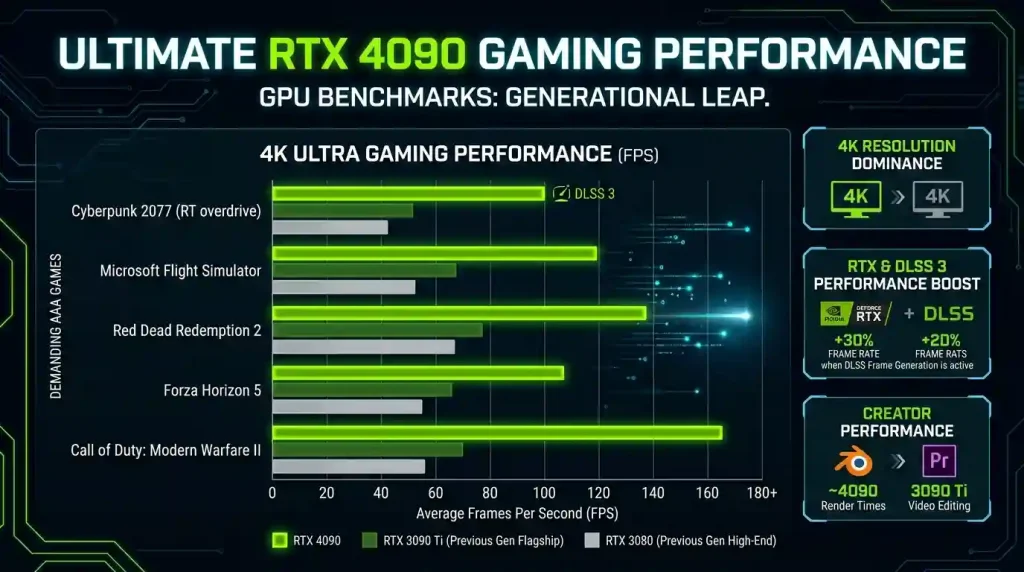
- In full ray-traced games, the RTX 4090 with DLSS 3 can be up to 4x faster than the RTX 3090 Ti with DLSS 2.
- Even without DLSS, the RTX 4090 can often achieve 60 FPS or more at native 4K with ultra ray tracing settings in many titles, making ray tracing a truly playable reality for the first time without significant compromises.
- In games like Control Ultimate Edition, the RTX 4090 showed a 67% advantage over the 3090 Ti with DXR enabled, extending to a 106% advantage in Fortnite with maxed-out RT options.
- At 4K with ray tracing and DLSS enabled, the RTX 4090 was 86% faster than the 3090 Ti in some titles, and a staggering 91% faster with just RT and no DLSS in Cyberpunk 2077.
The ability to render such detailed and realistic lighting, reflections, and shadows at high frame rates makes the RTX 4090 the undisputed champion for those who prioritize the most immersive visual experiences in modern gaming. For a deeper understanding of graphics processing, one might refer to the Wikipedia page on Graphics Processing Units.
Power Efficiency and Cooling: Managing the Beast
Despite its immense power, the RTX 4090 manages impressive power efficiency thanks to the TSMC 4N fabrication process. NVIDIA specifies a Total Board Power (TBP) of 450W for the RTX 4090. In real-world scenarios, power draw can range from 400W to 600W, depending on the workload. While this is a substantial amount, the Ada Lovelace architecture delivers a significant performance increase at the same 450W used by the RTX 3090 Ti, indicating a much higher performance-per-watt efficiency.
Effective cooling solutions are critical for maintaining optimal performance. NVIDIA’s Founders Edition and custom AIB cards typically feature robust cooling designs to manage the heat generated. Temperatures for the RTX 4090 Founders Edition usually hover around 67°C under load, even with lower fan speeds compared to some previous-gen cards. For optimal system stability and to accommodate other high-performance components, a power supply unit (PSU) with at least 850W capacity is recommended, with 1000W or higher being advisable for enhanced stability. It’s crucial to use a native 12VHPWR connector or high-quality adapters to prevent potential issues, as improper connections have led to reports of melted connectors. Notably, enabling DLSS 3.0 can also contribute to lower power consumption, with reported reductions from 461W to 348W in some tests.
RTX 4090 vs. The Competition: A Class Apart
When compared to its closest rival, AMD’s Radeon RX 7900 XTX, the RTX 4090 generally holds a significant lead, particularly in demanding 4K and ray tracing workloads. Aggregate benchmark results show the RTX 4090 outperforming the RX 7900 XTX by approximately 21% to 26% on average in 4K resolution. The performance gap widens considerably when ray tracing is enabled:
- In ray tracing-heavy games, the RTX 4090 significantly outperforms the RX 7900 XTX, often by margins of 40-50% or even higher at 4K. For instance, in some titles with high ray tracing settings at 4K, the RTX 4090 can be nearly 140% faster than the RX 7900 XTX.
- While the RX 7900 XTX offers better value for money in terms of price-per-FPS at lower resolutions, especially 1080p and 1440p, the RTX 4090’s raw power and advanced features like DLSS 3 make it the undisputed choice for uncompromised 4K and ray-traced gaming.
- For synthetic benchmarks that heavily utilize ray tracing, such as Port Royal and Speed Way, the RTX 4090 demonstrates a clear advantage, indicating NVIDIA’s continued lead in ray tracing capabilities.
The RTX 4090 also shows remarkable gains over its direct predecessor, the RTX 3090 Ti. In raw performance, it can be 30% faster than the RTX 3090 Ti in aggregate benchmarks. In some games, the 4090 delivers up to 64% higher average frame rates at 4K compared to the 3090 Ti. This generational leap makes the RTX 4090 a compelling upgrade for those coming from older high-end cards.
Future-Proofing Your Gaming Rig with the RTX 4090
Investing in an RTX 4090 is not just about current performance; it’s also about future-proofing your gaming setup. Its immense power and advanced features like DLSS 3 and enhanced ray tracing capabilities mean it will remain a top-tier GPU for many years to come. With games becoming increasingly graphically intensive and adopting more advanced rendering techniques like path tracing, the RTX 4090’s ability to handle these demands is a significant advantage. For instance, even with demanding path tracing enabled in titles like Cyberpunk 2077 and Alan Wake 2, the RTX 4090, especially with DLSS Performance and Frame Generation, can achieve highly playable frame rates, sometimes even exceeding native non-path-traced performance.
While newer generations of GPUs will inevitably arrive, the RTX 4090’s substantial headroom ensures that it can deliver excellent performance even as game fidelity continues to advance. Its 24GB of GDDR6X memory is ample for current and foreseeable future high-resolution texture packs and complex game worlds.
Conclusion: The Unrivaled Gaming King
The NVIDIA GeForce RTX 4090 stands as an undisputed titan in the realm of graphics processing units. Its benchmarks consistently showcase a GPU that not only dominates traditional rasterization at 4K but also transforms the ray tracing and upscaling landscape with its Ada Lovelace architecture and groundbreaking DLSS 3 technology. From doubling performance over its predecessor in many scenarios to offering truly uncompromised 4K gaming with all visual bells and whistles, the RTX 4090 sets a new gold standard for ultimate RTX gaming performance. For gamers and creators seeking the absolute pinnacle of graphical power and a future-proof investment, the RTX 4090 remains the definitive choice, delivering an unparalleled visual and gameplay experience.