Gaming GPU Comparison: 10 Amazing RTX vs Radeon Performance Tests Ranked
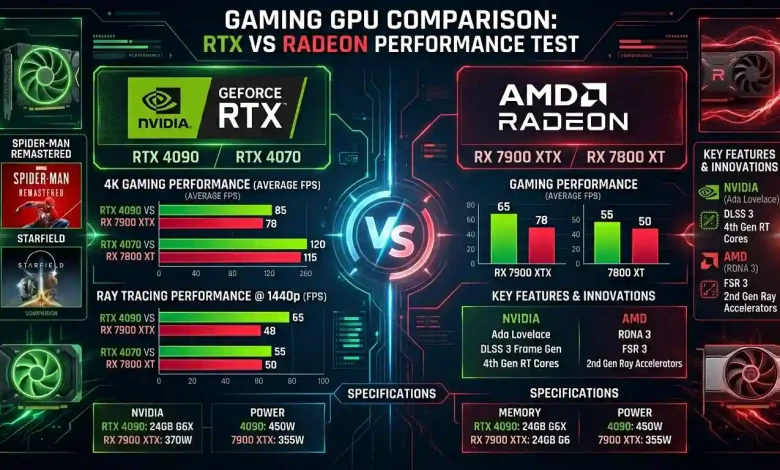
Table of Contents
Gaming GPU comparison between NVIDIA’s RTX and AMD’s Radeon series remains one of the most hotly debated topics among PC enthusiasts and gamers alike. In the ever-evolving landscape of high-performance computing, the graphics processing unit (GPU) stands as the beating heart of any serious gaming rig, tasked with rendering the incredibly detailed, lifelike virtual worlds we now expect. For years, NVIDIA and AMD have been the dominant forces, each pushing the boundaries of graphical fidelity and performance with their proprietary technologies and architectural innovations. As of mid-2026, both companies have rolled out their latest generations – NVIDIA with its Blackwell-based RTX 50-series and AMD with its RDNA 4-powered Radeon RX 9000-series – setting the stage for an intense competition. This comprehensive article delves deep into the performance metrics, feature sets, architectural nuances, and overall value propositions of these formidable contenders, helping you make an informed decision for your next gaming upgrade.
The Evolution of Gaming GPU Comparison: A Brief History of NVIDIA and AMD
The journey of modern gaming GPUs is a saga of relentless innovation, largely spearheaded by NVIDIA and AMD. NVIDIA, a pioneer in the graphics industry, revolutionized the market with its GeForce series, which eventually paved the way for the groundbreaking RTX line. The introduction of the RTX series in 2018 with the Turing architecture marked a significant shift, bringing real-time ray tracing and AI-powered Deep Learning Super Sampling (DLSS) to consumer graphics cards. Each subsequent generation, including the Ampere (RTX 30-series) and Ada Lovelace (RTX 40-series), has further refined these technologies, culminating in the current Blackwell architecture of the RTX 50-series, which promises even more efficient ray tracing, AI-enhanced rendering, and improved power efficiency.
AMD, while often playing the role of the challenger, has consistently delivered competitive products under its Radeon brand. AMD’s focus has historically been on strong rasterization performance and competitive pricing, often providing more video memory (VRAM) for the money. The Radeon RX series, built on various iterations of their RDNA (Radeon DNA) architecture, has steadily gained ground. With the RDNA 2 architecture, AMD introduced its first hardware-accelerated ray tracing capabilities, found in the RX 6000 series and also powering the latest generation of gaming consoles. The more recent RDNA 3 architecture (RX 7000 series) brought further refinements, and the current RDNA 4 architecture underpinning the RX 9000 series represents AMD’s latest push for impressive rasterization performance and improved ray tracing capabilities across a broader range of price points. Both companies have shaped the PC gaming landscape, pushing each other to achieve ever-higher levels of graphical realism and performance. For those interested in the broader history of GPUs and their impact on computing, a deeper dive into their evolution can be found on authoritative sources like Wikipedia’s Graphics Processing Unit page.
Decoding NVIDIA’s RTX Series: Ray Tracing, DLSS, and Architecture
NVIDIA’s RTX series is synonymous with cutting-edge graphical features, particularly real-time ray tracing and AI-powered upscaling. At the core of RTX GPUs are specialized processing units: RT Cores and Tensor Cores. RT Cores are dedicated hardware units designed specifically to accelerate ray tracing calculations, enabling games to render highly realistic lighting, reflections, and shadows in real-time. This specialized hardware gives NVIDIA a significant advantage in ray-traced workloads, often resulting in much higher ray-traced frames per second compared to AMD’s offerings.
Complementing ray tracing is NVIDIA’s Deep Learning Super Sampling (DLSS) technology. DLSS is a suite of neural rendering technologies that leverages AI to boost frame rates, reduce latency, and improve image quality. It works by rendering a game at a lower resolution and then using an AI neural network, powered by the GPU’s Tensor Cores, to intelligently upscale it to a higher resolution. The latest iteration, DLSS 4.5, includes advanced features like Multi Frame Generation and enhanced Ray Reconstruction, which can effectively multiply frame rates while maintaining or even exceeding native image quality. This technology significantly offsets the performance cost of ray tracing, making it more playable in demanding titles. DLSS typically provides better image quality and often higher FPS gains compared to AMD’s FSR, with superior anti-aliasing and detail preservation. However, DLSS requires RTX GPUs (20-series and newer, with frame generation on 40-series and newer) due to its reliance on dedicated Tensor Cores. NVIDIA’s latest Blackwell architecture, found in the RTX 50-series, further enhances these capabilities with fifth-generation Tensor Cores and fourth-generation RT Cores, delivering superior AI-augmented graphics and compute performance.
Unpacking AMD’s Radeon Series: RDNA Architecture, FSR, and Redstone
AMD’s Radeon series, particularly the latest RX 9000 models, are built upon the RDNA 4 architecture, representing AMD’s commitment to delivering strong gaming performance and innovative features. AMD’s approach to graphics processing emphasizes a balance of raw rasterization power, improved ray tracing capabilities, and a focus on open-source technologies. The RDNA 4 architecture brings generational improvements across the board, aiming to compete directly with NVIDIA’s offerings in various performance tiers.
One of AMD’s flagship technologies is FidelityFX Super Resolution (FSR). FSR is an upscaling technology designed to increase frame rates and visual quality, similar to DLSS. Unlike DLSS, FSR is hardware-agnostic, meaning it can run on a much wider range of GPUs, including older AMD Radeon cards (RX 500 series and newer), NVIDIA’s GTX 1070 and newer, and even some integrated graphics solutions. This broad compatibility makes FSR an attractive option for gamers not on the latest hardware. With its latest FSR “Redstone” suite, AMD has consolidated several machine learning-powered gaming technologies. FSR Redstone includes FSR Upscaling (formerly FSR 4, which is ML-accelerated on RDNA 4 GPUs), FSR Frame Generation, FSR Ray Regeneration, FSR Radiance Caching, and FSR Latency Reduction 2.0 (formerly Anti-Lag 2). While FSR has made significant strides, particularly with FSR 4’s ML-powered algorithms for RDNA 4 cards, it still typically lags behind DLSS in overall image quality and raw performance uplift, sometimes exhibiting issues like shimmering and ghosting, though these have been greatly improved with FSR 3.1 and subsequent versions. AMD continues to iterate on FSR, with new versions and features being developed, although the latest FSR 4.1 is currently planned exclusively for RDNA 4 GPUs, not older RDNA 3.5 architectures. AMD’s Adrenalin Edition software also provides a comprehensive suite of tools for performance tuning and in-driver features.
Performance Benchmarking: Head-to-Head in Key Gaming Titles
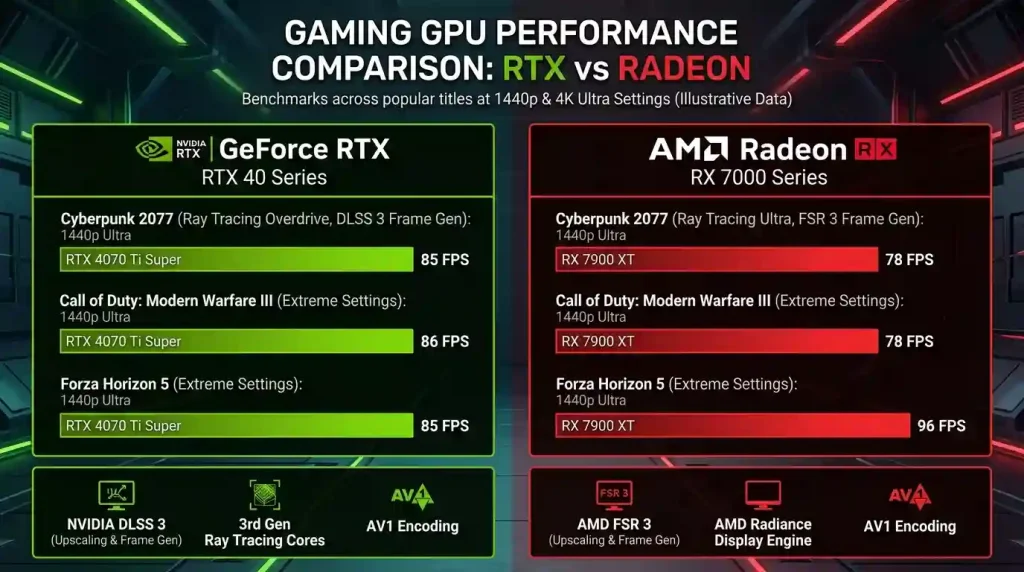
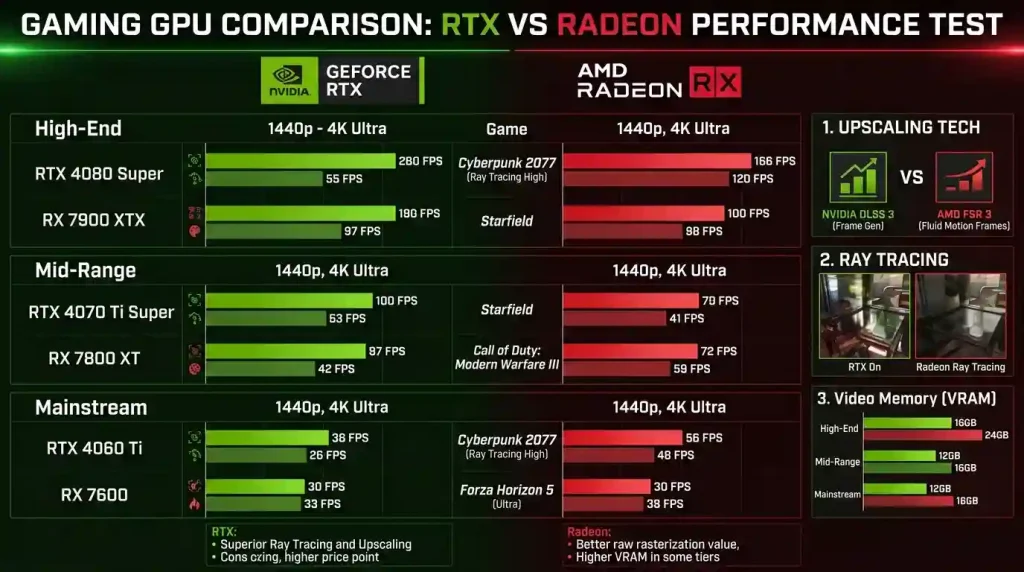
When it comes to raw gaming performance, both NVIDIA and AMD offer compelling options across different segments of the market. Benchmarking involves evaluating GPUs in various real-world gaming scenarios, typically across different resolutions (1080p, 1440p, 4K) and with varying graphical settings, including the impact of ray tracing and upscaling technologies. The current generation of GPUs, including NVIDIA’s RTX 50-series and AMD’s RX 9000-series, brings substantial performance gains over their predecessors.
In traditional rasterized workloads, where raw rendering power without advanced lighting effects is the primary factor, AMD’s RDNA 4 architecture often proves highly competitive, frequently offering a better performance-per-dollar ratio. For instance, the AMD Radeon RX 9070 XT typically holds a consistent performance lead over the NVIDIA GeForce RTX 5070 in rasterized games, often by 7% to 17% depending on the title. In demanding open-world games like Cyberpunk 2077 and Black Myth: Wukong at 1440p with ultra settings, the RX 9070 XT delivers noticeably higher average frame rates. Similarly, at the high-end, the RX 9900 XTX offers strong 4K gaming performance at a potentially lower cost than NVIDIA’s top-tier options. For 1080p and 1440p gaming, AMD’s RX 9060 XT and RX 9070 are considered strong contenders, often providing excellent value.
However, the narrative shifts significantly when ray tracing is enabled. NVIDIA’s dedicated RT Cores and the efficiency of its DLSS technology give it a substantial lead in ray-traced workloads. In titles that heavily utilize ray tracing, such as Alan Wake 2 or Cyberpunk 2077 with full ray tracing, the RTX 5070 can significantly outperform the RX 9070 XT. DLSS 4’s Multi Frame Generation further boosts frame rates in supported titles, making high-fidelity ray tracing a much more playable experience on NVIDIA hardware.
Below is a comparative overview of some key GPU models from both brands, based on recent market information and expected performance tiers in 2026. This table illustrates general performance expectations; actual benchmarks may vary based on specific game optimization, driver versions, and system configurations. It should be noted that the GPU market saw significant shifts in pricing and supply due to AI wafer demand crowding out gaming GPU production and memory, leading to higher costs across the board by early 2026.
| GPU Model | Architecture | VRAM | Typical Raster Performance (1440p/4K) | Typical Ray Tracing Performance (1440p/4K) | Upscaling Technology | Power Draw (TBP) | Approx. Starting Price (USD, as of mid-2026) |
|---|---|---|---|---|---|---|---|
| NVIDIA GeForce RTX 5090 | Blackwell | 32GB GDDR7 | Elite (4K/8K) | Elite (4K/8K) | DLSS 4.5 (MFG) | ~450W+ | $4,000+ |
| NVIDIA GeForce RTX 5080 | Blackwell | 16GB GDDR7 | Excellent (4K) | Excellent (4K) | DLSS 4.5 (MFG) | ~350W | $1,800+ |
| AMD Radeon RX 9900 XTX | RDNA 4 | 24GB GDDR6 | Excellent (4K) | Very Good (4K) | FSR “Redstone” | ~400W | Comparable to RTX 5080 (lower) |
| NVIDIA GeForce RTX 5070 Ti | Blackwell | 12GB GDDR7 | Very Good (1440p/light 4K) | Strong (1440p) | DLSS 4.5 (MFG) | ~285W | $1,000+ |
| AMD Radeon RX 9070 XT | RDNA 4 | 16GB GDDR6 | Strong (1440p/light 4K) | Good (1440p) | FSR “Redstone” | 304W | $699.99 |
| NVIDIA GeForce RTX 5070 | Blackwell | 12GB GDDR7 | Good (1440p) | Very Good (1440p) | DLSS 4.5 (MFG) | 250W | $609.99 |
| AMD Radeon RX 9070 | RDNA 4 | 16GB GDDR6 | Good (1440p) | Fair (1440p) | FSR “Redstone” | ~275W | $629.99 |
| NVIDIA GeForce RTX 5060 | Blackwell | 8GB/12GB GDDR7 | Solid (1080p/light 1440p) | Good (1080p) | DLSS 4.5 (MFG) | ~180W | $369.99 (for 12GB variant) |
| AMD Radeon RX 9060 XT | RDNA 4 | 16GB GDDR6 | Solid (1080p/light 1440p) | Fair (1080p) | FSR “Redstone” | ~200W | $469.99 (16GB) |
Feature Set Showdown: Ray Tracing, Upscaling, and Ecosystems
Beyond raw frame rates, the battle between RTX and Radeon is often fought on the grounds of feature sets and their respective ecosystems. Ray tracing is a prime example. NVIDIA’s early adoption and continuous refinement of dedicated RT Cores have given it a consistent and significant lead in ray tracing performance. While AMD has made strides with its Ray Accelerators in RDNA 2 and RDNA 3, and further improvements in RDNA 4, NVIDIA’s hardware still offers a superior experience in graphically intensive ray-traced titles. If photorealistic lighting and reflections are a top priority, NVIDIA generally holds the advantage.
Upscaling technologies are another critical differentiator. NVIDIA’s DLSS, now in its 4th and 4.5th iterations, is powered by AI and often provides better image quality, sharpness, and stability compared to AMD’s FSR. DLSS 4.5’s Ray Reconstruction and Multi Frame Generation further enhance performance and visual fidelity, especially in ray-traced scenes. The AI-driven nature of DLSS, relying on dedicated Tensor Cores, allows for a more intelligent reconstruction of images, often leading to results that can look better than native resolution in certain scenarios. AMD’s FSR “Redstone,” while offering similar features like FSR Upscaling and FSR Frame Generation, operates differently. While FSR 4 on RDNA 4 GPUs uses ML-accelerated algorithms, older FSR versions (like FSR 3.1 for RDNA 3.5 and older GPUs) are more shader-based, leading to some image quality compromises like softness, shimmering, or ghosting compared to DLSS, although these issues have been significantly mitigated with recent updates. The key advantage of FSR, however, lies in its broader compatibility, working across a vast array of GPUs from both AMD and NVIDIA, and even integrated graphics, making it more accessible to a wider audience.
The software ecosystems surrounding these GPUs also play a role. NVIDIA’s GeForce Experience offers a refined interface for automatic driver updates, game optimizations, and one-click streaming and recording. AMD’s Adrenalin Edition software has matured considerably, providing granular performance tuning, in-driver recording, and features like Radeon Chill and Boost. NVIDIA also maintains a reputation for more consistent day-one driver support for major game releases and strong software support for professional applications via CUDA cores, giving them an edge in creative and compute-heavy workloads. AMD has made progress in OpenCL and HIP support, making their cards increasingly viable for compute tasks as well.
Power Efficiency and Thermals: Optimizing Your Build
Power efficiency and thermal performance are increasingly important considerations for gamers, influencing system build costs, noise levels, and long-term operating expenses. In recent generations, NVIDIA has generally held an advantage in power efficiency. The RTX 40-series and current RTX 50-series cards are known for being quite power-efficient, often delivering significant performance with lower power draw compared to their AMD counterparts. For example, the NVIDIA RTX 5070 typically draws around 250W, whereas the AMD RX 9070 XT has a higher Total Board Power (TBP) of 304W. This difference can be a practical advantage for PC builders with tighter power supply unit (PSU) headroom or those aiming for quieter, cooler systems. Lower power consumption generally translates to less heat generation, which can result in lower fan speeds and reduced noise under load.
Both brands have made significant strides in cooler designs, with custom-board partners offering a wide range of cooling solutions. Modern GPUs from both NVIDIA and AMD are designed to run comfortably within thermal limits, provided adequate case airflow. However, NVIDIA’s architectural efficiency often means their cards can achieve similar performance at a lower wattage, leading to better thermal characteristics out of the box in many cases. This efficiency can be particularly appealing for compact builds or users conscious of their electricity bills, making it a noteworthy factor in the overall value proposition of a gaming GPU.
Price, Value, and Market Positioning: What’s Best for Your Budget?
The GPU market in mid-2026 is characterized by intense competition and evolving pricing strategies, significantly influenced by factors like AI demand and rising memory prices. NVIDIA’s market share in the add-in board (AIB) GPU sector remains dominant, reaching approximately 94% in Q4 2025, with AMD holding around 5-8%. This dominance often allows NVIDIA to position its high-end cards at a premium, targeting enthusiasts and professionals who demand the absolute best in performance, ray tracing, and AI features. Flagship cards like the RTX 5090, while offering unparalleled performance, come with a price tag exceeding $4,000.
AMD, on the other hand, often focuses on delivering strong gaming performance and value, particularly in the mid-range and high-end rasterization segments. AMD Radeon GPUs frequently offer more VRAM for the money, which can be a crucial factor for long-term longevity and future-proofing, especially with increasingly demanding game textures and resolutions. For instance, the RX 9070 XT offers 16GB of GDDR6 memory compared to the RTX 5070’s 12GB GDDR7, often at a competitive price, making it an excellent choice for 1440p gaming where raw frame rates are prioritized.
The “sweet spot” for value often shifts between generations and market conditions. In early 2026, the RTX 5070 and RX 9070 were noted as some of the least marked-up cards, while the RX 9060 XT 16GB, despite being a strong enthusiast value champion, saw significant price increases. For budget-conscious gamers, AMD’s offerings like the RX 9060 XT often provide compelling performance for 1080p and 1440p gaming. Meanwhile, NVIDIA’s RTX 5060 remains a solid option for 1080p gaming, especially if DLSS and ray tracing are desired. Ultimately, the best value depends on individual priorities: whether it’s raw rasterization performance per dollar, leading-edge ray tracing and AI features, or simply maximizing VRAM for future titles. Gamers should carefully consider their budget, target resolution, and desired graphical features when navigating the competitive GPU market.
Conclusion: Choosing Your Champion in the GPU Arena
The ongoing rivalry between NVIDIA’s RTX and AMD’s Radeon GPUs continues to push the boundaries of gaming graphics, offering gamers an unprecedented choice of powerful hardware in 2026. Both manufacturers bring distinct strengths to the table, making the “best” choice highly dependent on individual priorities and budget.
NVIDIA’s RTX series, particularly the latest Blackwell-based RTX 50-series, maintains its strong lead in real-time ray tracing performance and leverages its AI-powered DLSS (now DLSS 4.5 with Multi Frame Generation and Ray Reconstruction) to deliver superior image quality and significant performance boosts. If your gaming experience prioritizes the most realistic lighting effects, cutting-edge AI upscaling, and robust software support for creative workloads, NVIDIA’s offerings are generally the preferred choice, albeit often at a premium price. The RTX 5070, for instance, edges ahead for many gamers due to its feature advantage and competitive pricing within its tier.
Conversely, AMD’s Radeon RX 9000 series, built on the RDNA 4 architecture, shines brightly in traditional rasterized gaming, frequently offering a better performance-per-dollar ratio and more VRAM across various price points. While FSR “Redstone” has evolved to include ML-accelerated upscaling and frame generation for RDNA 4 GPUs, and is highly compatible across diverse hardware, DLSS generally maintains an edge in image quality and overall performance uplift. If you primarily focus on raw rasterization throughput, value larger VRAM capacities, and are seeking strong gaming performance without necessarily enabling the most demanding ray tracing effects, AMD’s Radeon cards often present a compelling and cost-effective solution.
In conclusion, for gamers prioritizing the absolute best in ray tracing and advanced AI-driven features like DLSS 4.5, NVIDIA’s RTX 50-series cards, such as the RTX 5070 or higher, remain the top contenders. For those who prioritize raw rasterization performance per dollar, value larger VRAM, and appreciate a broader hardware compatibility with FSR, AMD’s Radeon RX 9000-series, particularly models like the RX 9070 XT or RX 9070, offer exceptional value and strong gaming experiences. As the GPU market continues to evolve, staying informed about the latest architectural advancements and software innovations from both NVIDIA and AMD will be key to selecting the perfect gaming GPU for your needs.