T4 GPU Review: 7 Amazing Performance Results for AI & Cloud Workloads
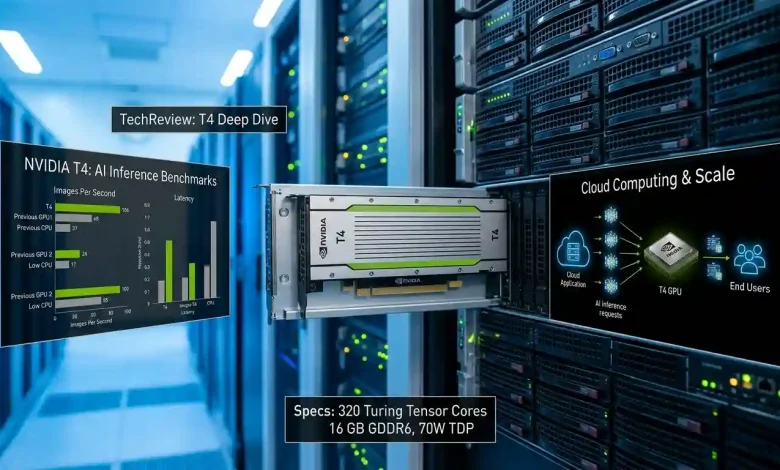
Table of Contents
T4 GPU, NVIDIA’s highly versatile and energy-efficient Tensor Core GPU, has established itself as a cornerstone for AI inference and cloud computing workloads since its introduction in 2018. Designed to accelerate a diverse range of cloud applications, including deep learning training and inference, machine learning, data analytics, and graphics, the T4 has maintained its relevance in a rapidly evolving technological landscape due to its balanced performance and cost-effectiveness. Even in 2026, the NVIDIA Tesla T4 remains a practical and efficient choice for many AI teams and data centers, offering a compelling blend of capabilities for those prioritizing stable, cost-optimized production environments.
Introduction to the NVIDIA T4 GPU
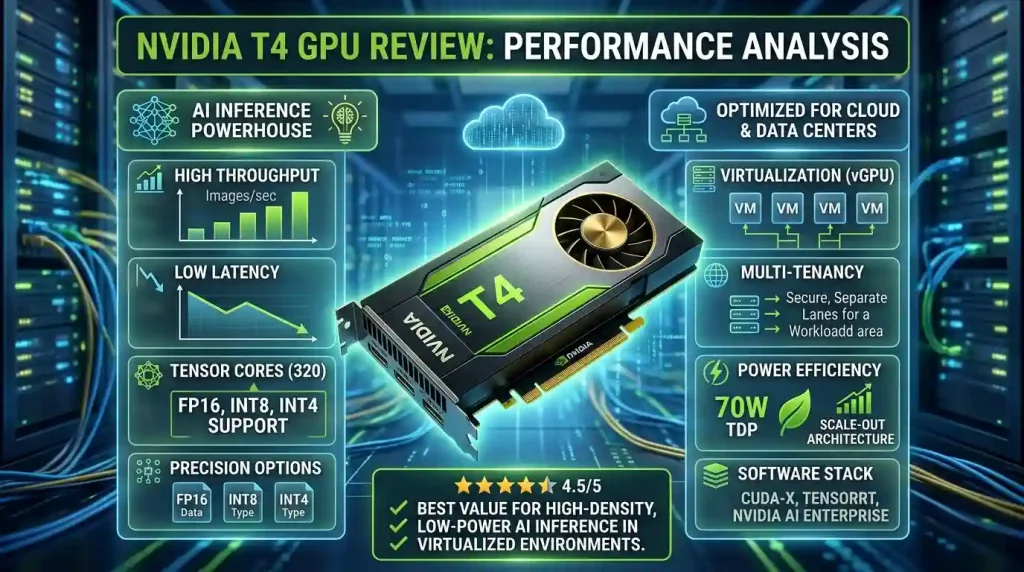
The NVIDIA T4 GPU, built on the Turing architecture, revolutionized data center acceleration by bringing multi-precision computing to mainstream servers. Its compact, low-profile PCIe form factor and remarkably low 70-watt (W) power envelope make it highly compatible with virtually any modern server configuration, enabling dense deployments and minimizing cooling costs. This design philosophy has made the T4 a workhorse for organizations looking to scale out AI and compute infrastructure without incurring the high operational costs associated with more power-hungry accelerators. It has cemented its position as a global standard for inference-based workloads and lightweight training tasks, particularly where power efficiency and total cost of ownership are critical factors.
The T4 is not merely a single-purpose accelerator; its flexibility allows it to handle a wide array of tasks beyond just AI inference. It’s adept at high-performance computing (HPC), video transcoding, and virtual desktops, making it an ideal universal accelerator for distributed computing environments. The GPU’s ability to support various precision modes, from FP32 to FP16, INT8, and even INT4, ensures it can balance accuracy and throughput across a wide spectrum of AI pipelines, from deep learning inference to virtual desktop infrastructure.
Architecture and Key Specifications
At the core of the NVIDIA T4’s capabilities lies the Turing architecture, which introduced several innovations crucial for modern AI and graphics workloads. The T4 integrates 2,560 NVIDIA CUDA cores and 320 Turing Tensor Cores. These Tensor Cores are specialized processing units designed to accelerate matrix operations fundamental to neural networks, offering significant performance improvements for AI workloads by enabling mixed-precision computing. This allows the T4 to dynamically adapt calculations to optimize throughput while maintaining accuracy.
Key specifications that underscore the T4’s design for efficiency and versatility include:
- GPU Architecture: NVIDIA Turing (TU104 core)
- CUDA Cores: 2,560
- Turing Tensor Cores: 320
- Memory: 16 GB GDDR6 with ECC support
- Memory Bandwidth: Up to 320 GB/s (or 300 GB/s in some sources)
- Thermal Design Power (TDP): 70-75 Watts
- Form Factor: Low-profile, single-slot PCIe Gen3 x16
- Precision Support: FP32 (8.1 TFLOPS), Mixed Precision FP16/FP32 (65 TFLOPS), INT8 (130 TOPS), INT4 (260 TOPS)
The 16 GB of GDDR6 memory is sufficient for a wide range of inference models, from ResNet-50 to smaller transformer architectures, supporting models up to approximately 7 billion parameters. The low 70W TDP is a significant advantage, enabling high-density deployments and reducing cooling requirements, which directly translates to lower operational costs for data centers.
AI Inference Performance
The NVIDIA T4 was purpose-built to excel in AI inference, the process of deploying trained machine learning models to make predictions on new data. Its Tensor Cores, a hallmark of the Turing architecture, are central to its inference capabilities. These cores deliver revolutionary multi-precision inference performance, accelerating diverse AI applications by allowing models to run efficiently at different precision levels, including FP32, FP16, INT8, and INT4.
For AI inference, the T4 can deliver up to 40 times higher performance than CPUs, making it a highly efficient solution for real-time AI responses and customer-facing services. Benchmarks have shown the T4 achieving significant speedups in various common AI models. For instance, in ResNet-50 inferencing, a T4 GPU can be 27X to 36X faster than a dual-socket Xeon Gold 6140 CPU. For natural language processing tasks like Google Neural Machine Translation (GNMT), the T4 offers substantial acceleration.
The ability of the T4 to leverage INT8 precision is particularly impactful for inference economics. Many production models can be quantized to INT8 with minimal accuracy loss, effectively doubling throughput compared to FP16. This optimization is crucial for achieving high throughput and low latency in real-time AI applications such as chatbots, translation services, speech recognition, and recommendation engines.
The T4 in Cloud Computing Environments
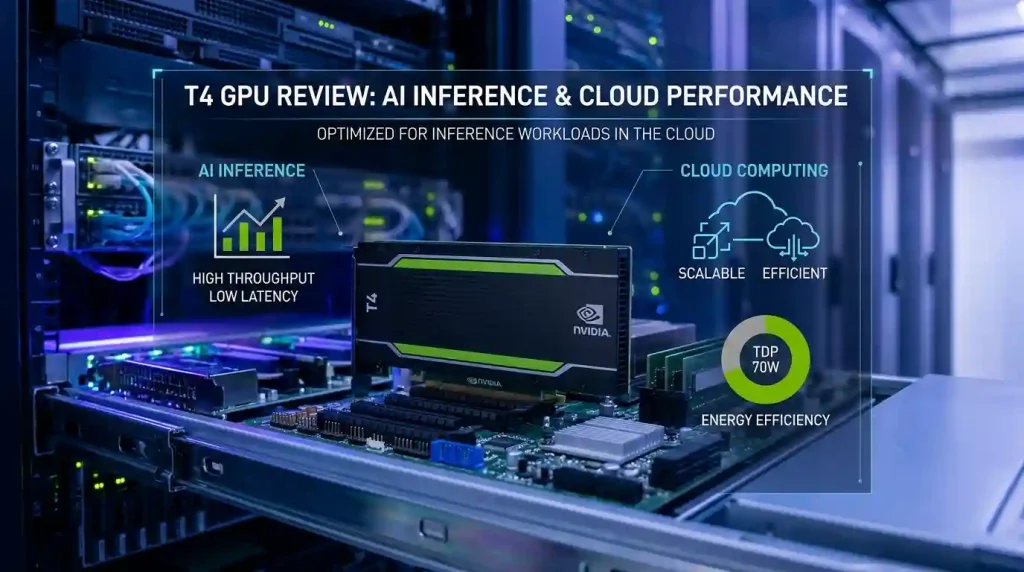
The NVIDIA T4 GPU has become a ubiquitous accelerator in cloud computing platforms due to its optimal balance of performance, power efficiency, and cost-effectiveness. Major cloud providers such as Amazon Web Services (AWS), Google Cloud Platform (GCP), and Microsoft Azure extensively offer T4 instances, making it accessible for a wide range of users and applications.
On Google Cloud Platform, the T4 GPU was made generally available in 2019, accelerating HPC, machine learning training and inference, data analytics, and graphics workloads. GCP allows customers to create custom VM configurations with up to four T4 GPUs, enabling flexibility for diverse needs. AWS offers G4dn instances powered by T4 GPUs, positioning them as some of the lowest-cost GPU-based instances for machine learning inference and small-scale training. These instances are also optimized for graphics-intensive applications like remote workstations and game streaming. Azure’s NV-series also offers T4 GPUs as cost-effective instances for inference serving, model development, and smaller-scale fine-tuning tasks.
The T4’s low 70W power draw and compact form factor make it highly suitable for cloud-scale deployments, where maximizing density and minimizing energy consumption are paramount. This makes it an ideal choice for businesses and developers optimizing for both density and cost in their cloud infrastructure.
Cost-Effectiveness and Power Efficiency
One of the most compelling aspects of the NVIDIA T4 GPU is its exceptional cost-effectiveness and power efficiency. Its 70W TDP enables high-density deployments and significantly reduces cooling costs, contributing to a lower total cost of ownership (TCO). Compared to CPU-only solutions, the T4 offers up to 50 times higher energy efficiency for scale-out servers, drastically cutting operational expenses. This makes it an attractive option for organizations with power or thermal constraints that limit hardware options.
In cloud environments, the T4 typically offers the lowest entry price for GPU compute across major providers. For example, in 2025, GCP spot instances could be as low as $0.14 per hour per GPU, with on-demand instances starting around $0.35 per hour, and even lower with sustained use discounts. This affordability, combined with its robust inference performance, positions the T4 as a go-to choice for budget-conscious projects, variable workloads, and inference-heavy applications. The T4’s ability to deliver consistent performance for medium-sized AI models and parallel video streams at a low power footprint provides an enduring edge for cost-sensitive data centers.
For a deeper understanding of the core technologies behind GPU acceleration, you can consult Wikipedia’s article on Graphics Processing Units.
T4 vs. Other NVIDIA GPUs: A Comparative Look
While the T4 excels in its niche, understanding its position relative to other NVIDIA GPUs like the V100, A100, and the newer L4 is crucial for optimal hardware selection. Each GPU is designed with specific workloads in mind, and the T4 is no exception.
| Feature/GPU | NVIDIA T4 | NVIDIA V100 | NVIDIA A100 | NVIDIA L4 (T4 Successor) |
|---|---|---|---|---|
| Architecture | Turing | Volta | Ampere | Ada Lovelace |
| Launch Year | 2018 | 2017 | 2020 | 2023 |
| CUDA Cores | 2,560 | 5,120 | 6,912 (SXM4) / 6,144 (PCIe) | 7,424 |
| Tensor Cores | 320 (2nd Gen Turing) | 640 (1st Gen Volta) | 432 (3rd Gen Ampere) | 232 (4th Gen Ada Lovelace) |
| Memory Capacity | 16 GB GDDR6 | 16 GB or 32 GB HBM2 | 40 GB or 80 GB HBM2e | 24 GB GDDR6 |
| Memory Bandwidth | 320 GB/s | 900 GB/s | 1,555 – 2,039 GB/s | 300-504 GB/s |
| FP32 Performance | 8.1 TFLOPS | 7.8 TFLOPS | 19.5 TFLOPS | 30.3 TFLOPS |
| Mixed Precision (FP16/FP32) | 65 TFLOPS | 125 TFLOPS | 312 TFLOPS (FP16) | 121 TFLOPS (FP16) |
| INT8 Performance | 130 TOPS | N/A (no native INT8 Tensor Core support) | 624 TOPS | 485 TOPS |
| TDP | 70-75W | 250-300W | 250-400W | 72W |
| Primary Use Case | Inference, light training, virtual desktops | Deep learning training, HPC | Large-scale AI training, HPC, data analytics | Energy-efficient AI, video transcoding, generative AI |
As the table illustrates, the T4 stands out for its excellent balance of performance and extreme power efficiency, making it the most cost-effective option for small model inference workloads. While the V100 and A100 offer significantly higher raw compute power, especially for deep learning training and large-scale HPC, they come with a higher power consumption and price tag. The T4’s successor, the NVIDIA L4, introduced in 2023, builds upon the T4’s strengths by offering improved inference performance (up to 3.2x higher than T4) and additional memory (24 GB GDDR6) while maintaining a similar low power envelope. However, even with newer architectures, the T4 continues to be a solid inference platform for mainstream enterprise and cost-effective cloud instances.
Diverse Use Cases and Applications
The versatility of the NVIDIA T4 GPU allows it to accelerate a wide array of applications across various industries. Its design is optimized for a broad spectrum of cloud workloads, making it a truly universal accelerator.
Some prominent use cases include:
- AI Inference at Scale: The T4 is exceptionally well-suited for real-time AI inference, driving applications like speech recognition, fraud detection, real-time recommendation engines, and chatbots. Its Tensor Cores allow for rapid decision-making from trained models, crucial for customer-facing services.
- Video Processing and Transcoding: With dedicated hardware transcoding engines, the T4 delivers breakthrough performance for AI video applications, offering twice the decoding performance of prior-generation GPUs. It can decode up to 38 full-HD video streams, enabling scalable deep learning integration into video pipelines for innovative smart video services, such as content recommendations and surveillance.
- Virtual Desktops (VDI): The T4 is an excellent choice for virtual desktop infrastructure, providing GPU-accelerated graphics in remote environments and smooth performance for creative professionals. It supports NVIDIA RTX Virtual Workstation (RTX vWS) software, enhancing virtual workstation performance and enabling real-time ray tracing.
- Machine Learning and Deep Learning Training: While primarily known for inference, the T4 can also handle lightweight deep learning training tasks, especially when cost control is a top priority. It offers significant speedups over CPUs for training, particularly in mixed-precision modes.
- Data Analytics and HPC: The T4 accelerates data analytics workloads, including ETL pipelines and graph analytics, and contributes to high-performance computing tasks such as scientific computing and large-scale simulations. For instance, climate scientists use T4 GPUs for weather simulation and environmental modeling.
- Edge Computing: The T4’s low 70W power draw and passive cooling make it suitable for deployment in edge locations with limited cooling capacity, extending AI capabilities closer to data sources.
Challenges and Considerations
Despite its numerous advantages, the NVIDIA T4 is not a one-size-fits-all solution, and certain considerations should be taken into account:
- Raw Compute Power for Intensive Training: While capable of light training, the T4 is not designed for brute-force deep learning training that requires massive computational resources and higher precision. For such workloads, more powerful GPUs like the NVIDIA V100, A100, or H100 are more appropriate, offering significantly higher TFLOPS and memory bandwidth.
- Memory Limitations for Large Models: The 16 GB of GDDR6 memory, while sufficient for many inference models, can be a limitation for very large language models (LLMs) or complex deep learning models that require more VRAM. Newer GPUs like the L4 (24GB) or A100 (40GB/80GB) offer greater memory capacity. Some benchmarks show that only smaller LLMs (e.g., 7B parameters) fit comfortably on a T4, even with minimal headroom for the KV cache during generation.
- Evolving AI Landscape: The AI landscape is continually evolving, with newer architectures like NVIDIA’s Ada Lovelace (L4) and Hopper (H100) offering substantial performance improvements, particularly for generative AI and advanced LLMs. While the T4 remains relevant, these newer GPUs provide significant leaps in performance and efficiency for cutting-edge AI research and production.
- Double Precision Performance: The T4 lacks strong double-precision (FP64) performance, making it unsuitable for scientific computing applications that heavily rely on high-precision floating-point arithmetic. For such tasks, GPUs like the V100 or A100 are better choices.
Therefore, the choice of whether to use a T4 GPU depends heavily on the specific workload, model size, and performance targets. For teams balancing power, cost, and compatibility, the T4 still delivers dependable returns, but for heavier AI inference and training, newer generations may offer higher efficiency.
Conclusion
The NVIDIA T4 GPU has solidified its position as a remarkable and enduring solution for AI inference and cloud computing. Its foundation on the Turing architecture, coupled with multi-precision Tensor Cores, provides a robust platform for accelerating a wide range of modern AI applications. The T4’s compact, energy-efficient 70-watt design ensures broad compatibility across data center infrastructures and makes it an incredibly cost-effective option for scaling AI workloads.
From powering real-time recommendation engines and sophisticated chatbots to accelerating video transcoding and delivering seamless virtual desktop experiences, the T4’s versatility is undeniable. Its widespread availability on major cloud platforms further enhances its accessibility, enabling businesses to leverage GPU acceleration without significant upfront hardware investments. While newer GPUs offer higher raw performance for the most demanding training and large-scale AI models, the T4 continues to anchor cost-efficient and reliable deployments for mainstream AI and media workloads. For organizations prioritizing a balance of performance, power efficiency, and favorable total cost of ownership in 2026, the NVIDIA T4 GPU remains an indispensable and highly relevant choice.