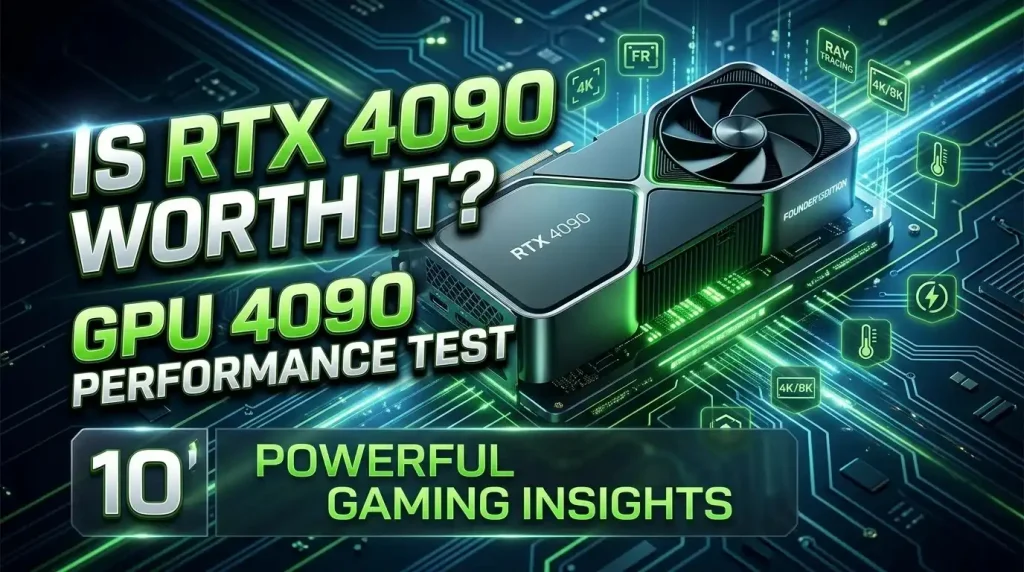
GPU 4090 Performance Test: Is RTX 4090 Worth It? 10 Powerful Gaming Insights
Table of Contents
GPU 4090, or more precisely, the NVIDIA GeForce RTX 4090, stands as the undisputed champion in the realm of consumer graphics processing units. Since its launch in October 2022, this flagship GPU, built on NVIDIA’s Ada Lovelace architecture, has consistently set new benchmarks for performance, redefining what’s possible in high-fidelity gaming, content creation, and AI workloads. However, its premium price tag and substantial power requirements naturally lead to a critical question for potential buyers: is the RTX 4090 truly worth the investment in 2026? This comprehensive article will delve into the multifaceted performance of the RTX 4090, examining its capabilities across various applications, its technological innovations, and ultimately, its value proposition in today’s rapidly evolving tech landscape.
The Unparalleled Power of the GPU 4090
At its core, the RTX 4090 is an engineering marvel. It is powered by the AD102 graphics processor, featuring 16,384 CUDA cores, 512 Tensor Cores (4th generation), and 128 RT Cores (3rd generation). This represents a significant leap from its predecessor, the RTX 3090 Ti, boasting approximately 50% more CUDA Cores and improved efficiency thanks to NVIDIA’s Ada Lovelace architecture built on TSMC’s 5nm process. The card comes equipped with 24 GB of GDDR6X VRAM on a 384-bit memory bus, providing roughly 1 TB/s of memory bandwidth. This massive VRAM capacity is crucial for handling demanding tasks, from running complex AI models to rendering high-resolution textures in the latest games.
The raw computational power is staggering, with an FP32 throughput of approximately 82.6 TFLOPS. This figure alone hints at the immense processing capabilities under the hood, enabling the RTX 4090 to deliver a level of performance previously unseen in consumer-grade GPUs. The architectural enhancements, including a significantly larger 72MB L2 cache, further contribute to its efficiency and speed, particularly in memory-bound workloads.
Gaming Performance at the Bleeding Edge: 4K and Beyond
For gamers, the RTX 4090 offers an unparalleled experience, especially at 4K resolution with maximum settings. It has redefined 4K benchmarks by consistently exceeding 100 FPS in many demanding titles, making high-refresh-rate 4K gaming a true reality. Compared to the RTX 3090 Ti, the RTX 4090 can deliver an average of 28.1% higher FPS across various games. In specific titles, this performance uplift can be even more dramatic; for instance, in Cyberpunk 2077, the RTX 4090 achieved an average of 77 FPS compared to the RTX 3090 Ti’s 43 FPS, a difference of 56.6%.
Even without upscaling technologies, the RTX 4090 is capable of providing over 60 FPS in many modern games at native 4K with ray tracing enabled. When focusing on 1440p resolution, the RTX 4090 often pushes well over 200 FPS, demonstrating significant future-proofing and ample headroom for high-refresh-rate monitors. The card’s prowess extends to ray tracing, where it shows a substantial advantage over previous generations. With ray tracing enabled and upscaling disabled, the 4090 can perform over 50% faster than the 3090 Ti on average. This means the difference between a barely playable 50 FPS and a smooth 85 FPS experience in graphically intensive titles.
DLSS 3 and Frame Generation: A Game Changer?
A significant innovation contributing to the RTX 4090’s exceptional gaming performance is NVIDIA’s Deep Learning Super Sampling (DLSS) 3, particularly its AI-powered Frame Generation technology. DLSS 3 leverages the GPU’s new 4th generation Tensor Cores and an Optical Flow Accelerator to generate entirely new frames, dramatically boosting frame rates.
This technology takes two partially reconstructed traditional frames and generates an intermediate AI-based frame between them. The impact is substantial; in games supporting DLSS 3, performance can increase by up to 4x compared to native rendering. For example, in titles like Cyberpunk 2077, users reported frame rates rising to 70-85 FPS with DLSS Quality and over 100 FPS with Frame Generation at 4K. In Microsoft Flight Simulator, DLSS 3 can more than double the average FPS from 50 to an impressive 115.
One of the key advantages of Frame Generation is its ability to overcome CPU bottlenecks, as the GPU creates these additional frames independently of the CPU. While DLSS 3 introduces a slight increase in input lag, NVIDIA Reflex is integrated to minimize this effect, ensuring optimal responsiveness. The visual quality of DLSS 3’s upscaling and generated frames is generally excellent, often indistinguishable from native resolution, especially at higher target frame rates.
Beyond Gaming: Professional Workloads and AI
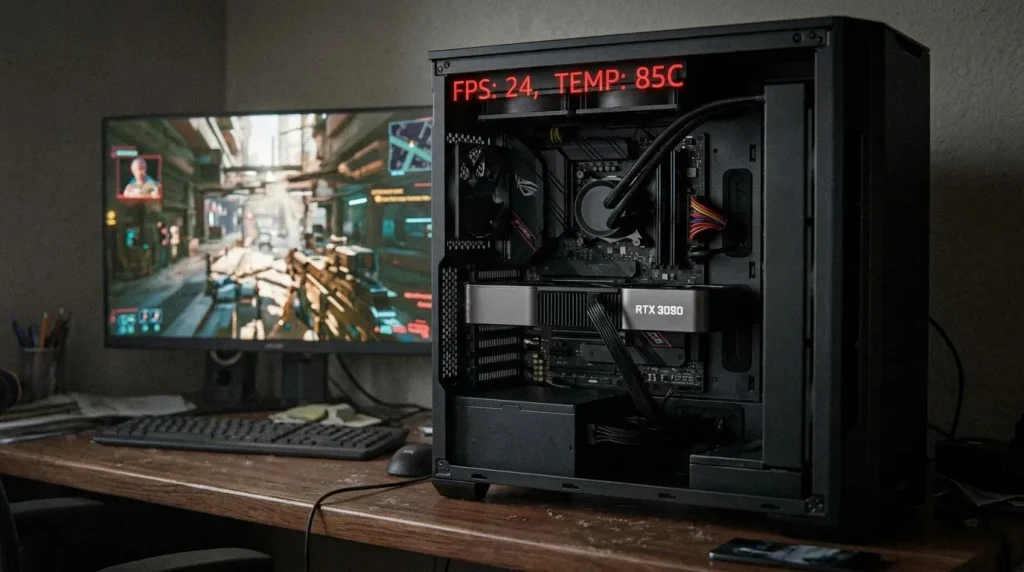
The RTX 4090 isn’t just for gamers; it’s a powerhouse for professional applications, particularly in content creation, scientific computing, and artificial intelligence (AI) workloads. Its 24 GB of GDDR6X VRAM is a major asset for these memory-intensive tasks, allowing it to handle large datasets and complex models without memory errors.
For AI and machine learning, the RTX 4090 is considered one of the best consumer GPUs available. Its 4th-generation Tensor Cores are specifically designed to accelerate AI tasks, delivering 2-4x faster training throughput compared to the previous generation. It efficiently handles inference on most open-source large language models (LLMs) at full precision, including 7B, 13B, and even quantized versions of 70B+ parameter models. For fine-tuning, it can manage models up to 7-13B parameters depending on precision and batch size.
In applications like Stable Diffusion and image generation, the RTX 4090 is the go-to consumer GPU, producing high-resolution images rapidly and without memory constraints. Its FP32 performance of 82.6 TFLOPS and FP8 performance of 1.32 PFLOPS make it highly competitive, offering performance that rivals data center GPUs like the A100 for a fraction of the cost, making it an excellent value for AI/ML researchers and developers on a budget. The RTX 4090 shows a 1.3x to 1.9x increase in training throughput compared to the RTX 3090, translating to faster model training times in frameworks like TensorFlow and PyTorch.
| Feature | RTX 4090 | RTX 3090 Ti (for comparison) | RTX 3090 (for comparison) |
|---|---|---|---|
| Architecture | Ada Lovelace | Ampere | Ampere |
| Process Node | TSMC 4N (5nm-class) | Samsung 8nm | Samsung 8nm |
| CUDA Cores | 16,384 | 10,752 | 10,496 |
| Tensor Cores | 512 (4th Gen) | 336 (3rd Gen) | 328 (3rd Gen) |
| RT Cores | 128 (3rd Gen) | 84 (2nd Gen) | 82 (2nd Gen) |
| VRAM | 24 GB GDDR6X | 24 GB GDDR6X | 24 GB GDDR6X |
| Memory Interface | 384-bit | 384-bit | 384-bit |
| Memory Bandwidth | ~1 TB/s (1008 GB/s) | ~1 TB/s (1008 GB/s) | 936 GB/s |
| Boost Clock | 2.52 GHz | 1.86 GHz | 1.70 GHz |
| FP32 Performance | 82.6 TFLOPS | 40 TFLOPS | 35.58 TFLOPS |
| TDP (Thermal Design Power) | 450W | 450W | 350W |
| Launch MSRP | $1,599 | $1,999 | $1,499 |
Power Consumption, Thermals, and Size Considerations
The immense power of the RTX 4090 comes with significant power demands. The card has a Total Board Power (TBP) of 450W, making a robust power supply unit (PSU) a necessity. NVIDIA recommends a minimum PSU capacity of 850W, but for enhanced stability, especially with overclocked CPUs or other high-performance components, a 1000W or higher PSU is often advisable.
The RTX 4090 utilizes a 16-pin 12VHPWR connector, capable of delivering up to 600W. Users should ensure proper connection and use high-quality cables or native ATX 3.0 PSUs with 12VHPWR connectors to prevent potential issues like melted connectors.
Despite its high power draw, modern cooling solutions for the RTX 4090 are highly effective. Many custom models feature triple-slot designs with large fans, managing to keep temperatures under control even under heavy loads. The Founders Edition, for instance, employs a dual-chamber cooling design that keeps the GPU cool and quiet. Undervolting the GPU can also significantly reduce power consumption (by over 100 watts in some cases) with minimal impact on performance, offering a more efficient operation.
Physical size is another important factor. The RTX 4090 is a large card, often triple-slot, with dimensions typically around 304 mm x 137 mm x 61 mm. This necessitates a spacious PC chassis with good airflow to accommodate its size and cooling requirements. Users building compact systems need to pay particular attention to case compatibility.
The Price Tag: Is the Investment Justified?
The NVIDIA GeForce RTX 4090 launched with an MSRP of $1,599. However, street prices can vary significantly due to market realities, including supply scarcity and demand from both gamers and AI professionals. Current market prices for new RTX 4090 cards can range from around $1,800 to over $2,000, and Founders Edition cards might even sell for higher on the used market.
Whether this investment is justified depends heavily on the individual’s needs and budget. For those seeking the absolute peak of consumer GPU performance for 4K high-refresh-rate gaming with ray tracing and DLSS, the RTX 4090 remains unmatched. It redefines the high-end gaming experience, offering a level of smoothness and visual fidelity previously unattainable.
In professional fields like AI/ML, content creation, and scientific computing, the RTX 4090 provides exceptional value for money compared to much more expensive data center GPUs. Its ability to accelerate complex workloads, reduce training times, and handle massive datasets can directly translate into increased productivity and cost savings over time. As Wikipedia explains, a Graphics Processing Unit (GPU) is specialized for rapidly manipulating and altering memory to accelerate the creation of images, a process critical for both gaming and advanced computational tasks.
However, if a user primarily games at 1080p or even 1440p without an extreme refresh rate monitor, the RTX 4090 might be considered overkill. Less expensive GPUs might offer sufficient performance for these resolutions. The ongoing rumors of the next generation of NVIDIA GPUs (RTX 50-series) also add a layer of complexity to the buying decision. While the RTX 4090 is expected to hold its ground for some time, those who can wait might consider upcoming releases, though pricing and availability for future cards are always uncertain.
Target Audience: Who is the RTX 4090 For?
The RTX 4090 is not for everyone. It targets a specific demographic that can fully leverage its immense power:
- Enthusiast Gamers: Those who demand the absolute best 4K gaming experience, targeting high refresh rates with all graphics settings maxed out, including ray tracing and DLSS 3.
- Content Creators: Professionals in video editing, 3D rendering, animation, and graphic design who require top-tier performance to accelerate their workflows and handle complex projects efficiently.
- AI/ML Researchers and Developers: Individuals or small teams working with large language models, deep learning, stable diffusion, and other AI computations who need powerful local compute resources without the prohibitive cost of enterprise-grade solutions.
- Early Adopters and Innovators: Users who want to experience the latest GPU technologies and are willing to invest in a bleeding-edge component that offers significant future-proofing.
Conclusion
The GPU 4090, the NVIDIA GeForce RTX 4090, undeniably represents the pinnacle of consumer graphics card technology. Its performance across 4K gaming, advanced ray tracing, and professional AI/ML workloads is simply unmatched in its class. With the revolutionary DLSS 3 Frame Generation technology, it offers unprecedented frame rates, even overcoming CPU bottlenecks in certain scenarios.
However, this exceptional power comes with a substantial price tag and significant system requirements in terms of power supply and physical space. For the discerning enthusiast gamer who demands uncompromising 4K performance, or the professional who relies on GPU acceleration for their livelihood, the RTX 4090 is an investment that delivers tangible returns and justifies its cost. Its efficiency and performance in AI tasks, in particular, offer a compelling alternative to much more expensive data center hardware.
For the average user or those with more modest gaming requirements (e.g., 1080p or 1440p gaming without the need for extreme frame rates), the RTX 4090 is likely an indulgence. But for those who truly push the boundaries of visual fidelity and computational power, the RTX 4090 isn’t just a graphics card; it’s a statement of intent, delivering an experience that is, for now, beyond compare. In 2026, while newer generations may be on the horizon, the RTX 4090 still firmly holds its position as a powerhouse, offering immense value to its specific target audience.