Cheap GPU Options for Budget Gaming PCs in 2026
Table of Contents
Cheap GPU options for budget gaming PCs in 2026 are more crucial than ever, as gamers navigate a dynamic market shaped by technological advancements, evolving demands, and fluctuating prices. Building or upgrading a gaming PC on a tight budget often means making smart choices, especially when it comes to the graphics card – the heart of any gaming rig. While high-end GPUs continue to push boundaries with astronomical price tags, the budget segment has become a battleground for manufacturers striving to offer respectable performance without breaking the bank. This article will delve into the current landscape, highlighting the best value GPUs available or anticipated in 2026, and provide essential guidance for budget-conscious gamers.
Understanding the Cheap GPU Landscape in 2026
The graphics processing unit (GPU) market in 2026 is characterized by intense competition and significant external pressures. NVIDIA maintains its dominant position, particularly in the high-end and AI sectors, but AMD and Intel are aggressively expanding their market share with competitive pricing and innovative solutions in the mid-range and budget segments. The demand for GPUs from AI data centers continues to be a major factor, leading to persistent supply chain challenges and notable price increases, especially concerning critical components like DRAM. This upward trend in pricing means that budget gamers must be more discerning than ever, focusing on performance-per-dollar and long-term value rather than just the lowest initial cost.
Despite these challenges, the good news for budget gamers is that GPUs in the $250 to $400 range are remarkably capable, delivering solid 1080p gaming experiences at high settings and even venturing into 1440p territory in many titles. Newer architectures from NVIDIA (RTX 50-series Blackwell), AMD (Radeon RX 9000-series RDNA 4), and Intel (Arc B-series Xe2) bring significant generational improvements, including enhanced ray tracing capabilities and advanced upscaling technologies like DLSS 4, FSR 4, and XeSS. These technologies are vital for budget GPUs, allowing them to achieve higher frame rates and better visual fidelity in modern games, effectively extending their lifespan and value proposition. The market for budget GPUs in 2026 is less about finding ultra-cheap options below $200 (which often entails significant compromises or looking to the used market) and more about identifying the sweet spot for performance, features, and longevity within a reasonable budget bracket.
Key Factors for Choosing a Budget Gaming GPU
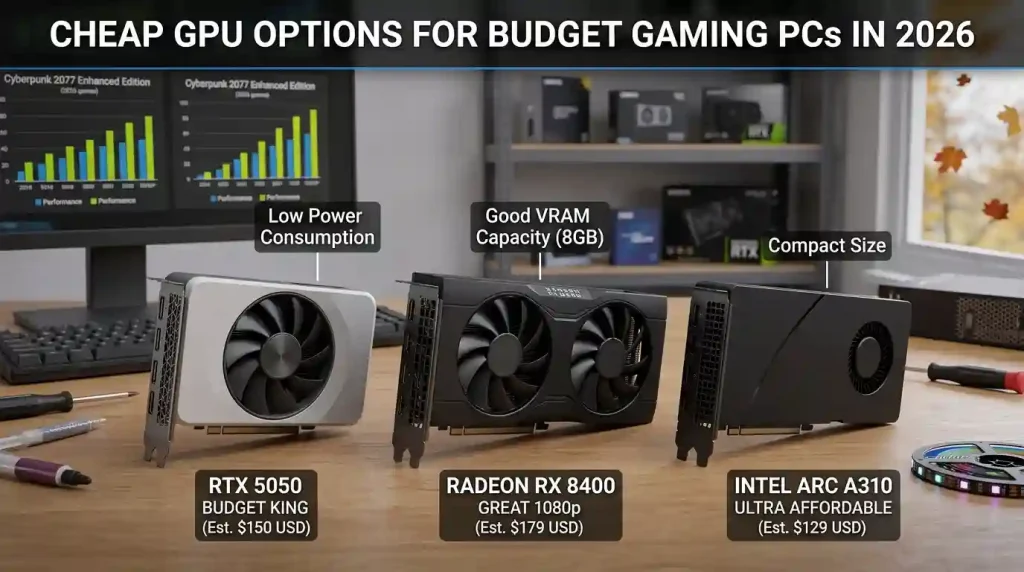
Selecting the right budget GPU involves more than just looking at the price tag. Several critical factors influence a card’s real-world gaming performance and its long-term viability:
- VRAM (Video RAM): This is arguably one of the most crucial specs for modern gaming. For 1080p gaming in 2026, 8GB of VRAM is considered the bare minimum, with 12GB or even 16GB increasingly preferred for future-proofing and handling texture-heavy titles. Insufficient VRAM can lead to stuttering and frame drops as the GPU has to pull data from slower system RAM.
- Performance-per-Dollar: This metric is paramount for budget builders. It involves evaluating how much gaming performance (measured in frames per second, or FPS) you get for every dollar spent. This often means looking beyond raw specifications to real-world benchmarks in popular games.
- Architecture and Features (Ray Tracing & Upscaling): Modern GPUs leverage advanced architectures that improve efficiency and introduce features like hardware-accelerated ray tracing and AI-driven upscaling technologies (NVIDIA’s DLSS, AMD’s FSR, Intel’s XeSS). While ray tracing can be demanding on budget cards, upscaling technologies can significantly boost frame rates without a major hit to visual quality, making them essential for a smooth experience.
- Power Consumption and Cooling: Budget GPUs typically have lower power draw, which is beneficial for systems with less powerful power supply units (PSUs) and smaller cases with limited airflow. Cards that run cooler and quieter are generally preferred, contributing to a better overall user experience and system longevity.
- Driver Support and Ecosystem: Reliable and frequently updated drivers are essential for optimal performance and compatibility with new games. NVIDIA and AMD have mature driver ecosystems, while Intel’s Arc series has made significant strides in improving its driver support since its initial launch.
- Build Quality: A robust cooler and sturdy components are important for durability and sustained performance, preventing overheating and throttling during long gaming sessions.
Top Cheap NVIDIA GPUs for Budget Gaming in 2026
NVIDIA continues to offer compelling options in the budget segment, primarily through its RTX 50-series (Blackwell architecture) and the lingering presence of the previous generation. These cards often excel in ray tracing and leverage the powerful DLSS (Deep Learning Super Sampling) technology for significant performance gains.
- NVIDIA GeForce RTX 5050: Positioned as one of the best budget NVIDIA GPUs in 2026, the RTX 5050 is an excellent choice for 1080p gaming systems. With an average price around $290 and typically featuring 8GB of GDDR6 VRAM, it offers a solid performance profile, including PCIe 5.0 support and DLSS 4. It’s a “grand little low-budget GPU” that provides a safe all-around pick for stability and features.
- NVIDIA GeForce RTX 5060: A step up from the 5050, the RTX 5060 is a competitive option for 1080p and light 1440p play, with prices around $350-$380. It delivers roughly 30% more performance than its predecessor, the RTX 4060, at a similar price point, and includes full DLSS 4 support with frame generation. It’s particularly noted for its efficiency and ability to deliver smooth performance in modern games at 1080p.
- NVIDIA GeForce RTX 4060: While a generation old, the RTX 4060 remains a solid and efficient choice for 1080p gaming, especially if found at a discounted price. Its 115W TDP means it sips power, and its DLSS 3 support is still highly relevant. It’s a good last-gen option for those looking for minimal fuss and strong driver support.
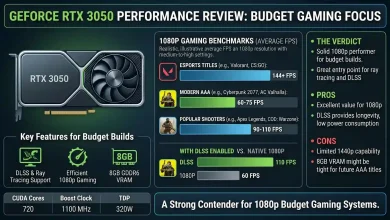
- NVIDIA GeForce RTX 3050 (6GB variant): For those looking to stay genuinely under or around the $200 mark, the RTX 3050 6GB (new) offers DLSS 2.0 and a low 70W power draw. It performs significantly better than ultra-budget alternatives like the Intel Arc A380 and can be a good choice for entry-level 1080p gaming. The older RTX 3050 models can also be found cheaply, offering reliable 1080p performance.
Top Cheap AMD GPUs for Budget Gaming in 2026
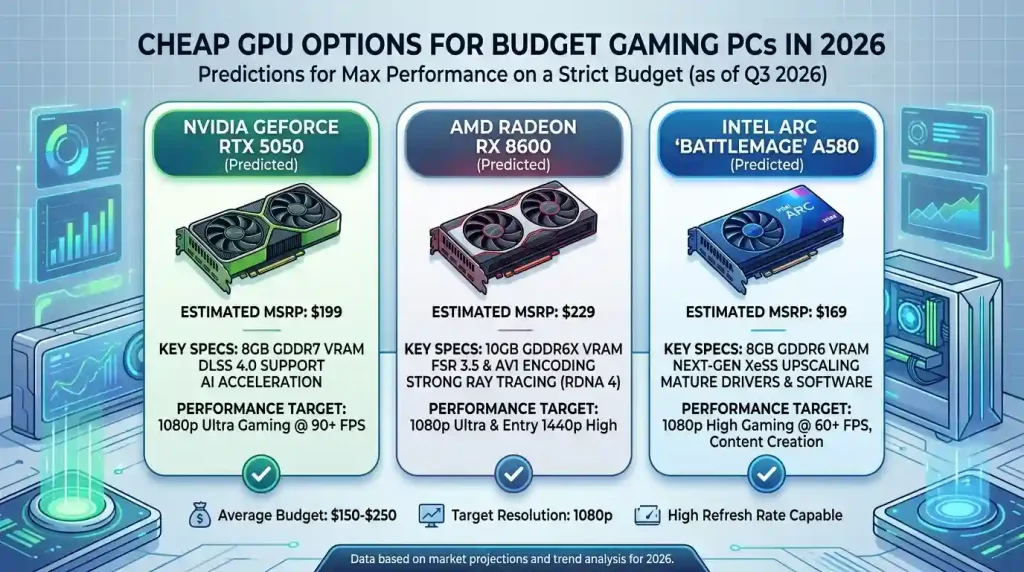
AMD’s Radeon RX series consistently provides strong price-to-performance ratios, often delivering excellent rasterization performance and generous VRAM buffers. Their FSR (FidelityFX Super Resolution) technology is also a powerful tool for boosting frame rates.
- AMD Radeon RX 9060 XT (8GB & 16GB): This GPU is widely acclaimed as the best budget-friendly AMD graphics card for 2026. It offers outstanding 1080p performance and holds its own at 1440p, often undercutting NVIDIA competitors in cost. The 16GB variant, priced around $430-$450, is particularly compelling for its longer-term value and ability to handle the growing memory demands of modern games. The 8GB version, available under $300, is also an excellent value for 1080p gaming. The RX 9060 XT is praised for its generational performance leaps and efficient RDNA 4 architecture.
- AMD Radeon RX 9600 XT: This card is AMD’s budget champion, often trading blows with the NVIDIA RTX 5060 in rasterization performance while costing less (MSRP around $269). It typically comes with 8GB of GDDR6 VRAM and has significantly improved FSR 4 support. Its lower power consumption also makes it attractive for compact builds.
- AMD Radeon RX 7600 XT: A notable contender, especially for those prioritizing VRAM, the RX 7600 XT stands out with its generous 16GB VRAM buffer, which is twice what many NVIDIA competitors offer at its price point. While it may slightly trail the RTX 4060 in ray tracing, it excels in rasterization workloads and benefits from excellent FSR 4 support. This makes it a strong option for gamers who run modded games, simulations, or plan to stream.
| GPU Model | VRAM | Target Resolution (Primary) | Approx. Price Range (USD, New) | Key Strengths |
|---|---|---|---|---|
| Intel Arc B580 | 12GB GDDR6 | 1080p / 1440p | $249 – $300 | Exceptional price-to-performance, 1440p capable, good ray tracing for its class, 12GB VRAM. |
| NVIDIA GeForce RTX 5050 | 8GB GDDR6 | 1080p | $290 – $320 | Solid 1080p performance, DLSS 4, PCIe 5.0, low power consumption. |
| AMD Radeon RX 9060 XT (8GB) | 8GB GDDR6 | 1080p | $299 – $350 | Strong 1080p gaming, competitive performance, good value. |
| NVIDIA GeForce RTX 5060 | 8GB GDDR7 | 1080p / light 1440p | $350 – $380 | Good 1080p, DLSS 4 with frame generation, efficient Blackwell architecture. |
| AMD Radeon RX 9060 XT (16GB) | 16GB GDDR6 | 1080p / 1440p | $430 – $450 | Excellent 1080p/1440p, large VRAM for future-proofing, strong rasterization. |
| NVIDIA GeForce RTX 4060 | 8GB GDDR6 | 1080p | $300 – $350 | Efficient, DLSS 3 support, reliable last-gen option. |
| AMD Radeon RX 7600 XT | 16GB GDDR6 | 1080p | $300 – $350 | High VRAM for its price, solid rasterization, FSR 4. |
Intel’s Impact: The Arc Series for Budget Gamers
Intel has emerged as a significant disruptor in the budget GPU market with its Arc series, particularly with models like the Arc B580. Intel’s entry has intensified competition, offering gamers more choices and often pushing established players to adjust their pricing. The evolution of graphics processing units has seen Intel leverage its extensive semiconductor manufacturing capabilities to deliver competitive hardware.
- Intel Arc B580: This GPU is a standout in the budget-friendly graphics card market. It’s lauded for its exceptional 1440p gaming performance at an aggressively affordable price point, often around $249.99. The Arc B580 typically comes with 12GB of VRAM and a 192-bit memory interface, efficiently handling the larger textures required for higher-resolution gaming. It often undercuts the NVIDIA RTX 4060 and AMD RX 7600 while offering equal or superior performance. Furthermore, the B580 shows surprisingly good ray tracing capabilities for its price point and offers excellent value for gamers watching their wallets. Its improved driver support and performance-per-dollar make it a compelling “value disruptor” for the budget-conscious tweaker.
The Used GPU Market: Value in Previous Generations
While new GPUs offer warranties and the latest features, the used market remains a treasure trove for budget gamers in 2026, offering significant performance for less money. This route, however, requires careful research and awareness of potential risks, as manufacturer warranties are often not transferable. Despite the general rise in GPU prices, last-generation cards can often be found at steep discounts, providing performance comparable to or even exceeding new budget-tier GPUs.
Key models to consider in the used market:
- AMD Radeon RX 6600 / RX 6600 XT: The RX 6600 is frequently cited as one of the best sub-$200 cards in the used market, typically selling for $120-$160. It delivers strong 1080p performance (around 43% faster than a new RTX 3050 6GB) with 8GB GDDR6 VRAM and a modest 132W TDP. The RX 6600 XT offers an additional 9% performance boost for slightly more. These cards are excellent for 1080p gaming at high-to-ultra settings.
- NVIDIA GeForce RTX 3060 12GB: Often available for $130-$160 used, this card provides excellent VRAM-per-dollar and strong 1080p performance. Its 12GB of VRAM is a significant advantage for modern games.
- NVIDIA GeForce RTX 3070: This GPU can be found for around $200-$220 used. It’s slightly slower than a new RTX 5060 but offers a substantial performance boost over cheaper new cards, making it a great value option. It provides a strong 1080p experience, even if it misses some modern features like DLSS 4.
- NVIDIA GeForce RTX 2070 Super / RTX 2080 Super / RTX 2080 Ti: These older high-end cards can offer fast 1080p and even 1440p performance for $120-$200 used. They were built with robust components and wider memory buses, making them excellent performers. However, they typically have higher power draw, requiring a more capable PSU (e.g., 650W for the RTX 2070 Super), and the RTX 2080 Ti can be power-hungry but offers 11GB of VRAM for 1440p gaming.
- NVIDIA GeForce GTX 1660 Series (Super/Ti): For extremely low budgets (around $100), the GTX 1660 series can still handle most games at 1080p, albeit with lower settings. They retain driver support and remain a viable entry point.
When venturing into the used market, it’s crucial to buy from reputable sellers, check the card’s condition, and ideally, test it if possible. Prices and availability can fluctuate frequently, so keeping an eye on platforms like eBay or local marketplaces is recommended.
Integrated Graphics: A Viable Alternative for Budget Builds?
The performance of integrated graphics processing units (iGPUs) has seen remarkable advancements, leading many to question if a dedicated GPU is still essential for budget gaming. In 2026, modern iGPUs, particularly those found in AMD’s Ryzen AI Max (Strix Halo) and Intel’s Core Ultra (Panther Lake) processors, are capable of running games at 1080p resolution and 60 frames per second on lower settings.
Benefits of Integrated Graphics:
- Budget-Friendly: Integrated GPUs significantly reduce the overall cost of a PC as they are built directly into the CPU or motherboard, eliminating the need for a separate graphics card.
- Energy-Efficient: They consume less power, leading to lower system temperatures, quieter operation, and extended battery life in laptops.
- Compact Form Factor: Without a dedicated GPU, systems can be thinner, lighter, and more compact, making them ideal for small form factor PCs or ultrabooks.
- Entry-Level Gaming: For casual gamers, esports titles, or older games, iGPUs can provide a perfectly playable experience, especially when paired with upscaling technologies like FSR or XeSS. AMD’s latest iGPUs, for instance, can match or even beat mobile GPUs like the RTX 4050 and RTX 4060 in some scenarios.
Limitations of Integrated Graphics:
- Shared Memory: iGPUs share the system’s RAM with the CPU, which can limit performance in graphically demanding tasks. Dedicated GPUs have their own high-speed VRAM.
- Performance Ceiling: While improved, integrated graphics still cannot fully replace a powerful dedicated gaming graphics card for high-end gaming, 3D rendering, or demanding content creation tasks. Achieving 60 FPS in AAA games often requires lowering settings to low or medium, and even then, some titles may simply be too demanding.
- Upgrade Constraints: Integrated GPUs cannot be easily upgraded independently; improving graphics performance often means replacing the entire CPU.
In conclusion, while integrated graphics have evolved dramatically and are a viable option for ultra-budget builds, casual gamers, or those planning a future dedicated GPU upgrade, a dedicated budget GPU remains essential for a consistently smooth and visually rich experience in modern AAA titles at reasonable settings.
Conclusion
Navigating the GPU market for a budget gaming PC in 2026 requires a strategic approach, blending awareness of current market trends with a keen eye for performance-per-dollar. Despite the challenges posed by rising prices and increased demand from AI sectors, gamers have a variety of compelling options across NVIDIA, AMD, and Intel’s lineups, as well as a robust used market.
For those prioritizing new hardware, the Intel Arc B580 stands out as an exceptional value proposition, offering strong 1080p and 1440p performance with a generous VRAM buffer at an aggressive price point. AMD’s Radeon RX 9060 XT (16GB) is another top contender, providing excellent all-around performance and future-proofing with its ample VRAM, making it the best budget-friendly AMD choice. On the NVIDIA side, the RTX 5050 and RTX 5060 offer reliable 1080p gaming with the benefits of DLSS 4 and efficient architecture.
The used market, while requiring more caution, can unlock significant value with cards like the AMD RX 6600 or NVIDIA RTX 3070 offering excellent performance for well under $250. Finally, for the tightest budgets or specific use cases, modern integrated graphics have advanced to a point where they can handle casual and esports titles at 1080p with realistic expectations, proving that gaming is accessible even without a dedicated card.
Ultimately, the “best” cheap GPU for a budget gaming PC in 2026 is one that balances your specific gaming needs (resolution, game types, settings) with your financial constraints, while keeping an eye on crucial factors like VRAM and upscaling technologies. By carefully considering these options, budget gamers can still build a powerful and enjoyable PC experience in 2026.