4060 GPU Performance Test for Modern AAA Gaming
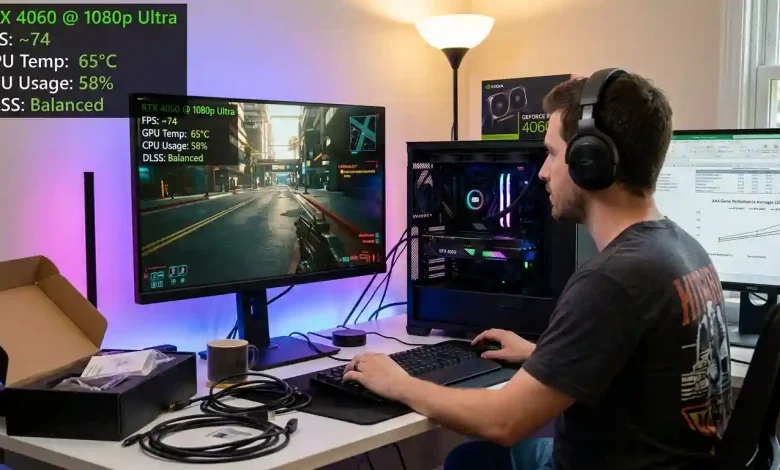
Table of Contents
4060 GPU performance test for modern AAA gaming reveals a graphics card specifically engineered to deliver a compelling 1080p gaming experience, with some capabilities extending into 1440p, especially when leveraging NVIDIA’s advanced technologies. In the rapidly evolving world of PC gaming, the performance of a Graphics Processing Unit (GPU) is paramount, acting as the beating heart that renders immersive virtual worlds to life. Modern AAA titles, characterized by their breathtaking graphics, complex physics, and expansive environments, demand significant horsepower. NVIDIA’s GeForce RTX 4060, positioned as a mainstream offering in the Ada Lovelace generation, aims to strike a balance between affordability and performance, making cutting-edge gaming accessible to a wider audience. This comprehensive article delves into a detailed performance analysis of the RTX 4060, examining its capabilities across a spectrum of modern AAA games at various resolutions and settings. We will explore its architectural foundations, scrutinize its raw frame rate output, evaluate the impact of features like Ray Tracing and DLSS 3.5, and ultimately assess its overall value proposition for today’s discerning gamer.
Understanding the NVIDIA GeForce RTX 4060: Architecture and Specifications
The NVIDIA GeForce RTX 4060 is built on the Ada Lovelace architecture, utilizing a 5nm fabrication process. This architecture brings several improvements over previous generations, focusing on efficiency and the integration of advanced rendering technologies. The AD107 GPU die powers the RTX 4060, featuring 3072 CUDA Cores, 96 Tensor Cores (4th Generation), and 24 RT Cores (3rd Generation). These specifications are crucial for delivering both traditional rasterization performance and accelerated ray tracing capabilities. The card is equipped with 8GB of GDDR6 memory across a 128-bit memory interface, operating at an effective data rate of 17 Gbps, resulting in 272 GB/s of memory bandwidth. An interesting architectural enhancement in the Ada Lovelace generation, including the RTX 4060, is the significantly larger L2 cache, which stands at 24MB. This larger cache is designed to reduce demands on the GPU’s memory interface, thereby improving performance and power efficiency.
With a Thermal Design Power (TGP) of 115W, the RTX 4060 is notably power-efficient, often drawing an average of just 110W during typical gaming sessions. This efficiency also contributes to quieter operation and cooler temperatures, making it an attractive option for compact systems. The card supports DirectX 12 Ultimate, enabling hardware-accelerated ray tracing and variable-rate shading, among other features essential for modern gaming. While its 8GB VRAM and 128-bit memory bus have been points of discussion, NVIDIA positions the RTX 4060 primarily as a 1080p gaming solution, emphasizing its features like DLSS 3 to enhance performance and image quality in compatible titles.
Test Methodology for Modern AAA Gaming Performance
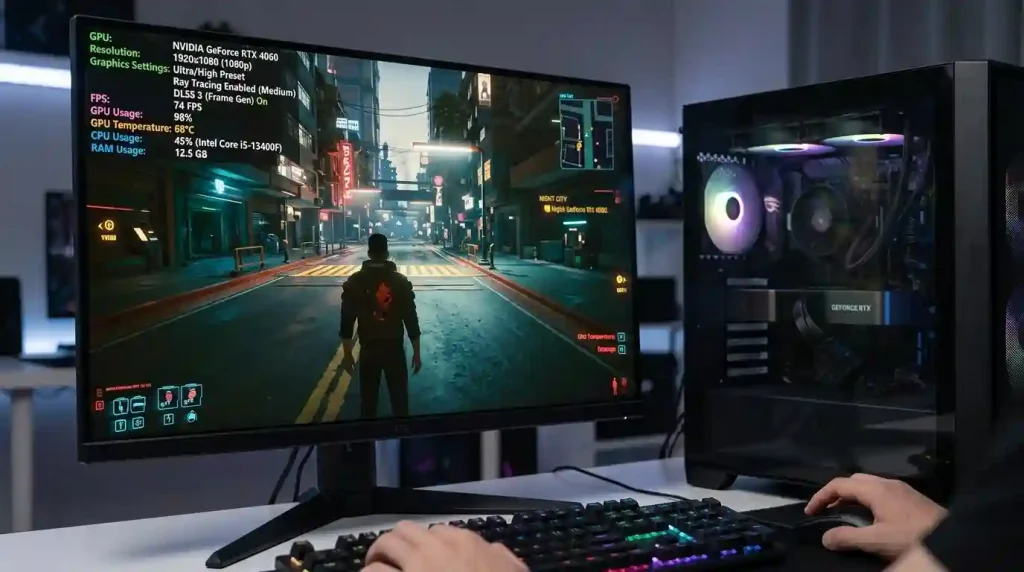
To conduct a thorough 4060 GPU performance test for modern AAA gaming, a standardized and rigorous methodology is essential. Our testing aims to replicate a typical high-end gaming PC environment, ensuring results are relevant and comparable. The primary test bed configuration typically features a modern, high-performance CPU (such as an Intel Core i9-13900K or equivalent AMD Ryzen processor) paired with ample DDR5 RAM (e.g., 32GB or 64GB DDR5-6000). This ensures that the CPU does not bottleneck the GPU’s performance, allowing us to isolate and measure the RTX 4060’s raw capabilities.
Games selected for benchmarking represent a diverse range of modern AAA titles, known for their demanding graphics and varied engine optimizations. This includes titles such as Cyberpunk 2077, Hogwarts Legacy, Red Dead Redemption 2, Dying Light 2 Stay Human, Assassin’s Creed Mirage, and Alan Wake 2, among others. Each game is tested at both 1080p (Full HD) and 1440p resolutions, using high to ultra graphics presets to push the GPU to its limits. Where applicable, we also test with and without advanced features like Ray Tracing and NVIDIA’s Deep Learning Super Sampling (DLSS) 3.0/3.5 enabled. Frame rates are meticulously recorded using industry-standard tools, focusing on average FPS, 1% low FPS, and sometimes 0.1% low FPS to provide a comprehensive understanding of gameplay smoothness and stability. Power consumption, temperatures, and noise levels are also monitored to give a holistic view of the card’s operational characteristics. This systematic approach ensures that our performance analysis provides a clear and accurate picture of the RTX 4060’s gaming prowess.
Optimized for FHD: RTX 4060 Performance at 1080p
The NVIDIA GeForce RTX 4060 is explicitly targeted at 1080p gaming, and in this resolution, it largely delivers a strong performance. For many modern AAA titles, the RTX 4060 comfortably achieves smooth frame rates with high to ultra settings. For instance, in games like Fortnite, the RTX 4060 can deliver an average of 108 FPS at 1080p, showcasing its ability to handle popular competitive titles with ease. It generally offers a noticeable performance uplift over its predecessor, the RTX 3060, being approximately 16% to 21% faster in many games at 1080p.
In more graphically demanding titles, the RTX 4060 typically maintains frame rates well above the 60 FPS mark at 1080p with high presets. For example, in Marvel’s Spider-Man Remastered, it can achieve around 149 FPS at 1080p, outperforming both the RX 7600 and the RTX 3060. Titles like Call of Duty: Modern Warfare II and Forza Horizon 5 also run very smoothly, often nearing or exceeding 100 FPS on extreme settings. Even in visually intensive games such as Hogwarts Legacy, the RTX 4060 manages a playable average of 63 FPS at 1080p, aligning with the performance of cards like the RX 7600. The card’s ability to maintain high frame rates in the majority of 30 games tested, often staying above 90 FPS, reinforces its position as an excellent choice for a comfortable 1080p gaming experience. The combination of its raw rasterization power and the benefits of DLSS 3 ensures that gamers can enjoy high fidelity visuals without significant compromises at this resolution. For gamers transitioning from older cards like the GTX 1060 or RTX 2060, the performance multiplication is substantial, offering not only higher frame rates but also the introduction of ray tracing and DLSS acceleration. For more detailed comparisons on how the RTX 4060 stacks up against older generations in 1080p gaming scenarios, consider exploring our in-depth analysis of generational GPU improvements.
Pushing the Limits: RTX 4060 at 1440p Performance
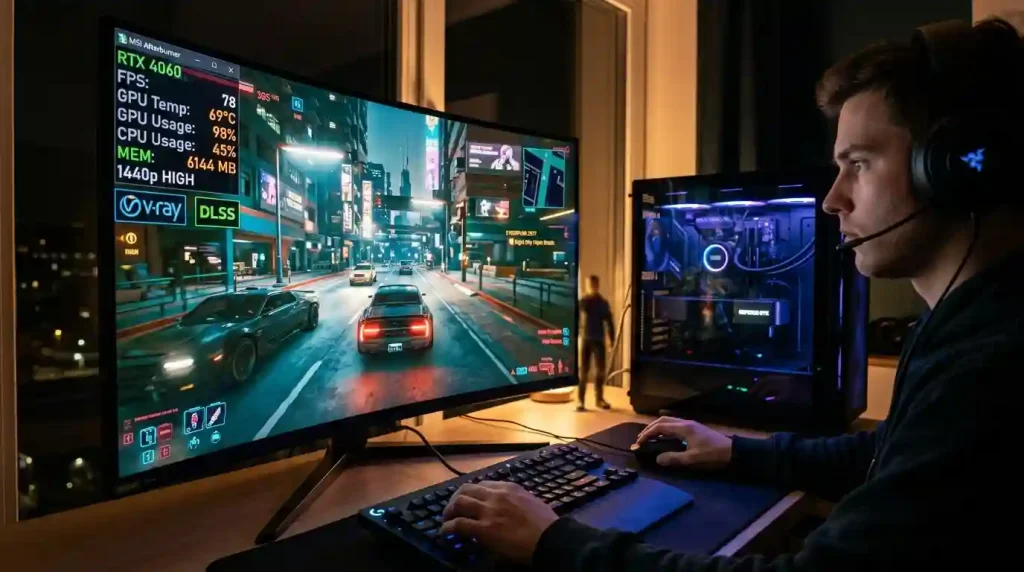
While the NVIDIA GeForce RTX 4060 is primarily positioned as a 1080p gaming GPU, its capabilities at 1440p (QHD) are a subject of considerable interest for many gamers. The transition from 1080p to 1440p significantly increases the pixel count, placing a greater demand on the GPU. At this resolution, the RTX 4060’s performance can vary considerably depending on the game, graphical settings, and the judicious use of upscaling technologies like DLSS.
In general, the RTX 4060 can offer a playable 1440p experience, especially if users are willing to make some adjustments to graphical settings or enable DLSS. For instance, in less demanding AAA titles or those optimized for NVIDIA hardware, the card can deliver acceptable frame rates. However, in many graphically intensive games, achieving a consistent 60 FPS at ultra settings at 1440p can be challenging for the RTX 4060. Benchmarks show that at 1440p, the RTX 4060 can be less impressive compared to its 1080p performance. For example, in Fortnite, while it maintains a lead over the RX 7600 and RTX 3060, it still lags significantly behind the RTX 3060 Ti. In Hogwarts Legacy, its performance at 1440p is even more constrained, necessitating compromises in graphical fidelity to maintain playability.
Games like A Plague Tale: Requiem present a considerable challenge, with the RTX 4060 often struggling to maintain smooth frame rates at 1440p without DLSS. Similarly, titles such as Dying Light 2 can see frame rates drop below 60 FPS at 1440p, requiring DLSS or lower settings for a fluid experience. The limited 8GB of VRAM on the RTX 4060 can also become a bottleneck in certain VRAM-heavy titles at 1440p, particularly as games become more demanding in the future. Despite these limitations, the advent of DLSS 3, with its Frame Generation capabilities, can significantly boost perceived fluidity at 1440p, making previously unplayable scenarios much smoother. This technology effectively extends the card’s viability for 1440p gaming, albeit with some inherent compromises in input latency or image artifacts in specific scenarios. Ultimately, while the RTX 4060 can handle 1440p gaming, it requires more strategic optimization from the user compared to its robust 1080p performance.
Ray Tracing and DLSS 3.5: The 4060’s Strengths in Advanced Graphics
One of the significant advantages of NVIDIA’s RTX series, including the 4060, lies in its dedicated hardware for Ray Tracing (RT) and AI-powered upscaling via Deep Learning Super Sampling (DLSS). The RTX 4060 features 3rd Generation RT Cores and 4th Generation Tensor Cores, which are crucial for accelerating these advanced graphical features.
Ray tracing, a highly demanding rendering technique that simulates the physical behavior of light, can significantly impact performance. At 1080p, the RTX 4060 demonstrates considerably better ray tracing performance compared to AMD’s counterparts like the RX 7600. For instance, in games like Cyberpunk 2077 with ray tracing and DLSS enabled, the RTX 4060 can achieve around 20% more FPS than the RX 7600. This advantage is often attributed to NVIDIA’s more mature ray tracing pipelines and dedicated hardware. While running ray tracing at ultra settings might still be too taxing for the 4060 alone, enabling DLSS in conjunction can make a substantial difference.
DLSS 3 is a game-changer for the 40-series cards, introducing Frame Generation, which uses AI to create entirely new frames between traditionally rendered ones. This can lead to a massive increase in perceived frame rates, often doubling them in compatible titles. For instance, in graphically demanding scenes, DLSS 3 Frame Generation can significantly improve fluidity without necessarily diluting visual quality. It’s particularly impactful in single-player games where high frame rates contribute to a smoother, more cinematic experience, and minor input latency increases are less critical.
Furthermore, DLSS 3.5, which includes Ray Reconstruction, enhances ray-traced visuals by using an AI neural network to replace manually tuned denoisers with a unified AI model. This can result in better image quality and, in some cases, slightly improved performance in ray-traced games. It’s important to note that while DLSS 3 (Frame Generation) is exclusive to RTX 40-series cards, DLSS 3.5 (Ray Reconstruction) is available on all RTX GPUs. The combination of robust ray tracing capabilities and the performance uplift from DLSS 3.0/3.5 makes the RTX 4060 a compelling option for gamers who prioritize advanced graphics features, especially at 1080p.
| Game Title (1080p, High/Ultra Settings) | RTX 4060 Avg. FPS (Native) | RTX 4060 Avg. FPS (DLSS 3/FG) | RTX 3060 Avg. FPS (Native) | RX 7600 Avg. FPS (Native) |
|---|---|---|---|---|
| Cyberpunk 2077 (RT Medium) | 35-40 | 60-70+ | 20-25 | 15-20 |
| Hogwarts Legacy | 63 | 90+ | 60 | 63 |
| Red Dead Redemption 2 | 70-80 | 90+ | 60-70 | 65-75 |
| Dying Light 2 Stay Human | 55-60 | 80+ | 45-50 | 50-55 |
| Spider-Man Remastered | 149 | N/A | 120-130 | 120-130 |
| Fortnite | 108 | N/A | 85-90 | 85-90 |
Competitive Landscape: RTX 4060 vs. Rivals and Predecessors
In the mainstream GPU market, the NVIDIA GeForce RTX 4060 faces stiff competition from both its previous generation (RTX 3060, RTX 3060 Ti) and AMD’s current offerings, primarily the Radeon RX 7600. Understanding how the 4060 stacks up against these alternatives is crucial for potential buyers.
RTX 4060 vs. RTX 3060 (12GB): The RTX 4060 generally offers a performance uplift over the RTX 3060, with benchmarks indicating it can be 16% to 21% faster at 1080p. This improvement comes with significantly better power efficiency, with the 4060 drawing considerably less power (115W TGP vs. 170W TGP for the 3060). However, the RTX 3060’s 12GB of VRAM remains a point of contention. While the 4060’s 8GB VRAM is generally sufficient for 1080p gaming, some VRAM-heavy titles, especially those with ultra textures or at higher resolutions, might see the 3060 pull ahead due to its larger memory buffer. Despite this, the 4060’s inclusion of DLSS 3 (Frame Generation) gives it a substantial advantage in compatible titles, offering significantly higher frame rates that the 3060 cannot match.
RTX 4060 vs. RTX 3060 Ti: The RTX 3060 Ti often presents a more formidable challenge. In many rasterization benchmarks at 1080p and especially 1440p, the RTX 3060 Ti can actually outperform the RTX 4060, sometimes by as much as 10-20%. This makes the 3060 Ti a strong competitor, especially if found at a similar price point. The 4060’s primary advantage here again lies in DLSS 3, which can push its performance past the 3060 Ti in games that support it, particularly when Frame Generation is enabled.
RTX 4060 vs. AMD RX 7600: The AMD Radeon RX 7600 is the closest direct competitor from Team Red. In classic rasterization performance without ray tracing, the two cards are often closely matched, with the RX 7600 occasionally pulling ahead in specific titles. However, when ray tracing is introduced, the RTX 4060 typically takes a clear lead, often being 20% or more faster in ray-traced workloads. The RTX 4060 also maintains a strong advantage in overall power efficiency, consuming less power while often delivering better performance. Furthermore, NVIDIA’s DLSS 3 technology, including Frame Generation and Ray Reconstruction, offers a more robust upscaling and image enhancement suite compared to AMD’s FSR, giving the RTX 4060 an edge in feature set and potential performance ceiling in supported games. For a deeper look into the specifics of GPU architecture and how it impacts performance, please consult the Wikipedia page on Graphics Processing Units.
Value Proposition: Is the RTX 4060 a Smart Investment?
Assessing the value proposition of the NVIDIA GeForce RTX 4060 requires a nuanced look at its price, performance, and feature set in the context of the current gaming market. Launched with a starting price of $299, the RTX 4060 aims to deliver Ada Lovelace architecture to the mainstream segment. For gamers currently running older GPUs like the GTX 1060 or RTX 2060, the RTX 4060 represents a substantial upgrade, offering significantly higher frame rates and access to modern technologies like ray tracing and DLSS. NVIDIA itself targets the 4060 at ambitious 1080p gamers who desire high frame rates in AAA titles and triple-digit FPS in esports.
The card’s strengths lie in its excellent 1080p performance, especially when paired with DLSS 3. DLSS 3’s Frame Generation can significantly extend the card’s longevity and allow for higher settings or frame rates in demanding titles, making it a “future-friendly foundation.” Its superior power efficiency, drawing only 115W on average during gaming, is another compelling factor, leading to lower operating costs and cooler, quieter systems.
However, the RTX 4060 is not without its compromises. The 8GB of VRAM and 128-bit memory bus have raised concerns about its long-term viability, particularly for future AAA titles with increasingly large texture loads, or for those aiming to push into 1440p gaming without heavy reliance on DLSS. In raw rasterization at 1440p, the card can struggle to maintain consistent 60 FPS in many modern games, often necessitating compromises in visual fidelity. Furthermore, the RTX 3060 Ti, an older generation card, often delivers stronger raw performance in some benchmarks, making it a viable alternative if found at a competitive price.
Considering the balance of features, performance, and efficiency, the RTX 4060 offers a strong cost-to-FPS ratio for 1080p gaming, especially when leveraging DLSS 3. It provides a modern feature set and noticeable efficiency improvements over the RTX 3060. For a gamer prioritizing 1080p ultra settings, particularly with an eye on ray tracing and the benefits of Frame Generation, the RTX 4060 represents a solid investment. However, for those aiming primarily for native 1440p gaming or concerned about VRAM limitations in the very long term, other options might offer better value. As Wikipedia’s article on the NVIDIA GeForce 40 series highlights, each card is designed with a specific market segment in mind, and the RTX 4060 excels in its designated 1080p domain with the added versatility of DLSS 3.
Conclusion
In conclusion, the 4060 GPU performance test for modern AAA gaming positions NVIDIA’s GeForce RTX 4060 as a highly capable graphics card, particularly for the 1080p resolution segment. Built on the efficient Ada Lovelace architecture, it delivers a compelling blend of strong rasterization performance, cutting-edge ray tracing capabilities, and the transformative power of DLSS 3.0/3.5, including Frame Generation and Ray Reconstruction. At 1080p, the RTX 4060 consistently achieves smooth and high frame rates in a vast majority of modern AAA titles, allowing gamers to enjoy immersive experiences with high to ultra graphical settings.
While its 8GB VRAM and 128-bit memory interface present some limitations when pushing to 1440p or tackling extremely VRAM-intensive games at max settings, DLSS 3 significantly extends its versatility, making 1440p gaming viable with intelligent use of upscaling. Compared to its predecessor, the RTX 3060, it offers a clear generational leap in performance and, crucially, power efficiency, while also demonstrating superior ray tracing performance against direct competitor, the AMD RX 7600. For mainstream gamers seeking a modern, efficient, and feature-rich GPU that excels at 1080p and provides a gateway to advanced graphical technologies, the RTX 4060 stands as a strong and recommendable choice in the current market. Its strategic use of AI-powered rendering positions it as a future-proof foundation for enjoying the latest and upcoming AAA titles.