GPUs Stock: An In-Depth Analysis of Market Dynamics and Investment Opportunities

Table of Contents
GPUs stock refers to the publicly traded shares of companies involved in the design, manufacturing, and sale of Graphics Processing Units. These powerful processors, once primarily associated with high-end gaming, have become critical components across a myriad of industries, particularly driving the exponential growth in artificial intelligence (AI), data centers, and high-performance computing. Understanding the dynamics of GPUs stock requires a deep dive into technological advancements, market demand shifts, supply chain complexities, and the competitive landscape. The market for GPUs is experiencing significant structural changes, moving from a period of speculative demand (like cryptocurrency mining booms) to sustained, enterprise-driven demand for AI infrastructure.
Introduction to GPUs Stock
The Graphics Processing Unit, or GPU, has evolved from a specialized chip for rendering graphics into a versatile parallel processor essential for modern computational tasks. This evolution has profound implications for GPUs stock, as companies producing these chips find themselves at the nexus of several burgeoning technological revolutions. The value of GPUs stock is intrinsically linked to the performance and innovation of these companies, reflecting their ability to meet the escalating demand from various sectors. The global GPU market size was approximately $51.8 billion in 2025 and is projected to reach $320.809 billion by 2033, demonstrating a Compound Annual Growth Rate (CAGR) of 25.6% from 2025 to 2033. This robust growth trajectory underscores the critical role GPUs play in the digital economy and the potential for investors in this sector.
Historically, the GPU market experienced significant volatility, influenced by factors such as the boom and bust cycles of cryptocurrency mining. For instance, cryptocurrency miners purchased GPUs in large quantities between 2013 and 2017, causing prices to skyrocket and leading to worldwide shortages that continued into 2021. However, with increased regulations and the shift of major cryptocurrencies to “proof-of-stake” algorithms, GPU mining has become less efficient, stabilizing the market and returning it closer to its pre-mining boom state. The current market dynamic is increasingly driven by long-term, structural demand from AI and enterprise-grade applications, rather than speculative surges.
Current Market Overview: Key Players and Trends
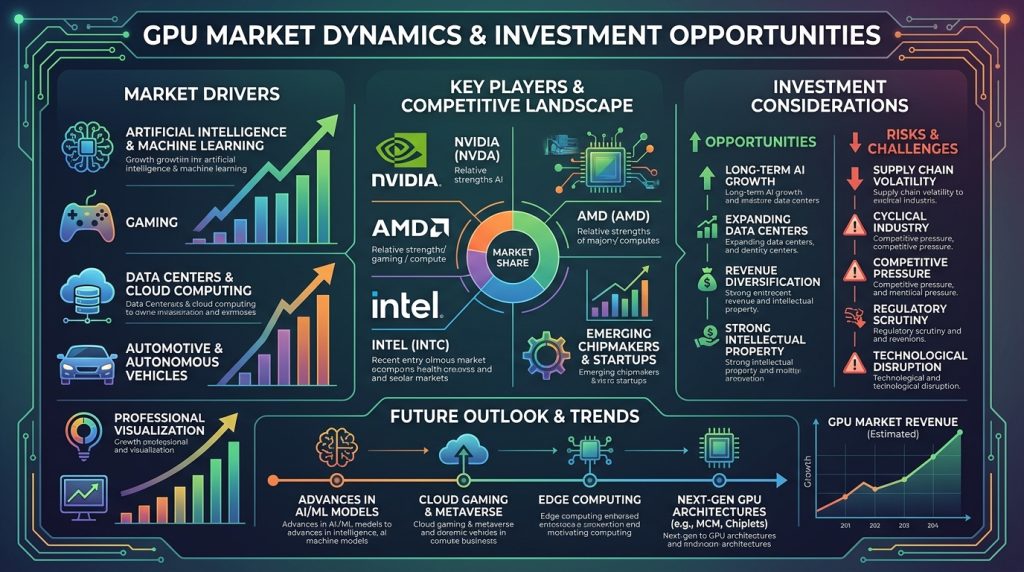
The GPUs stock market is primarily dominated by a few key players, with NVIDIA, AMD (Advanced Micro Devices), and Intel being the most prominent. These companies are constantly innovating, releasing new architectures and technologies that push the boundaries of computational power and efficiency. Their stock performance is closely watched as indicators of broader trends in the technology sector.
NVIDIA Corporation (NVDA) continues to hold a dominant position, especially in the discrete GPU market. In the third quarter of 2025, NVIDIA’s market share in discrete GPUs was 92%, despite a slight decrease of 1.2% from the previous quarter. NVIDIA’s success is largely attributed to its strong focus on AI and data center GPUs, which are experiencing “unprecedented surge in demand”. The company’s products, particularly its Hopper (H100, H200) and Blackwell (B200, GB300) series, are highly sought after for AI training and inference workloads. Analysts maintain a “Strong Buy” rating for NVDA stock, with a 12-month target price indicating significant upside potential.
Advanced Micro Devices (AMD) is a strong competitor, especially in the CPU and integrated graphics segments, and is steadily growing its presence in the discrete GPU market. AMD’s discrete GPU market share increased by 0.8% in Q3 2025, reaching 7%. The company’s stock has seen substantial growth, increasing by 215.54% over the last year, though it has experienced recent short-term fluctuations. AMD’s strategy in 2026 focuses on “mid-range dominance” with its RDNA 4 architecture, targeting gamers who seek value without compromising performance. Analysts generally rate AMD stock as “Strong Buy,” with an average price target that suggests upside potential, though some view its current market price as overvalued compared to intrinsic value.
Intel Corporation (INTC) has historically dominated the integrated graphics market but has made a concerted effort to re-enter the discrete GPU space with its Arc series. For the first time, Intel reported a 1% market share in the discrete GPU market in Q3 2025, a 0.4% increase from the previous quarter. While still a minor player in discrete GPUs, this marks a significant step for the company. Intel’s “Battlemage series” GPUs are contributing to this growth, primarily within the DIY PC market. Intel’s strategic moves in 2026 involve disrupting the market alongside AMD and NVIDIA, with evolving architectures and AI-centric features.
The overall add-in board (AIB) market, which includes discrete GPUs, amounted to $8.8 billion, with 12 million units shipped in Q3 2025, showing a 2.8% increase from the previous quarter. This indicates a healthy and expanding market for GPUs as demand continues to grow.
Driving Forces Behind GPU Demand
The sustained and accelerating demand for GPUs stems from several powerful technological and economic trends:
- Artificial Intelligence (AI) and Machine Learning: The explosion of AI infrastructure is the primary driver of current GPU demand. AI training and inference require massive amounts of GPU compute capacity, leading data centers and technology companies to purchase GPUs in very large volumes and often reserving capacity far in advance. This “structural” shift means AI demand is long-term and sustained, not speculative.
- Data Centers and Cloud Computing: The growth of cloud computing services and hyperscale data centers necessitates robust GPU infrastructure to handle complex workloads, including big data analytics, scientific simulations, and virtualized environments. The data center GPU market alone has exploded to $48.39 billion in 2026 and is expected to reach $320.8 billion by 2033 with a 25.6% CAGR.
- Gaming Industry: The gaming GPU market continues its robust expansion, driven by the increasing popularity of esports, gamification, and the demand for more immersive and realistic gaming experiences, including 4K and 8K gaming. The global gaming GPU market size was $6.23 billion in 2025 and is projected to expand to $59.72 billion by 2034, growing at a CAGR of 28.55% over the forecast period. Enthusiast and professional gamers represent the largest and fastest-growing demand base, prioritizing performance and feature access.
- Professional Visualization and Content Creation: Industries such as film production, architectural design, engineering, and scientific research rely heavily on GPUs for rendering, simulation, and complex data visualization.
- Cryptocurrency (Past Influence): While less of a driver now, cryptocurrency mining previously had a significant, albeit volatile, impact on GPU demand and prices. During the crypto bubbles of late 2017 and 2021, GPU prices soared due to high demand from miners. However, a crash in cryptocurrency prices in 2022 led to GPUs returning to their MSRP. Although GPU mining for some altcoins is still profitable in 2024, Bitcoin mining is no longer viable with GPUs.
Navigating Investment in GPU Stocks
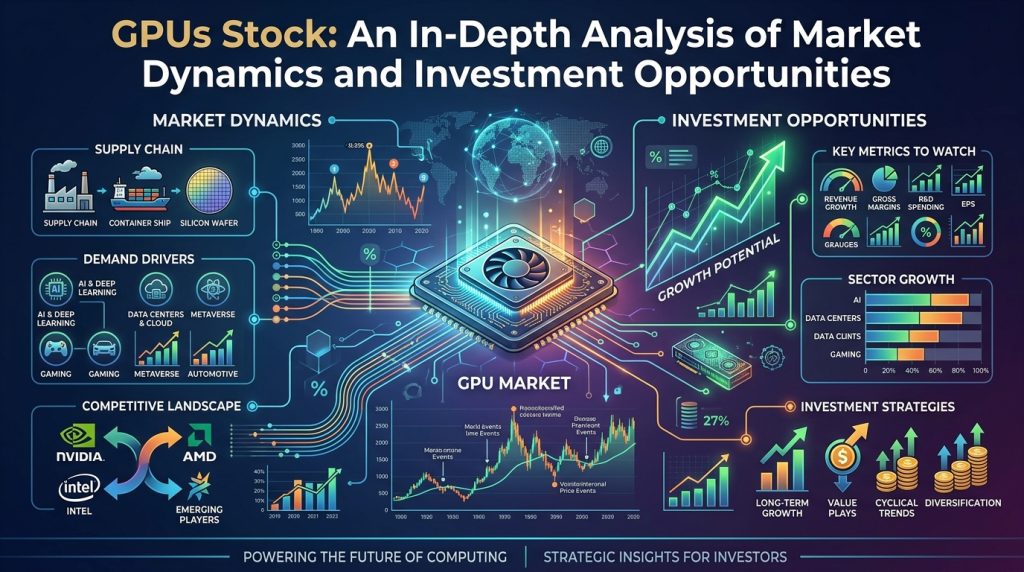
Investing in GPUs stock requires a nuanced understanding of the market’s complexities and future trajectories. Given the rapid technological advancements and evolving demand landscape, investors need to consider several factors:
| Investment Consideration | Description |
|---|---|
| AI Dominance | Companies with a strong foothold and continuous innovation in AI-specific GPU solutions (e.g., NVIDIA’s data center GPUs) are likely to see sustained demand and growth. The AI compute market is a critical long-term driver. |
| Market Share & Competition | While NVIDIA currently dominates, AMD and Intel are actively competing. Monitoring shifts in market share and competitive strategies is crucial. |
| Supply Chain Resilience | The GPU market has faced significant supply constraints due to limited High Bandwidth Memory (HBM) availability and bottlenecks in advanced chip packaging. Companies with robust supply chains and diversified manufacturing capabilities may be more resilient. |
| Diversification vs. Specialization | Some companies specialize purely in GPUs, while others offer a broader portfolio of semiconductors. Assess whether a focused or diversified approach aligns with your investment strategy. |
| Valuation Metrics | Traditional valuation metrics like Price-to-Earnings (P/E) ratios, revenue growth, and earnings forecasts are important, but also consider the long-term growth potential fueled by AI and data center expansion. |
| Macroeconomic Factors | Global economic conditions, interest rates, and geopolitical tensions can influence investment and consumer spending, impacting GPU demand. |
For investors seeking exposure to the GPU market, direct investment in GPU manufacturers like NVIDIA and AMD is a common approach. However, as with any single-stock investment, this is susceptible to market volatility and company-specific challenges such as intensifying competition or regulatory changes. Exchange-Traded Funds (ETFs) focused on semiconductors or AI infrastructure can offer a more diversified, lower-risk entry point into the sector. Additionally, alternative investment structures like GPU bond funds, which utilize GPU-as-a-Service (GPUaaS) business models, provide returns associated with the rental income from GPU usage.
The “AI bubble” is a theoretical stock market bubble that has been growing since 2025, driven by a rapid increase in AI investment. Concerns exist that leading AI tech firms might be involved in a circular flow of investments that could artificially inflate their stock values. Despite these concerns, companies like NVIDIA are seeing overwhelming AI demand and strong profitability. The semiconductor industry, which underpins GPU production, is expected to reach a historic peak of US$975 billion in annual sales in 2026, largely propelled by AI infrastructure.
Challenges and Risks in the GPU Market
Despite the immense growth potential, the GPUs stock market is not without its challenges and risks:
- Supply Chain Constraints: The demand for GPUs often outstrips supply, leading to shortages and increased prices. Key bottlenecks include the limited availability of High Bandwidth Memory (HBM) and complexities in advanced chip packaging technologies like CoWoS. These constraints are projected to persist through at least mid-2026.
- Intense Competition and Innovation Cycles: The GPU market is highly competitive, with companies constantly vying for technological leadership. A slower pace of innovation or a misstep in product development can significantly impact a company’s market position and stock performance.
- Pricing Volatility: GPU prices have historically been volatile, influenced by factors like cryptocurrency mining demand, supply shortages, and strategic pricing decisions by manufacturers. The baseline MSRP for new, advanced graphics cards is expected to be permanently elevated, making a return to pre-2020 affordability unlikely.
- Geopolitical Factors and Trade Restrictions: Government policies, such as export restrictions on high-performance GPUs to certain countries, can significantly impact sales and market access for GPU manufacturers.
- Shift to Custom Silicon and Alternative Architectures: While NVIDIA’s CUDA software ecosystem has created significant switching costs, there’s a growing trend among tech titans to develop second-sources or in-house custom silicon solutions to diversify away from NVIDIA’s dominance in AI. The acquisition of Modular by Qualcomm and OpenAI’s “Jalapeño” chip are examples of credible long-term challenges to NVIDIA’s ecosystem.
- Energy Consumption Concerns: The immense power consumption of AI data centers, heavily reliant on GPUs, is raising concerns about electricity demand. The U.S. data center electricity demand is projected to rise significantly by 2030, highlighting power infrastructure as a potential bottleneck for AI growth.
The Future Landscape of GPUs Stock
The future of GPUs stock appears promising, driven by the relentless march of AI and other data-intensive technologies. The market is expected to continue its robust growth, with new hardware generations and evolving architectures. Forecasts suggest continued growth in the GPU rental market, fueled by expanded AI adoption and new hardware capabilities. Key trends for 2026 and beyond include:
- Continued AI Acceleration: AI will remain the primary growth engine for GPUs. The focus will intensify on GPUs optimized for AI inference and training, with companies like NVIDIA doubling down on AI as their core product strategy. The demand for AI compute is so overwhelming that it is expected to continue supporting long-term investment in GPU stocks.
- Evolving Competitive Landscape: While NVIDIA is currently dominant, AMD is aggressively targeting the mid-range market, and Intel is making strides in discrete GPUs. The competition will likely lead to more innovation, broader hardware choices, and potentially improved service quality across the market.
- Emphasis on Efficiency and Specialized Solutions: As power consumption and costs become more critical, there will be an increased focus on energy-efficient designs and specialized GPUs tailored for specific workloads (e.g., edge AI, specific data center tasks).
- Role of Older Generation GPUs: As newer, more powerful GPUs are released, older generations will continue to offer significant value at lower costs, making high-performance computing more accessible to a wider range of users, including smaller teams and those with flexible pricing models.
- Potential for Quantum AI: While still in its early stages, quantum computing is an emerging technology that could eventually challenge the traditional GPU paradigm for certain AI tasks. Companies like Microsoft, D-Wave Quantum, and Alphabet are making significant advancements in quantum hardware, which could reshape the future of AI infrastructure in the long term. However, for the foreseeable future, GPUs are expected to remain critical.
The global GPU market size is projected to reach $320.809 billion by 2033, underscoring the long-term growth trajectory and the strategic importance of this technology. The semiconductor industry’s broader growth, largely driven by AI infrastructure, will also benefit GPU manufacturers.
For more detailed insights into the semiconductor industry’s trajectory, one can refer to reports from reputable sources such as Reuters’ coverage of semiconductor companies, which often provides timely analysis on market movements and company performance, offering a macro view of the landscape impacting GPU manufacturers.
Conclusion
GPUs stock represents a fascinating and dynamic investment arena, inextricably linked to the rapid advancements in AI, data centers, and the enduring strength of the gaming industry. While the market has seen its share of volatility, particularly influenced by past cryptocurrency mining trends, the current landscape is characterized by robust, structural demand driven by the insatiable need for high-performance computing. Key players like NVIDIA, AMD, and Intel are at the forefront of this technological evolution, continuously innovating to meet increasingly complex computational demands. Investors approaching GPUs stock must consider the ongoing supply chain challenges, intense competition, and the evolving technological paradigms, including the long-term potential of quantum computing. However, with careful analysis and a focus on companies demonstrating consistent innovation and strong market positioning, the GPUs stock sector continues to offer compelling opportunities for growth in the digital age. The industry is not just growing; it is fundamentally reshaping how data is processed and how intelligence is created, making GPUs an indispensable component of the future economy.