GPU Meaning: A Comprehensive Guide to Graphics Processing Units
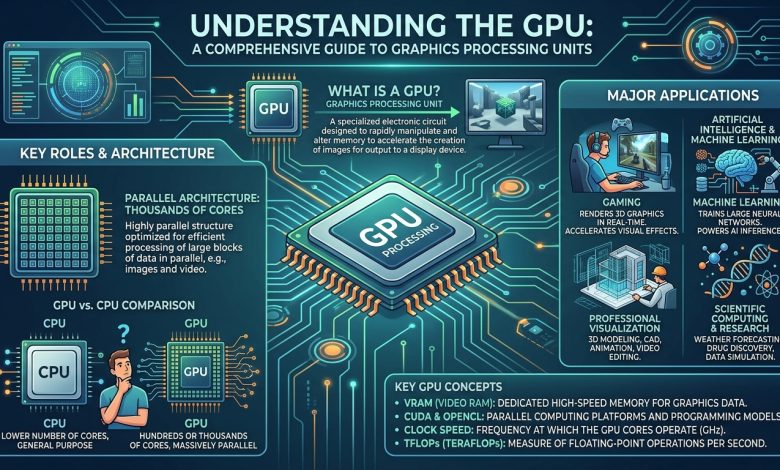
Table of Contents
The GPU meaning, or Graphics Processing Unit, refers to a specialized electronic circuit designed to rapidly manipulate and alter memory to accelerate the creation of images, videos, and other visual content for display on a device. Initially developed to enhance 3D graphics rendering, GPUs have evolved into powerful parallel processing engines capable of handling a wide array of compute-intensive tasks far beyond traditional graphics, becoming indispensable components in modern computing. From powering the intricate visuals of high-end video games to driving complex artificial intelligence algorithms and scientific simulations, the GPU’s role has expanded dramatically since its inception. This guide delves into the fundamental aspects of GPUs, exploring their architecture, functionality, diverse applications, and their projected future in an increasingly data-driven world.
What is a GPU?
A Graphics Processing Unit (GPU) is essentially a highly specialized processor, distinct from a computer’s Central Processing Unit (CPU), engineered for efficiency in parallel processing. While CPUs typically feature a few powerful cores optimized for sequential task execution, GPUs boast hundreds, or even thousands, of smaller, more specialized cores. This architectural difference allows GPUs to perform multiple calculations simultaneously, a capability crucial for tasks that involve processing large datasets where the same operation needs to be applied repeatedly across many different data points.
The concept of a dedicated graphics processor emerged as early as the 1990s, when the increasing complexity of graphical interfaces and the rise of video games demanded more efficient ways to render images. Prior to this, graphics controllers relied heavily on the CPU to manage visual tasks, leading to performance bottlenecks. NVIDIA is widely credited with popularizing the term “GPU” in 1999 with the launch of its GeForce 256 graphics card, which it marketed as the world’s first true GPU. This milestone marked a significant shift, as GPUs began to take on the intensive graphics functions, thereby alleviating the strain on the CPU and enabling greater overall processing speeds and more realistic visuals. Since then, the evolution of GPUs has been characterized by continuous innovation, leading to their adoption across a vast range of demanding computational fields.
GPU Meaning How Does a GPU Work?
At the core of a GPU’s operation is its ability to perform massively parallel processing. Unlike a CPU that processes tasks in a linear, step-by-step fashion, a GPU divides complex tasks into thousands of smaller, independent workloads. These smaller workloads are then distributed across its numerous processing cores, allowing them to be executed simultaneously. This design makes GPUs exceptionally efficient for operations where the same calculations need to be performed on a vast amount of data, a common scenario in graphics rendering, machine learning, and scientific simulations.
Each core within a GPU is simpler than a CPU core, but their sheer number and specialized design for parallel arithmetic operations enable unparalleled throughput for specific types of computations. For instance, rendering a 3D scene involves applying textures, lighting, and shading to millions of pixels. A GPU can process these pixel calculations concurrently across its many cores, dramatically speeding up the rendering process.
A crucial component that complements the GPU’s processing power is its dedicated memory, known as Video Random Access Memory (VRAM). VRAM is high-speed memory located directly on the graphics card, specifically designed to store graphical data such as textures, positional data, frame buffers, and shaders. By having its own memory, the GPU can access the necessary data for rendering images quickly and independently, without having to rely on the computer’s slower main system RAM. This dedicated and fast memory access is vital for maintaining high frame rates and handling high-resolution textures in graphically intensive applications. The architecture also includes memory buses and a cache hierarchy, which further optimize data flow and access speed, playing a significant role in overall performance.
GPU vs. CPU: Key Differences
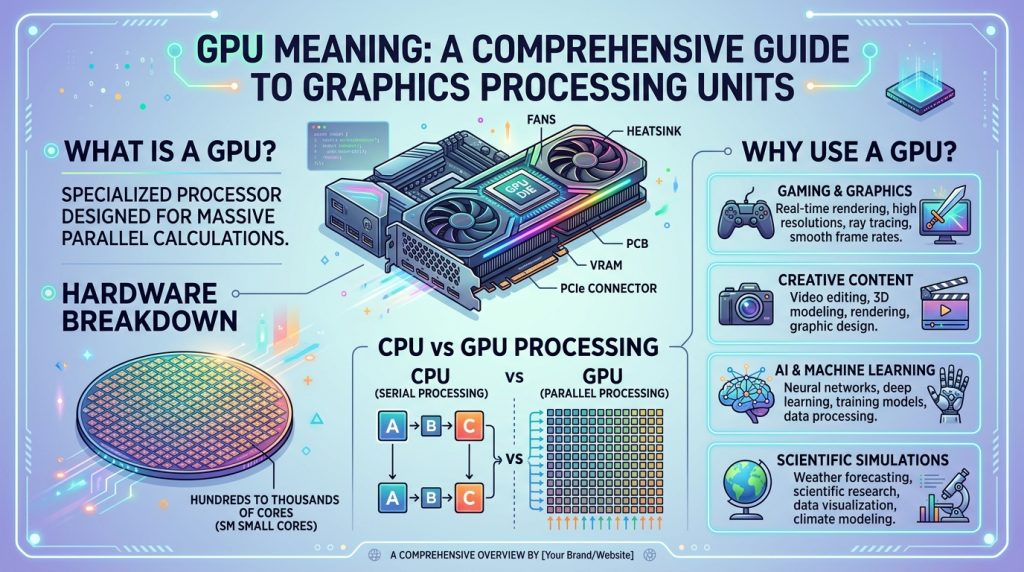
While both the CPU (Central Processing Unit) and GPU (Graphics Processing Unit) are fundamental processing units in a computer, their architectures and primary functions are distinct, catering to different types of computational demands. Understanding these differences is crucial for appreciating why each component excels in its respective domain.
| Feature | CPU (Central Processing Unit) | GPU (Graphics Processing Unit) |
|---|---|---|
| Primary Role | General-purpose processing, system control, sequential logic. | Specialized processing for parallel computations, graphics rendering, AI workloads. |
| Core Count & Type | Fewer, powerful, general-purpose cores (typically 4-16, sometimes more). | Hundreds to thousands of simpler, specialized cores (e.g., CUDA cores, stream processors). |
| Processing Style | Sequential processing, optimized for latency and complex decision-making. | Massively parallel processing, optimized for throughput and simultaneous simple calculations. |
| Memory | Uses system RAM for all general tasks. | Has its own dedicated high-speed VRAM (Video RAM). |
| Strengths | Operating systems, web browsing, word processing, database management, tasks where one step depends on the last. | Gaming, video editing, 3D rendering, machine learning, scientific simulations, cryptocurrency mining. |
| Power Consumption | Generally lower for basic tasks. | Higher, especially for dedicated units performing intensive tasks. |
The fundamental distinction lies in their execution models: CPUs prioritize minimizing latency for individual tasks, making them ideal for tasks that require a few instructions to be executed very quickly, often sequentially. In contrast, GPUs maximize throughput by executing tens of thousands of calculations simultaneously, making them perfect for “embarrassingly parallel” problems where the same operations can be applied to vast amounts of data independently. This architectural divergence means that while a CPU handles the orchestration, operating system tasks, and sequential logic, the GPU handles the parallel math and data-intensive computations. Modern computing environments often leverage both processors in tandem, allowing each to handle the tasks they are best suited for, thereby maximizing overall system efficiency and performance.
Types of GPUs
GPUs primarily come in two forms: integrated and dedicated (also known as discrete). The choice between these two types largely depends on a user’s specific computing needs, budget, and desired performance level.
Integrated GPUs (iGPUs)
An integrated GPU (iGPU) is a graphics processor built directly into the computer’s Central Processing Unit (CPU) or embedded on the motherboard. These GPUs do not have their own separate memory, instead sharing the system’s main RAM with the CPU.
The primary advantages of iGPUs include lower manufacturing costs, reduced power consumption, and less heat generation. This makes systems with integrated graphics more affordable, energy-efficient, and often allows for thinner and lighter designs, particularly beneficial for laptops and compact PCs. However, sharing system memory and resources with the CPU means iGPUs generally offer lower processing power and memory bandwidth compared to dedicated solutions. They are well-suited for basic computing tasks such as web browsing, word processing, video playback, and casual gaming, but may struggle with more demanding applications, leading to slower graphics rendering and lower frame rates. Upgrading an iGPU is typically not possible without replacing the entire CPU or motherboard.
Dedicated (Discrete) GPUs
A dedicated, or discrete, GPU is a separate, distinct chip mounted on its own circuit board, often referred to as a graphics card or video card. These cards are typically attached to a PCI Express slot on the motherboard and come with their own dedicated high-speed memory (VRAM), which is not shared with the CPU.
Dedicated GPUs are engineered for maximum performance, offering significantly more processing power and memory than integrated graphics. This makes them the go-to choice for high-performance gaming, professional content creation (such as 3D rendering and video editing), scientific computing, and advanced AI workloads. The advantages of dedicated GPUs include superior graphics quality, higher frame rates, and support for advanced technologies like real-time ray tracing. However, these benefits come with higher costs, increased power consumption, and greater heat generation, which necessitates robust cooling solutions within the computer system. Unlike iGPUs, dedicated graphics cards in desktop PCs offer an upgrade path, allowing users to replace or upgrade their GPU to improve performance in the future.
Applications of GPUs Beyond Graphics
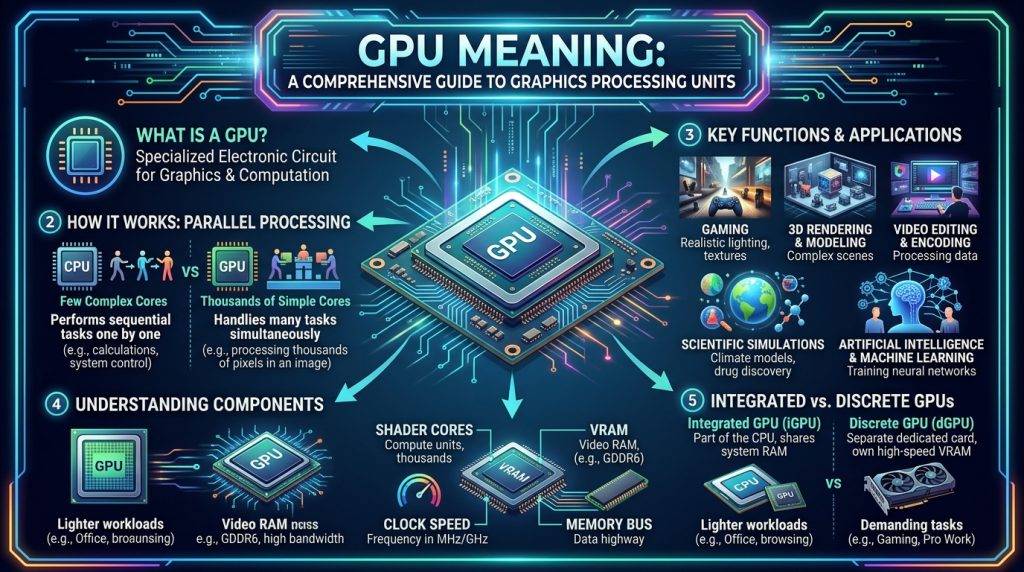
While the name “Graphics Processing Unit” suggests a primary focus on visual tasks, the highly parallel architecture of GPUs has made them incredibly versatile, leading to their adoption across numerous fields beyond traditional graphics rendering.
- Gaming and Visual Entertainment: This remains a core application. GPUs power the realistic visuals, intricate textures, and dynamic environments in modern video games. Technologies like real-time ray tracing, which simulates the physical behavior of light, have been made possible by advanced GPUs, delivering unprecedented visual immersion.
- Artificial Intelligence (AI) and Machine Learning (ML): GPUs are foundational to the rapid advancements in AI and ML. The parallel processing capabilities of GPUs are perfectly suited for the massive matrix operations and data-intensive calculations required for training neural networks and deep learning models. Dedicated components like NVIDIA’s Tensor Cores further accelerate AI workloads, making GPUs essential for AI acceleration and the development of ML applications.
- Scientific Computing and Simulations: Researchers use GPUs to accelerate complex calculations in fields such as molecular dynamics, weather forecasting, astrophysics, and fluid dynamics. Their ability to process large datasets quickly enables faster simulations and analysis, leading to breakthroughs in various scientific disciplines.
- Video Editing and Content Creation: Professionals in video production, animation, and graphic design rely heavily on GPUs to speed up rendering times, apply complex effects, and handle high-resolution media. GPUs significantly reduce the time required for tasks like video encoding, 3D modeling, and visual effects creation.
- Cryptocurrency Mining: The computationally intensive process of verifying transactions and creating new blocks in blockchain networks, known as cryptocurrency mining, heavily utilizes the parallel processing power of GPUs.
- Blockchain and Data Processing: Beyond mining, GPUs are being optimized for blockchain technologies to ensure faster transaction verifications and enhanced security protocols. They are also crucial in processing the vast amounts of data generated by IoT devices and other real-time data analysis applications.
- Autonomous Driving and Robotics: The real-time processing of sensor data (from cameras, LiDAR, radar) for object detection, path planning, and decision-making in self-driving cars and robotic systems is heavily dependent on the high-performance parallel computing offered by GPUs.
- Virtual Reality (VR) and Augmented Reality (AR): To create immersive and responsive VR/AR experiences, GPUs render complex 3D environments at very high frame rates, minimizing latency and motion sickness.
The increasing demand for parallel computing in these diverse areas underscores the GPU’s transformation from a mere graphics accelerator to a general-purpose parallel computing engine, a trend that is expected to continue evolving.
Choosing the Right GPU
Selecting the appropriate GPU is a critical decision that can significantly impact a computer’s performance, especially for demanding tasks. The “best” GPU is subjective and depends entirely on an individual’s specific needs, budget, and intended use.
When making a choice, several factors should be carefully considered:
- Intended Use: The most important factor is determining your primary computing needs. For basic tasks like web browsing, word processing, and light media consumption, an integrated GPU is often sufficient and cost-effective. However, for serious gamers, professional content creators (video editors, 3D artists), or those involved in AI/ML development, a powerful dedicated GPU is essential to achieve acceptable performance and quality.
- Budget: Dedicated GPUs represent a significant investment and can substantially increase the overall cost of a system. Integrated graphics are a more budget-friendly option. Setting a realistic budget will help narrow down the vast array of available options.
- Performance Requirements: Consider the specific applications and games you plan to run. If high frame rates, high resolutions (e.g., 4K), or advanced graphics settings (like real-time ray tracing) are priorities, a high-end dedicated GPU with ample VRAM will be necessary. For less demanding games or casual use, integrated or entry-level dedicated cards may suffice. The amount of VRAM (Video RAM) is particularly important for handling high-resolution textures and complex 3D models; insufficient VRAM can lead to performance bottlenecks.
- Portability (for Laptops): For laptops, integrated graphics are favored for their lower power consumption and heat generation, which translates to longer battery life and thinner, lighter designs. Laptops with dedicated GPUs offer superior performance but are typically heavier, thicker, and have shorter battery lives.
- Upgrade Potential: In desktop systems, dedicated graphics cards offer a clear upgrade path, allowing users to replace an older GPU with a newer, more powerful one as technology advances or needs change. Integrated GPUs, being part of the CPU or motherboard, cannot be easily upgraded independently.
- Ecosystem and Features: Consider the ecosystem of the GPU manufacturer, such as NVIDIA’s CUDA platform or AMD’s ROCm, which can be critical for specific professional applications, especially in AI and scientific computing. Features like DLSS (Deep Learning Super Sampling) or FSR (FidelityFX Super Resolution) can also influence performance and visual quality. Wikipedia provides detailed information on GPU technologies.
By carefully evaluating these factors, users can make an informed decision to select a GPU that perfectly balances performance, cost, and functionality for their individual computing environment.
The Future of GPUs
The trajectory of GPU technology points towards even greater computational power, enhanced specialization, and pervasive integration across an ever-widening range of devices and applications. GPUs are poised to remain a pivotal element in the future of computing, continuously pushing the boundaries of what is technologically possible.
One of the most significant trends is the continued increase in raw computational power. Future GPUs are expected to deliver higher performance through advancements in architecture, processing efficiency, and potentially new chiplet designs that integrate multiple processors. This relentless pursuit of power will enable even more complex simulations, higher fidelity graphics, and faster processing for data-intensive tasks.
AI integration will play an increasingly central role. Next-generation GPUs are likely to feature more specialized AI hardware, such as enhanced Tensor Cores or dedicated inference accelerators, to efficiently handle the growing complexity of AI models and massive datasets. AI-based energy controllers are also anticipated, using algorithms to optimize power consumption based on workload, balancing high performance with improved energy efficiency. This focus on energy efficiency is critical, especially for large-scale data centers and edge computing scenarios.
The refinement of real-time ray tracing technology will continue, making hyper-realistic graphics more accessible and pervasive not only in gaming but also in virtual reality (VR) and augmented reality (AR) applications, redefining user experiences. Beyond visual enhancements, GPUs are expected to become ubiquitous in a broader array of smart devices, from smartphones to smart appliances and autonomous systems. They will be crucial for processing the vast amounts of data generated by IoT devices, enhancing device intelligence, user interfaces, and response times in real-world AI applications.
Emerging trends also include potential optimizations for blockchain technologies, offering faster transaction verifications and enhanced security with reduced energy costs. Furthermore, the long-term future may see GPUs integrating with more heterogeneous architectures and even quantum computing, pushing the frontiers of high-performance computing. However, these advancements may come with increased costs, as major semiconductor manufacturers like TSMC anticipate price hikes for chip production in the coming years. This could potentially impact the pricing of future GPUs, CPUs, and other smart devices. Technological innovations will continue to drive the evolution of these powerful processing units.
Conclusion
In conclusion, the GPU meaning has evolved significantly from its original definition as a specialized circuit for accelerating graphics. Today, the Graphics Processing Unit stands as a cornerstone of modern computing, recognized for its unparalleled parallel processing capabilities. Its journey from a dedicated graphics accelerator to a versatile engine driving artificial intelligence, scientific discovery, and immersive digital experiences underscores its critical importance. As technology continues its rapid advancement, GPUs will undoubtedly remain at the forefront, continually redefining the boundaries of performance, efficiency, and computational possibility, shaping the future of how we interact with and leverage digital information. Advances in computing will continue to be tied to GPU innovation.