Latest GPU Releases: 7 Powerful New Graphics Cards You Should Watch
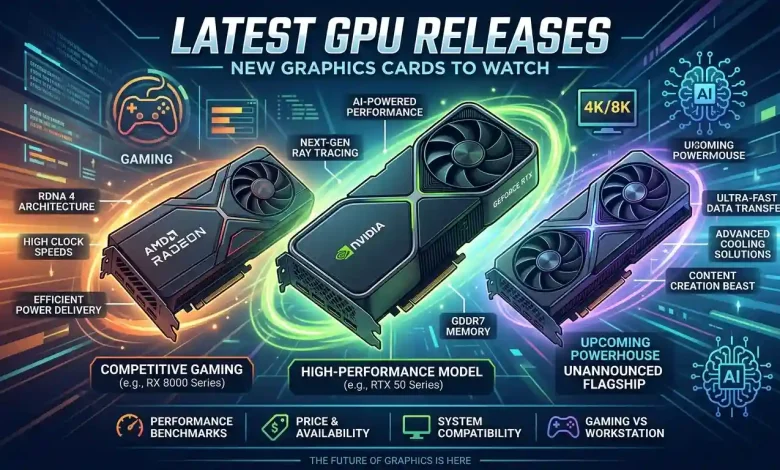
Table of Contents
Latest GPU releases continue to push the boundaries of visual fidelity, computational power, and efficiency, shaping the landscape for gamers, content creators, and professional users alike. The graphics processing unit (GPU) market is a fiercely competitive arena, with NVIDIA, AMD, and increasingly, Intel, vying for supremacy through continuous innovation in architecture, manufacturing processes, and software features. As of mid-2026, we’ve witnessed significant advancements across all three major players, with new generations of graphics cards offering enhanced ray tracing capabilities, advanced upscaling technologies like DLSS, FSR, and XeSS, and increasingly, specialized hardware for artificial intelligence (AI) workloads. This article will delve into the most recent and anticipated GPU releases, highlighting their key features, performance metrics, and what they mean for the future of computing.
Introduction to the Dynamic Latest GPU Landscape
The past few years have been particularly dynamic for the GPU industry. Following periods of intense demand and supply chain challenges, the market has stabilized, allowing manufacturers to release a steady stream of new hardware. These releases aren’t just about raw power; they encompass a holistic approach to improving user experience, integrating sophisticated software ecosystems, and addressing diverse computing needs. From high-end enthusiast cards designed for uncompromised 4K gaming and professional rendering to more accessible options for mainstream users, the innovation cycle remains rapid. Understanding these developments is crucial for anyone looking to build a new system, upgrade an existing one, or simply stay informed about the cutting edge of graphics technology.
NVIDIA: Innovation and Continued Dominance
NVIDIA has long been a dominant force in the discrete GPU market, and its recent releases continue to solidify its position, particularly in the high-performance and AI sectors. The company’s focus on ray tracing and its proprietary Deep Learning Super Sampling (DLSS) technology has set a high bar for visual quality and performance enhancement.
The RTX 40 Series and its Super Refresh
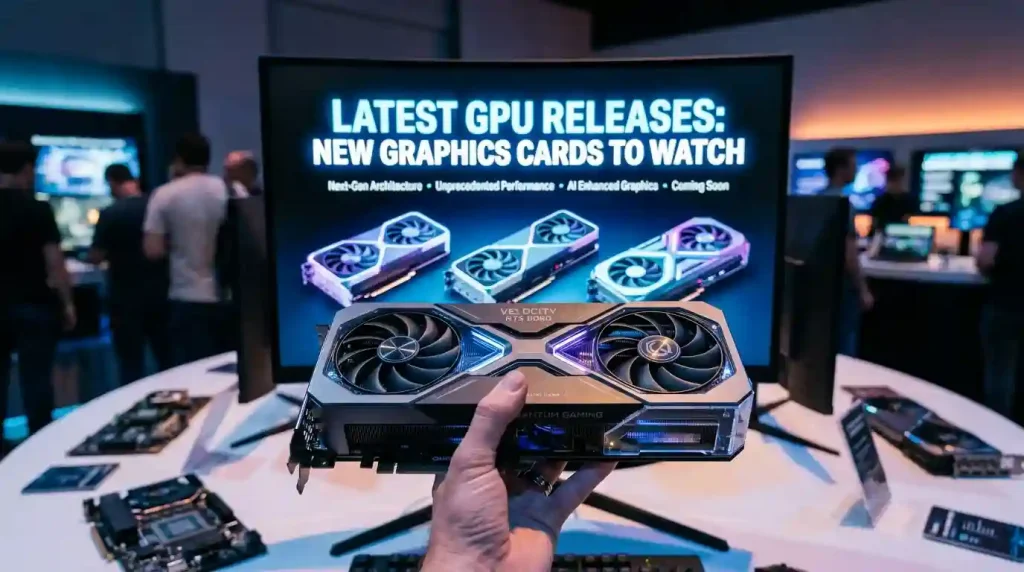
The NVIDIA GeForce RTX 40 series, based on the Ada Lovelace architecture, began its rollout in October 2022 with the flagship RTX 4090. This card immediately set new performance benchmarks for gaming and professional applications. Subsequent releases included the RTX 4080, RTX 4070 Ti, RTX 4070, RTX 4060 Ti, and RTX 4060, covering a broad spectrum of price points and performance tiers. These cards brought significant improvements in raw rasterization performance, third-generation RT Cores for accelerated ray tracing, and fourth-generation Tensor Cores for enhanced AI capabilities, most notably powering DLSS 3, which introduced Frame Generation for even higher frame rates.
In January 2024, NVIDIA further refined its offerings with the introduction of the RTX 40 SUPER series. This refresh included the GeForce RTX 4070 Super, RTX 4070 Ti Super, and RTX 4080 Super. These “Super” variants typically offered more CUDA Cores and sometimes increased VRAM compared to their non-Super counterparts, providing a performance boost at competitive price points. For instance, the RTX 4080 Super, launched on January 31st, 2024, at $999, featured more CUDA Cores and faster GDDR6X memory, making it ideal for 4K ray-traced gaming and demanding AI applications. Similarly, the RTX 4070 Ti Super, released on January 24th, 2024, increased its frame buffer to 16GB, catering to high-refresh 1440p and even 4K gaming. The RTX 4070 Super, available from January 17th, 2024, boasted 20% more CUDA Cores than the original RTX 4070, delivering performance comparable to the RTX 3090 with significantly lower power consumption.
The Arrival of Blackwell: RTX 50 Series
Looking ahead, NVIDIA formally introduced its next-generation Blackwell architecture for consumer graphics cards, the GeForce RTX 50 series, at CES 2025. This series debuted in January 2025 with the release of the RTX 5070, RTX 5080, and the flagship RTX 5090. Based on the Blackwell architecture and manufactured on TSMC’s custom 4N process node, these GPUs feature NVIDIA’s fourth-generation RT cores and fifth-generation deep-learning-focused Tensor Cores. The RTX 50 series promises further leaps in performance, especially with its advanced AI capabilities, which are becoming increasingly integrated into gaming and creative workflows through technologies like DLSS 4. Reports suggest that the RTX 5090, in particular, comes with a massive 32GB of GDDR7 VRAM, highlighting the trend towards higher memory capacities in high-end GPUs.
Rumors also persist about a potential RTX 50 SUPER series refresh around early 2027, which could include models like an RTX 5060 12GB and other Super variants, further expanding the Blackwell lineup. Beyond that, the GeForce RTX 60 series, potentially based on the Rubin architecture, is anticipated for a late 2027 or early 2028 launch.
AMD: Challenging the Status Quo with RDNA Architectures
AMD continues to be a strong contender in the GPU market, consistently offering competitive alternatives to NVIDIA. Their RDNA architecture has been the backbone of recent generations, delivering excellent rasterization performance and a growing ecosystem of features, including FidelityFX Super Resolution (FSR).
Radeon RX 7000 Series: RDNA 3’s Performance
The AMD Radeon RX 7000 series, built on the RDNA 3 architecture, was officially announced on November 3, 2022, with the first cards, the RX 7900 XT and RX 7900 XTX, launching on December 13, 2022. These enthusiast-grade cards aimed to deliver high-refresh-rate 4K gaming and featured DisplayPort 2.1 support, a dual media engine with AV1 encoding, and a significant performance-per-watt improvement over the previous generation. The RX 7900 XTX, priced at $999, offered 24GB of GDDR6 memory, making it a powerful option for demanding titles at 4K resolution.
The RX 7000 series later expanded to include a range of desktop graphics cards, from entry-level options like the RX 7400 and RX 7600 to mainstream choices such as the RX 7700 XT and RX 7800 XT, and the high-end RX 7900 GRE. AMD also released several laptop chips in the RX 7000 series, including the power-efficient S-series (RX 7600S, RX 7700S) and the M-series (RX 7800M, RX 7900M). These cards showcased AMD’s commitment to offering solutions across various market segments, focusing on strong rasterization performance and competitive pricing.
The Next Generation: Radeon RX 9000 Series (RDNA 4)

Following the RDNA 3 lineup, AMD introduced its RDNA 4 architecture with the Radeon RX 9000 series. The initial models, including the RX 9070 and RX 9070 XT, were announced at CES 2025 and began shipping in March 2025. The Radeon RX 9070 XT, in particular, has been lauded for delivering impressive performance at 1440p and even 4K resolutions, often matching more expensive NVIDIA counterparts, making it a strong value proposition. AMD’s RDNA 4 architecture aims to build upon the strengths of its predecessor, potentially introducing further enhancements to ray tracing and upscaling technologies like FSR.
Current information suggests that AMD’s RDNA 5 gaming GPUs are further out, with board partners reportedly expecting a launch window in mid-to-late 2027 or even early 2028. This timeline indicates a longer cycle between generations for AMD’s high-end consumer GPUs, possibly allowing them to focus on refining their architecture and competing strategically in various market segments. The company has also been focusing on the mid-range and affordable market spaces with its current GPU offerings.
Intel Arc: A Growing Presence in the Discrete GPU Market
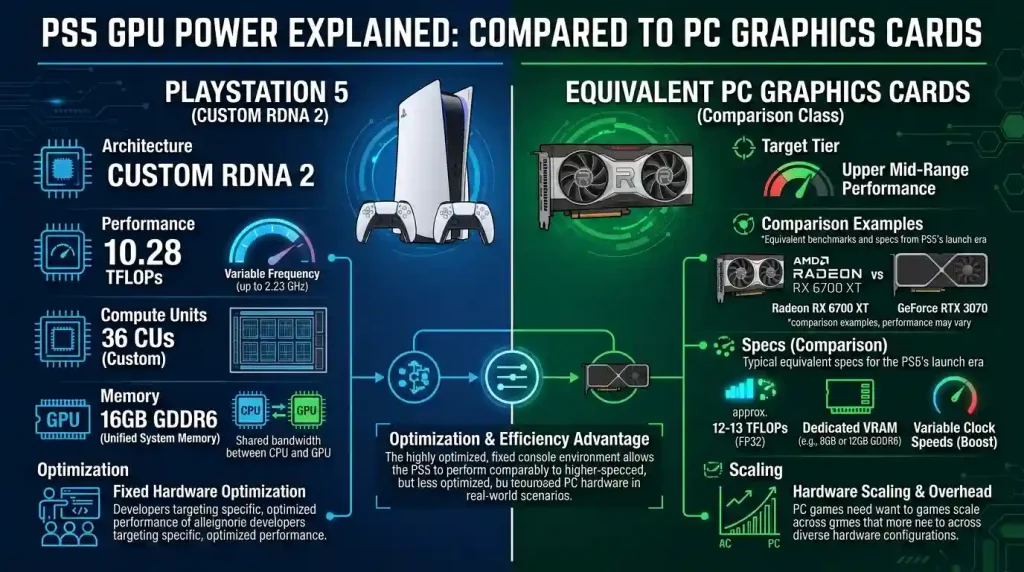
Intel, a long-time leader in integrated graphics, made a significant entry into the discrete GPU market with its Arc series, aiming to establish itself as a viable third competitor alongside NVIDIA and AMD. While its initial foray faced some challenges, Intel has shown a strong commitment to improving its graphics offerings.
Arc A-Series and Battlemage B-Series
Intel’s first generation of Arc GPUs, codenamed “Alchemist” and branded as the Arc A-series, debuted for laptops in March 2022 with the Arc A370M. Desktop models, such as the Arc A750 and A770, followed in October 2022. These GPUs supported modern features like hardware-based ray tracing, Intel’s XeSS (supersampling based on neural networks, similar to DLSS and FSR), and DirectX 12 Ultimate. Despite initial driver maturity issues, the A750 and A770 were seen as respectable starting points, offering competitive performance-per-dollar in their segments.
The second generation of Intel Arc GPUs, codenamed “Battlemage” and branded as the B-series, began to emerge in late 2024. The Arc B580 was announced in December 2024 and released later that month, receiving positive reviews. The Arc B570 was slated for release in early 2025. Intel also expanded its Arc Pro series for workstation and AI inference tasks in May 2025, with the Arc Pro B60 and B50 GPUs becoming available from June and July 2025, respectively. These professional cards aim to cater to prosumers and AI developers with larger memory configurations and enhanced software support.
The Celestial Future: Arc C-Series
Looking further into Intel’s GPU roadmap, the third generation, codenamed “Celestial” and expected to be the Arc C-series, is highly anticipated. Leveraging the new Xe3 architecture, which will first debut in their Panther Lake mobile CPUs, Celestial is rumored to bring significant efficiency gains and performance improvements. Speculation suggests models like the Arc C770 and C780 could arrive between Q4 2026 and Q1 2027, potentially challenging NVIDIA’s RTX 5080 in terms of performance at more competitive price points. This indicates Intel’s long-term strategy to become a major player in the high-performance discrete GPU market.
The Evolving GPU Market and the Impact of AI
| Manufacturer | Latest Consumer Architecture | Recent/Current High-End Series | Key Technologies | Upcoming Architecture (Rumored/Confirmed) |
|---|---|---|---|---|
| NVIDIA | Blackwell (RTX 50 Series) | GeForce RTX 5090, RTX 5080 | DLSS 4, Ray Tracing, Tensor Cores, NVENC (AV1) | Rubin (RTX 60 Series) |
| AMD | RDNA 4 (RX 9000 Series) | Radeon RX 9070 XT, RX 7900 XTX | FSR, Ray Accelerators, AMD Radiance Display Engine (AV1) | RDNA 5 |
| Intel | Battlemage (Arc B-series) | Arc A770, Arc B580 | XeSS, Ray Tracing, Intel Deep Link, AV1 Encoder | Celestial (Arc C-series) |
The global GPU market is experiencing explosive growth, driven by an increasing demand for high-performance computing in various sectors beyond traditional gaming. According to Jon Peddie Research, the global GPU market was expected to exceed $98.5 billion in 2024, with projections reaching $821.3 billion by 2034, growing at a Compound Annual Growth Rate (CAGR) of 29.4%. This rapid expansion is largely fueled by the burgeoning fields of artificial intelligence (AI) and high-performance computing (HPC).
AI applications, in particular, have become a major catalyst for GPU demand. High-end processors from companies like NVIDIA and AMD, often costing tens of thousands of dollars, are crucial for AI and supercomputer workloads, generating significant revenue for these developers. NVIDIA, for instance, has seen immense earnings from its AI and HPC GPUs, with sales potentially exceeding $90 billion for its fiscal year 2025. AMD also anticipates its AI GPU sales to exceed $3 billion, indicating a broad industry shift.
This shift means that while gaming remains a significant driver for consumer GPUs, the capabilities that enable AI—like Tensor Cores in NVIDIA cards or specialized AI accelerators in AMD and Intel offerings—are becoming increasingly important across the entire product stack. This trend not only influences hardware design but also affects market dynamics, including memory allocation and pricing. The consumer segment, however, still dominates the global GPU market in terms of volume, driven by the demand for high frame rates and enhanced visual fidelity in gaming. The continuous innovation in integrated GPUs for laptops and desktops also contributes significantly to the market share, offering cost-effective and efficient performance for everyday computing. For a more detailed understanding of the GPU market’s growth and segmentation, including insights into integrated versus discrete GPUs and the dominance of the consumer segment, one can refer to reports on the Graphics Processing Unit market on Wikipedia.
Conclusion
The latest GPU releases demonstrate an exciting period of innovation and competition within the graphics hardware industry. NVIDIA, with its powerful RTX 40 and 50 series, continues to lead in performance and advanced features like ray tracing and DLSS, while increasingly dominating the lucrative AI and HPC markets. AMD’s Radeon RX 7000 and 9000 series cards offer compelling performance with their RDNA 3 and RDNA 4 architectures, providing strong alternatives for gamers who prioritize rasterization performance and value. Intel’s Arc A and B series have successfully established the company as a credible third player, with the upcoming Celestial C-series poised to further challenge the established giants.
As we look towards the future, the integration of AI capabilities, advancements in upscaling technologies, and continuous architectural refinements will undoubtedly define the next wave of graphics cards. The robust growth of the overall GPU market, fueled by both gaming and the explosive demand from AI and data centers, ensures that innovation will remain at the forefront. For consumers and professionals alike, the array of new graphics cards to watch offers unprecedented choices and capabilities, promising even more immersive experiences and powerful computing solutions in the years to come.